
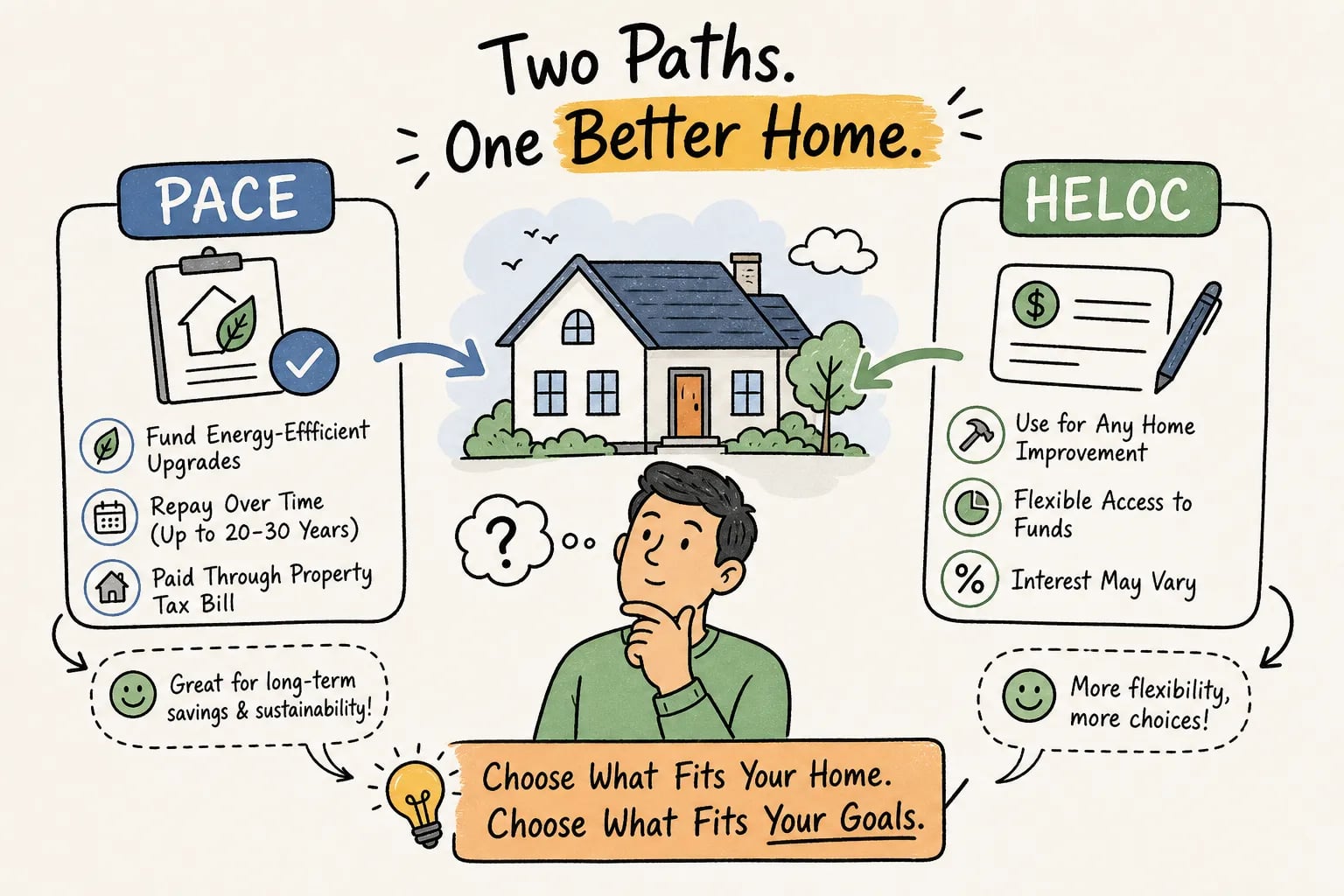
Many Florida homeowners don't have $20,000 readily available for a roof replacement, a new AC system, or a full set of impact windows. They need financing. When you start shopping, two options keep coming up: PACE financing and a HELOC. On the surface, both help you fund a major home upgrade, but they work in completely different ways, carry different risks, and favor different financial profiles. At Infinity Legacy, we walk homeowners through the PACE vs HELOC choice regularly, because picking the wrong one can cost you thousands in extra fees or derail a refinance you were counting on. This article lays both options out honestly so you can make the right call before you sign anything.
What PACE and HELOC Actually Are
How Property Assessed Clean Energy Financing Works
PACE financing is a government-authorized program, typically enabled at the municipal or county level and funded through private capital, not a direct federal loan, that lets you borrow money for eligible home improvements and repay it through your property tax bill. Approval is based on the property itself, not your credit score or income. The assessment attaches to your home as a lien, similar in structure to a tax obligation, and remains tied to the property until it's paid off.
In Florida, qualifying improvements fall into three statutory categories: energy conservation and efficiency (HVAC systems, window replacement, insulation), renewable energy (solar, wind, geothermal), and wind resistance upgrades (roof deck reinforcement, storm shutters, opening protections). Roofing, impact windows and doors, and HVAC systems all qualify, which is why PACE comes up constantly for the kinds of projects Infinity Legacy handles.
How a Home Equity Line of Credit Works
A HELOC is a revolving credit line secured by the equity you've built in your home. Your lender evaluates your credit score, income, debt-to-income ratio, and the combined loan-to-value ratio of your property before approving you. You draw from it as needed during a set period, then repay what you used, typically at a variable interest rate tied to market conditions.
Unlike PACE, a HELOC is a personal credit product. The obligation is tied to you as a borrower, not to your property as a tax assessment. That difference is the foundation of every other comparison between the two options. It's also what separates them from a traditional home equity loan, which provides a lump sum at a fixed rate rather than a revolving line.
The Key Structural Difference
PACE is a property obligation; a HELOC is a personal credit product, and that single distinction shapes who qualifies, how repayment works, what happens at closing when you sell, and how each option interacts with your existing mortgage. Everything else in this article follows from that one difference.
Who Qualifies: Credit-Based vs. Property-Based Eligibility
HELOC Qualification Requirements
Most Florida lenders in 2026 want a credit score of at least 620 to 680 to approve a HELOC, though competitive rates typically require 700 or higher. They also check your debt-to-income ratio (generally below 43%), verified income, and a combined loan-to-value ratio that keeps total borrowing at or below 80 to 85 percent of your home's appraised value. These thresholds are consistent with industry standards and represent the benchmarks most conventional lenders apply. If your home hasn't appreciated much or you've already got a large mortgage balance, you may not have enough equity to clear the threshold.
Recent job changes, self-employment income, or a credit score dip can all push you below what a lender is willing to accept. The HELOC is a strong tool for the right borrower profile, but it screens out a meaningful portion of the homeowners who actually need major upgrades.
Why PACE Doesn't Use Your Credit Score
PACE programs typically do not use traditional borrower underwriting, credit score, income verification, or debt-to-income ratio, as the primary eligibility screen, though individual program rules may vary. Eligibility depends on whether your property qualifies under the local program and whether your improvement falls within the eligible categories under Florida statute. That structure opens PACE to homeowners who've been turned down by conventional lenders or who simply don't have enough equity to satisfy a HELOC underwriter. For an apples-to-apples comparison, think of it this way: where a home equity loan or HELOC evaluates you as a borrower, PACE evaluates the property itself.
Florida requires county-level approval before PACE energy-efficiency financing can be offered to residents, so availability varies by location. But across much of the state, including the areas Infinity Legacy serves, PACE programs are active and accepting applications from residential property owners.
Which Financial Profile Benefits Most from Each Option
If your credit score is above 680, your DTI is manageable, and you've built significant equity, a HELOC gives you real leverage and competitive rates. If your credit has taken hits, your income is variable, or your equity position is thin, PACE often becomes the most realistic path to a major upgrade without draining your savings. Neither option is universally better, they suit different financial situations, and knowing which category you fall into is the first step.
PACE vs HELOC: Interest Rates, Fees, and What You Actually Pay
Current Rate Ranges for Both Options
PACE financing in Florida currently carries stated interest rates ranging from 6% to 12.99%, with most programs averaging somewhere between 7% and 10% depending on the provider and loan term. HELOCs are running in the mid-6% to high-9% APR range depending on lender, credit tier, and whether the draw period rate is introductory or variable. On paper, those ranges overlap. In practice, the full picture is more nuanced.
Why PACE APR Runs Higher Than Its Stated Rate
PACE programs frequently embed origination fees, administrative fees, tax administration costs, lien recordation, title, escrow, and processing charges directly into the loan structure. In its analysis of PACE financing, the Consumer Financial Protection Bureau found that average PACE APRs ran about one full percentage point above the stated interest rate, placing many PACE APRs between 8.2% and 11% once fees were factored in. Florida PACE Funding Agency documentation estimates closing fees alone at approximately 6.99% of the loan amount, folded into the financed balance.
With a HELOC, fees exist but tend to be lower and more transparent. The APR stays closer to the rate quoted because there are fewer embedded charges layered into the product. For borrowers comparing options, the stated PACE interest rate and the true cost of the product are not the same number.
A Real-Dollar Comparison on a $20,000 Project
On a $20,000 upgrade financed over 10 years, PACE at 8% runs roughly $243 per month with approximately $9,200 in total interest. A HELOC at 7.5% over the same term lands around $237 per month and about $8,400 in total interest. Stretch the PACE term to 20 years and the monthly payment drops to around $168, but total interest climbs past $20,000, meaning you'd pay more in interest than the original project cost. The longer you carry a PACE assessment, the more expensive it becomes in aggregate.
How Repayment Works for Each Option
PACE Repayment Through Your Property Tax Bill
With PACE, there is no separate monthly loan payment. The annual assessment is added to your property tax bill, which you pay either directly or through your mortgage escrow account. Some homeowners find this convenient because it folds the obligation into a bill they're already managing. Others are surprised when their escrow payment jumps because their servicer has recalculated based on the higher tax bill. If you're in escrow, expect your mortgage payment to adjust sooner than you might anticipate.
The repayment period for PACE financing commonly runs 15 to 20 years, with some programs extending to 30 years. That long horizon keeps monthly carrying costs low, but it also drives up the total interest paid over the life of the assessment.
HELOC Draw Period and Repayment Schedule
A HELOC typically runs in two phases. During the draw period, often five to ten years, you borrow as needed and make interest-only or low minimum payments. Once the repayment period begins, you pay down the full principal and interest balance. Variable rates mean your monthly payment can shift with market conditions, which is a real consideration if rates move significantly during your repayment window.
The draw structure also gives you flexibility for phased projects. If you're doing a roof replacement now and plan to add impact windows in 18 months, you can draw only what you need at each stage rather than borrowing the full amount upfront.
Matching Repayment to Your Cash Flow
PACE works best for homeowners who want a predictable, long-term obligation folded into a bill they're already paying, with no separate loan account to manage. A HELOC suits homeowners who want flexibility during the project, the ability to pay it down aggressively, and the option to close it out before interest accumulates on idle funds. Your cash flow habits and income consistency matter as much as the rate comparison when deciding which structure fits your life.
The Lien Issue: What PACE Means for Your Mortgage and Future Plans
PACE vs HELOC, Impact on Refinancing and Lien Priority
In many PACE programs, the assessment lien is treated like a property-tax obligation and can take priority over your existing mortgage, though state and program rules vary. This means if you default, the PACE lien could be satisfied before your mortgage lender. Most mortgage servicers take that risk seriously, and it has created documented friction between PACE programs and federally backed lending institutions. This is not a technicality to gloss over; it's a core feature of how the product is structured.
Fannie Mae will not purchase a mortgage secured by a property with an outstanding PACE loan unless the PACE program does not allow lien priority over the first mortgage. If the assessment does carry first-lien priority and the borrower cannot pay it off at closing, refinancing options become severely limited. Freddie Mac treats properties with priority-lien PACE assessments as ineligible for purchase altogether. FHA-insured refinancing is similarly off the table unless the PACE obligation is paid off so the FHA mortgage holds first-lien position.
If you plan to refinance in the next five to ten years, this is not a footnote. It's a scenario you need to model before signing a PACE agreement. The question is straightforward: will you have the funds to pay off the remaining PACE balance at closing, or will you need to absorb that constraint into your refinancing timeline?
Selling Your Home with a PACE Assessment
PACE assessments generally run with the property, not the borrower. In Florida, sellers must provide written notice of the outstanding assessment to the buyer before sale. The buyer either assumes the remaining payments or the seller pays off the balance at closing. Buyers using conventional, FHA, or VA financing will almost always require payoff before closing, because their lenders won't accept the senior lien position. This doesn't make a home with a PACE assessment unsellable, but it does mean you need to account for the payoff amount when calculating net proceeds from any future sale.
When PACE Is the Right Call vs. When HELOC Wins
Projects and Profiles Where PACE Makes the Most Sense
PACE is the stronger fit when you have little to no home equity, a credit score below 680, or no stable W-2 income to document. It also works well for homeowners who want to keep monthly carrying costs low through a longer repayment term, or who can't come to the table with cash or credit access when a roof, AC, or windows need replacing. Eligible projects under Florida statute include all of the major categories Infinity Legacy specializes in: roofing, HVAC, impact windows and doors, and insulation-related improvements.
The $0 down structure is useful for homeowners who have equity but limited cash on hand and don't want to open a line of credit for an urgent repair. If the roof is failing after a storm and you need to move immediately, PACE removes the underwriting delay that a HELOC approval process introduces.
When a HELOC Is the Smarter Option
If your credit is strong, you've built solid equity, and you're planning to refinance or sell within the next five years, a HELOC gives you more flexibility and fewer complications at closing. It also carries lower embedded fees and may deliver a better effective APR if your credit qualifies for a competitive rate. For homeowners doing a multi-trade renovation in phases, the revolving draw structure lets you borrow only what you need at each stage rather than taking a lump-sum assessment upfront.
The clearest case for a HELOC is when you have a definite exit strategy within a short horizon. If you're planning to sell in three years, carrying a PACE assessment that requires payoff at closing adds friction and cost you don't need. A HELOC you can pay down or close out on your own timeline keeps more of the sale proceeds in your pocket.
Projects Where Either Option Can Work
For a project in the $15,000 to $30,000 range, a full roof replacement, an HVAC system upgrade, or a complete impact window installation, either option can be structured to work. The decision usually comes down to three variables: your credit access, your timeline for selling or refinancing, and how long you plan to stay in the home. Run both options with your actual numbers before committing to either path. The difference in total cost over a 10-year period may be smaller than you expect, while the lien and refinancing implications of PACE are often larger than homeowners realize going in.
How Infinity Legacy's PACE Program Works for Florida Homeowners
$0 Down with No Traditional Credit Requirement
Infinity Legacy works with PACE programs that allow Florida homeowners to begin eligible upgrades with zero out-of-pocket costs at the time of installation, no credit check in the traditional sense, no income documentation, and no down payment required upfront. The assessment attaches to your property and is repaid through your annual property tax bill. Specific program terms and eligibility details are confirmed in writing during the estimate process, so you know exactly what you're agreeing to before signing anything. For homeowners who've been turned away by conventional lenders or who want to preserve their cash reserves, this is a legitimate path to getting a new roof or HVAC system completed now rather than postponing a necessary upgrade.
Eligible Upgrades Through Infinity Legacy's Services
Roof replacements in tile, shingle, metal, and flat systems all qualify under Florida's PACE statute as wind resistance improvements. Full HVAC installations, including heat pumps and mini-split systems, qualify under the energy conservation and efficiency category. Impact windows and doors are also PACE-eligible and represent one of the most common project types Infinity Legacy completes through this financing path.
These upgrades address storm resilience, energy efficiency, and insurance eligibility at the same time, without requiring the homeowner to bring cash or strong credit to the table. Infinity Legacy is a licensed multi-trade contractor (CGC1540795) based in Palm Coast, serving homeowners across Northeast and Central Florida. Having one team manage permitting, installation, and financing coordination across all of these trades removes the complexity of coordinating multiple vendors and multiple financing conversations.
Getting Started with a Free Estimate
If you're weighing PACE vs HELOC and want to understand exactly what a project would cost and how an assessment would be structured for your property, a free estimate gives you the concrete figures you need to compare. You can't make a meaningful financing decision without knowing the project total, the term options, and what the assessment would add to your annual tax bill. Infinity Legacy offers free estimates across its service area, from Palm Coast to Jacksonville, St. Augustine, Daytona Beach, Orlando, Tampa, and beyond. Contact our team to schedule your free estimate and get the project total and assessment breakdown in writing before you decide anything.
Quick Decision Checklist: PACE or HELOC?
Before you contact a lender or a PACE program, work through these five questions. Your answers will point you toward the right path without requiring a finance degree.
- Is your credit score above 680 and your DTI below 43%? If yes, a HELOC is likely available to you and worth getting a quote on.
- Do you have at least 15 to 20 percent equity in your home after accounting for the project cost? If no, a HELOC almost certainly won't work.
- Do you plan to refinance or sell within the next five years? If yes, PACE creates lien complications that may require payoff at closing, factor that into your decision now.
- Is your improvement energy-related or storm-resilience focused, such as roofing, HVAC, or impact windows? If yes, it qualifies for PACE under Florida statute.
- Do you need $0 out of pocket and flexible qualification without income or credit verification? If yes, PACE is almost certainly your path.
What to Ask Before You Sign Anything
Whether you go with PACE or a HELOC, ask for the full APR, not just the stated interest rate. Ask whether there are prepayment penalties and what it costs to pay off early. Ask what happens to the obligation if you sell before the term ends. For PACE specifically, ask how the assessment will appear on your property tax bill and whether your mortgage servicer has been notified. These questions take five minutes to ask and can save you from surprises that cost thousands at the worst possible moment.
The most informed homeowners are the ones who get the numbers in writing from both options before deciding. A verbal rate quote isn't enough. Get the APR disclosure, the total interest figure at full term, and the payoff amount at five and ten years. With those documents in hand, the comparison becomes straightforward.
Making the Call with Confidence
The PACE vs HELOC decision gets clearer once you know your own numbers. Strong credit, solid equity, and a near-term sale or refinance plan together make a HELOC the cleaner choice. If you lack traditional credit access, have limited equity, or need to move quickly on a necessary upgrade, PACE is often the practical, and sometimes the only workable, option. Neither is inherently better. They serve different situations, and the worst outcome is choosing one without understanding how the other would have served you.
The lien priority, refinancing restrictions, and transfer-at-sale mechanics of PACE aren't automatic dealbreakers. They're variables you need to understand and plan around. At Infinity Legacy, we work with both financing paths and can walk you through what your specific project would look like under each structure before you commit to anything.
Start with a free estimate and bring your real numbers to the conversation. That full picture is what protects you at closing, at refinance, and every year the assessment runs.