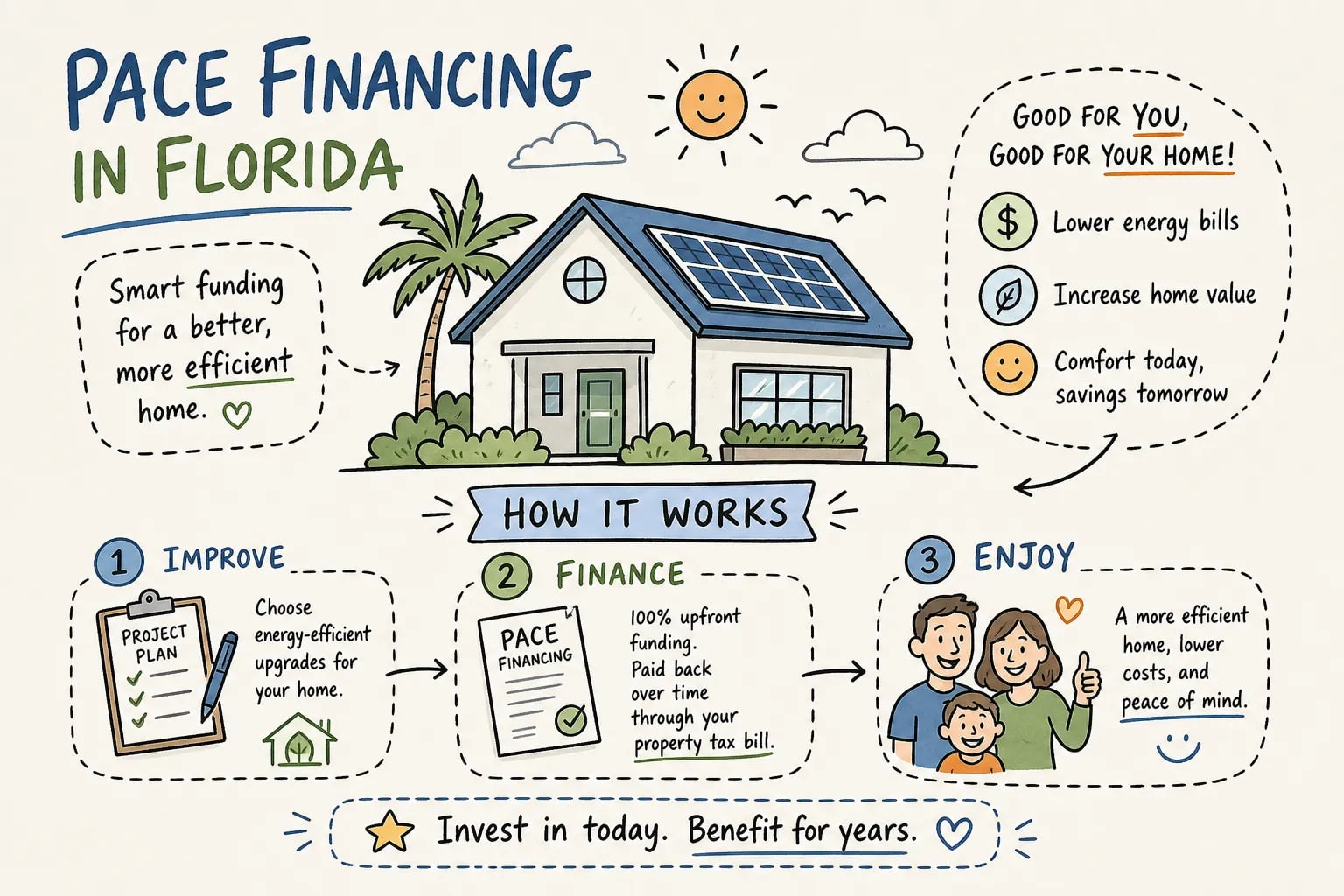
If you're a Florida homeowner exploring PACE financing Florida options for a roof replacement, HVAC upgrade, or impact window installation, here's what you need to know before you sign anything. Picture this: hurricane season is six weeks out, your roof is pushing 20 years old, your AC unit is gasping through every afternoon, and your windows are single-pane originals. You know the upgrades need to happen. The contractor estimates land between $18,000 and $35,000. And you do not have that sitting in a savings account ready to go. This is exactly the situation that Florida's Property Assessed Clean Energy financing program, PACE financing, was built for.
At Infinity Legacy, we have helped many Florida homeowners through this process. In our experience, many had not heard of PACE financing before they called us. By the end of that first conversation, they understood how it worked, what it would cost them, and whether it made sense for their situation. This article gives you the same clarity: what the program actually is, who qualifies, how repayment works, what the real risks are, and exactly how to move forward if it fits your needs.
What PACE financing actually is and how it works
The core concept: financing tied to your property, not your credit
PACE stands for Property Assessed Clean Energy. The fundamental thing that separates it from every other home improvement financing option is this: the loan is attached to the property itself, not to the borrower's credit profile. You are not taking out a personal loan. You are adding a repayment obligation to the real estate, which has specific implications for your tax bill, your mortgage, and any future sale of the home.
There are two versions of the program. R-PACE Florida programs apply to residential properties, which is what most Florida homeowners are asking about. C-PACE Florida applies to commercial real estate and operates under a slightly different structure. For the purposes of this article, everything below is specific to residential R-PACE in Florida.
How PACE financing Florida programs are structured by county
Florida law requires each county to adopt a PACE ordinance before the program can be offered to residents within its boundaries. This county opt-in requirement went into effect on July 1, 2024. As of 2026, counties with documented residential programs include Palm Beach, Miami-Dade (unincorporated areas), and Osceola, each with authorized providers administering the program locally. Authorized providers currently operating in Florida include FortiFi Financial, Home Run Financing, RenewPACE, and Ygrene in select counties. Because county participation varies, the second paragraph of this section is not a transitional note, it is a practical reminder worth spelling out: confirm your county's status before assuming you have access.
PACE availability depends entirely on where your property sits. Before assuming you qualify, verify that your specific county has adopted a PACE ordinance and that a residential provider is authorized to operate there. County program pages and the Florida PACE provider sites list current participation status and authorized contractors for each area.
Who qualifies and what upgrades are covered
Basic eligibility requirements
To qualify for a residential PACE assessment in Florida, you need to own the property, be current on your mortgage, have no delinquent property taxes in the past three years, carry no involuntary liens or notices of default, and have sufficient equity in the home to support the assessment. The property itself serves as the collateral for the financing. Credit score is not a qualifying factor, which is the program's most distinctive and appealing feature for homeowners who don't meet traditional lending requirements.
PACE providers review your property's location, tax payment history, existing lien structure, and available equity. The decision is based on the property's financial standing, not yours personally. For homeowners who have been declined for a HELOC or personal loan, this distinction often changes what is possible.
What projects are eligible under Florida PACE
Florida statute defines qualifying improvements across three categories: energy efficiency, renewable energy, and wind resistance. In practical terms, this covers a wide range of residential upgrades:
- Roof replacement (shingle, tile, metal, and flat systems)
- Full HVAC replacement including heat pumps, mini-splits, and ductwork
- Impact windows and doors
- Solar energy systems and related equipment
- Insulation, air sealing, and energy controls
- Hurricane-hardening work including gable-end bracing, roof deck attachment, and opening protection
Florida PACE programs also require that any licensed trade work be performed by a properly certified or registered contractor. This is where working with a licensed multi-trade contractor like Infinity Legacy simplifies the process considerably, one permit pull, one coordinated inspection schedule, and one accountable team across all trades. Our roofing, HVAC, and impact window projects all qualify for a PACE loan in Florida. All three trades are handled under one licensed team (CGC1540795) with $0 down, eliminating the need to source and schedule multiple contractors for a single project. Contact us to confirm current program approval status for your county before scheduling your estimate.
PACE Financing Florida: How repayment appears on your property tax bill
The assessment mechanics explained plainly
Once your project is funded, the repayment amount is added to your property's annual tax bill as a non-ad valorem assessment. It appears as a separate line item on your bill, not folded into the base tax rate, and is collected through the same system as your regular property taxes. If your mortgage is escrowed, your lender will collect the higher monthly escrow payment and remit the full tax bill, including the PACE charge, at year end. If you pay taxes directly, you pay the PACE line when your property tax bill is due, the specific due date varies by county, so confirm the schedule with your local tax collector.
There are no separate monthly loan statements, no bank transfers to set up, and no additional billing relationships to manage. The assessment simply appears on your tax bill each year until the balance is paid off. Once it is cleared, the lien is released and the line item is removed.
Lien priority: what it means and why it matters
A PACE assessment is recorded as a lien on the property. In Florida, that lien holds priority over most other liens, including your existing mortgage. This means that if the property went to tax sale due to nonpayment, the PACE balance would be paid out before your mortgage lender received anything. This lien priority is one of the most consequential details in the entire program, and it shapes how PACE interacts with refinancing and home sales.
For homeowners who make their payments on time and are not planning to refinance or sell within the PACE term, this detail often does not create immediate problems, but it can become a significant issue if either of those events occurs. Anyone considering a refinance in the next five to ten years, or planning to sell the home before the assessment is paid off, needs to understand the lien priority before signing anything.
Typical rates, fees, and terms to expect
Interest rates and financing costs
Current Florida residential PACE interest rates generally fall between 6% and 12.99%, depending on the provider, the term selected, and the project type. These ranges are based on published provider disclosures and county program materials; because rates and fees vary by provider, always review the specific program's disclosure documents before committing. Closing fees run approximately 6.99% of the financed amount and are typically rolled into the total balance rather than collected out of pocket at signing. Most programs also charge a small annual administration fee. Many Florida PACE programs do not carry a prepayment penalty, meaning you may be able to pay the balance off early, but verify this with your specific provider, since terms can vary.
Compared to a HELOC, PACE tends to cost more in total. For a $20,000 project, the total cost of PACE financing over the full term can run meaningfully higher than a HELOC at a comparable rate, the gap widens primarily due to rolled-in closing fees and a longer repayment structure. (For a rough sense of scale: at a 10% PACE rate over 20 years with a 6.99% closing fee versus a 7% HELOC over 10 years, the difference in total interest and fees paid can easily reach several thousand dollars.) PACE is not the cheapest option on the market. For homeowners who can access a HELOC at a favorable rate, that route usually saves money over time.
Term lengths and how to think about annual impact
Residential PACE terms in Florida run up to 20 years, which keeps the annual tax bill addition manageable even for larger projects. A $20,000 roofing or HVAC replacement spread over 15 to 20 years translates to a relatively modest annual assessment. Compare that to a personal loan at a similar rate on a 5- to 7-year term, and the annual cash-flow difference is significant. PACE is designed to make large projects affordable on a year-to-year basis, even if the total cost over the term is higher.
How PACE financing Florida affects refinancing and home sales
Refinancing with a PACE assessment in place
This is where the program's lien priority creates real friction with conventional mortgage financing. Many lenders, including those backing loans through Fannie Mae and Freddie Mac, will not refinance a property carrying an active PACE lien that holds senior position. Freddie Mac's guidelines are particularly strict: it will generally not purchase a mortgage secured by a property with a first-lien PACE assessment. Fannie Mae allows a limited cash-out refinance with the PACE obligation remaining in place under specific conditions, but the remaining balance factors into your debt-to-income calculation. Confirm the current guidelines directly with your lender, as secondary-market policies on PACE assessments can be updated.
In Florida, the most common outcome at refinance is a required payoff of the remaining PACE balance before the new loan can close. Any homeowner who thinks they may want to refinance within the next decade should factor this into the decision before entering a PACE agreement.
Selling a home with an active PACE balance
Because the assessment follows the property, it can theoretically transfer to a new buyer at closing. In practice, the seller's lender, the buyer's lender, or the title and closing process often requires full payoff of the PACE balance as a condition of the transaction. Be transparent with your real estate agent and any potential buyers early in the listing process. A PACE-financed project that resulted in a new roof or hurricane-rated windows may support resale value, though the extent of that benefit depends on market conditions, the appraiser's assessment, and buyer perception. The outstanding balance needs to be disclosed and accounted for in the closing numbers regardless. A paid-off PACE project is often a selling point; an undisclosed active balance is a closing problem.
How to move forward with PACE financing in Florida
A clear 5-step action plan
- Confirm your county has an active PACE ordinance and identify the approved residential providers authorized to operate in your area.
- Check your property's eligibility: ownership, current on taxes and mortgage for the past three years, no involuntary liens or defaults, and sufficient equity.
- Select your qualifying improvement and get a free project estimate. Roof replacement, HVAC, and impact windows all qualify under Florida PACE categories.
- Work with a PACE-approved, licensed contractor to submit the project for program approval. The contractor must hold the appropriate Florida license for the trade involved.
- Review the financing agreement carefully before signing. Confirm the interest rate, total cost of financing, term length, closing fees, and the lien disclosure. If anything is unclear, ask for a written explanation. Know exactly what you are committing to before the assessment is recorded against your property.
Why the contractor you choose matters
Not every Florida contractor is set up to work within PACE programs. Infinity Legacy serves homeowners across Northeast and Central Florida, offering roofing, HVAC, and impact window projects structured for PACE financing with $0 down. One licensed team covers all three trades, so there is no juggling of separate contractors across separate projects, every piece of the work falls under a single accountable team.
Reach out to get a free estimate and find out exactly what your upgrade qualifies for. We will walk you through the PACE financing Florida process from start to finish, including whether it is the right fit for your specific property and goals.
Making the decision that is right for your property
Florida's Property Assessed Clean Energy program is a legitimate, state-regulated financing tool that makes major home upgrades accessible without upfront capital. The repayment structure is unique. The lien priority is real. The mortgage implications are worth understanding before you sign. None of these are reasons to avoid the program, they are reasons to go into it informed.
For the right homeowner, one who needs a roof, a new AC system, or hurricane-rated windows and does not want to wait another season to save the cash, PACE financing Florida can be the difference between getting it done now and gambling on whatever the next storm season brings. The program's value is highest when the alternative is delay, and in Florida, delay on storm protection rarely pays off.
Infinity Legacy handles these projects from the initial estimate through installation and final permit close-out, with PACE financing built into the process from day one. If you are a Florida homeowner weighing your options, contact our team for a free estimate and a straight conversation about whether PACE financing Florida is right for your property.