Search "PACE program Florida" and you'll get two completely different results depending on who's answering. One is a senior healthcare program for older adults who need nursing-level care but want to stay home. The other is a property-based financing tool that lets homeowners fund major home improvements with no money out of pocket. Mixing up the two costs people real time and sometimes real money.
This article covers the financing version: Property Assessed Clean Energy, better known as PACE. If your roof is overdue, your AC is losing the battle against Florida heat, or your windows couldn't survive a serious storm, the PACE program in Florida may be the path that gets the work done without waiting until you've saved up the full cost. At Infinity Legacy, our Palm Coast-based team works alongside PACE-enrolled programs across the state, and we've seen firsthand how this financing tool plays out in practice, and where homeowners need the clearest guidance before they sign anything.
Florida PACE program overview: what it actually is
A property assessment, not a personal loan
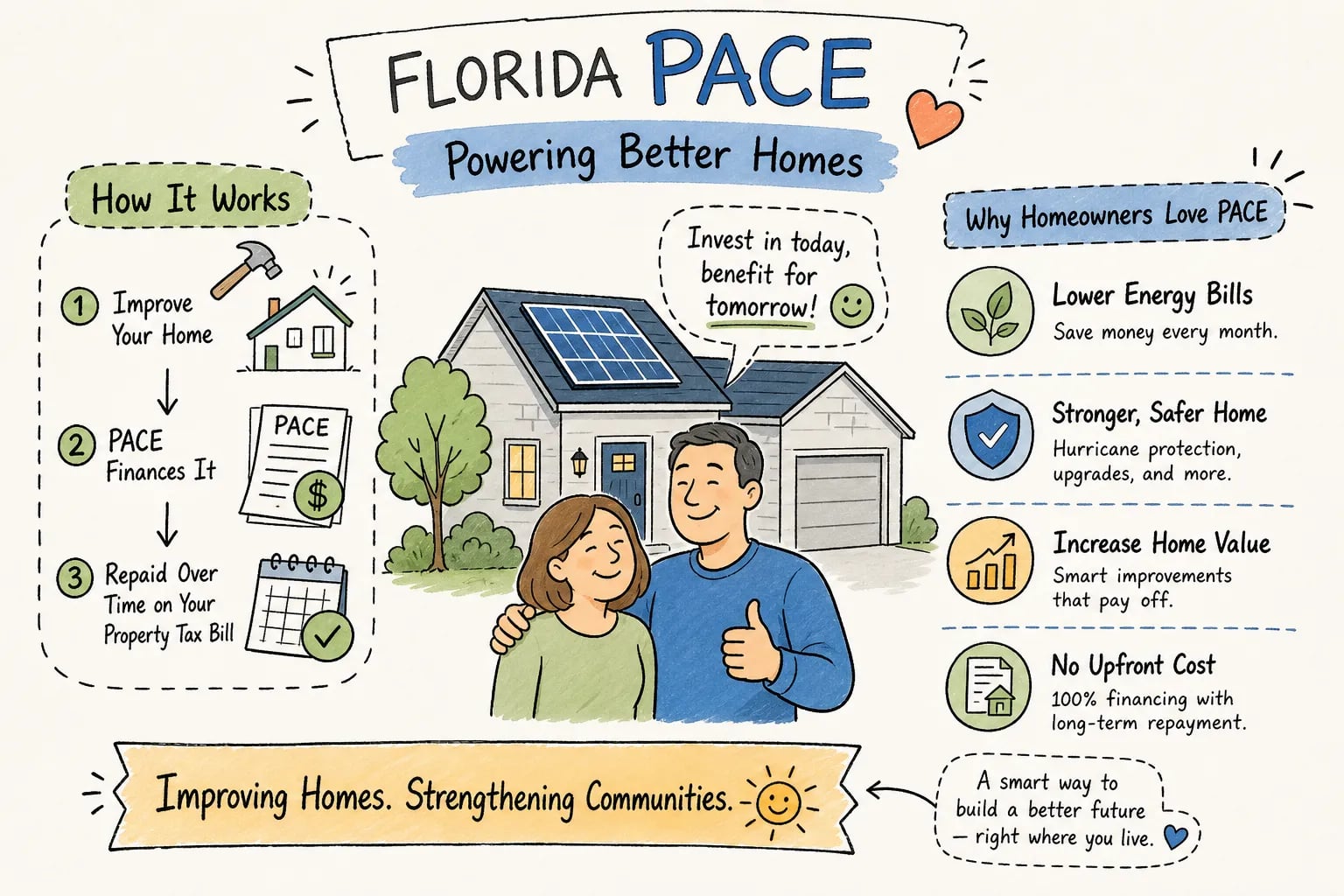
PACE stands for Property Assessed Clean Energy. The core mechanic is straightforward: instead of borrowing money against your personal credit, the financing is attached to your property as a non-ad valorem assessment. The obligation follows the home, not the individual. That distinction matters more than most people realize when they first hear about the program.
Because PACE isn't a personal loan, the qualification process works differently from a conventional bank application. PACE administrators are required to conduct an ability-to-repay review that examines your income and existing financial obligations, but there's no traditional credit approval and no requirement to bring cash to the table before work begins. Qualification is primarily property-based, though the ability-to-repay review does consider your financial picture. For Florida homeowners who need a major upgrade now but don't have the liquid savings a bank wants to see, that's a meaningful difference.
How the funding process flows from approval to completion
The process follows a specific sequence designed to protect homeowners. First, you get approved through a PACE administrator. Then, you select a PACE-enrolled licensed contractor to complete the project. The work gets done, and once it's finished and you sign off that everything was completed as agreed, funds are released directly to the contractor. You never touch the money, and no funds move before the job is done.
Before you sign any agreement, a PACE administrator is required by Florida law to complete a recorded phone call with you, walk through all the costs and lien terms, and provide written disclosures. You also have a three-day right to cancel without penalty after signing. These aren't optional steps, they're legal requirements built into the process.
What home projects are covered under PACE financing
Storm protection, energy efficiency, and major system upgrades
The Florida PACE program was built for improvements that harden a property or increase its energy performance, which makes it a natural fit for Florida's real-world upgrade needs. Eligible projects include roof replacements in shingle, tile, metal, and flat systems; hurricane-grade impact windows and doors; full HVAC replacements including heat pumps and mini-splits; insulation; solar installations; flood mitigation improvements; and building envelope upgrades.
At Infinity Legacy, our four core service lines, roofing, HVAC, impact windows and doors, and remodeling, align with the categories Florida PACE programs commonly approve. A homeowner replacing a storm-damaged roof and upgrading to impact windows at the same time can cover both under a single PACE approval rather than financing each separately. That's exactly the kind of bundled project where working with a multi-trade contractor simplifies everything. One approval, one contractor, one project scope.
What does not qualify
Cosmetic renovations with no energy or storm-hardening component typically fall outside PACE guidelines. Pure aesthetic upgrades like new kitchen cabinetry, decorative tile work, or landscaping don't qualify. If the project doesn't contribute to the property's resilience, efficiency, or envelope performance, it generally won't clear PACE underwriting. A straightforward example: replacing aging single-pane windows with impact-rated units qualifies; repainting the exterior does not. Set that expectation before you apply so the process doesn't stall later.
PACE program Florida eligibility requirements
Property conditions that must be met first
The eligibility criteria are property-level, not personal. Your property taxes must be current, your mortgage payments must be current, and there can be no existing defaults or involuntary liens on the property. PACE is available for both residential and commercial properties, which makes it a viable tool for investment property owners and business operators as well as homeowners.
One requirement that changed significantly under Florida law effective July 1, 2024: the county where your property is located must have adopted a local ordinance authorizing PACE financing before any program can be offered there. As of early 2026, at least thirteen counties carry full countywide residential PACE coverage, including Flagler, Nassau, Marion, Sarasota, and Monroe, though that list is not exhaustive, and other counties have partial coverage at the city or unincorporated area level. Verify your county's status before assuming you qualify. Your contractor or PACE administrator can confirm this quickly.
What the ability-to-repay review looks at
PACE administrators are required to conduct an ability-to-repay review before approving financing. This isn't a traditional credit check, but it's not a rubber stamp either. The review confirms that the annual assessment payment is manageable relative to your income and existing obligations, it's a safeguard, not a barrier, designed to prevent homeowners from taking on assessments that strain their budgets. PACE can finance up to 100% of eligible project costs, which is the feature that draws most budget-conscious homeowners to it in the first place.
How property tax repayment works in practice
Fixed payments, long terms, and no surprises at the end
Once your project closes, the PACE repayment shows up as a fixed line item on your annual property tax bill. Current Florida PACE interest rates range from 6% to 12.99%, with many programs clustering between 6% and 8% depending on the term selected and the provider. Terms are structured around the useful life of the improvement, with options typically ranging from 5 to 30 years. Unlike variable-rate products, PACE carries fixed interest with no balloon payment at term end.
The repayment comes once a year with your tax bill rather than monthly, which is an adjustment from how most people think about loan payments. It's worth factoring that annual payment into your budget planning so it doesn't catch you off guard when tax time arrives.
What happens if you sell or refinance
This is where the PACE program in Florida gets more complicated, and it's the section most homeowners wish someone had explained clearly before they signed. Because the assessment is tied to the property, it can technically transfer to a new owner at sale. In practice, most conventional lenders, and nearly all FHA and VA lenders, require the PACE balance to be paid off before they'll fund a new loan on the property, which makes a clean transfer uncommon.
If you're planning to sell or refinance within the repayment term, factor the outstanding PACE balance into that calculation now. It doesn't mean PACE is the wrong choice; it means the decision works best when you understand the full picture before you commit. Disclose the assessment early in any sale process, and coordinate with your title company and lender well ahead of closing.
Risks and consumer protections to review before you sign
The lien priority issue and what it means for your mortgage
The most significant risk in PACE financing is the lien. The PACE assessment is recorded as a lien on your property, and under Florida's statutory structure, that lien can hold priority over existing mortgages, including your first mortgage. If the assessment goes unpaid, foreclosure is possible even if your mortgage is current. That's an unusual and consequential position for any financing product to occupy, and it's worth weighing carefully before you sign.
Some Florida counties have responded to this risk with additional consumer safeguards or outright restrictions. Pinellas County determined that residential PACE providers weren't offering adequate consumer protections and adopted an ordinance blocking residential PACE offers. Broward County has issued consumer alerts flagging the lien and foreclosure risks. Palm Beach County has warned that some providers operate without the county's additional protection measures. Knowing what your county requires, beyond the state baseline, is not optional research.
Your legal rights as a Florida homeowner
Florida law requires several consumer protections to be in place before any PACE agreement is signed. You're entitled to a recorded review call that explains all costs and lien terms. You must receive written disclosures covering the total financed amount, the annual assessment, the term, the interest rate, and the fact that a lien will be placed on your property. You have a three-day right to cancel without penalty. Funds cannot be released until the work is complete and you've signed off.
A 2026 federal court ruling in Florida confirmed that residential PACE financing is treated as credit under the Truth in Lending Act, which brings federal disclosure protections and related remedies into play for homeowners. That's a meaningful development for consumer rights in this space. Before you sign anything, verify that the contractor is licensed and insured, and that your PACE administrator has provided every required disclosure. If any of those steps is skipped or rushed, that's a signal to slow down.
Why working with a PACE-enrolled contractor like Infinity Legacy makes it simpler
One team handles financing coordination and the actual work
When your contractor is PACE-enrolled, the gap between financing approval and project completion closes. There's no disconnect between the company that handled your financing conversation and the crew showing up to do the work. At Infinity Legacy, we handle roofing, HVAC, impact windows and doors, and eligible remodeling work under one licensed team. A homeowner tackling a roof replacement and impact window installation at the same time has a single point of contact for both the project scope and the financing conversation.
That matters more than it sounds. Coordinating two separate contractors with two separate PACE financing conversations doubles the paperwork, the scheduling, and the risk of something falling through the cracks. A multi-trade enrolled contractor eliminates that friction entirely. Infinity Legacy handles every trade your project requires, one estimate, one accountable team, no handoffs.
Free estimates and the clear next step
Infinity Legacy serves homeowners across Northeast and Central Florida, from Palm Coast and St. Augustine down through Daytona Beach, Orlando, Tampa, and beyond. The starting point is a free estimate that covers your project scope, confirms which components qualify under PACE program Florida guidelines, and provides projected costs. From there, we walk through financing options including PACE so you can make a clear, informed decision without any pressure to sign on the spot.
If your county is among those where PACE is currently authorized, and your property meets the baseline requirements, we can help you understand what your annual assessment would look like and what improvements would fall under a single approval. That clarity is the difference between a financing conversation that stalls and one that moves a real project forward.
What to take away before you apply for the PACE program in Florida
The PACE program in Florida is a property-assessed financing tool that lets qualified homeowners fund major upgrades, including roofing, HVAC, impact windows, and other storm-hardening or energy improvements, with no money down and repayment through the annual property tax bill at fixed rates over an extended term. It's a real and practical option for homeowners who need to act on critical upgrades but don't have the cash or credit to pursue conventional financing.
The key points to carry into any PACE conversation: confirm your county has adopted the required ordinance, make sure your property taxes and mortgage are current, understand the lien and what it means for any future sale or refinance, and verify that your PACE administrator has provided every required disclosure before any work begins. The Florida PACE program done right is a genuinely useful financing structure. Done without that understanding, it can create real problems.
The simplest path forward is working with a contractor who's already part of the PACE ecosystem and who handles every trade your project requires. If you're a Florida homeowner with a roof that needs replacing, an aging AC, or windows that can't stand up to hurricane season, reach out to Infinity Legacy for a free estimate. We'll show you exactly what's possible and walk you through every step before anything gets signed.