When comparing PACE financing vs. a home equity loan for roof replacement in Florida, the stakes are real: a failed inspection comes back with an estimate somewhere between $12,000 and $30,000, and the first question most homeowners ask is not which material to use, it's how to pay for it. Two options keep coming up in that search: PACE financing and a home equity loan or HELOC. Both let you spread the cost over time, and both use your property as the foundation. But the way they work, what they cost, and what they mean for your home's title are genuinely different.
The right choice depends on your credit profile, how much equity you have, how fast you need the work done, and whether you plan to sell or refinance in the next several years. Neither option is universally better. What matters is which one fits your specific situation, and that requires understanding each one clearly before you sign anything.
At Infinity Legacy, we're a licensed, PACE-enrolled Florida contractor (CGC1540795) that handles full roof replacements with $0 down through PACE financing. We've walked hundreds of Florida homeowners through this decision, and what we've found is that most people just need honest information to make the right call. By the end of this article, you'll have real numbers, a clear picture of the risks, and a practical checklist to pick your path.
What each option actually is: understanding the core difference
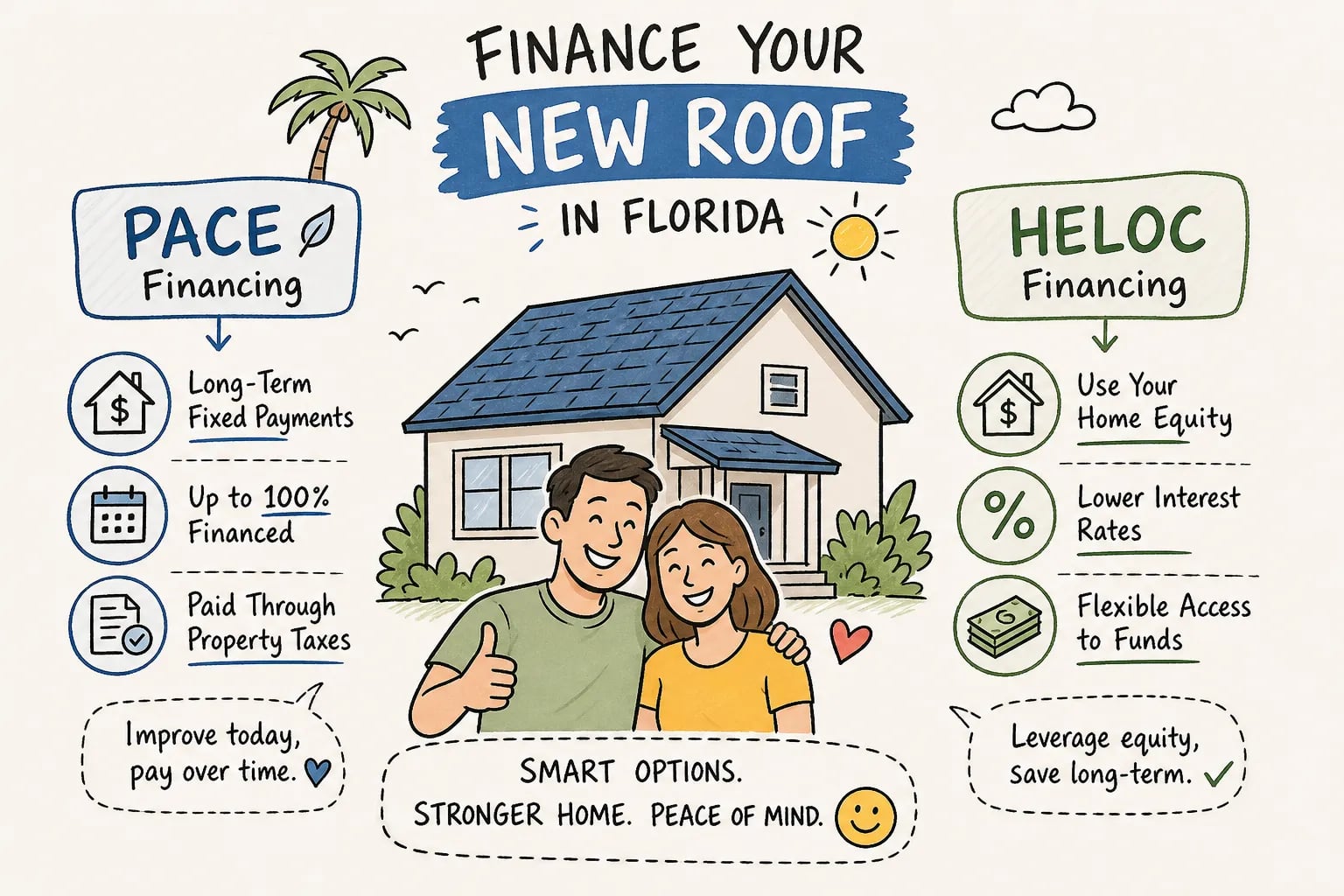
The terminology alone trips people up. PACE stands for Property Assessed Clean Energy. It is not a personal loan. It's an assessment attached to your property and repaid through your annual property tax bill, not a separate monthly payment. The financing is authorized under Florida Statute section 163.08 and requires county approval before it can be offered to residents. A home equity loan, by contrast, is a second mortgage secured by the equity you've built in the home. A HELOC (Home Equity Line of Credit) is similar but structured as a revolving line of credit with a draw period rather than a lump sum.
The most important structural difference is this: a PACE assessment lien stays with the property, while a home equity loan follows you as the borrower. That single distinction has real consequences for resale, refinancing, and title, consequences we cover in detail below.
How PACE financing works in Florida
When you finance a roof through a PACE program, the PACE provider works with the county to record a property assessed clean energy loan assessment against your property. You don't make a monthly loan payment to a bank; instead, the repayment is added to your property tax bill each year. The rate is fixed for the life of the assessment, and there's no penalty for paying it off early. Funding isn't released until after the project is completed and passes a final inspection, which means the contractor gets paid after the work is done and verified.
How a home equity loan and HELOC work
A home equity loan gives you a lump sum at a fixed interest rate, repaid in equal monthly installments over a set term. A HELOC works differently: you're approved for a credit line up to a certain amount, you draw from it during a draw period (commonly 10 years), and you repay what you actually used. HELOCs typically carry variable rates, which means your payment can shift as market rates move. Both products require the lender to underwrite your credit, income, and equity position before approval.
PACE financing vs. home equity loan for roof replacement in Florida: who can qualify
This is often where the decision gets made. PACE has no minimum credit score requirement. Eligibility is property-based: your property taxes must be current with no delinquency in the prior three years, you must be current on your mortgage, there can be no involuntary liens against the property, and the total PACE assessment generally cannot exceed 20% of the property's assessed value. Some Florida PACE programs also apply an income-to-payment test, requiring that your annual PACE payment not exceed 10% of household income, which may mean providing a recent tax return. But there is no credit score check and no traditional credit underwriting.
A home equity loan or HELOC works the other way. The lender checks your credit score (typically requiring a minimum of 640 to 700), verifies your income through pay stubs or tax returns, reviews your debt-to-income ratio, and confirms that your combined loan-to-value doesn't exceed roughly 80% to 90%. For homeowners with strong credit and solid equity, this process is manageable. For those who've had financial disruptions, medical bills, or recent credit problems, the bank door may simply be closed.
PACE eligibility: the property, not the borrower
The core PACE eligibility requirements are current property taxes, no mortgage delinquency, no involuntary liens, and a total financed amount within the program's property-value cap. Some programs also require income documentation to confirm the payment fits within household affordability limits. What you won't need is a strong credit score, and that distinction makes PACE accessible to a much broader range of Florida homeowners than conventional bank products.
Home equity loan and HELOC underwriting in Florida
In 2026, Florida lenders handling home equity loan applications typically require a credit score of at least 640, and many prefer 700 or above for competitive rates. They'll calculate your combined loan-to-value ratio and want to see that you retain at least 10% to 20% equity in the home after the new loan is added. Income documentation is standard: W-2s, pay stubs, or two years of tax returns for self-employed borrowers. The debt-to-income ratio generally needs to stay below 43%, though some lenders will stretch to 50% with compensating factors.
How fast you can get funded for a roof replacement
For Florida homeowners dealing with a roof that's already failing or showing storm damage, timing is not a secondary consideration. PACE pre-approval can happen within 48 to 72 hours, and some programs return decisions faster than that. The complete process, from application to contractor payment, typically runs one to two weeks. The funding sequence matters: you get approved first, the work gets done, a final inspection confirms project completion, and then the funds are released to the contractor. You're not waiting on money to start; the contractor starts on the strength of the PACE approval.
A home equity loan or HELOC typically takes two to six weeks from application to funding. The main bottleneck is the appraisal requirement. Lenders need to confirm your property's current market value before they can finalize your loan amount, and scheduling, completing, and processing an appraisal adds time that you may not have when your roof is letting in water after a tropical storm.
PACE: fast approval, post-completion funding
The PACE approval process is largely digital and property-based, which is why it moves quickly. Once you're approved, your PACE-enrolled contractor scopes the project and the work begins. After completion, the program sends an inspector to verify the project meets specifications, and then the contractor receives payment. The homeowner never handles the funds directly; the PACE provider pays the contractor once the work is confirmed complete.
Home equity loan and HELOC: the appraisal bottleneck
Most borrowers underestimate how much time the appraisal adds to a home equity application. The lender orders it, you wait for scheduling availability in your area, the appraiser completes the inspection, the report is written and submitted, and the underwriting team reviews it. In active markets across Northeast and Central Florida, this step alone can take one to three weeks. If the appraisal comes in lower than expected, it can reduce your available loan amount or stall the approval entirely.
PACE financing vs. home equity loan for roof replacement in Florida: rates, fees, and total cost
Most comparison articles stop at the interest rate and call it a day. The actual cost picture requires looking at the rate, the fees, and the term together. PACE rates in Florida currently run from approximately 6% to 12.99%, with many programs landing between 6% and 8% for qualified homeowners. On top of the rate, expect a closing fee of approximately 6.99% of the financed amount, plus county-level service charges capped at 4% total. For a $20,000 roof, that's roughly $1,400 to $2,200 in fees absorbed into the assessment balance.
Home equity loans in Florida are averaging 7.30% to 8.40% in 2026, with closing costs that vary by lender. Some Florida credit unions and banks are running no-closing-cost promotions, which can meaningfully lower the total cost. HELOCs are averaging 7.00% to 9.50% with generally lower upfront costs, but the variable rate structure means your payment exposure can shift as prime rates move.
PACE rate range and fee structure in 2026
For a $15,000 roof replacement on a 15-year PACE term at 7.5%, the annual payment would run approximately $1,680, about $140 per month equivalent, plus the closing fee of around $1,050 built into the assessment. The total interest paid over the full term would be approximately $10,200, bringing the all-in cost to roughly $26,200. Rates at the lower end of the range (6%) reduce total interest to about $8,600, while rates toward the higher end (10%) push total interest above $12,000 for the same $15,000 project.
Home equity loan and HELOC rates in Florida for 2026
A fixed home equity loan at 7.75% over 15 years on a $20,000 balance carries a monthly payment of approximately $187 and total interest of about $13,700. A HELOC at 8.00% during a 10-year draw period on the same balance would show similar or slightly lower initial payments, but variable rate adjustments can change that picture significantly over time. Some Florida credit unions advertise HELOCs starting as low as 6.75% APR with no closing costs for well-qualified borrowers, as of mid-2026, rates vary by institution and borrower profile, so verify current offers directly with your lender. That said, when a HELOC rate and terms align favorably, the total cost advantage over PACE financing for roof replacement can be meaningful.
A side-by-side monthly cost scenario
For a $20,000 roof replacement over 15 years: a PACE assessment at 8% with the 6.99% closing fee built in produces an effective balance of roughly $21,400, a monthly equivalent of about $204, and total interest-plus-fees of approximately $16,800. A fixed home equity loan at 7.75% with no closing costs on the same $20,000 over 15 years produces a monthly payment of about $187 and total interest of approximately $13,700. The home equity loan is cheaper in total cost, assuming you qualify and there are no closing costs. If the lender charges $1,500 in closing costs, the gap narrows considerably. PACE costs more on a pure numbers basis, but it's available to homeowners the home equity path excludes entirely, and for those borrowers, it's often the only viable roof financing option in Florida.
The lien risk most Florida homeowners don't see coming
PACE financing carries a risk that's rarely explained clearly upfront, and it's significant enough to drive the decision for some homeowners. Because a PACE assessment is recorded as a non-ad valorem assessment lien against the property, it holds a senior lien position under Florida Statute section 163.08. Senior lien status means it can take precedence over your existing mortgage. That creates two downstream problems that matter a lot depending on your plans.
First, when you try to sell the home, the buyer's lender or the title company may require the full PACE balance to be paid off at closing, even if you intended to transfer the assessment to the buyer. Buyers' lenders often won't accept a senior lien obligation they don't control. Second, when you try to refinance, Fannie Mae, Freddie Mac, FHA, and VA loan programs generally will not proceed with an outstanding PACE assessment unless it's paid in full at or before closing. Your existing lender put up their mortgage expecting first-lien position; a PACE assessment recorded after the mortgage complicates that claim.
This isn't a reason to avoid PACE categorically. For a homeowner who has no plans to sell or refinance in the next several years and needs a roof now, the lien structure is manageable. But going in without understanding it is how homeowners get surprised at the closing table.
How the PACE assessment lien attaches to the property in Florida
The PACE provider records the assessment lien against your property's public record after the project is funded. The obligation follows the property, not you personally. That means if you sell without paying it off, the lien stays with the home until it's discharged. Some buyers and their lenders will accept the transfer of a PACE balance; many won't, particularly if the buyer is using a conventional conforming loan.
Impact on resale and refinance in Florida: what a PACE balance means
Fannie Mae and Freddie Mac have documented policies that block conventional conforming refinances on properties with outstanding first-lien PACE assessments. The practical effect is that if you want to refinance into a conventional loan while a PACE balance remains, you'll need to pay off the assessment first. Whether your equity can absorb that payoff depends on your home's current value and what you owe. For homeowners who've built substantial equity, payoff at closing is feasible. For those with limited equity, it can make refinancing impossible without selling. Understanding this impact on resale and refinance in Florida is one of the most important steps before committing to any PACE program.
Repayment structure and long-term flexibility
Florida PACE assessments run from 5 to 20 years for residential projects, with the rate locked in for the full term and no prepayment penalty. The repayment is added to your annual property tax bill. If you pay your property taxes through an escrow account managed by your mortgage servicer, that servicer will need to adjust your escrow calculation to account for the higher tax obligation. That adjustment can affect your monthly mortgage payment even though the PACE is technically a separate assessment. It catches some homeowners off guard when their escrow analysis runs the following year.
A fixed home equity loan gives you a predictable monthly payment over a set term, typically 5 to 30 years. A HELOC gives you flexibility during the draw period but introduces variable rate exposure during the repayment phase. The best fit depends on whether you prefer bundling the cost into your tax bill or managing it as a separate monthly loan obligation.
Paying through the property tax bill: what PACE homeowners experience
Homeowners who pay property taxes directly tend to have the smoothest experience with PACE repayment. The assessment shows up as a line item on the tax bill alongside your regular tax obligations. For those with escrow accounts, the process works, but the timing of the escrow adjustment can create a temporary gap in monthly payment expectations. Contact your mortgage servicer before the PACE assessment is finalized so there are no surprises in your next escrow analysis.
Fixed home equity loan vs. HELOC draw periods
In a 2026 rate environment where rates have stabilized compared to the volatility of prior years, the predictability of a fixed home equity loan is attractive for a defined project cost like a roof replacement. HELOCs work well when you're managing a multi-phase renovation with uncertain total costs, because you borrow only what you draw. For a single roof replacement with a firm estimate, the fixed home equity loan is usually the cleaner structure if you qualify.
A decision checklist: PACE financing vs. home equity loan for roof replacement in Florida
There's no universal winner here. The right choice depends on four factors: your credit profile, your urgency, your plans for the home, and your preference for how the payment is structured. Work through these conditions honestly and the answer usually becomes clear.
Choose PACE financing if:
- Your credit score is below 640 or you've had recent financial disruptions that disqualify you from bank underwriting.
- The roof is failing now and you can't wait two to six weeks for a home equity approval to process.
- You plan to stay in the home long-term (five or more years) and won't be refinancing in the near future.
- You have limited savings and need $0 down access to get a critical repair completed.
- You understand the senior lien structure and have sufficient equity to absorb a payoff if circumstances change.
Choose a home equity loan or HELOC if:
- Your credit score is 680 or above and you have documented income that meets lender requirements.
- You have at least 20% equity in the home after accounting for the new loan.
- You're planning to sell or refinance within the next three to seven years and don't want a senior lien complicating the transaction.
- You want the lowest total interest cost and the cleanest possible title.
- You can wait two to six weeks for funding without the roof situation becoming an emergency.
Frequently asked questions: PACE vs. home equity loan for roof replacement in Florida
Can a PACE assessment be transferred to the buyer when I sell?
In some cases, yes, but buyer acceptance is not guaranteed. Many buyers' lenders, particularly those issuing conventional conforming loans backed by Fannie Mae or Freddie Mac, will not allow the transaction to close with an outstanding PACE lien. The safest assumption is that the PACE balance will need to be paid off at closing unless your buyer is paying cash or using a lender that specifically permits the transfer.
Does PACE financing affect my credit score?
PACE is not underwritten as a traditional loan and does not typically appear on your personal credit report the way a mortgage or personal loan would. However, if you fall behind on property taxes that include a PACE assessment, the delinquency can escalate through the county tax collection process, which can have serious consequences for your property. Make sure you understand the payment structure before you commit.
What's the difference between a PACE loan and a home equity loan for roofing in Florida?
A PACE loan is technically a property tax assessment, not a loan in the traditional sense. It's tied to the property, repaid through your tax bill, and doesn't require credit underwriting. A home equity loan is a second mortgage that requires credit approval, is tied to you as the borrower, and is repaid as a separate monthly obligation. The total cost, lien implications, and qualification criteria are meaningfully different, which is why comparing them carefully before you choose matters.
Starting your Florida roof replacement: practical next steps
The most efficient way to start is with a licensed, PACE-enrolled contractor who can scope the project and help you understand both financing paths with real numbers attached. At Infinity Legacy, we're licensed across Florida (CGC1540795) and PACE-enrolled, which means we handle the PACE application paperwork, scope the project with a detailed estimate, and coordinate the post-completion inspection that triggers funding. You don't have to navigate the PACE process on your own; we manage it with you from the first conversation.
The single biggest time-waster we see is homeowners applying for financing before they have a project estimate in hand. Both PACE and home equity lenders need a written scope of work and cost estimate before they can finalize an approval. Getting your free estimate from Infinity Legacy first means that document serves double duty: it's both your project scope and the financing application anchor, whether you go the PACE route or the bank route.
Documents to gather before you apply for either option
For PACE, you'll need proof of property ownership (a deed or mortgage statement works), your most recent property tax statement, a government-issued photo ID for each owner on title, and the contractor's written estimate for the project scope. Some programs require income documentation for the payment-to-income test, so having your most recent tax return available can prevent delays. For a home equity loan or HELOC, gather two years of tax returns or recent pay stubs, recent bank statements, proof of homeowners insurance, and be prepared for the lender to order a property appraisal as part of underwriting.
Why starting with a PACE-enrolled contractor saves time
When you call Infinity Legacy, the free estimate we provide is the same document the PACE program requires to initiate the application. That means you're not making two separate trips through a process; one conversation with our team produces the project scope, the cost breakdown, and the starting point for financing paperwork simultaneously. For homeowners who go directly to a PACE portal without a contractor enrolled in the program, the application stalls at the "provide a contractor estimate" step anyway. Starting with the contractor eliminates that bottleneck entirely and gets the project moving faster.
Bring the right financing to your next roof replacement
Choosing between PACE financing and a home equity loan for roof replacement in Florida comes down to a clear trade-off. PACE is the right fit for homeowners who need fast access with no credit barrier and plan to stay in the home long enough that the lien position won't become a problem. A home equity loan or HELOC offers lower total cost and a cleaner title for homeowners who qualify and aren't in a rush. The PACE assessment lien is real and should factor into your decision, but for the right homeowner, it makes a necessary replacement possible when it otherwise wouldn't happen at all.
The worst outcome is a roof that keeps deteriorating while the financing decision stays unresolved. Water damage, mold, and structural rot compound the cost dramatically the longer a failing roof goes unaddressed in Florida's climate. A well-informed decision made promptly is better than the perfect decision made too late.
Reach out to the Infinity Legacy team for a free estimate and a frank conversation about your roof financing options in Florida. You get a real project number and an honest read on which path fits your situation, nothing more. We serve homeowners and commercial property owners across Northeast and Central Florida, and we're here to make the process straightforward from the first call to the final inspection.