What is the best roof material for Florida weather? It's one of the most consequential decisions a Florida homeowner makes, because Florida is one of the most demanding roofing environments in the country. The wrong choice doesn't just cost money. It costs safety and sometimes the home itself. Between hurricane-force winds, relentless UV radiation, tropical rainfall, and coastal salt air, the standards a Florida roof must meet are categorically different from what works in most of the country.
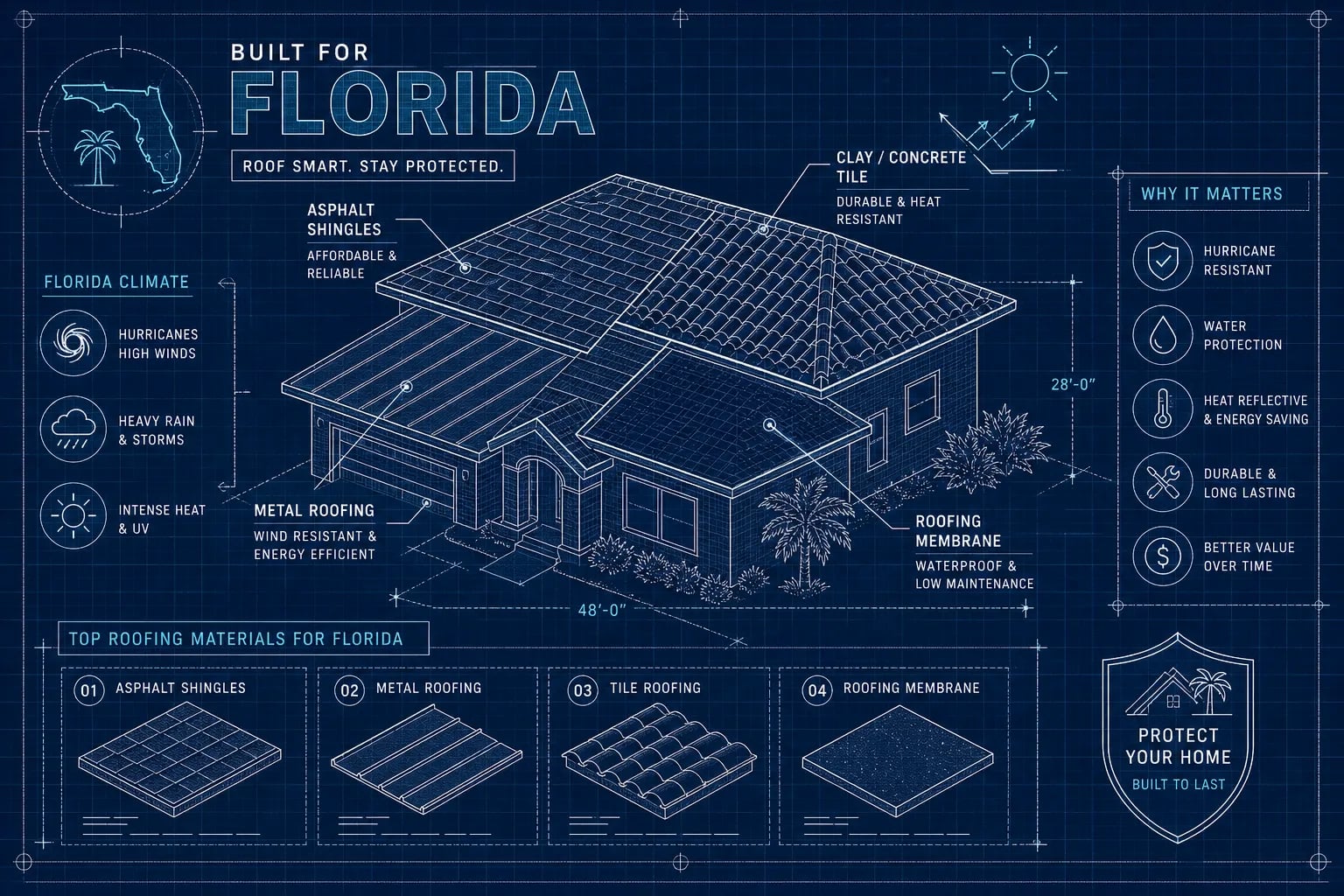
This article covers the four main roofing systems Florida homeowners choose from: asphalt shingles, clay and concrete tile, metal, and flat or low-slope membranes. Infinity Legacy's team has been replacing roofs across Northeast and Central Florida for over a decade, and that field experience informs every recommendation here. What follows is a practical decision guide built on that experience, current Florida Building Code requirements, and real cost data for 2026. By the end, you'll know which material fits your location, budget, and storm exposure.
Why Florida demands more from a roof than almost any other state
Three forces separate Florida roofing from the rest of the country. Understanding them before comparing materials is what keeps those comparisons grounded in real stakes rather than marketing language.
The year-round heat and UV load
Florida rooftops can reach surface temperatures well above typical ambient levels in summer, studies on dark roofing surfaces in high-solar-intensity climates have documented extremes approaching or exceeding 160°F. UV radiation at Florida's latitude degrades adhesives, coatings, and organic materials significantly faster than northern climates do. Most roofing product warranties are written to national averages, not to Florida's solar intensity, which means the warranty language and the real service life often tell two very different stories.
Hurricane wind loads and why every material rating matters here
Florida is the only state that requires Miami-Dade product approvals for the High-Velocity Hurricane Zone, which covers Miami-Dade and Broward counties. Even outside that zone, the Florida Building Code mandates wind-resistance standards that eliminate certain product assemblies outright, particularly those that meet lower-wind-speed design criteria used in neighboring states. A roofing assembly approved for use in Georgia may not meet the wind speed or testing requirements for Volusia or Brevard County. Outside the HVHZ, design wind speeds generally range from 150 mph in Central and North Florida inland areas up to 165 to 175 mph along Southeast coastal counties, based on the ASCE 7-22 wind maps adopted by the Florida Building Code.
Salt air, humidity, and the coastal corrosion problem
Within a few miles of the Florida coastline, airborne salt accelerates corrosion on metal components, degrades sealants, and attacks fasteners. This isn't a minor inconvenience. It's a material-selection variable that changes the right answer depending on whether a home is beachfront or 10 miles inland. Two homes in the same county can require completely different roofing specifications because of that distance variable.
What is the best roof material for Florida weather? A quick summary by type
The short answer: it depends on where you live, how long you plan to stay, and what your storm exposure looks like. The sections below break down each major system so you can match the right roofing material for Florida weather to your specific situation.
Asphalt shingles: the affordable starting point and its real Florida trade-offs
Asphalt is the most common roofing material in the country, and it remains the most budget-accessible option in Florida. "Affordable" and "right for Florida," though, are two different conversations worth separating before you sign a contract.
What architectural shingles actually offer in a Florida climate
Installed at $5 to $8 per square foot, architectural (dimensional) shingles are significantly cheaper than tile or metal. Many carry Class 4 impact ratings and can meet ASTM D7158 Class H wind resistance for HVHZ use when the product holds a Miami-Dade Notice of Acceptance. For inland homeowners with tighter budgets and shorter time horizons, they're a legitimate option that checks real code requirements.
The lifespan reality in Florida heat and humidity
The national warranty language, whether 30-year, 50-year, or "lifetime", is written for northern climates. In Florida, most architectural shingles realistically perform for 15 to 25 years, with coastal and South Florida homes typically landing on the lower end of that range. Granule loss, UV-accelerated adhesive breakdown, and storm exposure all shorten the real service life well below what the package suggests.
When asphalt makes sense and when to consider stepping up
Asphalt is a reasonable choice for homeowners who plan to sell within 10 to 15 years, have a tighter budget, or are replacing a roof on a structure that doesn't justify a premium material investment. It's the wrong choice for a coastal home, a forever home, or a property where the next replacement will fall squarely in the peak of the owner's life. The math changes significantly when you factor in replacement frequency over a 40-year horizon.
Clay and concrete tile: the classic Florida roof and why it earns its reputation
Tile has been the dominant premium roofing material in Florida for generations. There are real performance reasons behind that market preference, along with trade-offs that homeowners should understand before committing to the system.
Clay tile vs. concrete tile: what's actually different
Clay tile runs $12 to $20 per square foot installed. Concrete tile comes in at $9 to $14 per square foot installed. Both can achieve 150-plus mph wind resistance in approved Miami-Dade assemblies. Clay outlasts concrete in pure longevity, 50 to 100-plus years for the tile itself versus 40 to 50-plus years for concrete, but the practical difference is often less significant than it sounds, because both systems share the same limiting factor: the underlayment.
The underlayment issue that tile owners often discover too late
The tiles on a well-maintained roof can look perfect while the waterproof membrane underneath approaches failure. Underlayment on tile systems typically needs replacement every 20 to 30 years, even when the tiles themselves are structurally sound. This is the most common surprise cost in tile roof ownership, and it's worth factoring into any honest lifetime cost comparison with metal alternatives.
Structural load and what your roof deck needs to support tile
Clay and concrete tile are heavy, running 8 to 12 psf on the roof deck compared to 2 to 4 psf for asphalt shingles. A tile system can weigh four to six times what an asphalt system weighs per square foot. Older Florida homes, especially those built before the 1990s, sometimes require structural reinforcement before tile can be installed. This is a permit and engineering conversation, not a cosmetic one, and discovering it mid-project can add significant time and cost to a replacement.
Metal roofing: the longest-lasting system for Florida homes
Metal roofing has moved from a niche upgrade to a mainstream choice in Florida over the last decade, and the performance record supports the shift. For homeowners who want to replace their roof once and be done with it, metal is usually the system that makes the most long-term financial sense.
Standing seam vs. stone-coated metal: which one is right for Florida
Standing seam metal runs $12 to $22 per square foot installed, with South Florida and complex-geometry roofs pushing toward the top of that range. It offers 40 to 70 years of expected service life, concealed fasteners that eliminate the most common corrosion entry points, and wind ratings that reach 160 to 180 mph in approved systems. Stone-coated metal offers a tile-like aesthetic at a slightly lower price point. Miami-Dade approvals are available in certain HVHZ configurations, with wind ratings that vary by specific product approval and typically range from 130 to 150 mph.
Coastal corrosion requirements: what the specs actually mean
For homes within 3,000 feet of saltwater, Florida roofing guidance calls for 300-series stainless steel fasteners, with 316 stainless preferred at closer proximity. Galvalume panels should carry a PVDF (polyvinylidene fluoride) finish, with Kynar 500 being the most commonly cited coastal specification. Unpainted Galvalume should not be used within 1,500 feet of saltwater without a protective coating. For beachfront properties, aluminum panels are often the better substrate choice over coated steel entirely, because aluminum's natural corrosion resistance holds up where even good coatings eventually wear.
Energy performance and the cool roof advantage
Metal roofing reflects solar radiation significantly better than asphalt or dark tile, reducing heat transfer into the home and lowering cooling loads. In a state where air conditioning runs the better part of the year, that's a meaningful operational savings. Many metal systems qualify as cool roofs under Florida energy codes, and some carry Energy Star ratings that may contribute to utility rebate eligibility, adding another layer of long-term financial return on the higher upfront investment.
Flat and low-slope roofing: what commercial and some residential owners need to know
Flat roofing is common across Florida commercial properties and a subset of contemporary residential designs. It operates under different performance logic than sloped systems, and the material choices reflect that distinction.
TPO, modified bitumen, and built-up roofing explained
TPO (thermoplastic polyolefin) is the dominant flat roofing membrane in Florida commercial work, valued for heat reflectivity, UV resistance, and seam weld strength. It consistently outperforms other flat systems in Florida's high-UV, high-rainfall environment. Modified bitumen offers durability and good puncture resistance, but its UV performance requires a granulated or coated surface to hold up. In Florida's direct sun exposure, modified bitumen's UV performance consistently trails TPO unless a reflective cap sheet is applied. Built-up roofing (BUR), layered with asphalt and gravel, is older technology that can perform well but typically delivers less reflectivity and lower energy efficiency unless topped with a reflective cap sheet.
Florida-specific challenges for flat systems
Flat roofs depend entirely on drainage. Florida's intense rainfall events, often measured in inches per hour, expose any drainage deficiency quickly. Standing water is the leading cause of premature flat roof failure in the state. Proper tapered insulation design and drain placement are not optional on a Florida flat system; they're structural to the roof's performance and should be engineered, not estimated.
Maintenance expectations and realistic service life
A well-installed TPO system in Florida typically lasts 15 to 25 years before full replacement, with modified bitumen running a similar range. Regular inspections, at minimum annually and after every significant storm, extend service life by catching seam failures, punctures, and drain blockages before they become interior water events. The cost of a $300 inspection is vastly more attractive than the cost of interior remediation after a membrane failure goes undetected through a wet season.
Wind ratings, Miami-Dade approvals, and how they affect your insurance bill
This is where technical specifications translate directly into real money. Most Florida homeowners know their roof needs to be "hurricane-rated" but don't fully understand what that means for product selection, installation, or insurance premiums.
Miami-Dade NOA and the Florida Building Code approval system
A Miami-Dade Notice of Acceptance is a product-and-assembly-specific approval, not a material category stamp. "Metal" doesn't have an NOA. A specific standing seam panel, with specific clip spacing, deck attachment, and underlayment, has an NOA for a specific wind speed. The same logic applies to tile, shingles, and every other system. Contractor experience and permit-ready documentation matter as much as material selection; the right material installed in the wrong assembly can fail both inspection and a storm.
Class 4 impact ratings and TAS testing in HVHZ
Outside the HVHZ, UL 2218 Class 4 impact ratings apply to products like impact-resistant shingles and some metal panels. Inside the HVHZ, TAS 201 and TAS 203 testing is the controlling standard. Many homeowners confuse these two systems, and that confusion can result in purchasing a product that doesn't meet local code. Understanding which approval applies to your specific address is the difference between buying a compliant product and buying one that fails inspection after installation.
Insurance premium savings by material and approval level
Florida homeowners who replace their roof with a code-compliant system can expect 15% to 45% off the windstorm portion of their premium, depending on carrier and features. Homes meeting current Florida Building Code standards may qualify for significantly larger windstorm credits. Impact-resistant products commonly add another 5% to 15% on top of that baseline. Metal roofs specifically are cited by Florida insurers for 5% to 35% savings depending on the system. Based on what our clients on coastal policies report, annual premium reductions of $500 to over $1,000 are not unusual after a metal roof installation, and savings tend to be highest where windstorm premiums carry the most weight.
How to choose the best roof material for Florida weather based on your location
Florida is not a single climate environment. A home in Palm Coast faces different material requirements than one in Ocala. A beachfront property in Daytona Beach has different corrosion exposures than a home five miles inland. Location is the first variable to establish before any other comparison makes sense.
The distance-from-water rule and how it shifts material specs
Within 3,000 feet of saltwater, fastener and flashing specifications tighten significantly. Within 1,500 feet, unpainted Galvalume steel should be avoided entirely. Beachfront or marina-adjacent properties should consider aluminum panels rather than coated steel, regardless of coating quality. These aren't builder opinions, they're reflected in FEMA coastal guidance and Florida code, and they carry real consequences for roof longevity and warranty validity when ignored.
How inland climate zones affect material priority
Inland Central and North Florida homeowners face strong hurricane wind exposure without the constant salt-air corrosion of coastal sites. For this group, the priority shifts toward wind rating and heat performance rather than corrosion resistance. Metal roofing still leads in long-term value for inland homes, but concrete tile is a viable and common choice for homeowners who want the classic Florida look without the full premium of clay. The structural load consideration remains relevant regardless of location.
Budget calibration by location type
Coastal construction costs more because the materials cost more. Stainless fasteners, aluminum panels, PVDF coatings, and Miami-Dade-approved assemblies all carry premiums over inland equivalents. A homeowner budgeting for a coastal metal roof should expect to land toward the upper end of the $12 to $22 per square foot range. Anyone converting from asphalt to tile on an older home should also factor in potential structural prep costs before comparing sticker prices between systems.
How to choose your material and what working with a Florida contractor actually looks like
The material decision comes down to four variables: location relative to the coast, storm exposure, budget, and how long you plan to own the home. Getting all four right before selecting a product is what separates a roof that performs for decades from one that disappoints within ten years.
A practical decision framework for Florida homeowners
Use location as your starting point, then layer in budget and time horizon:
- Beachfront or within 1,500 feet of saltwater: aluminum standing seam metal or approved tile with full marine-grade hardware specifications.
- Coastal but more than 1,500 feet from water: standing seam metal with PVDF-coated Galvalume, or clay or concrete tile with stainless hardware.
- Inland with a longer time horizon: metal roofing or tile, based on budget and aesthetic preference.
- Inland with a shorter time horizon or tighter budget: architectural shingles with a Class 4 impact rating and Miami-Dade NOA for HVHZ zones, or a high-wind-rated product for other areas.
- Any commercial or low-slope application: TPO with proper tapered drainage design as the default, modified bitumen where puncture resistance or rooftop traffic is a factor.
What the Florida permitting process involves
Roof replacements in Florida are subject to permit requirements that vary by jurisdiction, but in practice the large majority of full re-roofs across the state require a permit. The permitting process includes plan review, product approval documentation (the NOA or Florida Product Approval number), inspection at installation, and final sign-off. In most non-HVHZ counties, straightforward residential re-roof permits are approved within 1 to 10 business days; Miami-Dade can run 3 to 6 weeks or more for complete submissions. A licensed contractor handles this entire process: pulling the permit, supplying the product approval documentation, scheduling inspections, and delivering the certificate of completion your insurer needs for premium adjustments.
Homeowners who hire unlicensed contractors or attempt to skip the permit process expose themselves to failed home sales, insurance claim denials, and real safety risk. The permit is not paperwork for the contractor's benefit. It's the mechanism that verifies your home was protected correctly.
Why working with a single accountable contractor removes the guesswork
At Infinity Legacy (license CGC1540795), our team works with Florida homeowners across Palm Coast, Jacksonville, Daytona Beach, Orlando, and the broader Northeast and Central Florida region to match the right roofing system to each home's specific climate zone, budget, and storm exposure. We handle material selection, product approvals, permitting, and installation under one licensed, accountable team, so homeowners aren't managing multiple vendors or chasing permit paperwork through a county office.
We offer free estimates on every project. For homeowners who need to replace a roof but aren't ready to pay out of pocket, we offer a PACE financing option that provides $0 down with no traditional credit requirement, repaid through the property tax bill. That means a homeowner facing an aging shingle roof can move to a standing seam metal system or a tile roof without waiting years to save the full amount. Critical upgrades don't have to wait for perfect financial timing.
Choosing the right roof for your home and your Florida reality
Asphalt shingles offer accessibility and code compliance at the lowest upfront cost, but their shorter service life in Florida's climate makes them best suited for budget-conscious projects with shorter time horizons. Tile delivers decades of proven performance and a wind resistance profile that has held up through generations of Florida hurricane seasons, with the caveat that underlayment replacement cycles and structural load deserve careful attention before committing. Metal roofing provides the longest service life, the best energy performance, and the strongest case for long-term value, especially on coastal properties where material specifications must account for salt exposure. Flat and low-slope systems follow their own logic, with TPO leading in Florida's UV and rainfall conditions when drainage is engineered correctly.
Figuring out what roofing performs best in Florida isn't a universal answer. It's a function of where you live, how long you plan to stay, what your storm exposure looks like, and what you're working with financially. Every one of those variables shifts the right answer, which is why a conversation specific to your address and your home is more valuable than any general comparison.
Get in touch with the Infinity Legacy team for a free estimate and a material recommendation built around your home's location, current condition, and goals. Our team covers Northeast and Central Florida, and we bring the permits, the product approvals, and the field experience to back every recommendation we make.