Florida is one of the most challenging climates in the country for roofing materials. Subtropical heat, relentless humidity, salt air, and hurricane-force winds combine to destroy average roofing systems faster than almost anywhere else in the U.S. Yet many Florida homes are still covered with asphalt shingles that weren't engineered for any of those conditions. Metal roofs in Florida aren't a trend; they're a direct response to that reality.
Homeowners across Jacksonville, Palm Coast, Orlando, and Tampa are all asking the same questions: Is a metal roof actually worth the higher upfront cost? What will it realistically set me back? And what does the so-called 15-year rule actually mean for my insurance? These are the right questions, and this article answers all of them. Infinity Legacy (CGC1540795) is a licensed Florida contractor that installs metal roofing systems engineered specifically for the state's storm conditions, and the guidance below reflects what we see on the ground across Northeast and Central Florida every day.
Why Florida homeowners are making the switch to metal roofing
Storm resilience that goes beyond marketing claims
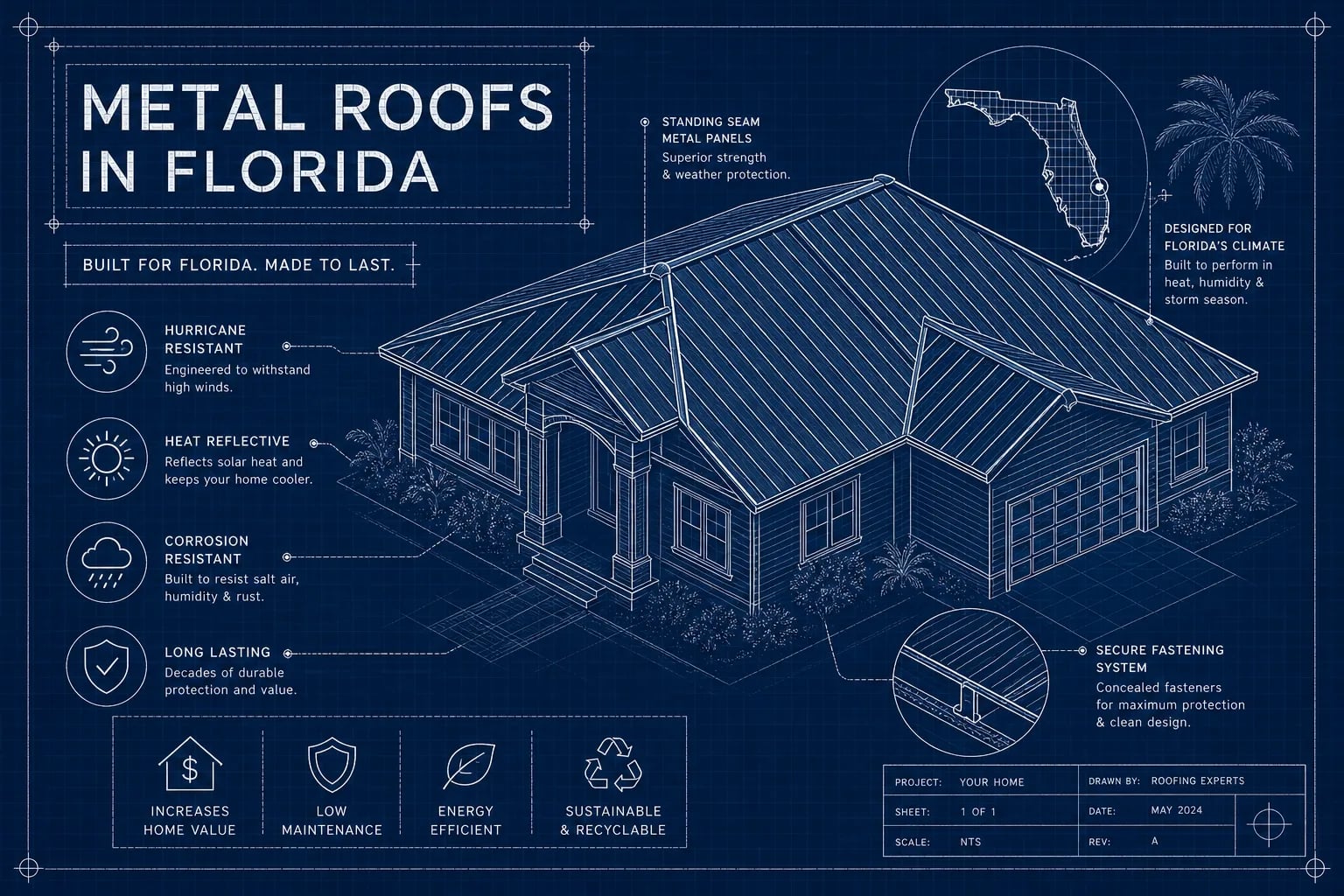
Metal roofs in Florida must meet Florida Building Code requirements for high-wind zones, with approved systems engineered to match each site's specific design wind speed. Design wind speeds across South Florida run 170 to 185 mph; in Central and North Florida, they generally fall in the 150 to 165 mph range. A properly specified and installed metal system carries a Florida Product Approval (FL#) or, in Miami-Dade and Broward counties, a Miami-Dade County Notice of Acceptance (NOA) matched to those regional wind loads. That's not a marketing claim, it's a code requirement backed by product approvals.
Asphalt shingles, by contrast, tend to degrade and lose granules over time and can suffer wind-related damage at lower wind speeds than comparable metal systems. Repeated storm damage creates a cycle of repairs and premature replacement that adds up fast over a 20-year window. For Florida homeowners, a one-time upgrade to a hurricane-rated metal roof shifts the risk calculation entirely. Instead of budgeting for partial repairs after every named storm, you're investing in a system built to withstand the season's worst.
Energy efficiency in Florida's year-round heat
Metal roofing reflects solar radiation rather than absorbing it, which keeps attic temperatures significantly lower and reduces the cooling load on your HVAC system. In a state where air conditioning runs for the majority of the year, that thermal performance isn't trivial. Many metal panels also carry CRRC (Cool Roof Rating Council) ratings and ENERGY STAR qualifications, meaning their reflectance and emittance values are independently verified, not just advertised.
The real-world utility bill impact varies by home and system, but lower attic heat means your AC isn't working as hard, and in Florida, that adds up to real savings over the life of the roof.
A lifespan that outlasts most other decisions you'll make about your home
Most metal roof systems installed in Florida last 40 to 70 years depending on the material and location. Asphalt shingles in the same conditions typically last 15 to 25 years before requiring full replacement. For a homeowner planning to stay in their property long-term, that lifespan difference fundamentally changes the cost-benefit equation before you even look at a single dollar figure.
What metal roofs in Florida actually cost
Installed cost ranges by panel system
Installed metal roofing in Florida currently runs $7 to $18 per square foot, and the range reflects real differences in system type and location. Exposed-fastener panels land toward the lower end of that range. Standing seam roof installations in Florida trend toward the middle to upper end. Coastal and High-Velocity Hurricane Zone (HVHZ) jobs with Miami-Dade approvals typically sit at the top of the range, reflecting the stricter product and installation requirements.
For a typical Florida home with 1,500 to 2,500 square feet of roof area, a realistic fully installed budget falls between $12,000 and $35,000, calculated at roughly $7 to $18 per square foot across that size range. That's a real number, and it's fair to say it's higher than shingles upfront. But the comparison doesn't end there.
How the upfront cost compares to shingles over time
Asphalt shingles run $4.50 to $8 per square foot installed in Florida, but in Florida's climate they typically need full replacement every 15 to 20 years. Run a simple scenario: two shingle replacements over a 40-year period, plus storm repair costs in between, plus the insurance premium difference from weaker wind-mitigation credits. The cumulative total can easily approach or exceed the metal roof's upfront cost, particularly when you factor in recurring repair bills after named storms.
What Florida homeowners pay upfront for metal is really a 50-year decision. When you divide the installed cost by the expected lifespan and factor in the insurance and energy savings, the math works in metal's favor for most Florida properties.
Aluminum, Galvalume, or steel: choosing the right material for your Florida home
How each material holds up in Florida's environment
Aluminum is the strongest performer in Florida's coastal zones. With a natural oxide layer that resists corrosion without any coating help, aluminum roof installations in Florida typically last 50 to 70 years even near saltwater. It's the go-to material within a mile of the coast for good reason.
Galvalume and coated steel are strong options for inland and mid-coast locations, delivering 40 to 60 years of service life with proper coatings and maintenance. Bare steel is the most vulnerable of the three once its protective coating is compromised, especially near saltwater, and it's generally not the right choice for coastal Florida properties.
What salt air does to a roof over time, and how to minimize it
Salt-laden air attacks fasteners, coatings, and exposed cut edges gradually, shortening service life without any obvious warning signs until the damage is already done. The closer your property is to the ocean or an inlet, the faster that process moves. Aluminum is the preferred material within roughly a mile of the coast, while Galvalume performs well for properties farther inland away from direct salt spray.
Coastal-rated coatings, stainless or coated fasteners, and periodic inspections extend the life of any metal system regardless of material. This is exactly why material selection is a professional decision, not a DIY one: the right choice depends on your specific location, not just a general preference for one panel type over another.
Florida codes, wind ratings, and what the 15-year rule actually means
Miami-Dade NOA vs. Florida Product Approval: what applies to your address
Florida operates a two-track approval system for roofing products, and your address determines which track applies. Homes in Miami-Dade and Broward counties fall within the High-Velocity Hurricane Zone, where products must carry a Miami-Dade County Notice of Acceptance (NOA). Standard Florida Product Approval is not accepted for roofing products in the HVHZ. Everywhere else in Florida, roofing systems are approved through Florida Product Approval (FL#), matched to the local design wind speed for that site.
Design wind speeds in South Florida run 170 to 185 mph. Across Central and North Florida, they generally fall in the 150 to 165 mph range. A contractor must specify and install a system approved for your actual location and wind zone, not just a product labeled "Florida-approved" in a general sense. That distinction matters when it comes to permitting, inspections, and insurance credits.
The 15-year rule myth: it's about insurance, not replacement mandates
This is one of the most misunderstood points in Florida roofing, and it's worth being direct about it. Under Florida Statute 627.7011, insurers cannot deny or nonrenew a homeowners policy solely because of roof age if an inspection shows at least five years of useful life remaining. That's a consumer protection statute, not a building code requiring you to replace a roof at 15 years. No Florida building code mandates replacement at the 15-year mark.
For a hurricane-rated metal roof with a 50-plus-year lifespan, this rule is largely a non-issue. Once your metal roof passes 15 years old, the statute's inspection pathway still applies, but a well-maintained metal roof will easily demonstrate remaining useful life. Understanding this distinction protects you from unnecessary pressure to replace a sound roof prematurely.
Insurance savings after a certified metal roof installation
A certified metal roof combined with a wind mitigation inspection typically produces premium reductions of 5% to 35%, depending on the carrier, roof system, and documentation. Standing seam metal with strong wind ratings tends to qualify for the stronger end of those wind-mitigation credits. The discount applies primarily to the wind portion of the premium, which in Florida represents a significant share of the total bill given the state's hurricane exposure. After installation, a licensed inspector completes the OIR-B1-1802 form documenting your roof's hurricane-resistance features, and you submit that to your carrier for the credit.
HOA rules and practical considerations before committing
Navigating HOA approval for metal roofing in Florida
Florida law treats qualifying metal roofs as a form of hurricane protection, which means HOAs cannot issue a blanket ban on metal roofing simply because the board prefers the look of shingles. Under Florida Statute 720.3035, associations must adopt written specifications for hurricane-protection products and cannot reject a compliant application based on informal preference alone. That said, HOAs can still regulate color, profile style, and compatibility with the community's aesthetic standards, as long as those rules are written and applied consistently.
Standing seam and stone-coated steel systems are often more acceptable to HOAs in planned communities than exposed-fastener industrial-style panels, though community standards vary. Before signing any contract, review your HOA's deed restrictions and architectural review requirements, and confirm the panel profile you're considering matches the community's written standards.
What to confirm before the project starts
Three steps protect your investment before a single panel goes up. Verify the contractor holds a valid Florida general contractor or roofing contractor license. Confirm the product specified carries the correct Florida Product Approval or Miami-Dade NOA for your property's wind zone, not just a generic approval. And make sure permits are pulled before work begins. Skipping permits creates insurance coverage problems and can disqualify you from wind-mitigation credits entirely.
How to find a qualified metal roofing installer in Florida
What separates a Florida-specific installer from a general roofer
Metal roof installation in Florida requires more than knowing how to lay panels. Florida-specific factors include correct product approval selection by wind zone, proper underlayment for humidity and heat management, coastal-rated fasteners where the location demands them, and permit-compliant installation that ensures the roof qualifies for insurance wind-mitigation credits. A contractor unfamiliar with Florida's regional code differences can install a technically sound-looking roof that doesn't qualify for the expected insurance credits, eliminating much of the long-term financial benefit.
The roof may look fine from the street and still fail a wind mitigation inspection because the wrong product was specified for the wind zone or the installation didn't meet the documented requirements. That's a costly mistake that a Florida-experienced installer prevents on the front end.
Getting estimates from a contractor who knows Florida's conditions
Infinity Legacy is a licensed Florida contractor (CGC1540795) based in Palm Coast, serving homeowners across Northeast and Central Florida from Jacksonville to Orlando. We install metal roofing systems selected for Florida's actual storm conditions, not generic residential specs, and we handle permitting, product selection, and wind-mitigation documentation as part of every installation. Free estimates are available for all projects, and we'll confirm which product approval applies to your specific address before any work begins.
Making the decision: is a metal roof right for your Florida home?
Metal roofs in Florida are a strong long-term investment for homeowners who want hurricane resilience, lower energy costs, and a roof that won't need replacement in the next 15 to 20 years. The upfront cost is real, but the math works over time when you account for shingle replacement cycles, storm repair costs, energy savings, and insurance credits. The 15-year rule is an insurance protection statute, not a replacement mandate, and it has minimal practical impact on a well-maintained metal roof.
Material selection depends on your proximity to the coast. Aluminum outperforms steel and Galvalume in salt-air environments; Galvalume is a strong performer inland. The right installer makes the difference between a roof that qualifies for wind-mitigation credits and one that doesn't, so verifying your contractor's Florida license and the product's approval for your specific wind zone is non-negotiable.
If you're ready to find out what metal roofs in Florida would cost on your specific property, and whether a system qualifies for your wind zone and insurance credits, a free estimate from a Florida-licensed contractor is the right starting point. Contact Infinity Legacy to schedule yours. No pressure, no obligation. Just accurate information for your specific home and location.