Every June, the same feeling hits Florida homeowners: hurricane season is here, and the windows are still bare. Maybe last year you told yourself you'd handle it before the next storm. Maybe a close call changed your mind. Whatever brought you here, you're now looking at a wall of options for types of storm shutters: accordion shutters, roll-down systems, storm panels, Bahama shutters, fabric screens. It genuinely isn't obvious which one is worth your money.
The good news is that this decision is simpler than the product landscape makes it look. At Infinity Legacy, we install both hurricane shutters and impact windows across Florida, and we walk homeowners through this exact comparison every week. What follows is the honest breakdown our team gives in person: what each system does, what it costs, how it holds up to Florida's building code, and when it makes more sense to skip shutters altogether and upgrade to impact glass.
By the time you finish this article, you'll know exactly which protection option fits your home, your county's code requirements, and your long-term budget. No jargon, no sales pitch, just the information you need to make a confident call.
The five main types of storm shutters, explained
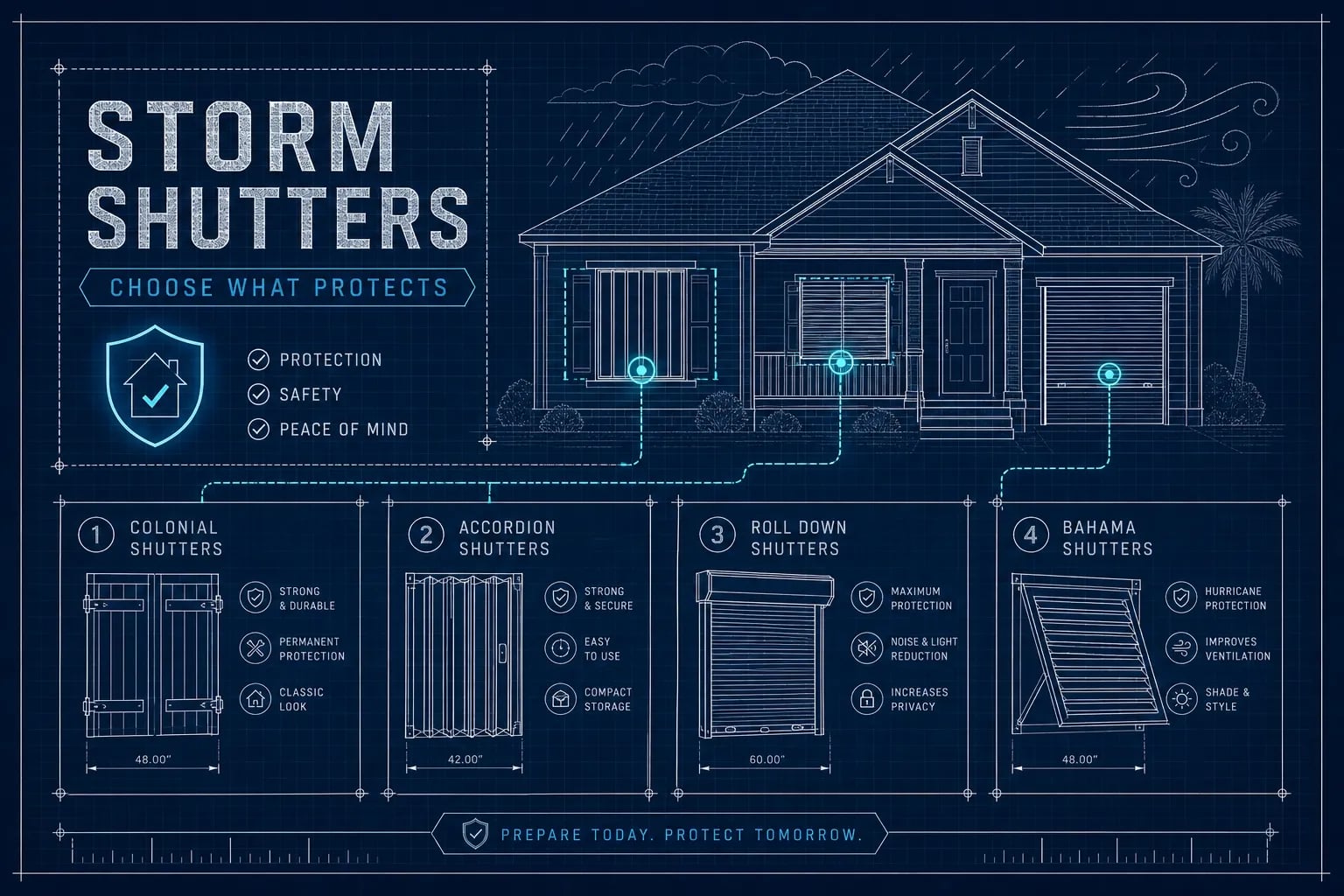
Before comparing costs and ratings, it helps to have a clear mental map of the options. Florida homeowners typically encounter five distinct hurricane shutter categories, each with different mechanics, price points, and protection levels. Understanding the differences among these types of storm shutters up front will save you time and prevent costly missteps.
Accordion shutters: the permanent fold-and-close system
Accordion shutters are hinged aluminum panels permanently mounted on tracks on both sides of a window or door opening. When a storm approaches, you unfold them and lock them in seconds, no tools, no storage, no panels to carry. They're one of the most common permanent hurricane shutter systems in Florida, particularly popular for sliding glass doors and larger openings where other systems get complicated. They come in single-panel and bi-fold configurations depending on the opening size.
Roll-down shutters: the retract-above-the-window option
Roll-down shutters coil up into a housing box mounted above the window when not in use, making them the most visually discreet of all permanent systems. You deploy them manually with a crank or via a motorized mechanism with remote or smart-home controls. Manual versions cost less upfront, but motorized versions are worth considering for large openings or anyone who doesn't want to physically crank down shutters while a storm is building. Roll-downs are often chosen where a discreet, retractable solution is preferred for aesthetic reasons, particularly on commercial properties.
Storm panels: the removable, store-it-away approach
Storm panels are typically aluminum or polycarbonate panels that slide into tracks pre-installed around windows and doors, then get removed and stored between storm seasons. They carry the lowest upfront cost of any approved system. That low upfront cost is the system's primary draw, though what the price tag doesn't show is the time and physical effort required to deploy and store them every hurricane season. Steel versions exist but are heavier and more prone to corrosion in Florida's salt-air environment; polycarbonate versions transmit light, which helps maintain some natural light during a storm watch. Storm panels are sometimes called hurricane panels in the trade, particularly when referring to steel or aluminum corrugated versions.
Bahama and colonial shutters: decorative with a protective function
Bahama shutters hinge at the top and prop outward at an angle, providing shade year-round and then lowering and latching shut before a storm. Colonial shutters are bi-fold panels mounted on either side of the window that fold flat against the wall normally, then close and latch across the opening when needed. Both styles improve curb appeal in ways that aluminum accordion systems simply don't, but their angled geometry and span limitations mean they typically carry lower published design pressure ratings compared to roll-down or accordion systems. They're a legitimate code-approved option for many homes, but they work best on standard-sized windows rather than large openings.
Fabric and screen hurricane systems: the newer category
Reinforced woven fabric screens and solid fabric panels represent the newest category of hurricane protection. They deploy from a housing track or install directly over the opening, and they're lighter than aluminum, which makes them easier to handle during deployment. Performance varies by model and manufacturer, check test reports for specific wind-driven water infiltration resistance before purchasing. Their main limitation is lifespan: most fabric and screen hurricane systems are rated for 5 to 10 years, and UV exposure combined with Florida's salt air accelerates that aging curve significantly.
How storm shutter ratings actually work
Here's a misconception that costs homeowners money: the idea that the shutter style determines the protection level. It doesn't work that way, and understanding why matters before you spend a dollar on any system.
The product approval system behind every rated shutter
There is no single wind-speed rating that applies to an entire shutter type. A roll-down shutter is not automatically stronger than an accordion shutter just because it looks more substantial. What determines the actual protection level is the specific model, its tested design pressure, and the installation method. That rating gets verified through a Florida Product Approval number or, in South Florida, a Miami-Dade Notice of Acceptance (NOA). Accordion and roll-down systems often reach the highest design pressures and are more easily engineered for large openings, which is why contractors and structural engineers tend to favor them for high-exposure homes. A top-rated accordion system from a reputable manufacturer will outperform a bottom-tier roll-down from an unknown brand every time.
What Miami-Dade NOA and HVHZ standards mean for your purchase
In Miami-Dade and Broward counties, which fall within the High-Velocity Hurricane Zone (HVHZ), every shutter installed must carry a Miami-Dade NOA and meet the HVHZ impact and design-pressure requirements for that specific opening. Miami-Dade lists approved accordion shutters across a wide range of design pressures, from +62/−62 psf on the lower end to +140/−140 psf and beyond, depending on the model and opening size. Outside the HVHZ, Florida Building Code still requires opening protection in wind-borne debris regions, but the product needs a valid Florida Product Approval number rather than a Miami-Dade NOA specifically. The underlying laboratory test standard used to prove debris resistance is ASTM E1886/E1996, the impact test most approvals are built on, not a standalone rating class you'll find printed on the shutter.
Types of storm shutters: cost and ratings by category
Cost ranges for hurricane shutters span a wide band depending on system type, number of openings, and whether you're going manual or motorized. Here's where each category typically lands for Florida homeowners in 2026.
Entry-level and removable systems
Storm panels are the most affordable starting point, with installed costs typically running $185 to $500 per window depending on material and the number of openings being covered. Fabric and screen systems are comparable in per-window cost but carry higher long-term replacement costs as the material degrades. Neither figure accounts for the time and labor of deploying and storing these systems before every storm, a real cost that never appears on a contractor's invoice but adds up considerably across a decade of ownership.
Permanent systems and what drives the price up
Accordion shutters generally run $275 to $600 per window installed, with whole-home projects in Florida typically falling in the $5,000 to $12,000 range depending on the number and size of openings. Roll-down shutters carry the widest cost range of any system: $335 to $1,200 or more per window installed, with motorized versions pushing toward the top of that band. Bahama and colonial shutters typically fall between $325 and $800 per window installed. Their decorative nature requires more custom fabrication, which adds to the total cost. Across all permanent systems, the number that matters most for your budget is the whole-home total, not the per-window figure. Single-family homes often require coverage for a significant number of openings, windows, doors, and other protected areas, so whole-home totals matter far more than any per-window figure.
Insurance credits and the paperwork your insurer will require
One of the primary reasons Florida homeowners invest in storm shutters is the promise of lower insurance premiums. Understanding how that discount actually works, and what documentation it requires, prevents expensive surprises after installation.
Which shutter styles qualify for opening-protection credits
Florida insurers generally don't distinguish between shutter styles once a product is approved and all openings are covered. An accordion system, roll-down system, approved storm panel, and even approved impact-resistant shutters such as Bahama or colonial styles can all qualify for opening-protection credits under a wind-mitigation inspection. The size of the discount varies by carrier, policy, and the wind portion of your specific premium, but opening-protection credits can reduce the wind and hurricane portion of a premium meaningfully, especially when combined with other improvements like a new roof. Impact windows fall under the same opening-protection category, which is why most insurers don't dramatically differentiate between shutters and impact glass once the protection standard is met. That said, some carriers in coastal South Florida markets have quoted a $500 to $1,500 annual premium advantage in favor of impact windows, confirm with your specific insurer for accurate figures.
Documentation you'll typically need to claim the discount
A wind mitigation inspection report completed by a certified inspector is the primary document most Florida carriers require. Supporting materials typically include contractor-provided proof of installation, the Florida Product Approval number or Miami-Dade NOA where applicable, and photographs showing full coverage of all protected openings. Without that inspection report, the discount usually can't be applied, and scheduling one after installation is a step many homeowners skip, only to realize their premium hasn't changed at renewal. Book the inspection as part of your project closeout, not as an afterthought months later.
Maintenance demands and how long each system lasts
The true cost of any hurricane protection system includes what you'll spend maintaining it over the years you own the home. Total cost of ownership looks very different depending on which system you choose.
Permanent accordion and roll-down systems
Aluminum roll-down and accordion systems are the longest-lasting option when maintained properly. With monthly operation checks, quarterly cleaning, and annual professional inspection, these systems can deliver 15 to 30 years of service life. Note that motorized components and electrical drive mechanisms in coastal salt-air environments often average closer to 10 to 15 years before needing replacement, so factor motor servicing into your long-term maintenance budget. The moving parts, tracks, hinges, springs, and motorized drive mechanisms, need periodic lubrication and occasional component replacement. In salt-air coastal environments, aluminum holds up considerably better than steel components, and any system near the ocean should be rinsed regularly to prevent corrosion buildup in the track hardware.
Storm panels and fabric systems: the short-lifespan category
Steel storm panels typically last 10 to 15 years with proper care; aluminum panels last longer but still require regular inspection of fasteners and mounting hardware. Fabric and screen hurricane systems carry the shortest lifespan on the market: most are rated for 5 to 10 years, with UV exposure and salt air being the primary aging factors in Florida's climate. The practical implication is straightforward: fabric systems have the lowest upfront cost but the highest replacement frequency, which erodes their initial price advantage significantly over a 15 to 20 year homeownership horizon. A system you replace twice costs more than a system you install once, even if the first purchase price was lower.
Florida building code compliance and the permit process
Florida's building code requirements for storm shutters are strict, and they're enforced. Understanding what the permit process involves before you hire a contractor helps you avoid shortcuts that create problems later.
What Florida law requires for shutter installation
Florida law requires a building permit before installation of any storm shutters. This isn't optional, and unpermitted shutters create real problems during insurance wind-mitigation inspections and at resale. In the HVHZ, only shutters with a valid Miami-Dade NOA that meet the required impact and design-pressure standards for the specific opening are legally acceptable. Outside the HVHZ, the requirement shifts to a valid Florida Product Approval number and installation that matches the approved method, but the permit requirement still applies statewide without exception.
What the permit package typically includes
When a contractor submits for a shutter permit, the package generally includes the selected product approval documentation, installation and anchorage details for each opening, and a compliance statement showing how the installation meets Section 1609.1.2 of the Florida Building Code. Always ask your contractor for copies of all permit and product approval documents at project completion. These records are required for wind-mitigation inspections, insurance filings, and future sale disclosures. A contractor who resists providing this paperwork is a contractor you should reconsider hiring.
Storm shutters vs. impact windows: the real comparison
If you've spent time researching hurricane protection, you've probably wondered whether shutters are even the right answer, or whether impact windows make more sense for your situation. This is the comparison most contractors won't give you straight, so here it is.
The convenience gap that shutters never close
Every shutter system requires action before a storm: unfolding accordion panels, rolling down shutters, sliding in storm panels, or deploying fabric screens. That action has to happen while a storm is approaching, under time pressure, in heat, and sometimes at night when a storm track shifts faster than expected. Impact windows require nothing. They are always in their protected state, with no deployment checklist, no storage requirements, and no risk that you forget to cover one window. For second-home owners, rental property managers, or anyone who travels during hurricane season, impact windows eliminate an entire category of risk that no shutter system can address.
Long-term cost and what you actually get for the money
A quality accordion or roll-down shutter system for a mid-size Florida home can run $8,000 to $15,000 or more. That cost sits on top of your existing windows, which still need to be maintained and eventually replaced on their own timeline. Impact windows replace the window entirely, so you're paying once for protection, energy efficiency, UV blocking, noise reduction, and improved security. You're not layering a protective system on top of an aging single-pane or builder-grade window. Over a 20 to 30 year ownership horizon, impact windows can cost less per year than maintaining and eventually replacing a shutter system, particularly for homeowners whose existing windows already need replacement, while adding permanent appraised value to the home.
Protection level, code compliance, and property value
Both properly installed storm shutters and impact windows can meet Florida Building Code and qualify for opening-protection insurance credits when approved and permitted correctly. Where impact windows gain significant ground is on permanence and property appeal. Impact windows are often perceived as a lasting improvement by appraisers and buyers; the perceived value of exterior shutters varies by buyer and market. At Infinity Legacy, we install hurricane-grade impact windows and doors across Florida and guide homeowners through this comparison every day. If your budget allows and you plan to stay in your home, impact windows are often the smarter long-term investment, particularly when existing windows already need replacing and financing options bring the upfront cost within reach.
How to choose the right hurricane protection for your home
Every situation is different, and the right answer depends on your property, your timeline, and your goals. The following framework helps you sort through the different types of storm shutters available, and determine whether shutters or impact windows are the better fit, without getting lost in the details.
Match your choice to your situation, not just your budget
If you rent, have a tight upfront budget, or need temporary protection for a property in transition, storm panels or fabric systems are a legitimate starting point. Go in knowing the maintenance and replacement cycle, and factor that into your total cost estimate. If you want a permanent system and plan to stay in your home long-term, accordion or roll-down shutters are a real upgrade: they protect reliably, qualify for insurance credits, and can last 15 to 30 years with proper care. If you want to eliminate the deployment problem entirely, improve energy efficiency, reduce noise, and add lasting resale value, impact windows address all of those goals at once. Florida's PACE program offers $0 down for qualifying hurricane-protection upgrades in participating counties, repaid through your property tax bill, confirm availability for your specific property, as participation varies by district.
The decision checklist
Before you call a contractor, work through these five questions. Your answers will point you toward the right system:
- Are you in a Miami-Dade or Broward HVHZ county, or a standard wind-borne debris region? Your county determines which product approvals are required.
- How many openings need protection, windows, doors, sliding glass doors, and garage openings? The total opening count drives your real project cost more than the per-window price.
- Will you always be present and physically able to deploy shutters before a storm? If the answer is "not always," removable systems carry real risk.
- Do your existing windows need replacing anyway? If they do, the cost comparison between shutters and impact windows shifts dramatically.
- Have you explored PACE financing? Florida's PACE program offers $0 down for qualifying hurricane-protection upgrades in participating counties, repaid through your property tax bill with no traditional credit requirement.
Infinity Legacy offers free estimates across Florida for impact window and door installation, as well as storm shutter options. If you're weighing these choices and want real numbers for your specific home rather than ballpark figures from the internet, reach out to our team for a no-obligation consultation. One conversation will give you a clear picture of what each path costs and what it delivers.
The bottom line on hurricane protection
The options for hurricane protection in 2026 span a wide range of protection levels, costs, and convenience trade-offs. Storm panels work for some situations. Accordion and roll-down shutters are a genuine long-term upgrade. Bahama and colonial shutters add curb appeal without sacrificing code compliance on appropriate openings. None of those answers is wrong; they just fit different circumstances.
The most important thing to remember before you sign any contract: your shutter's protection level is determined by the specific product approval and installation method, not by the style category. Always ask for the Florida Product Approval number or Miami-Dade NOA before committing to any system, and make sure your contractor pulls the permit. Unpermitted work creates problems that are far more expensive to fix than the permit cost would have been.
Storm shutters protect your home. Impact windows protect your home and upgrade it at the same time. If you're ready to compare the types of storm shutters and impact windows that make sense for your Florida home, contact Infinity Legacy for a free estimate. We'll help you find the solution that fits your home, your location, and your budget.