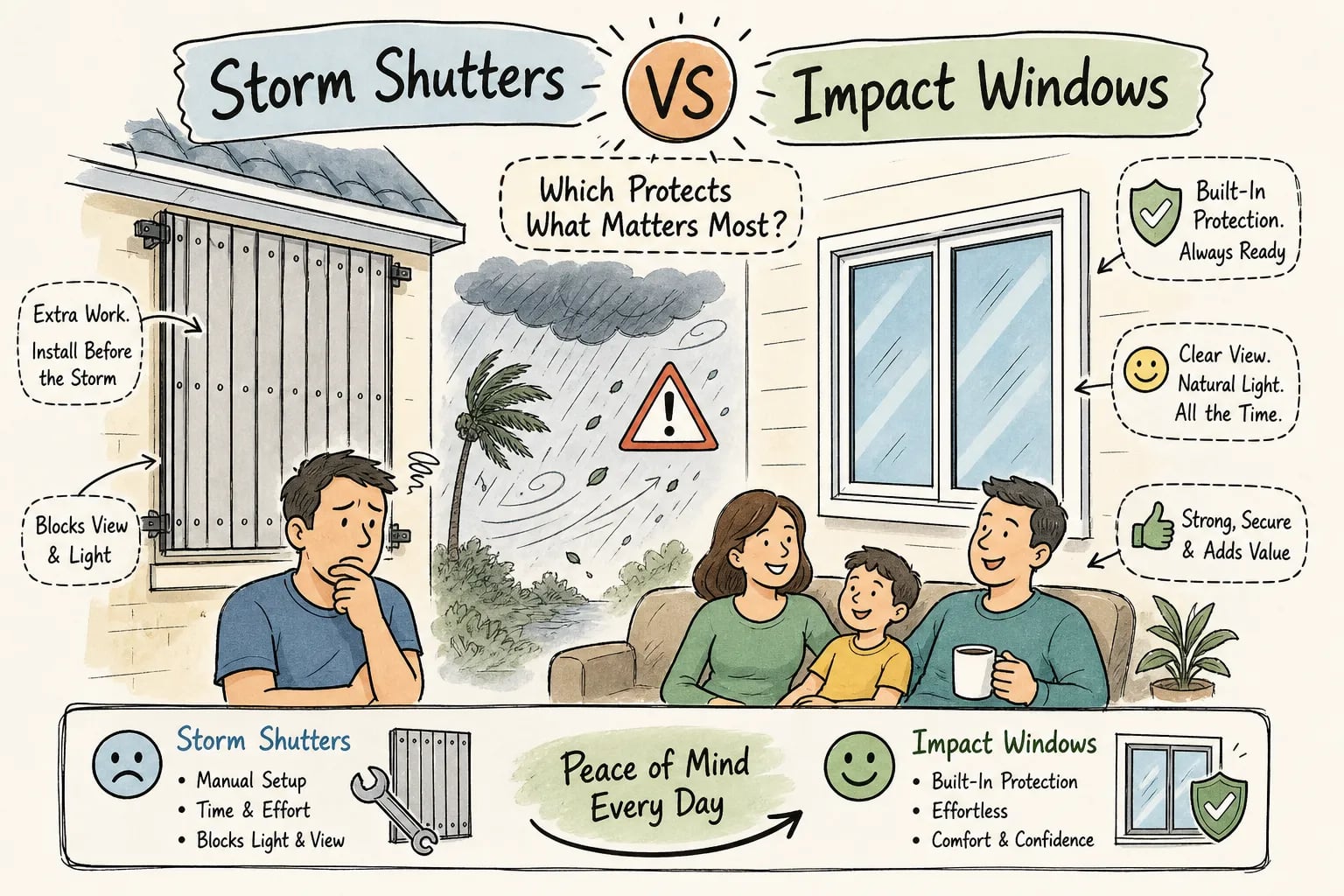
It's May in Florida, hurricane season is six weeks out, and a homeowner is standing in a big-box store aisle staring at storm panel kits, wondering if they should have just replaced the windows years ago. That homeowner is weighing whether to protect their windows with storm shutters or replace them entirely with impact windows, one of the most common decisions Florida property owners face. After years of helping homeowners navigate this exact choice at Infinity Legacy, the answer almost always points in one direction once you look at the full picture.
The surface-level question is simple: do you protect the glass you have, or do you replace it entirely? The real answer lives in the details: how each option performs in a storm, what each one costs over time, how they affect your insurance premium, and what they add to your home the other 364 days of the year when there's no named storm on the radar. This article breaks down every major shutter type, what each costs installed in 2026, how impact windows stack up on protection and long-term value, and which option actually makes sense for your home and budget.
The main types of storm shutters for windows (and what each one actually does)
Storm shutters fall into two broad categories: permanent systems that stay attached to your home year-round, and removable systems that you store and deploy as needed. Both categories have real merit in the right situation, but they come with very different trade-offs.
Permanent shutters: accordion, roll-down, Bahama, and colonial
Accordion shutters fold closed from sides that are permanently mounted to the window frame. They deploy fast, work well on large openings, and require no storage space. Roll-down shutters retract into a housing box above the window and can be manual or motorized. They're the most convenient permanent shutter option but also carry the highest upfront cost. Bahama shutters are hinged at the top and close downward over the window, offering moderate protection with an awning-style look that works well for everyday shade.
Colonial shutters fold closed from each side of the window, deliver solid storm ratings, and carry strong curb appeal, but they're slower to close than accordion or roll-down systems. The one limitation that applies to every permanent shutter type is the same: they only protect when they're closed. That requires someone to be at the property and physically deploy each shutter before a storm arrives. When a storm accelerates overnight or when a homeowner is traveling, that requirement becomes a real vulnerability.
Removable systems: storm panels and polycarbonate options
Aluminum, steel, and polycarbonate panels are bolted or tracked over windows before a storm and removed afterward. Storm panels for windows represent the most budget-friendly option in the shutter category. Polycarbonate versions are lighter than metal and offer some translucency that helps reduce the sealed-in-the-dark feeling during installation. The major drawback is the labor involved: panels must be stored year-round, installed before every storm event, and taken back down after the threat passes.
These are the shutters most Florida homeowners start with because of the low upfront price. They're also the ones most homeowners eventually want to move past, either because the annual deployment labor wears thin or because a storm arrives faster than expected.
Windows with storm shutters: types, installed costs, and what you're actually buying in 2026
Installed pricing varies significantly by shutter type. Storm panels run roughly $14 to $22 per square foot installed, making them the entry-level option. Accordion shutters come in at $26 to $35 per square foot installed. Roll-down hurricane shutters are the most expensive shutter option, ranging from $45 to $100 per square foot installed depending on whether the system is manual or motorized and the size of each opening.
For a typical Florida home with 10 to 12 windows, the total shutter installation cost ranges from a few thousand dollars for storm panels to $15,000 to $25,000 or more for motorized roll-downs on every opening. Bahama and colonial shutters fall toward the higher end of their respective categories based on material and size.
What doesn't show up in that quote is the ongoing cost of ownership. Labor to deploy and remove panels before and after storm events adds up over years, particularly for households without able-bodied adults available to do the work. Accordion and roll-down tracks and moving parts require periodic maintenance. Motor repairs on electric roll-down systems can run several hundred dollars per window. And shutters provide no benefit for energy efficiency, UV protection, noise reduction, or security on non-storm days. Homeowners who start with panels often end up replacing them with a better system or upgrading to impact windows within five to ten years, which means they effectively pay twice.
How impact windows hold up against windows with storm shutters when it actually matters
Impact windows are built with laminated glass and reinforced frames tested to meet Florida's hurricane codes, including the stricter High-Velocity Hurricane Zone (HVHZ) standards used in Miami-Dade and Broward counties. They provide 24/7 storm protection for windows without any deployment step, which matters most when a storm tracks faster than forecast or when a homeowner is away from the property. Accordion and roll-down shutters can meet the same code requirements when properly rated and closed, but that "when closed" caveat carries significant real-world weight.
Shutters protect the glass; impact windows replace it entirely with a system engineered to hold the building envelope sealed even if the outer pane cracks. That distinction matters in a direct-impact scenario because a sealed building envelope limits the interior pressure surge that causes structural failures, including roof uplift, during a major storm.
Beyond storm events, impact windows deliver daily benefits that no shutter system can match. Impact glass significantly reduces outside noise year-round, which matters on Florida streets near traffic, airports, or commercial corridors. Low-E coatings block up to 99% of UV rays, protecting flooring, furniture, and artwork from fading. The sealed laminated construction reduces heat gain and directly lowers monthly AC costs in Florida's climate. Impact windows also act as a security upgrade; the laminated glass resists forced entry in a way standard windows covered by shutters never will.
The long-term math: which option actually costs less over 10 to 15 years
On a wind mitigation inspection, impact windows typically earn a premium discount of roughly 25% to 45% of the wind portion of the insurance premium. Storm shutters qualify for a discount too, but the range is lower, approximately 10% to 25%. The practical difference is about 15 to 20 percentage points, and on Florida coastal policies with significant wind exposure, that gap translates to real dollars every year.
Both systems can qualify for Florida wind mitigation credits, but full credit requires every opening on the home to be protected: every window, door, and skylight. Homes that mix shutter types or leave any opening unprotected typically receive partial credit, which reduces the insurance savings a homeowner expects. Impact windows on all openings remove that calculation entirely.
On resale, impact windows are a verified value driver in Florida hurricane markets. Florida Realtors data and NAR research consistently show resale premiums in the range of 7% to 10% on comparable homes, representing $35,000 to $50,000 on a mid-range coastal property. Storm panels and removable systems don't carry the same premium; they can actually make a home feel more burdensome to prospective buyers who factor in their own storm-prep obligations. Quality impact windows carry a lifespan of 25 to 30-plus years with minimal maintenance. Motorized roll-down shutters typically last 20 to 25 years, but their motors may need replacement after 10 to 15 years at several hundred dollars per window.
Florida code, permits, and what qualifies in your county
Florida's High-Velocity Hurricane Zone covers Miami-Dade and Broward counties and applies the strictest building code standards for hurricane-rated opening protection. In HVHZ areas, shutters must carry a Miami-Dade Notice of Acceptance (NOA) or Florida Product Approval showing the product passed the required impact testing for that specific zone. Outside HVHZ but still in a high-wind exposure category, Florida Product Approval is typically the standard, but the required design wind pressure is site-specific and directly affects which products qualify for your address.
Both shutters and impact windows require permits, product approval submittal, and inspections in most Florida jurisdictions. No code-compliant hurricane protection product is a DIY-permit-free install, regardless of what the packaging implies. This is especially important for homeowners who plan to use their installation as the basis for a wind mitigation inspection: the inspector will ask for the approval number, and products installed without permits may not qualify.
For wind mitigation purposes, the Florida inspection form evaluates opening protection as one of the highest-value line items. Full protection of all openings earns the largest available credit. Partial coverage, whether from mixing shutter types or leaving any opening unprotected, reduces the credit proportionally. Working with a licensed contractor who pulls permits and submits product approvals correctly is the only way to ensure the installation actually qualifies when the inspector shows up.
Making the call: which option is right for your home
Storm panels or accordion shutters are a reasonable choice for homeowners who are renting, plan to sell within a few years, or face a strict short-term budget constraint. If a home already has permanently installed accordion shutters in good working condition, replacing functional shutters with impact windows may not pencil out until those shutters need replacement anyway. Bahama or colonial shutters on a home with strong curb-appeal priorities can also be a legitimate choice, provided the homeowner understands the protection trade-off and the deployment requirement.
For any Florida homeowner planning to stay in their home more than five years, impact windows are the clearer long-term choice across every major measure: storm protection, daily convenience, energy savings, insurance premium reduction, and resale value. They eliminate storm prep entirely, protect the home when no one is there, and deliver practical benefits that windows with storm shutters simply don't provide the other 364 days of the year.
That's the approach we take at Infinity Legacy. We install hurricane-grade impact windows designed specifically for Florida's coastal and inland wind exposures, handling permits, inspections, and installation under one licensed contractor (CGC1540795). PACE financing is available for qualified homeowners, meaning a full impact window upgrade can start at $0 down with repayment structured through the property tax bill. That removes the upfront cost barrier that often pushes homeowners toward the cheaper shutter option they'll eventually want to replace. Free estimates are available across Northeast and Central Florida, the conversation starts with your specific windows, your county's code requirements, and a real number you can plan around.
The bottom line: windows with storm shutters vs. impact windows
When evaluating windows with storm shutters versus impact windows, the core trade-off comes down to deployment versus permanent protection. Windows protected by storm shutters can meet code and defend a home, but they require action before every storm, ongoing maintenance, and a homeowner who is present and prepared when a system approaches. Impact windows protect the home on day one, every day, with no prep required and no maintenance burden beyond standard cleaning.
For most Florida homeowners weighing this decision for a home they plan to keep, the math and the practicality both point in the same direction. The upfront cost difference narrows significantly when you factor in insurance savings, energy efficiency, lifespan, and the resale premium buyers in hurricane markets are willing to pay.
If you're still working through the numbers, get a free estimate from a licensed contractor who installs both options and can tell you exactly what your home needs, what it will cost installed and permitted, and how to finance it without tying up cash. That's the conversation worth having before the next named storm starts trending on the weather apps.
Frequently asked questions
Do storm shutters or impact windows qualify for wind mitigation credits in Florida?
Both qualify, but the credit amounts differ. Impact windows typically earn a wind premium discount of 25% to 45%, while approved storm shutters earn roughly 10% to 25%. In both cases, full credit requires every opening on the home, windows, doors, and skylights, to be protected with a permitted, code-approved product. Partial coverage reduces the credit proportionally.
How much do windows with storm shutters cost installed in 2026?
Installed shutter costs vary by type. Storm panels run approximately $14 to $22 per square foot. Accordion shutters range from $26 to $35 per square foot. Roll-down hurricane shutters, the most convenient and most expensive permanent option, run $45 to $100 per square foot depending on size and whether the system is manual or motorized. For a typical Florida home with 10 to 12 windows, total installed costs range from a few thousand dollars for panels to $25,000 or more for full motorized roll-down coverage.
Can I install storm shutters myself to save money?
Not if you want them to count toward a wind mitigation inspection or insurance discount. Code-compliant hurricane protection requires permits, product approval submittal, and a final inspection in most Florida jurisdictions. Products installed without permits may not qualify for wind mitigation credits, which eliminates most of the long-term financial benefit of the investment.