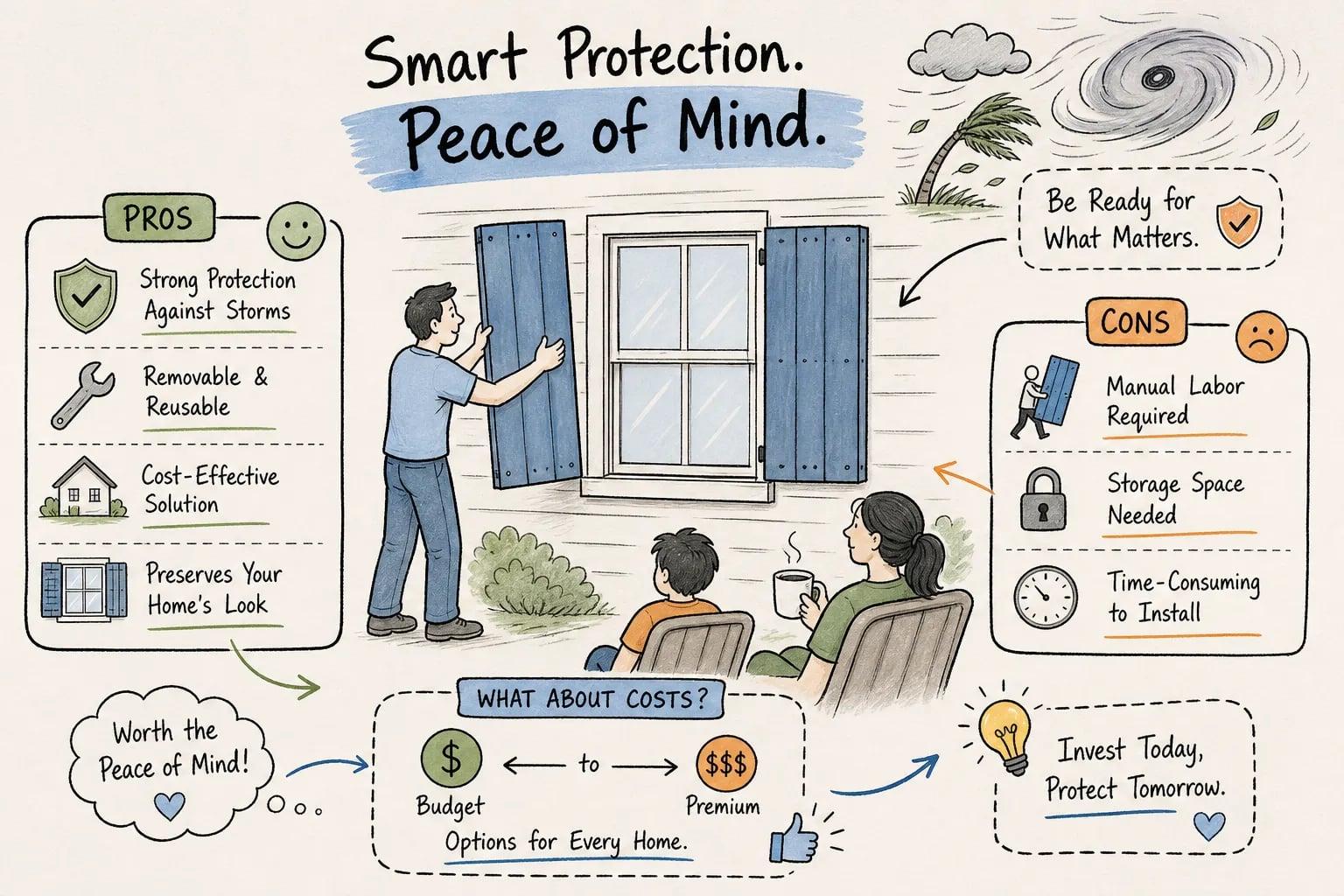
Every June, Florida homeowners drag out a stack of aluminum panels, hunt for missing wing nuts, and spend a weekend on a ladder hoping everything still fits. Removable hurricane shutters are a widely used storm protection option across the state, but widespread use doesn't always mean the right fit for every home or every homeowner.
At Infinity Legacy, we've installed, inspected, and replaced storm protection systems across Northeast and Central Florida for years. We've seen every shutter type in use, and we know what actually matters when you're standing at a supplier's counter trying to decide between materials, approval ratings, and price tiers. This article covers all of it: types, real 2026 costs, how to measure and install, what Florida's building code actually requires, and when a permanent upgrade makes more financial sense than another season of panels in the garage.
By the end, you'll know whether removable panels are the right call for your specific situation, or whether a one-time investment in impact windows largely removes the need for seasonal shutters altogether.
The four types of removable hurricane shutters and how they compare
Not all removable storm panels work the same way, and the wrong choice for your home's location, layout, or priorities is easy to make when you're shopping by price alone. Each material has a different profile for weight, visibility, durability, and ease of seasonal handling. Match the type to what you actually need, not just what's in stock at the local home improvement store.
Aluminum and steel storm panels
Aluminum is widely recommended in Florida and is often the best all-around choice for removable window panels, and for good reason. Aluminum panels are lightweight, corrosion-resistant, and hold up well in salt-air environments. That makes them a practical default for coastal homes from Palm Coast to Daytona Beach. The tradeoff is that solid aluminum panels block all natural light when installed, so your home goes dark the moment a storm approaches.
Steel panels offer strong rigidity and tend to carry lower per-unit costs, but they're significantly heavier to handle and more prone to rust without a proper protective coating. Over a decade of seasonal installations, that rust vulnerability becomes a real maintenance burden. Aluminum is the better all-around choice for most Florida homeowners because the weight and corrosion advantages compound over time, especially on homes within a mile of the water.
Clear polycarbonate panels
Polycarbonate panels solve the main quality-of-life complaint about aluminum: they let natural light and visibility through during a storm, so your home doesn't feel like a bunker. For homeowners with young children or anyone who wants to monitor conditions without going outside, that's a meaningful upgrade over opaque metal. The upfront cost is higher than standard aluminum, and you need UV-stabilized material to prevent yellowing over time.
Proper anchoring is more critical with polycarbonate than with metal panels. The material performs well when it's correctly installed and rated for the design pressure of your opening, but an undersized anchor pattern voids the product approval and the protection. Don't let the transparent look fool you into treating the installation as casual work.
Fabric and screen-based systems
Fabric hurricane screens are lighter and easier to store than rigid panels, which makes them appealing for homeowners with large openings or limited storage space. Some systems fold down to a fraction of the volume that aluminum panels require, making them a practical choice for oversized garage doors or wide lanai openings where rigid DIY hurricane panels would be awkward to handle. Most fabric systems carry lower design pressure ratings than equivalent rigid metal panels, which is reflected in their product approval specifications. They're best suited for homeowners who prioritize portability and convenience over maximum storm barrier strength, and they work well as a secondary layer on lower-risk openings.
What removable hurricane shutters cost in 2026
Storm panels sit at the lower end of the shutter market, and that's one of their primary selling points. Installed costs for aluminum and steel panels run roughly $10, $22 per sq. ft. in most Florida markets, with some areas reaching $15, $30 per sq. ft. depending on local labor rates and access difficulty. Clear polycarbonate panels run higher than plain aluminum due to material cost alone.
For context on where removable panels sit in the broader market: accordion shutters run about $26, $35 per sq. ft. installed, and roll-down shutters range from $45, $100 per sq. ft. Removable panels are the entry-level option in terms of upfront spend, and that gap is real.
For a typical Florida home with roughly 350 square feet of openings, installed storm panels run approximately $5,250, $10,500 at mid-to-upper market rates. Smaller homes with 12, 15 standard openings can fall in the $2,000, $5,000 range on the lower end. The main cost drivers are the total number of openings, panel material, whether anchor studs are already installed or need to be drilled new, and whether you're doing the installation yourself or hiring a professional.
One cost that homeowners frequently overlook is storage hardware: labeled bags, wall racks, clips, and organization systems to keep panels matched to their correct openings across multiple storm seasons. It's not a large expense, but it's real, and it belongs in your initial budget conversation.
DIY vs. professional installation: what the job actually involves
Single-story homes with pre-installed anchors and standard-sized openings are genuinely manageable as DIY hurricane panel projects for a handy homeowner. The process is straightforward once you understand the sequence. Two-story homes, large door openings, and any situation requiring new anchors in concrete or concrete block construction are different conversations entirely.
How to measure your windows for custom-cut panels
Measure the inside opening, not the trim. Take three width measurements across the top, middle, and bottom of the opening, and three height measurements at the left, center, and right. Order using the smallest dimension in each direction, because openings are rarely perfectly square. Check for square by measuring diagonally corner-to-corner; if the two diagonals differ by more than 1/4 inch, flag this with your manufacturer before placing the order.
Most removable panel manufacturers want panels cut slightly undersized for fit and removal. A common tolerance is to subtract 1/8 inch from the width dimension, but always confirm the exact tolerance on the specific product's installation sheet, because this varies. Label each panel to its corresponding opening before the first storm of the season. Searching for unlabeled panels in the dark the night before a hurricane is a problem worth preventing in advance.
Hardware required and the installation sequence
You'll need the storm panel itself, mounting studs or pre-installed anchors, washers, wing nuts or screws depending on the system, a drill with driver bit, and gloves for handling metal edges. The installation sequence matters: dry-fit the panel first to confirm fit, then fasten from the bottom up. Secure all hardware loosely before final tightening, confirm overlap and alignment across adjacent panels, then tighten fully.
Never skip the dry-fit step. Panels that don't fit properly under real storm conditions are a liability, not protection. One more note on caulk: it's generally not recommended around the bottom sill on storm panel systems, because many designs rely on drainage clearance. Follow the product's installation sheet, not general weatherproofing instincts.
When to stop DIYing and call a professional
Two-story homes, large sliding door openings, and any new anchor installation into CBS (concrete block structure) construction all warrant a professional installer. If the product's Florida Product Approval or NOA specifies professional installation as a condition of code compliance, that condition is not optional. Any home in an HVHZ area where the installation must be permit-ready should have a licensed contractor handling the anchor work.
Florida code compliance and product approval requirements
This is where homeowners make the most costly mistakes, and the consequences show up either during an insurance claim or a building inspection. Every removable shutter used as hurricane protection in Florida must carry a Florida Product Approval or equivalent certification. That approval covers the full system, including attachment hardware, maximum opening size, design pressure rating, and anchor pattern. Swapping out one component, even a fastener specification, can void the approval and leave your home unprotected from a compliance standpoint.
Installing new anchor studs requires a building permit in most Florida jurisdictions, even for temporary hurricane shutters. The local building department's inspector will verify that the installation matches the product approval and the manufacturer's installation requirements. This isn't a formality; it's the step that makes your protection count when it matters.
HVHZ vs. non-HVHZ: why the distinction matters when you're shopping
Miami-Dade and Broward counties make up Florida's High Velocity Hurricane Zone. Products installed there must carry a Miami-Dade NOA or a Florida Product Approval that explicitly states HVHZ approval. A standard statewide approval alone is not sufficient in the HVHZ, and that's a distinction many online suppliers don't make obvious when you're comparing prices.
Outside the HVHZ, a standard Florida Product Approval that meets local wind-borne debris and impact requirements is generally accepted. A product approved for HVHZ can be used outside the HVHZ, but not the reverse. Non-HVHZ-only products are often cheaper, and that price difference is real, but it comes with a geographic restriction. When evaluating any shutter product, check the approval type, whether it explicitly states HVHZ applicability, the test standard used, and the maximum opening size tested under that approval.
When impact windows make more sense than seasonal panels
The upfront cost of removable storm panels is lower than impact windows. That's a fact, and it's the reason most homeowners start with panels. But the financial case for panels weakens significantly once you account for a full decade of storage, seasonal installation and removal, hardware replacement, and the recurring labor cost of putting them up and taking them down before and after every storm threat.
Aluminum panels are rated to last 25, 30 years with proper storage and maintenance, but in a coastal Florida environment with salt air and UV exposure, the lower end of that range is more realistic if you're not diligent about annual cleaning and hardware checks. A lost panel, corroded wing nut, or cracked anchor stud doesn't announce itself; it shows up when you're installing panels the afternoon before a storm.
Impact windows remove the setup-and-teardown routine entirely. The protection is in place year-round, regardless of how much warning you have. Beyond storm season, impact windows reduce heat transfer through the glass, which lowers cooling loads year-round in Florida's climate. Noise reduction, UV protection, and improved home security are benefits that show up every day, not just during hurricane season.
On the insurance side, Florida homes with full impact windows and doors typically earn 25, 45% off the wind portion of their policy. Homes with panel shutters generally see 10, 25% in wind credits. That difference of $500, $1,500 per year in insurance savings compounds over a decade into a meaningful offset against the higher upfront cost of impact windows. One 10-year model for a South Florida home showed storm panels at roughly $3,500 upfront but a lower total net value than impact windows over 10 years, once insurance savings, energy savings, and resale value were factored in. Impact windows at roughly $22,000 upfront approached break-even or better once all costs were accounted for.
Infinity Legacy installs hurricane-grade impact windows across Northeast and Central Florida, from Palm Coast to Jacksonville, Daytona Beach, Orlando, and throughout our broader service area. Every installation is permitted and code-compliant, managed by a licensed multi-trade contractor under one accountable team. PACE financing may be available in qualifying areas, with terms that vary by program and locality, ask us about current options when you request your estimate. Free estimates are available for all impact window projects.
FAQ: Removable hurricane shutters, installation, cost & code
How long do removable hurricane shutters last?
Aluminum storm panels are rated to last 25, 30 years with proper storage and maintenance. In coastal Florida environments with salt air and UV exposure, expect the realistic service life to fall toward the lower end of that range unless you're consistent about annual cleaning and hardware checks.
Do removable hurricane shutters require a permit in Florida?
Installing new anchor studs requires a building permit in most Florida jurisdictions, even for temporary hurricane shutters. Using existing, pre-approved anchors typically doesn't trigger a permit requirement, but confirm with your local building department before drilling anything new.
Can I install removable window panels myself?
Single-story homes with pre-installed anchors and standard openings are manageable DIY projects for a prepared homeowner. Two-story homes, new anchor installations into CBS construction, and any HVHZ location where the work must be permit-ready all call for a licensed professional installer.
What's the difference between HVHZ and non-HVHZ product approvals?
HVHZ (High Velocity Hurricane Zone) covers Miami-Dade and Broward counties. Products installed there must carry a Miami-Dade NOA or a Florida Product Approval explicitly listing HVHZ compliance. A standard statewide approval alone is not sufficient. Products approved for HVHZ can be used anywhere in Florida; non-HVHZ approvals cannot be used in the HVHZ.
Making the right call before the next storm season
Removable hurricane shutters are a legitimate, code-compliant storm protection option. Aluminum panels are the best all-around choice for most Florida homes, polycarbonate panels work well where natural light matters, and professional installation is worth the cost for multi-story homes or HVHZ locations. At $2,000, $10,500 installed for a typical home, they're the lower upfront investment, and for homeowners who are disciplined about storage and maintenance, that investment can serve them well for years.
That math changes when you factor in 10, 15 years of storage, seasonal handling, and replacement costs. For homeowners who are done with the annual setup-and-teardown routine and want protection that's always in place, impact windows solve the problem permanently. The total cost of ownership, combined with insurance savings and energy efficiency, makes the comparison closer than the sticker prices suggest.
Use this article to make an informed decision before the next storm season arrives. If you're ready to explore a permanent upgrade, contact Infinity Legacy for a free on-site estimate. We'll walk you through the options, the costs, and the available financing so you can protect your home on a clear, informed plan.