Florida homeowners replace their roofs more often than homeowners in almost any other state, and the material they choose is the biggest reason why. When comparing metal roofing lifespan vs. asphalt shingles in Florida's climate, most national guides quote lifespans built on data from temperate regions, not a state that absorbs category-five hurricanes, year-round ultraviolet radiation, and subtropical humidity simultaneously. At Infinity Legacy, our roofing crews see the difference between a 12-year-old shingle roof and a 12-year-old metal roof side by side on the same street after a storm, and the contrast is not subtle. This article breaks down what each material actually delivers in Florida's specific conditions: real-world lifespans, installed costs in 2026, storm performance data, and the true cost of ownership over decades. By the end, you'll have the numbers you need to make a confident, long-term decision for your home and location, not just a reprint of a national manufacturer's brochure.
Why Florida's climate shortens every roof's life expectancy
The UV and heat load that shingles weren't built for
Florida's average annual UV index is 7.2, roughly 2.2 points above the national average of 5.0 and classified as "very high" by the EPA's UV Index Scale. In Miami, summer UV averages hover between 10 and 11, and that intensity persists across most of the state for the majority of the year. National manufacturer lifespan ratings are tested under average conditions, not a subtropical sun that breaks down asphalt binders year-round. As that binder degrades, granules loosen, wash away in the next rain event, and leave the shingle surface even more exposed to further UV damage. It becomes a self-reinforcing wear cycle that Florida homeowners experience faster than the warranty card suggests.
Attic heat buildup compounds the problem. When a Florida attic reaches 150 degrees or more in the summer, the heat radiates back up through the roof deck and accelerates surface degradation from below while the sun attacks from above. Metal panels also expand and contract with thermal cycling, but the material itself does not degrade at the molecular level the way asphalt does under prolonged UV exposure.
Humidity, rain cycles, and biological growth
Florida's wet season delivers intense daily rainfall followed by periods of concentrated humidity, and that wet-dry cycling creates ideal conditions for algae, mold, and moss to establish themselves on asphalt shingles. Biological growth on shingles is not purely cosmetic. It retains moisture against the shingle surface, accelerates granule loss, and works its way under shingle edges over time, promoting moisture intrusion into the deck below. For metal roofing, the non-porous surface resists biological growth more effectively, which removes an entire maintenance category and a meaningful lifespan reducer from the equation. In terms of asphalt shingle lifespan in Florida's climate, humidity alone can subtract years from the manufacturer's projected service life.
Salt air in coastal and near-coastal zones
Within roughly one mile of the Florida coastline, salt air creates a separate set of challenges that affect both material categories differently. For asphalt shingles, salt accelerates the degradation of granules and the underlying mat. For steel metal panels, salt air can compromise protective coatings, particularly at cut edges, fasteners, and any point where the coating has been breached, allowing the steel substrate to begin rusting. This distinction becomes important when comparing Galvalume steel to aluminum for coastal applications, a topic covered in detail in the metal roofing section below.
Metal roofing lifespan vs. asphalt shingles in Florida's climate: how each material holds up
How long asphalt shingles actually last in Florida
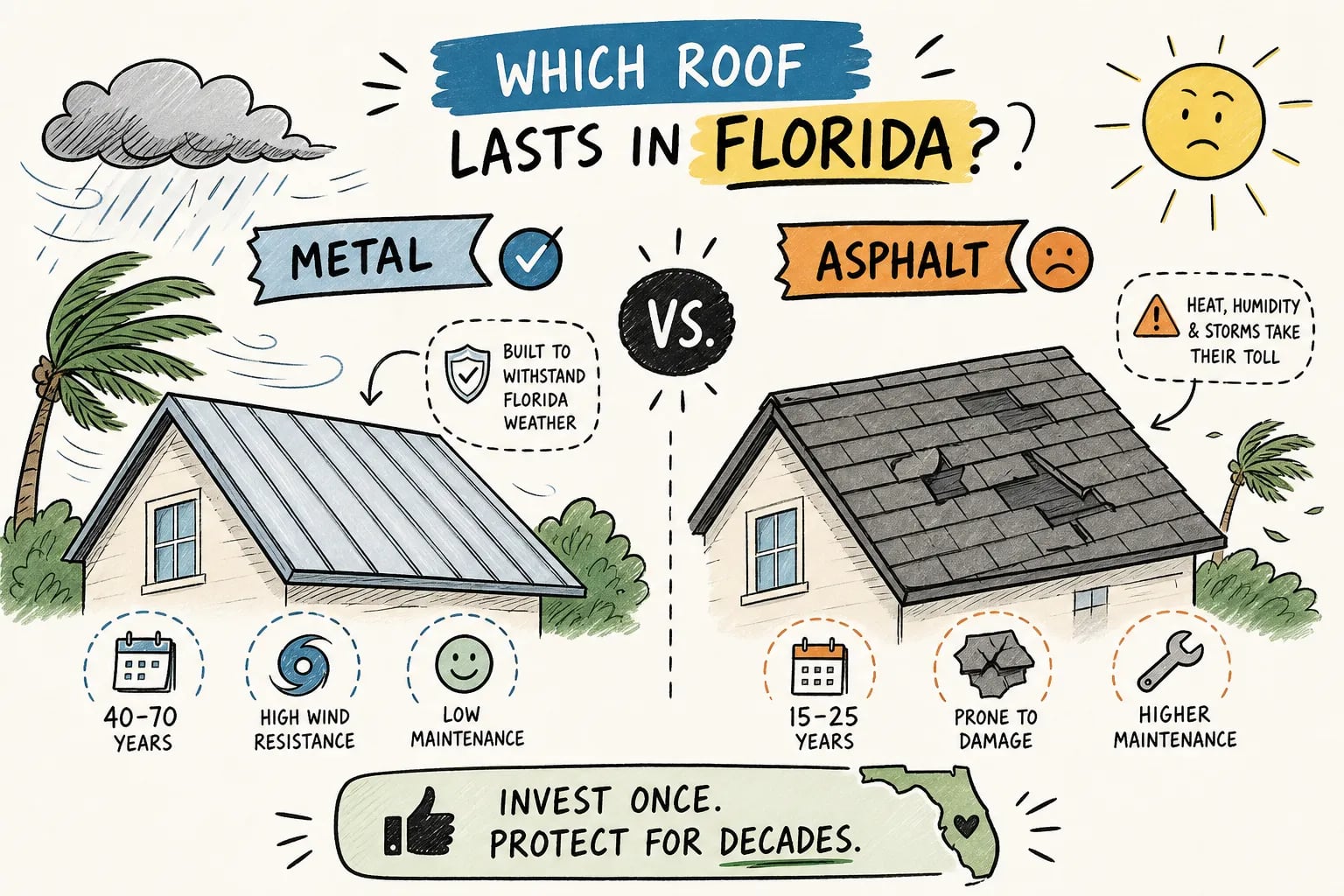
The national average lifespan cited for 3-tab asphalt shingles is around 20 years. In Florida, the realistic range drops to 10 to 15 years, and in coastal or hurricane-corridor locations, some 3-tab roofs need full replacement within 10 to 12 years. The combination of UV exposure, storm stress, and humidity consistently pushes this product to the lower end of any lifespan estimate. Very few Florida roofing contractors still recommend 3-tab for new installations, because the lifecycle math simply does not work in Florida's favor. You pay less upfront and replace it more often, which adds up to more total spending and more disruption over time.
Architectural, or dimensional, shingles are the standard recommendation for Florida residential roofing, and for good reason. They're heavier, more wind-resistant, and longer-lived than 3-tab. But the national rating of 25 to 30 years does not translate directly to Florida conditions. The realistic asphalt shingle lifespan in Florida's climate is 18 to 25 years, with inland properties closer to the upper end and coastal or storm-exposed homes trending toward 15 to 20 years. Granule loss from UV exposure is the primary aging mechanism, and Florida's UV intensity accelerates that process by years compared with Midwest or Northeast installations.
The practical difference between a well-maintained architectural shingle roof in Ocala versus one in Fort Lauderdale can be five to seven years of service life. Location within Florida matters almost as much as material selection, which is why any honest lifespan conversation needs to account for where your property sits on the state's storm and UV exposure map.
What the national warranty rating actually means in Florida
A "30-year architectural shingle" is not a guarantee of 30 years of performance in Florida; it is a prorated material warranty that diminishes in value over time. If a shingle fails at year 20, the manufacturer's reimbursement is calculated on the remaining prorated value, not the replacement cost. In practice, the labor, tear-off, and disposal costs that make up a large portion of a roof replacement are rarely covered. Florida's climate can also complicate claims if the insurer or manufacturer attributes failure to "weather events" rather than manufacturing defect. Understanding what the warranty actually covers before you commit to a product is part of making an informed decision.
How long metal roofs hold up in Florida by system type
Galvalume and coated steel roofing with exposed fasteners generally delivers a 30 to 50 year lifespan in Florida's climate, with quality inland installations reaching the higher end of that range. The word "exposed" is important here. Every fastener penetration is a potential point for corrosion, leaking, or loosening under thermal cycling and wind stress. Over decades, the rubber gaskets on exposed fasteners can degrade, and the thermal expansion and contraction of Florida's extreme temperature swings accelerates that process. Poor installation, including undertightened or overtightened fasteners, can push this system down into the 20 to 40 year range. When you're comparing bids and one contractor is significantly cheaper on a metal roof, exposed fastener quality and installation detail are often where the difference lives.
Standing seam metal roofing, where panels interlock and fasteners are hidden from the weather, is the system that produces the most impressive Florida lifespans. Well-installed standing seam systems commonly reach 40 to 70 years, with assessments from Florida's insurance mitigation programs and building science researchers placing quality installations in the 50 to 70 year range. Hidden fasteners eliminate the most common corrosion and leak entry points, and continuous panels reduce the number of seams where water can work its way in. For coastal properties within a mile of the ocean, aluminum standing seam is the superior choice over steel. Aluminum forms a stable natural oxide layer that protects it from salt air without depending on an intact coating system. Galvalume steel is corrosion-resistant only as long as its coating stays intact; once salt air compromises that coating at an edge or scratch, the steel underneath begins to rust.
Why installation quality is the real variable in Florida
The same metal panel system installed by two different contractors can have dramatically different real-world lifespans. Florida-specific variables that determine the outcome include thermal expansion clip spacing appropriate for the state's temperature range, hurricane clip and fastener schedules that meet local wind zone requirements, and proper underlayment selection for the roof's exposure category. A contractor who installs metal roofing primarily in the Midwest and takes on Florida work occasionally does not carry the same institutional knowledge as one who has been installing and inspecting Florida roofs for years. That institutional knowledge directly affects how long your roof performs when you're investing in a system you expect to outlast two shingle roof cycles.
Hurricane and wind performance: where the gap becomes undeniable
Wind ratings on paper vs. performance in practice
Quality metal roofing systems are commonly rated for wind uplift at 140 to 180 mph, while premium architectural shingles typically carry ratings in the 110 to 130 mph range. Florida Building Code requirements in high-velocity hurricane zones, specifically Miami-Dade and Broward counties, require Miami-Dade NOA-approved products with enhanced attachment and underlayment specifications that go well beyond standard wind zone requirements. In those zones and in coastal areas throughout the state, the gap between metal and shingle wind performance is not theoretical. It directly affects whether your roof survives a storm intact or becomes an insurance claim.
Outside the HVHZ, standard Florida wind zone requirements vary by location, with minimum roof-to-wall uplift capacities scaling from 500 pounds in 120 to 140 mph zones up to 1,000 pounds in 160-plus mph zones. Metal systems generally achieve these requirements more consistently than shingle systems when properly installed, and they maintain those ratings over a longer portion of their service life because wind resistance doesn't degrade the way shingle adhesion strips can over time.
What Hurricane Ian actually revealed about each material
Post-storm engineering assessments conducted across Southwest Florida following Hurricane Ian produced a statistic that every Florida homeowner should know: approximately 50% of asphalt shingle roofs showed damage, compared with roughly 12% of metal panel roofs. That means asphalt shingle roofs sustained damage at a rate about four times higher than metal roofs in the same storm event. For older shingle roofs specifically, the damage rates were even more pronounced. "Visible damage" in insurance terms means filed claims, adjusters, contractor bids, and replacement costs. Over a roof's lifetime in a hurricane state, that statistical difference translates directly into dollars, disruption, and risk.
Hail, flying debris, and what each material can withstand
Hail is underestimated as a roofing threat in Florida because most homeowners associate it with the Midwest. Florida sees hail events regularly, particularly during severe thunderstorm season. For asphalt shingles, hail causes granule loss and micro-fractures in the mat that accelerate aging even when they don't cause immediate visible failure. A shingle roof that looks intact after a hail event may have lost several years of remaining service life. Metal panels may dent from significant hail impact, but they retain full functional integrity, especially when specified with higher impact ratings. A dent is cosmetic; granule loss and mat fracture are structural aging events. The difference matters when you're evaluating whether a storm requires a full replacement or just a repair.
Installed cost comparison: what you'll actually pay in Florida in 2026
What asphalt shingles cost installed in Florida
Architectural asphalt shingles in Florida run $5 to $10 per square foot installed, or $500 to $1,000 per roofing square (100 square feet). For a 2,000-square-foot roof footprint requiring roughly 22 to 25 squares of material after waste factor, that puts total installed cost in the $11,000 to $25,000 range depending on the region, roof pitch, number of tear-off layers, and county permit costs. Labor markets vary across Florida, and a Jacksonville installation will often price differently than the same job in Orlando or Naples. 3-tab shingles come in below that range, but as covered earlier, the shorter lifecycle in Florida makes the upfront savings misleading.
What metal roofing costs installed in Florida
Exposed-fastener metal roofing runs $7 to $15 per square foot installed, while standing seam systems range from $9 to $30 per square foot depending on the panel profile, alloy, and coating specification. The upfront premium is real and significant. The calculation changes when you frame it correctly: a $25,000 metal roof that delivers 50 years of service is a fundamentally different investment than a $14,000 shingle roof replaced every 20 years. Over 40 years, two shingle replacements plus accumulated maintenance and storm repair costs can approach or exceed the cost of one metal roof installation. Cost per year of service, not sticker price, is the metric that actually matters for a long-term property decision.
Warranty differences that affect long-term risk
Metal roofing systems commonly carry manufacturer warranties of 30 to 50 years on finish and material, with higher-end coated aluminum systems sometimes backed by longer paint-finish warranties. Architectural shingles carry 30-year limited warranties, but the prorated structure means the warranty's actual value decreases significantly after the first decade. At year 20 on a 30-year product, a homeowner filing a warranty claim is working with a fraction of the original replacement value. Metal warranty coverage, particularly on premium systems, tends to hold more consistent value across the warranty period. Reading the proration schedule before selecting a product is a step most homeowners skip and most contractors don't volunteer.
The real cost of ownership over 40 years: maintenance and replacement cycles
What asphalt shingle maintenance looks like over two decades
On an asphalt shingle roof in Florida, plan for annual inspections, periodic algae treatment every three to five years depending on tree coverage and shade, and gutter cleaning after the rainy season. After any significant storm, a visual inspection for lifted tabs, missing shingles, and granule accumulation in gutters is essential. Over a 20-year shingle lifecycle, most Florida homeowners will face at least one mid-cycle repair event from wind damage, and on coastal or storm-corridor properties, possibly two. Add that repair cost to the eventual full replacement, and the total 40-year spending on two shingle roof cycles consistently exceeds initial projections.
What metal roof maintenance requires over 40-plus years
Metal roofs in Florida require one to two annual inspections, with attention to fastener condition, seam integrity, flashing details, and debris accumulation in valleys. In coastal zones within a mile of the ocean, a freshwater rinse to remove salt accumulation is recommended at least twice a year, and quarterly rinsing is advisable for properties very close to the waterline. Basic maintenance visits run $150 to $500 depending on roof size and scope, and periodic sealant checks on exposed-fastener systems add a modest recurring cost for steel installations. In practical terms, a well-installed metal roof on an inland Florida property does not require full replacement during the same 40-year window where an asphalt shingle roof would be replaced twice.
Running the 40-year cost comparison side by side
When you stack the numbers honestly, the 40-year cost picture shifts significantly in metal roofing's favor for most Florida homeowners planning to hold their property long-term. Two architectural shingle replacements over 40 years, each at $12,000 to $20,000 depending on the market year, plus cumulative maintenance and storm repair costs, can easily reach $35,000 to $55,000 over four decades. One standing seam metal installation at $20,000 to $35,000, with lower annual maintenance costs and no expected full replacement in that window, produces a lower cost per year of service across the same period. The metal roof's higher upfront price is real, but it is often not the more expensive choice over time.
Choosing the right material for your specific Florida home and situation
Location-driven factors that should influence your choice
A beachfront property in Fort Lauderdale and an inland home in Ocala have fundamentally different roofing needs, and a recommendation that makes sense for one does not automatically apply to the other. Coastal and near-coastal Florida properties, particularly those in South Florida's hurricane corridors, face the highest combination of UV intensity, salt air, and wind exposure. For those properties, aluminum standing seam is the system that delivers the longest service life with the least maintenance burden. Inland properties in lower wind zones with more modest storm exposure profiles can still benefit from metal roofing, but architectural shingles at the higher end of the product range may be a cost-effective choice for homeowners with a shorter planned ownership window or tighter upfront budgets.
Budget, financing, and how PACE changes the calculus
The upfront price difference between a standing seam metal roof and an architectural shingle roof is the single most common reason Florida homeowners default to shingles even when the long-term math favors metal. PACE financing changes that equation. Through Florida's Property Assessed Clean Energy program, qualified homeowners can finance a metal roof upgrade with $0 down and no traditional credit requirement, repaying the cost through their property tax bill over time. When the upfront barrier to the better long-term option is removed, the decision becomes much clearer. At Infinity Legacy, our team can walk you through PACE financing options during the consultation, so you're not choosing a shorter-lived material simply because the upfront cost felt out of reach.
Resale value and insurance premium implications
A metal roof in Florida can qualify for wind mitigation insurance discounts, which apply to the wind portion of a homeowners policy when the roof covering is properly documented on the state's uniform inspection form. Both metal and code-compliant architectural shingles can qualify for these credits, but metal roofs often score better across the full wind mitigation profile, particularly when they carry high wind ratings and hidden-fastener attachment systems. On the real estate side, a newer metal roof is a documented selling point: it signals decades of remaining service life, reduced insurance risk, and storm resilience that buyers in hurricane-aware markets actively seek. A shingle roof near the end of its service life, by contrast, can complicate a sale if lender requirements for remaining roof life are not met.
Why a Florida-licensed roofer's assessment matters before you decide
What a professional roof evaluation actually covers
A qualified Florida roofing contractor does not simply quote materials and send an invoice. A thorough assessment covers the condition of the existing roof deck, attic ventilation adequacy, local wind zone classification, proximity to the coast, and the current code requirements for the specific county and permit jurisdiction. A standing seam metal roof installed on a deteriorated deck without adequate ventilation will not reach its rated lifespan, regardless of the quality of the panels. These variables are invisible from the ground and require direct inspection to evaluate. Skipping the professional assessment and making a material decision based solely on cost comparison leaves out the most important inputs.
Getting a free assessment from Infinity Legacy
Infinity Legacy is a Florida-licensed multi-trade contractor (CGC1540795) with roofing expertise across both metal and shingle systems throughout Northeast and Central Florida and beyond, serving homeowners and commercial property owners from Jacksonville and St. Augustine down through Daytona Beach, Orlando, Melbourne, and across the state. Our team handles everything from the initial inspection through permitting and installation, with a single point of contact managing the entire project. There is no need to coordinate between a roofer, a permit runner, and a separate inspector. We offer free estimates for all roofing services, and for homeowners who want to upgrade to metal roofing without a large upfront cash outlay, our team can walk through PACE financing options during the same consultation.
The bottom line on metal roofing lifespan vs. asphalt shingles in Florida's climate
The evidence is consistent: when comparing metal roofing lifespan vs. asphalt shingles in Florida's climate, metal outlasts shingles by 20 to 40 years depending on the system and location, withstands hurricane-force winds with substantially lower failure rates, and delivers a lower cost per year of service over a 40-year window despite the higher upfront price. The post-Ian damage data, the UV lifespan math, and the lifecycle cost comparison all point in the same direction for most Florida homeowners planning to hold their property long-term.
Asphalt shingles still make sense in specific situations. A shorter planned ownership window, a tight upfront budget on an inland property with lower storm exposure, or a home already requiring replacement where the budget simply does not allow for metal, all represent legitimate reasons to choose quality architectural shingles. But that decision should be based on honest Florida-specific numbers, not national manufacturer ratings that were never designed to account for subtropical conditions.
Before committing to either material, get a professional assessment from a Florida-licensed contractor who can evaluate your specific roof deck, location, wind zone requirements, and long-term ownership goals. The right answer for your home is not a general comparison chart; it is a conclusion built on what your property actually needs. Reach out to the Infinity Legacy team to schedule your free estimate and start that conversation with contractors who know Florida roofing from the inside out.