There's a specific kind of dread that sets in when a storm track shifts toward Florida and you realize you still haven't sorted your hurricane shutters or other hurricane protection. The weather apps are updating every hour, the hardware stores are getting picked over, and you're standing in front of your windows trying to remember what the previous owner said about those panels in the garage. Every Florida homeowner knows that feeling. What makes it worse is that the shutter market gives you no shortage of options that look similar on paper but perform very differently when a serious storm arrives.
After two decades of protecting Florida homes across Northeast and Central Florida, our team at Infinity Legacy has seen what happens when homeowners pick the wrong system, and when they wait too long to decide at all. This guide covers every major shutter type, what each one actually costs in 2026, what Florida's building code requires, and whether any of this is realistic as a DIY project. By the end, you'll have a clear shortlist and a straightforward picture of what hurricane shutters can and can't do for your home.
How hurricane shutters actually protect your home
The basic mechanics behind storm protection
Hurricane shutters work by covering glazed openings: windows, doors, and skylights. Their job is to prevent windborne debris from penetrating the building envelope. Once an opening is breached, interior pressure spikes rapidly, and structural failure becomes exponentially more likely. The roof lifts, walls shift, and what started as a broken window becomes a catastrophic loss. Shutters interrupt that chain at the first link.
Not every product marketed as a shutter qualifies as protective, though. There's a meaningful difference between an impact-rated, code-approved storm shutter and a decorative Bahama shutter that looks the part but was never tested for debris impact. The material alone doesn't tell you anything. The approval number does.
What shutters guard against, and what they don't
Shutters address wind and debris at your openings only. They don't reinforce the roof deck, protect an unrated garage door, or provide any structural benefit between storms. A home with perfect hurricane shutter systems on every window can still lose a roof if that roof wasn't built or maintained to withstand the storm's wind load. That's not a knock on shutters, it's just a clear-eyed scope of what they do.
Code compliance also depends on the product's specific approval, not its advertised wind speed claim. A shutter marketed as "rated for 150 mph" may or may not be compliant for your specific opening, attachment condition, and local jurisdiction. That distinction matters more than the headline number on the box.
The 6 main types of hurricane shutters compared
Accordion and rolling shutters: the permanent, fast-deploy options
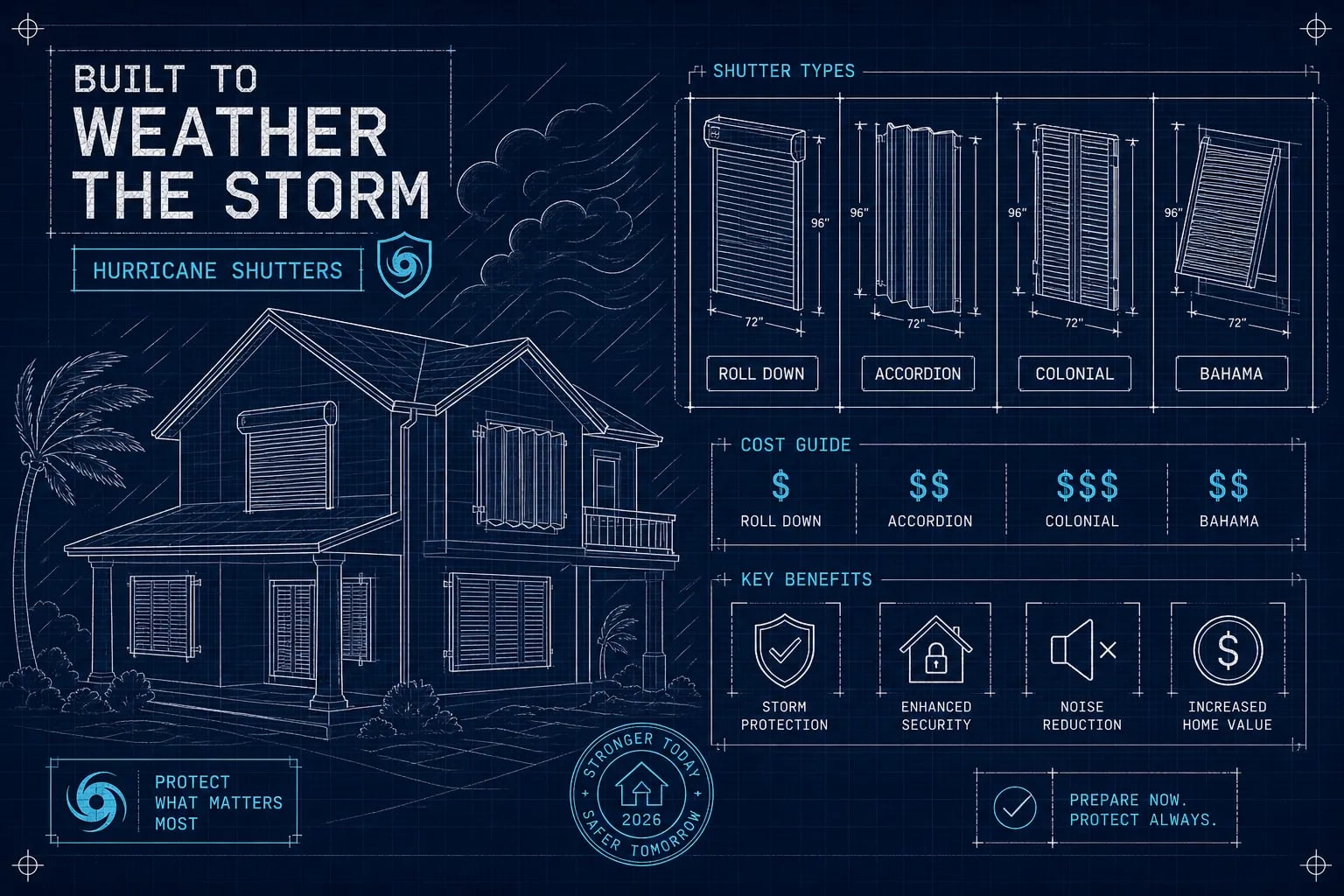
Accordion shutters mount permanently in tracks beside the opening and fold closed quickly without carrying or storing panels. They work especially well for wide windows, sliding doors, and covered lanais. Rolling shutters store compactly in a housing above the opening and are the fastest to deploy, particularly when motorized. Both systems eliminate the pre-storm scramble that panel systems require.
Accordion shutters generally cost less than motorized rolling systems and provide a solid balance of convenience and price. Rolling shutters offer superior ease of use and can be motorized with a manual backup for power-outage situations. Both require periodic maintenance: track cleaning, lubrication, and wheel checks. Either system also requires motor servicing for motorized units, skipping that maintenance is how shutters fail at the worst possible moment.
Bahama and colonial shutters: when appearance matters
Bahama shutters are top-hinged and prop outward, providing shade and ventilation year-round. Before a storm, they swing closed and latch. Colonial shutters are side-hinged and swing across the opening from each side, giving windows a traditional architectural look. Both offer genuine everyday benefits that pure storm shutters don't: shade, privacy, and curb appeal.
The tradeoff is deployment speed and side clearance. Neither system closes as quickly as an accordion, and both require unobstructed space around the opening. More importantly, decorative versions of both styles are not always impact-rated. A Bahama shutter with a 4.7-star rating and a 20-year finish warranty is not the same as an approved storm shutter, and confusing the two is an expensive mistake in a high-wind zone.
Storm panels and polycarbonate storm panels: the budget-friendly options
Removable aluminum and steel hurricane panels are the lowest-cost certified option available. They attach with bolts, tracks, or permanent fasteners installed around the opening and must be retrieved from storage, carried out, aligned, and secured before every storm. Clear polycarbonate storm panels work on the same principle but let in daylight during installation, which matters in multi-day storm preparation.
Both panel types are the most DIY-accessible option on this list, but they demand two things that are easy to underestimate: adequate dry storage space and a realistic commitment to installing them before a storm arrives. Neither factor is trivial in Florida, where storms accelerate and forecast tracks shift quickly.
What hurricane shutters cost in 2026
2026 price ranges by shutter type
Installed shutter costs in 2026 run roughly $20 to $45 per square foot across the full range of types, but the per-window picture is more useful for budgeting. Vinyl and PVC panels sit at the low end, typically $75 to $300 per window installed. Aluminum and composite systems run $200 to $900 per window depending on size and complexity. Motorized rolling shutters occupy the high end at $500 to $1,200 or more per opening.
For a standard 3-bedroom Florida home with 14 to 20 openings, total installed hurricane shutter costs typically fall between $3,000 and $10,000. That range is wide because opening sizes, materials, motorization, and local labor rates vary significantly. Getting multiple itemized quotes from licensed Florida contractors is the only way to land on a number that applies to your actual home.
What drives costs up beyond the base price
Several factors push quotes above the baseline figures. Large sliding glass doors and lanai openings cost more per unit than standard windows. Motorization adds cost upfront but reduces the labor and physical demand of deployment over time. Masonry attachment requires different hardware than wood-frame construction and typically costs more. Second-story installation adds complexity and, in most cases, labor time.
HVHZ-approved shutters, required in Miami-Dade and Broward County, carry higher costs than standard Florida Product Approval systems. Custom sizing for non-standard openings also increases the per-unit price. Permit fees, mandatory for most shutter installations across Florida jurisdictions, add to the final total and should be factored in from the start of your budgeting.
Florida building codes and HVHZ approvals: what you actually need to know
HVHZ requirements for Miami-Dade and Broward County
Florida's High-Velocity Hurricane Zone provisions apply to Miami-Dade and Broward County and represent the strictest shutter requirements in the state. Impact shutters in these counties must carry a Miami-Dade Notice of Acceptance (NOA) that covers the exact shutter assembly, opening size, attachment condition, and required design pressure. A general product approval is not sufficient. The NOA drawings must match your actual installation precisely, including fasteners, substrates, spacing, anchors, and maximum opening dimensions.
The three key test standards for HVHZ approval are TAS 201 (large and small missile impact), TAS 202 (static air pressure), and TAS 203 (cyclic wind pressure). Every element of your installation must align with the approved drawings. A shutter with a valid NOA installed with the wrong anchors or on the wrong substrate is not a compliant installation, and it may not perform as expected in a major storm.
What applies to the rest of Florida
Outside Miami-Dade and Broward, the Florida Product Approval system governs along with ASTM E1886 and E1996 testing standards. Required design pressures are site-specific, calculated from the building's wind zone, height, risk category, exposure classification, and the specific geometry of each opening. A shutter rated for "150 mph" is not automatically code-compliant for your specific opening. The correct threshold is a calculated pressure in pounds per square foot, and it must match or fall below the product's approved rating for that exact configuration.
Before purchasing any hurricane shutter system, confirm the product approval number and the required design pressures with your local building department. A licensed Florida contractor familiar with your county's permitting process is the most reliable source for that information. Shortcuts at this stage create problems at inspection, and during an actual storm, a non-compliant installation offers far less protection than the product's label suggests.
DIY vs. professional installation: making the right call
Which shutter types are realistic for homeowners to install themselves
Storm panels on accessible ground-floor windows with sound wood framing are the most DIY-friendly option on the list. Fixed exterior and standard vinyl shutters on single-story homes are also manageable for a homeowner comfortable with basic carpentry and hardware work. Expect to spend one to three hours per opening for panel systems and two to four hours for exterior decorative shutters. Done correctly, DIY installation on simple systems can save 30 to 50 percent of labor costs.
Realistic DIY conditions come down to a few factors: sound framing, ground-level access, and standard opening sizes on a non-masonry substrate. Step outside those conditions and the difficulty increases sharply, along with the risk of an installation that passes visual inspection but fails under actual storm loads.
When hiring a licensed contractor is the only sensible option
Rolling shutters, motorized systems, accordion shutters requiring structural anchoring, masonry attachment, second-story work, and any installation requiring a permit in a high-wind zone should be handled by a licensed professional. Electrical connections for motorized systems carry safety and code liability that DIY work can't reliably address. An incorrectly installed accordion or rolling shutter can fail the same way an unapproved product would, regardless of the product's rating.
Before signing any installation contract, require proof of licensure, active insurance, and a verifiable permit-pull-and-pass history in your county. A contractor who can't point to completed, inspected shutter installations in your jurisdiction is a contractor to avoid, regardless of how low the quote comes in.
Top hurricane shutter brands and products worth considering
Best options for removable storm panels
For clip-based removable panels, HURR-PRO and Prime-Line storm-panel systems both carry substantial customer-review histories across multiple hurricane seasons. They represent the established options in that category for homeowners prioritizing low cost and manual installation flexibility. For fabric-based removable systems, AstroGuard hybrid hurricane fabric has a visible and verifiable retail review record: 4.5 out of 5 from more than 134 reviews on a major home improvement retailer's platform. Twitchell Tex hurricane fabric is another option worth evaluating, backed by a stated 10-year manufacturer warranty.
These products give you a defensible starting point for comparison shopping. Before purchasing, confirm the product approval number in the Miami-Dade NOA or Florida Product Approval database, and verify that the approval covers your specific opening sizes and attachment conditions. A review average from a retail page doesn't substitute for that step.
What to look for in a permanent shutter system
For accordion and rolling systems, the installer and the engineering approval matter more than the brand name. Require a written warranty that covers slats, tracks, hardware, motor, finish, and corrosion separately, not as a bundled product warranty that leaves coverage ambiguous. Verify that the product's approval listing is searchable in the Miami-Dade NOA or Florida Product Approval database before committing to a quote.
Local installer references for the same product in your county carry more weight than review averages from a retailer page. A motorized roll-down shutter installed by a contractor with no permit history in your jurisdiction is a risk you don't need to take when verifiable alternatives exist.
The real limitations of hurricane shutters most buyers don't consider
The storage and deployment problem nobody warns you about
Removable panels require dry, accessible storage and a realistic plan for installation under time pressure. In Florida, that pressure is real: storm tracks shift fast, and a system that takes three hours per opening to install becomes a serious problem when a watch is issued 24 hours out. Accordion and rolling systems eliminate the storage issue, but even permanent shutters need annual maintenance, track cleaning, lubrication, wheel inspection, and hardware checks. A motorized system that hasn't been tested since last season may fail during a power outage at exactly the moment you need it most.
Many Florida homeowners don't deploy their hurricane shutters in time for storms they know are coming. The reasons are consistent: they're away from home, they're dealing with physical limitations that make panel installation difficult, or the process is inconvenient enough that they delay until it's too late. That's a real cost of a shutter system that doesn't appear in any installer's quote.
No everyday benefit between storm seasons
This is the core limitation that separates shutters from impact windows. From November through May, shutters sit dormant. They provide zero energy savings, no UV protection for your furniture and flooring, no noise reduction, and no additional security layer during the other eleven months of the year. Storm protection is their only function, and unlike impact windows, they require active effort every single time.
For a home in a high-wind zone, that tradeoff deserves a real cost-benefit comparison against permanent glazing solutions. The upfront cost difference between shutters and impact windows is real, but it doesn't account for maintenance costs, the value of year-round benefits, or the insurance premium picture that a wind-mitigation inspection reveals after installation.
When impact windows make more sense than shutters
How impact windows compare to shutters across every major factor
Impact windows meet the same Florida Building Code and HVHZ requirements as hurricane shutters, including TAS 201, TAS 202, and TAS 203 testing in HVHZ jurisdictions. The difference is that they provide that protection year-round without any deployment step. They reduce energy costs by blocking solar heat gain, cut exterior noise significantly, block UV rays that fade furniture and flooring, and add a meaningful layer of intruder resistance. The building envelope is protected every day, not just when a storm is tracked close enough to prompt action.
On insurance, properly certified shutters and impact windows can qualify for comparable wind-mitigation credits when both protect every required opening and are documented by an OIR-B1-1802 inspection. The claim that impact windows always earn a larger discount often reflects a comparison between fully protected impact windows and partially protected or undocumented shutter systems, in our experience reviewing wind-mitigation reports, complete and properly documented shutter coverage regularly produces credits comparable to impact glazing. The distinction matters because the credit applies to the wind portion of your premium, which may represent 40 to 60 percent of total policy cost depending on your location.
The installed cost of impact windows for a typical Florida 3-bedroom home runs $12,000 to $22,000, compared to $3,000 to $10,000 for shutters. That's a real difference. But the absence of maintenance, storage requirements, and annual prep work changes the long-term math considerably. For homeowners who travel during storm season, have physical limitations, or simply want a permanent solution, the upfront premium buys something shutters can't provide: protection that doesn't require anything from you.
How Infinity Legacy approaches impact window installation in Florida
At Infinity Legacy, we install hurricane-grade impact windows and doors across Northeast and Central Florida, from Palm Coast to Orlando to Jacksonville. Every installation is permitted, code-compliant, and backed by our licensed contractor credentials (CGC1540795). We handle the permitting process, the inspection, and the installation under one accountable team, which means you're not coordinating between an impact window supplier, a separate installer, and a permit expediter.
For homeowners who qualify, PACE financing means $0 down with repayment structured through the property tax bill, without a traditional credit requirement. That makes a permanent impact window installation accessible for a wider range of homeowners than most people assume when they first look at the cost comparison. If you're weighing hurricane shutters against impact windows and want a straight answer about what makes financial sense for your specific home, reach out to our team for a free estimate. We'll give you a real number and a straightforward recommendation.
Making your decision: shutters, impact windows, or both
Hurricane shutters are a viable and sometimes cost-effective form of storm protection. The right type depends on your budget, how reliably you're home during storm season, your opening sizes, and your local code requirements. Accordion and rolling systems offer the best convenience among shutter options. Storm panels offer the lowest entry cost. Every hurricane shutter system, regardless of type, demands something from you: installation time, storage space, maintenance, or the discipline to deploy before a storm arrives.
Impact windows eliminate all of that while delivering benefits that shutters simply can't match between seasons. The upfront cost is higher, but the long-term picture, convenience, energy savings, UV protection, security, and the elimination of annual prep work, often shifts the calculation in their favor. For many Florida homeowners, upgrading to impact windows is the last storm protection decision they'll ever have to make.
If you're in Florida and ready to move past the annual shutter scramble, request a free estimate from Infinity Legacy. We'll walk through your openings, your code requirements, and your financing options so you can make a permanent decision with real numbers in front of you, not estimates from a storm-season panic.