Knowing how to finance a new roof without a home equity loan in Florida is the first problem most homeowners face after a storm. A roof replacement in Florida runs anywhere from $9,000 for basic shingles to $45,000 for a full tile system, and storm season doesn't pause while you figure out the money. For a lot of Florida homeowners, the standard advice of "tap your home equity" simply doesn't apply: you bought recently and haven't built much equity, your first mortgage balance limits what a lender will extend, or you don't want another lien on your property before a potential sale. HELOCs can take several weeks to close. A roof breached by wind or water can't wait that long.
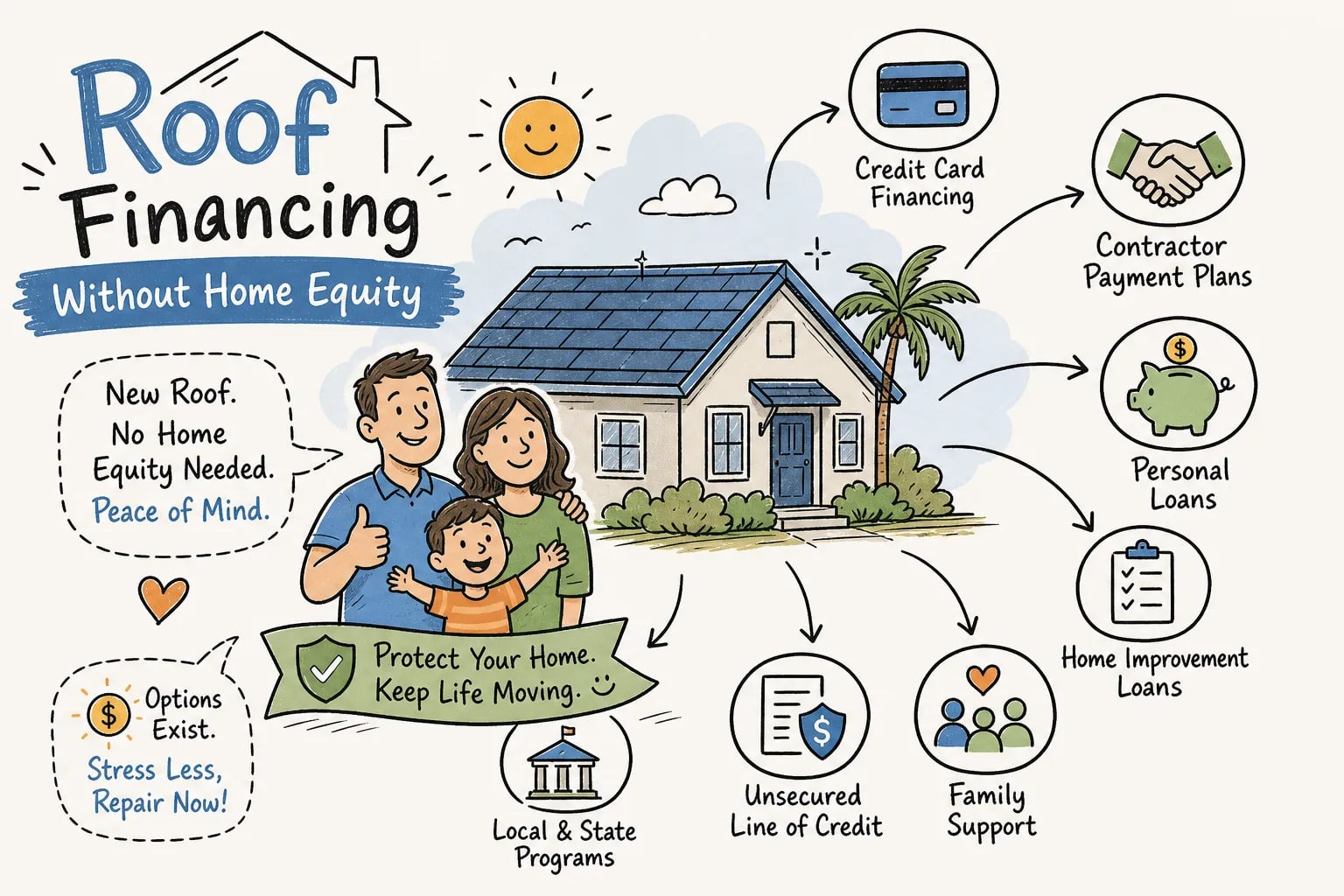
The good news is that home equity is one route, not the only route. There are eight well-documented ways to finance a new roof in Florida without using a home equity loan, and the sections below break down each option with actual numbers so you can match the right tool to your situation and act quickly. Infinity Legacy, a licensed multi-trade Florida contractor (CGC1540795) based in Palm Coast, works with homeowners across all of these paths and, according to the company, offers $0 down PACE financing as part of qualifying roofing projects, verify terms and eligibility directly with the team.
Why Florida homeowners often avoid home equity for roof repairs
The equity gap is more common than people think
Homeowners who purchased in the last three to four years may have limited usable equity, particularly after appraisal fluctuations. Even when equity exists on paper, lenders typically calculate available credit by subtracting your first mortgage balance from a percentage of appraised value, commonly around 80% to 85% of the home's appraised worth. That math frequently leaves far less to borrow against than the homeowner expects. The result is that a significant share of Florida property owners are underserved by the traditional home equity route, even if they're not underwater.
There's also a straightforward personal preference at play. Homeowners who plan to sell within a few years don't want a HELOC complicating the transaction. Others have already used their equity and don't have a second draw available. Neither situation is a financial failure, it's just a reason to look at the alternatives honestly.
Time is the other problem
A standard HELOC application involves a credit pull, an appraisal or automated valuation, underwriting review, and a closing. That process can realistically take several weeks. After a tropical storm tears shingles loose or a failing flat roof starts letting water into a commercial space, that kind of delay is not a timeline that works. Tarps have limits, insurance adjusters have schedules, and according to CDC guidance, mold can begin developing within 24 to 48 hours of water intrusion. The pressure to move faster than a home equity product allows is real, and it's a legitimate reason to choose something else.
How to finance a new roof without a home equity loan in Florida: PACE and alternatives
How PACE works and why more homeowners qualify
PACE stands for Property Assessed Clean Energy. The financing is attached to the property, not the borrower, and it's repaid as a special assessment line on your annual property tax bill. Because approval is based on the property rather than a FICO score, there is no minimum credit score requirement under Florida's PACE program. Eligibility centers on four conditions: you must be current on property taxes with no delinquency in the past three years, current on your mortgage, free of involuntary liens, and the property must be located in a participating county or municipality. Typical repayment terms run five to twenty years at a fixed rate, with APRs in Florida generally ranging from about 6% to 13%, depending on the provider and whether a buydown is applied.
Where PACE is available in Florida and what projects qualify
PACE availability is county-by-county, not statewide. Florida law effective July 1, 2024 requires local ordinance approval before any PACE program can operate. Counties with active residential PACE programs include Flagler (covering Palm Coast), Broward, Miami-Dade, Palm Beach, Osceola, Manatee, Sarasota, Hillsborough (unincorporated areas), Citrus, Volusia, Duval, St. Johns, Marion, and Nassau, along with others across the panhandle and central regions, check with your county directly or a PACE-approved contractor for the most current list. Residential roof replacement and repair are qualifying improvement types under Florida's program structure.
Infinity Legacy's $0 down PACE financing for roofing
According to Infinity Legacy, the company processes $0 down PACE financing as part of the roofing project for homeowners in eligible counties, which removes the step of locating a separate lender or managing two relationships during a stressful project. If the property qualifies, the job can begin without any upfront payment. Reach out to Infinity Legacy directly to confirm eligibility and get a free estimate, same-day PACE eligibility checks are available. For homeowners with fair or limited credit who need a new roof in a PACE-approved county, this is one of the most accessible routes available.
The trade-offs to know before signing
PACE financing places a senior lien on the property, which means it sits ahead of most other obligations in terms of repayment priority. That can create complications during a refinance or home sale if the buyer's lender doesn't account for the assessment or if the buyer isn't willing to assume it. The total interest cost over a long term can also be substantial: a $20,000 roof financed at roughly 9.5% APR over 20 years results in total repayment near $44,600, though actual figures vary depending on provider fees and program structure. For a homeowner who qualifies for a personal loan at 7% or 8%, that personal loan will cost less overall. PACE earns its place when other options aren't accessible, not necessarily when they are.
Unsecured personal loans: fast funding, no collateral required
What rates look like by credit score band
Personal loan APRs for home improvement in Florida follow a steep curve based on credit. Borrowers with excellent credit can access APRs in the 11.7% to 15.3% average range, with some lenders starting near 6% to 7.5% for the strongest profiles. Good credit borrowers typically see 17% to 23%. Fair credit lands in the 24% to 32% range, and poor credit borrowers face rates up to 35.99%. Loan amounts generally run from $1,000 to $100,000, with repayment terms of one to seven years. Florida credit unions often offer more competitive rates than national online lenders for the same credit profile, so checking local options first is worth the extra step.
Speed and simplicity are the main advantages
Many online lenders and credit unions can approve and fund a personal loan within one to three business days. There's no appraisal, no title company, and no collateral required. For a homeowner with strong credit who needs to move fast on a storm-damaged roof, this can be the cleanest option available. Consider what that looks like practically: a $25,000 metal roof financed at 8% APR over five years carries a monthly payment of roughly $507. At a 10% APR, that same loan runs about $531 per month. Those are manageable numbers for a homeowner with steady income and a good credit score, exactly the profile where a personal loan wins.
When a personal loan doesn't make sense
If your credit puts you in the 28% to 36% APR range, the math changes dramatically. A $20,000 loan at 35% APR over five years costs more in total interest than the original loan amount, and the monthly payment at that rate exceeds $700. For homeowners in that credit tier, PACE financing or a contractor's third-party program will almost always produce a lower total cost. As a general rule of thumb: if your credit gives you access to a rate under 15%, a personal loan is worth serious consideration. Above 20%, work through the other options in this list first.
Contractor financing: payment plans built into the job
In-house plans vs. third-party lender programs
Most Florida roofing contractors don't carry loans on their own books. What they offer instead are partnerships with third-party lenders like Service Finance Company, Wisetack, GreenSky, or Sunlight Financial. These programs are integrated into the contractor's sales process, which means the homeowner applies during the estimate appointment and often receives an approval decision within minutes. Some programs advertise 0% APR promotional periods of 12 to 18 months, no application fees, no down payment requirement, and no prepayment penalty. For a homeowner who can pay off the balance before the promotional window closes, these can be a solid short-term bridge.
The promotional rate trap to avoid
Zero-percent promotional financing sounds straightforward, but many third-party contractor loan programs use deferred interest rather than true 0%, always read the contract carefully to confirm which structure applies. The distinction matters enormously. With deferred interest, the interest accrues during the promotional period but is waived if you pay the full balance before it ends. If any balance remains at month 13 or month 19, all of the interest that quietly accumulated during the promo period is added back to your balance at once. On a $15,000 roofing project at 9.99% deferred interest over 18 months, that's a retroactive charge of roughly $2,200 to $2,500 landing on the account the day after your deadline. Read the agreement before signing and confirm whether the rate structure is deferred interest or a true 0% note.
What to ask your contractor before signing
The financing paperwork handed to you at a sales appointment deserves more than a quick signature. Before committing, ask these questions: Is this an in-house plan or a third-party lender, and who will I actually owe money to? What is the APR after any promotional period ends? Is the 0% promotional rate deferred interest or true 0%? Is there a prepayment penalty if I pay it off early? What is the approval rate for applicants with fair credit? Getting clear answers to these five questions before signing protects you if a dispute arises later.
Your homeowners insurance claim: the first stop, not a financing option
What Florida policies typically cover for roof damage
Insurance is not financing, but it's the first offset that determines how much you actually need to finance. Florida homeowners policies generally cover sudden roof damage caused by wind, hurricanes, hail, falling trees, lightning, and fire. They do not cover gradual deterioration, normal aging, or deferred maintenance. That distinction matters when you're deciding whether to file a claim. If the damage is storm-related and sudden, file first and let the insurance figure reduce your financing gap before you commit to any loan product.
The hurricane deductible reality
Florida hurricane deductibles are typically calculated as a percentage of the insured value of the home, not a flat dollar amount. On a home insured for $350,000 with a 2% hurricane deductible, the homeowner pays the first $7,000 before the insurance carrier covers anything. That deductible gap is often exactly where PACE, contractor financing, or a personal loan becomes necessary. Understanding this sequence matters: insurance pays its share first, and financing covers what's left, including the deductible, any depreciation holdback, and code-upgrade costs.
Filing deadlines and documentation that protects your claim
Florida requires new property damage claims to be filed within one year of the date of loss, with supplemental claims tied to the same event allowed within 18 months. After you file, the insurer must acknowledge within 14 days and generally pay or deny within 60 days of receiving a completed proof of loss. Photograph the damage before any emergency tarping begins. Keep all receipts for mitigation work. Written contractor estimates and dated inspection reports give the adjuster a clear record of the loss, which reduces disputes and speeds up the payment that will shrink your financing need.
FEMA assistance and Florida disaster programs: limited but real
What FEMA individual assistance actually provides
FEMA individual assistance is available only after a federally declared disaster, and it's designed to address basic unmet needs rather than cover full replacement costs. The average FEMA household grant runs a few thousand dollars for home repairs. That amount won't fund a full roof replacement, but it's not meant to. For a homeowner dealing with a $30,000 tile roof replacement after a major hurricane, a $3,000 FEMA grant still reduces the financing gap meaningfully. Every dollar counts when you're building a financing stack, so applying for FEMA after a declared disaster is worth doing even if the expectation is a partial contribution.
SELF and Florida-specific low-interest programs
The Sustainable Energy Loan Fund (SELF) is a Florida-based nonprofit lender that provides home improvement loans to homeowners across the state, including some roofing projects. SELF requires no minimum credit score and no income cap, but applicants must demonstrate an ability to repay, be current on property taxes and mortgage, and own a residential property in Florida. SELF isn't widely known, which means it's underutilized by homeowners who might qualify. Some Florida counties and municipalities also operate their own repair assistance programs, particularly for income-qualified households, which are worth researching through your local government website before taking on higher-cost debt.
Promotional credit cards and short-term bridge financing
When a 0% APR card makes sense for a roof job
A credit card is not a realistic solution for a $25,000 roof replacement, but it can be a useful bridge tool in specific scenarios. Covering a hurricane deductible, paying for a code-required upgrade not covered by insurance, or bridging the gap between an insurance payout date and a contractor start date are all situations where a 0% intro APR card can eliminate interest cost entirely. Many cards offer 12 to 21 months interest-free for new cardholders. If the balance is small enough to clear within that window, the effective cost is zero.
The credit limit and carry risk to account for
Most consumer credit cards cap new accounts somewhere between $10,000 and $20,000, which is unlikely to cover a full Florida roof but may handle a partial payment scenario. If the balance isn't cleared before the promotional period ends, it typically resets to a 25% to 29% variable APR with no warning period. This option only works with a firm payoff plan in place. Carrying a large balance close to your credit limit will also lower your credit score during the repayment period, which matters if you're planning to refinance or finance anything else in the near term.
How to finance a new roof in Florida without a home equity loan: matching options to your situation
Start with insurance, then layer in what's needed
The sequence matters more than which individual option you choose. If the roof damage is storm-related, file the insurance claim first and get the adjuster's figure before committing to any financing product. Calculate your actual out-of-pocket gap: deductible plus any depreciation holdback plus code-upgrade costs not covered by the policy. That number, not the full replacement cost, is what needs financing. Applying for a $25,000 loan when you only need to bridge $9,000 after insurance pays out costs you interest on $16,000 you didn't need to borrow.
Matching your situation to the right option
Two variables drive the decision: your credit profile and how quickly you need to move. Use this as a starting framework:
- Strong credit, two or more weeks available: A personal loan from a credit union or online lender will usually produce the lowest total cost.
- Limited equity, fair credit, qualifying property: PACE is the most accessible route, particularly in Flagler County, Broward, Miami-Dade, Palm Beach, Osceola, or another active county.
- Working with a contractor offering third-party lender programs: Verify the APR and deferred interest terms before signing. Use the promo period only if you can pay it off in time.
- Need to bridge a deductible quickly: A 0% promotional card handles a small gap cleanly.
- Low income after a federally declared hurricane event: Check FEMA eligibility and SELF before adding any higher-cost debt.
One contractor that handles roofing and financing together
For Florida homeowners in PACE-eligible counties, working with a contractor who already processes $0 down PACE financing removes the step of finding a separate lender, comparing PACE providers, and managing two relationships during a stressful project. Infinity Legacy handles roofing, HVAC, impact windows and doors, and remodeling across Northeast and Central Florida as a single, accountable team. Free estimates are available across Florida's service area, and PACE eligibility can be confirmed during the same conversation. Get in touch with the Infinity Legacy team to start the process with no obligation.
The real cost of waiting
Financing a roof is not the same as affording one. The right financing structure makes a necessary upgrade manageable, and the cost of the right loan is almost always lower than the cost of delaying. A failing roof in Florida's subtropical climate doesn't stabilize on its own. Water intrusion leads to mold, structural damage, insulation loss, and eventual interior repairs that dwarf the original roofing cost. Delaying a needed repair after storm damage can turn a manageable replacement cost into a much larger remediation bill, a risk no homeowner in Florida's climate can afford to take lightly.
Work through this sequence: check your insurance coverage first, explore PACE if your property qualifies and your credit is limited, consider a personal loan if your credit supports a reasonable rate under 15%, and use contractor financing or a promotional card to bridge specific gaps rather than fund the whole project. If you're still working out how to finance a new roof without a home equity loan in Florida, start with an insurance claim review and contact a PACE-approved contractor for a free eligibility check. One of these paths fits your situation, and acting now costs less than acting later.