Florida roofs face a combination of stressors found almost nowhere else in the country: intense UV radiation, year-round humidity, salt air along hundreds of miles of coastline, and hurricane-season wind loads that expose every weakness in materials and installation. That combination doesn't just shorten roof lifespans, it punishes roofs that were never engineered for these conditions in the first place.
The right way to think about a Florida roof is not as a commodity purchase you replace every fifteen years and forget. It's a building system specifically engineered for heat, moisture, and wind loads that would be considered extreme in almost any other U.S. market. Get the system right, and a properly installed tile or standing seam metal roof can protect a home for fifty years. Get it wrong, and the first major storm season turns that mistake into a very expensive education.
At Infinity Legacy, we help homeowners across Northeast and Central Florida navigate exactly these decisions, selecting the right material, verifying code compliance, and installing roofs that hold up to what this state actually throws at them. This guide covers everything you need to make a confident choice: roof shapes, material performance, Florida Building Code requirements, 2026 cost ranges, and how to find a contractor you can trust.
Why Florida roofing is its own category
Most roofing advice you'll find online was written for markets where a shingle roof lasts 25 to 30 years with minimal drama. Florida isn't that market. This state stacks three simultaneous threats that most other regions handle separately, and each one accelerates the others.
The three climate forces every Florida roof faces
Heat and UV exposure come first. Roof surface temperatures in Florida regularly exceed 150°F during summer months, a figure documented in field measurements conducted by Florida solar and energy research programs, which accelerates granule loss in asphalt shingles, degrades sealants, and makes underlayment brittle years ahead of schedule. According to NOAA and EPA climatology data, Florida's UV index ranks among the highest in the continental United States, and there's no winter reprieve to give materials a chance to recover.
The moisture cycle compounds that heat damage. Florida's tropical rainfall and persistent humidity create conditions where algae, mold, and moisture infiltration are constant threats, not occasional ones. Coastal homes add salt air to that equation, which corrodes fasteners and degrades coatings significantly faster than inland environments.
Then there's wind. Tropical storms and Category 1 through 5 hurricanes generate uplift forces that standard residential roofing installations aren't always designed to resist. Any material that performs well against all three of these forces simultaneously earns its cost in this market.
Why Florida building code sets a higher bar
The Florida Building Code (FBC) governs all roofing work in this state, and it goes considerably beyond the International Residential Code that most other states follow. Florida's code incorporates ASCE 7-22 wind design values, requires product testing to specific standards, and mandates that installed assemblies demonstrate uplift resistance matched to their geographic location. Miami-Dade and Broward counties go further still: they sit inside the High-Velocity Hurricane Zone (HVHZ), where the most stringent roofing requirements in the country apply. (Parts of the Florida Keys may also be subject to HVHZ or equivalent treatment under current FBC guidance.)
The 2026 Florida Building Code framework takes effect December 31, 2026, continuing the state's practice of regularly updating wind design requirements as research improves. Understanding that Florida has this framework isn't just regulatory background, it's the context that explains why certain materials and installation methods are non-negotiable here.
How roof shape affects hurricane performance
Most homeowners focus entirely on material when they think about a roof replacement. Shape is often the bigger variable in hurricane performance. The geometry of a roof determines how wind interacts with the structure, where uplift pressure concentrates, and how likely the system is to fail at the edges, ridge, or gable ends.
Why hip roofs outperform gable roofs in storm winds
Wind-tunnel testing and post-hurricane damage assessments conducted by institutions including the Insurance Institute for Business and Home Safety (IBHS) and Florida International University's Wall of Wind lab consistently show that hip roofs outperform gable roofs in high-wind events. Peak wind-induced pressures have been measured at up to 50% lower on hip roofs than on comparable gable roofs under identical wind conditions. The geometry explains why: four slopes meeting at a central ridge offer a lower profile to the wind, reduce peak uplift pressures, and eliminate the exposed vertical gable ends that act like sails under lateral wind loads.
Gable roofs concentrate structural stress at the end walls and are significantly more likely to experience catastrophic failure in high-wind events unless those end walls are heavily braced. Florida storm-damage records consistently identify gable-end failures as one of the leading causes of total roof loss. Multi-hip roofs share the same wind-friendly geometry as standard hip roofs and perform similarly well.
What flat roofs need to survive Florida storms
Flat and low-slope roofs require full adhesion, strong edge termination, and proper drainage to perform in high winds. Uplift risk concentrates most heavily at corners and perimeters, which is why HVHZ counties impose more prescriptive requirements on low-slope assemblies than on pitched systems. When those construction details are executed correctly under Florida code, flat systems can perform reliably, but the margin for error is narrow, and installation quality is the deciding factor.
Florida roofs by material: tile, metal, shingle, and flat systems compared
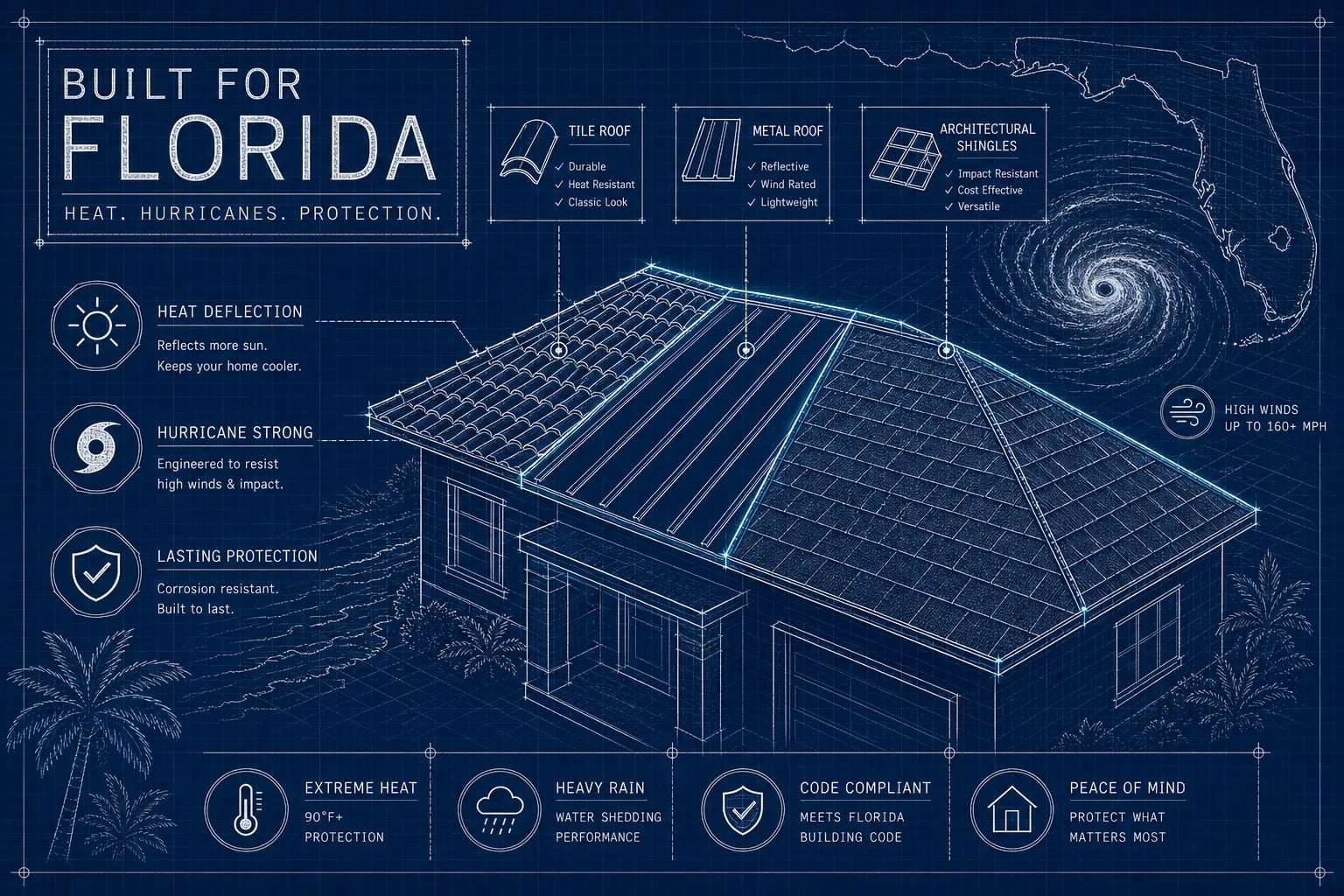
Each major material category has genuine strengths in Florida conditions and real trade-offs that affect long-term value. Here's how they compare based on actual field performance across the state.
Concrete and clay tile: the Florida standard for a reason
Tile has dominated Florida roofing for decades because it handles the state's specific climate challenges better than almost any other material. It resists UV degradation inherently, manages heat far better than asphalt, and carries a documented lifespan of 35 to 50 years in Florida conditions; some well-installed tile roofs remain functional well beyond that range. The tile itself is rarely the problem on an aging roof. Underlayment failure is the most common practical failure point, along with corroded fasteners in coastal environments and cracked tiles from impact.
Tile's weight is a structural consideration that requires a properly rated roof deck. Concrete tile and clay tile both perform well in Florida's climate. Some sources note that clay may perform better in salt-air coastal environments due to its comparatively lower porosity, though the advantage depends on installation quality and specific product ratings. For homeowners who plan to stay in their home for decades, tile is consistently one of the strongest long-term investments available.
Metal roofing: the long-haul performer
Standing seam metal roofing offers 30 to 50-plus years of documented lifespan in Florida, excellent wind uplift resistance when fasteners and seams are properly installed, and strong performance in both heat and storm conditions. The higher upfront cost relative to shingles looks different when calculated over a 30-year horizon. A homeowner who replaces architectural shingles twice in that period has likely spent as much as a metal roof would have cost initially, without the wind resistance advantages.
Coastal installations require attention to coating and fastener specifications to manage salt-air corrosion, and seam quality is the variable that separates long-performing metal roofs from those that develop leaks early. With those details handled correctly, metal is one of the most capable roofing systems available for Florida's conditions.
Architectural and impact-rated shingles: the value case
Architectural shingles are Florida's most common middle-ground option because they meet FBC minimums, offer reasonable wind ratings, and price out significantly below tile or metal. In Florida's subtropical climate, realistic lifespans run 18 to 25 years for architectural shingles, shorter than northern markets because of UV exposure and heat, but sufficient for homeowners who aren't planning a 50-year stay. Standard architectural shingles are a practical choice for budget-conscious homeowners who need code compliance without tile or metal pricing.
Impact-resistant shingles are a separate category worth understanding. They carry stronger wind ratings than standard architectural shingles and often qualify for Florida insurance discounts, making them the strongest ROI case within the shingle product family. The cost premium over standard architectural shingles typically runs several thousand dollars on an average Florida home, and that gap frequently pays back through insurance savings, commonly within five to ten years depending on your insurer and county.
TPO and flat membrane: the right tool for low-slope roofs
TPO and PVC membranes are the standard choice for commercial buildings, flat-roofed additions, and modern homes with low-slope designs. Documented lifespans typically run 15 to 25 years, with performance tied closely to seam quality, drainage design, and UV exposure management. A flat roof with poor drainage will fail years ahead of schedule regardless of membrane quality; a properly detailed system will reach or exceed its rated lifespan.
Reflective white TPO membranes do double duty as cool-roof systems, reflecting 70 to 85% of solar radiation. That reflectivity makes them a strong energy efficiency choice for commercial properties and any home with substantial flat-roof area. For the right application, TPO is an efficient and cost-effective system; it just requires a contractor who understands the installation details that matter.
Wind uplift ratings and Florida roofs: what the numbers actually mean
Wind uplift ratings confuse most homeowners because the numbers vary by location and the terminology is technical. The core concept is straightforward: every roofing product installed in Florida must demonstrate it can resist the uplift pressure generated by design-wind speeds for that specific location. The required resistance is not uniform; it changes based on where you are in the state and where on the roof you're measuring.
HVHZ vs. non-HVHZ: how your county changes the requirements
Miami-Dade and Broward counties sit inside the HVHZ, where the most stringent roofing requirements in the United States apply. Roof coverings in HVHZ must carry a Notice of Acceptance (NOA) demonstrating they've passed testing specific to those conditions, requirements that eliminate many products that perform adequately in other parts of Florida. Design wind speeds in HVHZ approach 175 to 185 mph in current code guidance, and uplift connection requirements reach a minimum of 1,000 pounds of resistance per connection in those zones.
Outside HVHZ, the FBC still requires wind design based on each site's ultimate design wind speed: roughly 150 mph in inland Central and North Florida, rising to 160 to 170 mph along the Gulf Coast, and reaching 165 mph or higher along the Southeast coast. The 2026 code framework maps these to tiered uplift connection minimums: 500 pounds per connection for 120 to 140 mph zones, 700 pounds for 140 to 160 mph zones, and 1,000 pounds for 160 mph and above.
What roof uplift ratings mean for homeowners
Uplift pressure is not uniform across any roof surface. Corners experience the highest pressure, perimeters the next highest, and the field (the central area) the lowest. A product's rated uplift resistance must meet or exceed the code-calculated design pressure for each zone, which means a roof assembly needs different performance specifications at the corners than at the center. This is why a product that's code-compliant in one county can fall short in another with higher design wind speeds.
The practical takeaway for homeowners is this: permit-pulling is not bureaucratic overhead. When a licensed Florida contractor pulls a permit, it triggers inspection steps that verify the installed system actually meets the code requirements for that specific location. That verification step protects you during an insurance claim after a storm and confirms that the investment you made in your roof is actually built to what you paid for.
Cost and lifespan by material: real 2026 numbers for Florida homeowners
Here are installed cost ranges for a typical Florida home in 2026, based on current market pricing. These represent statewide averages; South Florida and HVHZ markets run significantly higher across every category.
- Architectural shingles: $9,000 to $16,000 installed; lifespan 18 to 25 years in Florida
- Impact-resistant shingles: $11,000 to $19,000 installed; lifespan 20 to 25+ years
- Metal roofing: $20,000 to $38,000 installed; lifespan 30 to 50+ years
- Concrete or clay tile: $25,000 to $50,000 installed; lifespan 35 to 50+ years
- Flat membrane (TPO/PVC): $8,000 to $16,000 installed; lifespan 15 to 25 years
Cost per square foot varies by slope complexity, roof geometry, and existing deck condition. A steep, complex hip roof costs more to install than a simple gable of the same square footage. Deck replacement, when needed, adds cost on top of the material and labor figures above, and it's most commonly required on homes with older OSB or plywood that has absorbed moisture over multiple roof cycles.
Where impact-rated materials earn back their cost in Florida
Impact-resistant shingles and metal roofing carry the strongest ROI argument specifically in Florida, and the reason is straightforward: insurance savings, wind mitigation credits, and longer replacement cycles combine to offset the price premium over time. Florida homeowners who qualify for wind mitigation discounts after installing impact-rated materials regularly see annual insurance reductions that pay back the cost difference within five to ten years.
Architectural shingles represent the strongest budget-to-value balance for homeowners who need code compliance without reaching tile or metal pricing. The honest long-term calculation, though, consistently favors the more durable options: a homeowner who replaces architectural shingles twice in 40 years has spent more in total cost, managed two disruptions to their home, and accepted greater storm-season risk throughout. The cheapest roof upfront is rarely the cheapest roof over a 20-year window once replacements and storm repairs are factored in.
Cool roofs and energy savings in Florida's climate
Florida's heat is not a seasonal inconvenience, it's a year-round load on your air conditioning system. The right roofing material and finish can meaningfully reduce attic temperatures and cut the energy your HVAC system expends fighting that heat. In a state where cooling costs dominate utility bills twelve months a year, that efficiency gain compounds over time.
How reflective materials lower attic heat in Florida roofs
Cool roof coatings and high-SRI (Solar Reflectance Index) shingles work by reflecting more solar energy and emitting absorbed heat rather than transferring it into the attic space. Florida field studies from FSEC and related energy research programs show that cool roofs can reduce peak attic air temperatures by 30 to 40°F compared to dark conventional roofs. Roof surface temperatures on reflective systems have been measured 50 to 60°F cooler than dark asphalt or EPDM surfaces under identical sun exposure.
That temperature reduction matters most in Florida homes where ductwork and air-handling equipment sit in unconditioned attic space, which describes a significant portion of the state's housing stock. When attic temperatures drop by 30 to 40 degrees, the heat gain into ducts and the air handler drops correspondingly, and your HVAC system does less work to deliver conditioned air to the living space.
Which options qualify and how much you can save
Reflective white TPO membranes lead the low-slope category, reflecting 70 to 85% of solar radiation. High-SRI shingle products and roof coatings provide similar benefits on pitched roofs. Florida testing found average cooling-energy savings of 16 to 20% for homes with reflective roofing systems, with the largest gains in homes that have thin attic insulation and ductwork running through unconditioned attic space.
The energy efficiency argument for cool roofing doesn't exist in isolation from the rest of the building's systems. A well-insulated attic with a reflective roof and a properly sized, high-efficiency HVAC system performs significantly better than any single upgrade alone. At Infinity Legacy, we handle roofing and HVAC together, which means we can evaluate how a roof upgrade and an HVAC replacement interact, rather than solving each problem in isolation.
How to choose a Florida roofing contractor: what actually matters
The best material decision you can make still fails with the wrong installer. Florida's contractor landscape includes licensed professionals and unlicensed operators, and storm seasons, when the demand for roofing work spikes, reliably attract both. Knowing what to look for before you sign anything protects your investment.
What a licensed Florida roofing contractor should provide upfront
Start with license verification through the Florida Department of Business and Professional Regulation (DBPR). A legitimate Florida roofing contractor holds an active CCC or CGC license, and that license number should be verifiable online before any conversation about pricing or materials goes further. Alongside the license, verify current liability insurance and workers' compensation coverage, not a certificate that expired six months ago, but active coverage for the duration of your project.
Permit-pulling should be standard practice, never optional. Any contractor who suggests permits are unnecessary or offers a lower price for skipping them is signaling a risk you don't want to accept. Product NOAs for the specific materials being installed confirm that what's going on your roof is actually approved for your location's wind design requirements. Finally, get a written warranty covering both materials and labor; verbal assurances about workmanship are not a warranty.
Why a multi-trade contractor like Infinity Legacy changes the equation
Roof replacements rarely happen in complete isolation. Decking damage discovered mid-project, ventilation problems that interact with HVAC performance, or attic conditions that affect insulation and indoor air quality are common findings once a licensed team starts working. When you have a single contractor who handles roofing, HVAC, impact windows and doors, and remodeling through one contract, those findings get addressed without you coordinating multiple vendors, managing overlapping schedules, or absorbing the gaps in accountability that come with fragmented projects.
Infinity Legacy is based in Palm Coast and serves homeowners across Northeast and Central Florida, with projects reaching Jacksonville, St. Augustine, Daytona Beach, Orlando, and beyond. Our license number (CGC1540795) is verifiable through the Florida DBPR, we carry full liability and workers' compensation insurance, and we pull permits on every project as standard practice. For homeowners who want to replace a roof and are also dealing with an aging AC system or considering impact windows, PACE financing is available for qualified upgrades, repaid through the property tax bill as an alternative to traditional financing. Every project starts with a free estimate. Reach out to our team and we'll walk you through the options specific to your home, location, and budget without any pressure to buy.
Making the right call for your Florida home
The decisions that matter most for Florida roofs come down to a few clear principles: shape affects wind performance as much as material does, Florida's building code is stricter than most homeowners expect, and the cheapest option upfront is almost never the cheapest option over the life of the roof. A well-selected, properly installed roof that matches your climate zone and wind-design requirements protects everything below it, and that protection is measurable in storm damage avoided, insurance premiums reduced, and energy costs lowered.
The right starting point is a conversation with a licensed Florida contractor who can look at your specific home, your location's wind design requirements, your current roof condition, and your budget, then give you a straightforward assessment of your options. That conversation should clarify the trade-offs without a sales pitch attached to every sentence.
If you're unsure which material, system, or upgrade path fits your situation, get in touch with the Infinity Legacy team for a free estimate. We've worked across Florida roofs and roofing conditions long enough to know what holds up and what doesn't, and we'll give you the same honest recommendation we'd want if it were our own home on the line.