
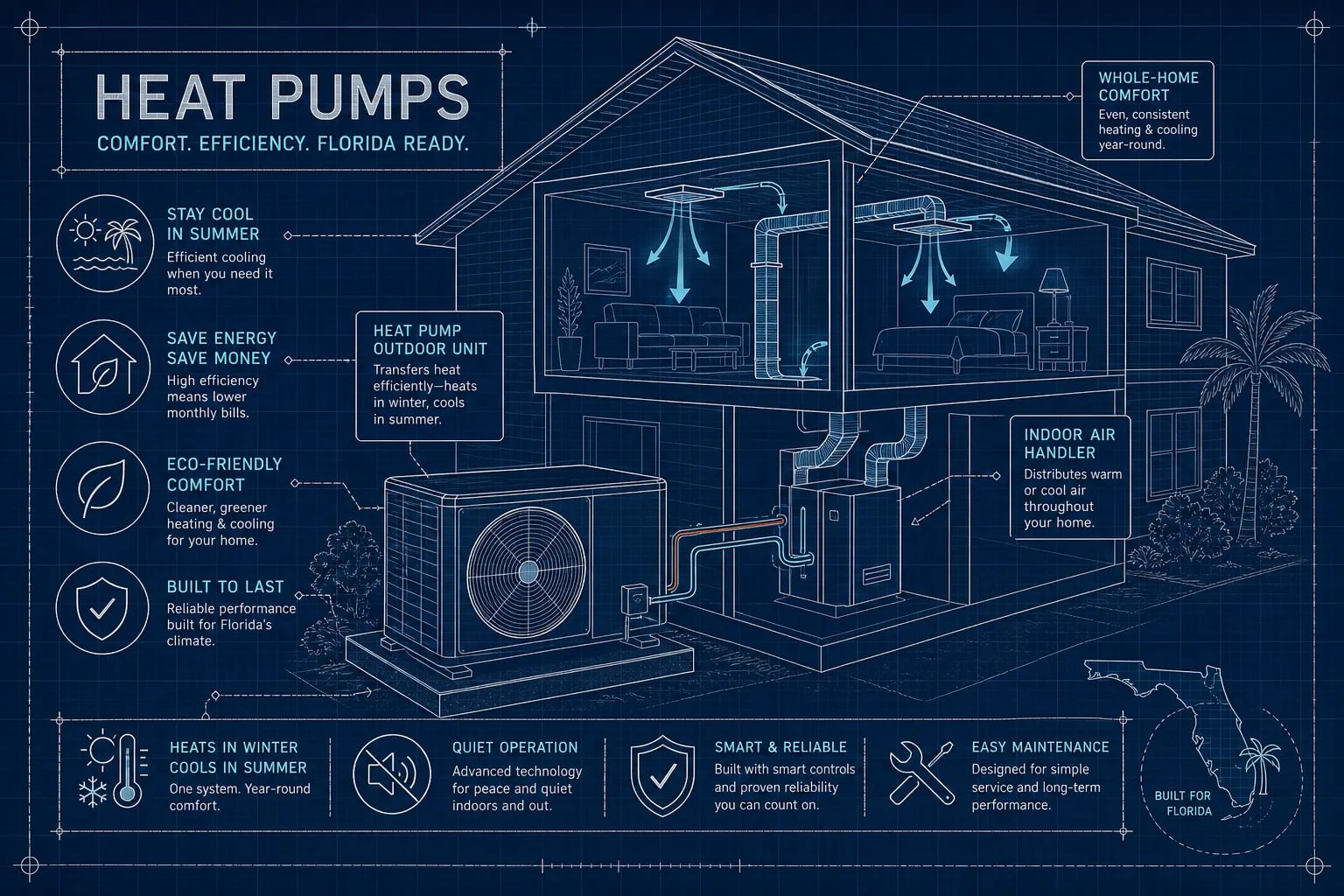
Florida heat pump systems are an ideal match for the state's mild winters and brutal summers, and yet plenty of homeowners are still running a central AC paired with inefficient electric strip heat they almost never think about. When most of the country debates whether a heat pump can handle cold winters, Florida sits in a completely different position: a climate so well-suited to heat pumps that the real question is why more homeowners haven't made the switch. That strip-heat setup costs money every time temperatures drop cool enough for it to kick on, during nights when the heat pump's output would have been adequate on its own.
At Infinity Legacy, we install HVAC systems across Northeast and Central Florida, and heat pumps come up in almost every replacement conversation we have. Some homeowners are ready for the upgrade; others aren't sure if it applies to them. This guide gives you a clear, honest picture: how heat pumps work, which type fits your home, what installation costs look like in 2026, what rebates and financing options are actually available, and how to keep the system running well in Florida's demanding environment.
How Florida heat pump systems actually work
A heat pump doesn't generate heat through combustion the way a furnace does. It moves heat from one place to another using refrigerant. In cooling mode, it pulls heat out of your home and dumps it outside, exactly what a standard central air conditioner does. In heating mode, it simply reverses the process: it extracts heat from the outdoor air and moves it inside. That reversal is what makes it a "heat pump" rather than just an air conditioner.
The reason heat pumps get a mixed reputation in some parts of the country is that they struggle to extract heat from very cold outdoor air. When temperatures drop well below freezing for extended periods, the system has to rely on backup electric resistance strips to make up the difference. That strip heat is inefficient and expensive. Florida's mild winters mostly eliminate that problem. The few nights a year that Palm Coast, Daytona Beach, or Orlando dips near freezing contribute very little to annual operating costs when you look at actual heating-degree-day totals for those cities.
Why Florida's mild winters give heat pumps a real edge
Florida's climate plays directly to a heat pump's strengths. Florida's long cooling season, most of the year, means your system runs hard for an extended stretch, and a heat pump's efficiency advantage compounds over that runtime. Short, mild winters mean the system handles heating comfortably on its own, without the backup strip heat engaging regularly. That combination makes Florida one of the best climates in the country for heat pump performance.
The role of humidity in how your system cools and dehumidifies
Humidity is just as important as temperature in Florida, and a properly sized heat pump handles both. When a heat pump runs in cooling mode, it removes moisture from the air as a natural part of the refrigerant cycle. Variable-speed and inverter-driven systems are especially effective at dehumidification because they run at lower speeds for longer periods, giving the coil more time to pull moisture out of the air rather than short-cycling on and off.
How runtime and load in Florida differ from northern climates
A heat pump in Minnesota might run hard for five months of cooling and five months of heating. A heat pump in Florida runs hard for cooling most of the year and handles light heating loads the rest of the time. That asymmetry changes how you evaluate efficiency ratings. In Florida, your SEER2 rating matters far more than your HSPF2 rating, because cooling is where the vast majority of your energy dollars go. Understanding HSPF2 helps you read spec sheets accurately, but it should not be the primary driver of your purchasing decision when cooling dominates the annual load.
Air-source, mini-split, or geothermal: which type fits your Florida home?
Three main heat pump system types exist, but they are not equally viable for most Florida homeowners. Understanding where each one fits helps you avoid spending money on a solution that doesn't match your home's actual situation.
Air-source heat pumps: the practical Florida standard
Air-source heat pumps are the dominant residential choice in Florida by a wide margin. They use the outdoor air as the heat exchange medium, work with existing ductwork in most homes, and are available from all the major HVAC brands. For a Florida homeowner replacing a central AC system, an air-source heat pump is almost always the practical upgrade path. The installation process is similar to a straight AC swap, the equipment costs are reasonable, and the efficiency gains over an AC-plus-strip-heat setup are real and measurable.
Ductless mini-splits: when they make more sense than a ducted system
Mini-splits make the most sense in three specific situations: homes without existing ductwork, room additions where running new ducts is impractical, and supplemental zones where one room consistently runs hotter or cooler than the rest of the house. A mini-split consists of an outdoor compressor unit connected to one or more indoor air handlers mounted on the wall or ceiling. They are efficient, quiet, and give each zone independent temperature control. For a whole-home replacement in a home that already has ductwork in good condition, a ducted air-source system is typically the better value.
Geothermal systems: high efficiency, higher barrier to entry
Geothermal systems exchange heat with the ground rather than the outdoor air, which gives them stable efficiency regardless of outdoor temperature swings. In theory, that's a compelling advantage. In practice, geothermal systems require significant excavation or drilling, a site with suitable soil or well conditions, and an upfront investment that starts around $12,000 and can reach $40,000 or more. For the average Florida homeowner, geothermal is not the realistic first choice. It makes more sense for new construction projects with the right site conditions, or for property owners willing to pay a premium for maximum long-term efficiency.
Heat pump vs. central air: the comparison Florida homeowners often get wrong
The most common misconception is treating a heat pump as a specialized or exotic system. A heat pump cools your home exactly the same way a central air conditioner does; the difference is that a heat pump also heats. A standard central AC only moves heat in one direction, so when winter arrives, a separate heating source steps in. In most Florida homes, that heating source is an electric resistance strip built into the air handler. That strip works, but it is one of the least efficient ways to produce heat.
What a standard central AC system leaves on the table
A heat pump producing heat in mild temperatures operates at roughly two to three times the efficiency of a resistance strip heater. For every unit of electricity the heat pump uses, it delivers two to three units of heat by moving it from the outdoor air. A resistance strip converts electricity to heat at a 1:1 ratio. Over a Florida winter, even occasional strip-heat usage adds a meaningful amount to your utility bill. Switching to a heat pump eliminates that inefficiency.
Operating cost comparison over a Florida year
Because cooling dominates the Florida energy calendar, the difference in annual operating cost between a heat pump and a central AC depends heavily on how often you run heat. Homeowners in North Florida who use heat regularly from November through February will see the clearest savings on their heating costs. In Central or South Florida, where heating usage is minimal, the operating cost difference is smaller, but the heat pump still delivers the same cooling efficiency as a comparable central AC. In either case, you're not giving up anything on cooling performance.
When sticking with central AC still makes practical sense
If your home already has a gas furnace in good condition and gas is cheap in your area, the math may not favor switching to a heat pump for heating. Central AC also remains a reasonable choice if your existing system is mid-life and only needs a compressor-side replacement without touching the air handler. For most Florida homes running electric strip heat, a heat pump is the financially smarter choice at replacement time.
Efficiency ratings that actually matter for Florida heat pumps
Spec sheets include several efficiency ratings, and it's easy to get lost in the acronyms. The following breakdown explains what each rating actually means for your utility bill in a Florida climate.
What SEER2 and HSPF2 mean for your monthly utility bill
SEER2 (Seasonal Energy Efficiency Ratio 2) measures cooling efficiency over an entire season. A higher SEER2 number means the system uses less electricity to produce the same amount of cooling. For Florida homeowners, this is the rating that matters most, because cooling accounts for the bulk of annual runtime. HSPF2 (Heating Seasonal Performance Factor 2) measures heating efficiency over a heating season. In Florida's context, it plays a secondary role because heating loads are light and the winter season is short, understanding it helps you read spec sheets, but it should not drive your purchasing decision here.
Florida's 2026 minimum efficiency requirements for heat pump installations
Florida falls in the Southeast region under federal efficiency standards. The 2026 minimums for split-system heat pumps in Florida are 14.3 SEER2 and 7.5 HSPF2. Every heat pump installed by a licensed Florida contractor must meet at least these thresholds. Major brands including Carrier, Trane, Daikin, and Mitsubishi Electric all offer systems that meet the minimum, and most sell product lines that exceed it significantly. EER2 minimums for Florida split-systems are 11.7 for systems under 45,000 BTU and 11.2 for larger units, which measures efficiency at peak conditions rather than averaged across a season.
Which rating carries the most weight in a hot, humid climate
In Florida, SEER2 is the number to prioritize when comparing systems. The difference between a 15 SEER2 system and an 18 SEER2 system may look modest on paper, but compounded over many months of near-constant summer runtime, it translates to meaningful savings on every monthly bill. Variable-speed or inverter-driven systems typically land at the higher end of the efficiency range and also perform better at humidity control, a real quality-of-life benefit in Florida's climate.
Top heat pump brands suited for Florida's heat and humidity
Florida's environment is significantly harder on outdoor HVAC equipment than most of the country. Salt air, coastal humidity, and months of high-temperature runtime accelerate corrosion on aluminum fins, copper coils, steel cabinets, and fasteners. A heat pump built to standard inland specifications may perform fine in Ohio or Tennessee but degrade faster than expected in a coastal Florida application.
What separates a Florida-grade heat pump from a standard model
The features that matter most for Florida durability are factory-applied corrosion-resistant coatings on the outdoor coil, stainless steel or coated fasteners, sealed electrical connections, and galvanized steel or powder-coated cabinets. The best coastal-grade systems carry epoxy-phenolic or phenolic coatings on the coil, proprietary fin treatments like Gold Fin or hydrophilic blue-fin coatings, and in some cases all-aluminum coil construction that reduces galvanic corrosion between copper tubes and aluminum fins. A published salt-spray test rating of 1,000 hours or more under ASTM B117 standards is a practical benchmark worth asking about when comparing outdoor units.
Brands and product lines worth evaluating for Florida installations
Carrier and Trane earn consistently strong marks from Florida installers and homeowners for humidity control, variable-speed performance, and corrosion-resistant construction in their coastal-grade product lines. Daikin and Mitsubishi Electric perform exceptionally well on dehumidification and are especially strong in ductless and variable-speed applications. Lennox rounds out the top tier with efficient variable-capacity systems and solid humidity management. FHP, based in Fort Lauderdale, has built a specialized product line focused on geothermal and water-source heat pumps; if you're specifically exploring a water-source system, FHP's Florida-focused experience is worth considering. For standard air-source residential applications, Carrier, Trane, Daikin, and Mitsubishi are the most practical starting points.
Key corrosion-resistant features to ask about before you buy
When comparing systems, ask whether the outdoor coil has a factory-applied coating and what type it is. Ask whether the unit is explicitly marketed as coastal-rated or salt-air rated. Ask about fastener material and cabinet construction, the answers tell you a great deal about whether a manufacturer has engineered the product for Florida conditions or simply adapted an inland design. A contractor who can answer those questions clearly knows the product. At Infinity Legacy, we guide Florida homeowners through brand and model selection based on the home's location, its proximity to the coast, and the realistic maintenance commitment involved.
Florida heat pump systems installation costs in 2026
Cost is always a central part of the decision, and the range is wide enough that generic national numbers aren't useful for planning. Here's what Florida homeowners actually pay.
Installed price ranges by home size and system type
For a standard ducted air-source heat pump in Florida, the installed cost varies primarily by home size and system tier. Costs can span a wide range depending on system tonnage, equipment tier, and whether ductwork repairs are needed alongside the installation. Smaller homes around 1,000, 1,300 square feet often come in at $6,500 to $8,500 for a mid-efficiency system with ductwork in good condition. Most 1,500, 2,000 square foot homes land between $8,000 and $11,000 for a comparable mid-efficiency setup. Homes in the 2,000, 2,500 square foot range typically run $10,500 to $13,500. High-efficiency or premium variable-speed systems add cost across all size categories. Ductless mini-splits range from roughly $2,000 for a single-zone installation to $12,000 or more for multi-zone whole-home systems. Geothermal systems start around $12,000 and can reach $40,000 or more depending on site conditions and system size. An on-site estimate from a licensed Florida contractor is the most reliable way to establish a specific budget, because tonnage requirements and ductwork condition affect the final number significantly.
What drives installation costs higher (ductwork, permits, equipment tier)
The biggest cost variables beyond equipment are ductwork condition, permit requirements, and system efficiency tier. Homes with aging or damaged ductwork may need repairs or partial replacement alongside the new system, which adds $1,000 to $4,000 or more depending on the extent of the work. Florida Building Code requires permits for HVAC replacements, and permit fees and inspection logistics vary by county. Moving from a minimum-code system to a high-efficiency inverter-driven unit adds cost upfront but reduces monthly operating expenses over the system's life. Equipment access, particularly in homes with difficult attic configurations or confined equipment closets, can also affect labor time.
Getting an accurate quote: why a free on-site estimate matters
Online cost calculators give you a starting point, but they can't account for your home's duct layout, insulation levels, equipment location, or local permit requirements. The most reliable way to budget for a heat pump replacement is to get an on-site estimate from a licensed Florida contractor who can evaluate all those factors in person. Infinity Legacy offers free estimates for heat pump installations across Florida, with no commitment required. A single conversation with our team gives you a specific number built around your actual home rather than a national average.
Rebates, incentives, and financing options available to Florida homeowners
The incentive landscape for heat pump systems in Florida shifted in 2026 with the end of the federal 25C equipment credit and ongoing changes to utility rebate tiers. It's worth understanding exactly what's available before you budget for a replacement.
What Florida utility rebates are actually available right now
Florida's major utilities offer heat pump rebates, though the amounts and eligibility rules vary by program. FPL provides a $200 instant rebate for qualifying central heat pump replacements installed by an FPL-approved contractor, with a SEER2 requirement of 15.2 or higher. Duke Energy Florida offers rebates for qualifying heat pump replacements, including a higher tier for homeowners converting from electric strip heat to a full heat pump system, though exact amounts are subject to program-year updates and should be confirmed with your contractor before installation. TECO ranges from $40 for systems meeting SEER2 15.2 to $550 for systems at SEER2 16.2 or higher. OUC provides a tiered rebate based on tonnage and efficiency that can reach $1,150 in some configurations. JEA offers rebates for qualifying heat pump installations; confirm current amounts and thresholds directly with your contractor, as utility programs can adjust eligibility requirements mid-year. Your contractor should verify current program terms before work begins.
Federal tax credit status for heat pump purchases in 2026
The federal 25C tax credit for heat pump equipment, which allowed homeowners to claim up to $2,000 against their federal income taxes, ended for equipment placed in service after December 31, 2025. A heat pump installed in 2026 does not qualify for that federal credit. Florida's statewide IRA-funded home energy rebate program has also not launched as of 2026, so homeowners are currently limited to utility rebates rather than any state-level program.
Heat pump parts, warranty, and service coverage: what to ask before you sign
Beyond equipment costs, understand what your installation includes on the back end. Most major brands offer parts warranties ranging from five to ten years on compressors and covered components, though registration requirements and coverage terms vary. Ask whether your contractor is an authorized service provider for the brand you're installing, because warranty claims often require work performed by credentialed technicians. Maintenance plan options, covering annual inspections, priority scheduling, and discounted service calls, are worth comparing when you're getting quotes. A system that's well-supported through its warranty period costs meaningfully less to own than one that requires out-of-pocket service on components that should be covered.
PACE financing: how $0-down works for Florida HVAC upgrades
For homeowners who prefer not to pay out of pocket for a system replacement, PACE financing is a practical alternative. Many PACE programs allow financing based on property eligibility and do not require a traditional unsecured credit check, though exact terms vary by program and administrator. The program covers the cost of qualifying upgrades, with repayment handled through your annual property tax bill rather than a separate loan payment. Eligibility is generally based on property equity rather than credit score, making it accessible for homeowners who wouldn't qualify for a conventional loan. Infinity Legacy offers PACE financing for heat pump installations and other qualifying home upgrades across Florida, making it possible to move forward with a system replacement without waiting to save up.
Protecting your heat pump from Florida's coastal environment
The biggest long-term threat to a Florida heat pump isn't heat, it's corrosion. Salt air and humidity work together to degrade outdoor HVAC equipment faster in Florida than in almost any other part of the country. Understanding how that happens and what to do about it is the difference between a system that lasts 15 years and one that struggles past 10.
How salt air and humidity degrade outdoor HVAC equipment over time
Salt deposits on aluminum fins create a conductive layer that accelerates galvanic corrosion between the copper refrigerant tubes and the aluminum fins surrounding them. Over time, that corrosion leads to micro-leaks in the coil, refrigerant loss, and reduced heat transfer efficiency. Humidity keeps the process active because moisture helps salt stay reactive on metal surfaces rather than drying out and becoming inert. Coastal units within a mile or two of the ocean face the most aggressive exposure, but the effect extends well inland in Florida's consistently humid air.
Construction features and coatings that slow corrosion in Florida
The right equipment choice reduces the maintenance burden significantly. Look for systems with factory-applied epoxy, phenolic, or polyurethane coatings on the outdoor coil, stainless steel or zinc-plated fasteners, powder-coated galvanized steel cabinets, and sealed electrical enclosures. Some manufacturers offer all-aluminum coil designs that reduce galvanic corrosion risk by eliminating the copper-aluminum interface. For units that don't come with these features from the factory, manufacturer-approved polymer sealants and anti-corrosion sprays applied annually can extend coil life. Placing the outdoor unit on a raised stand also reduces exposure to ground-level moisture, sand, and salt spray.
A practical Florida maintenance schedule to protect your investment
Heat pump systems in Florida need more maintenance attention than the national average suggests. A realistic schedule, based on manufacturer guidance and Florida-specific conditions, includes:
- Filter replacement every one to two months during heavy-use periods (not quarterly)
- Outdoor coil rinse with fresh water every three months to clear salt and debris from fins
- Annual professional inspection covering refrigerant levels, electrical connections, coil condition, and drain line clearing
- Annual application of a manufacturer-approved corrosion-inhibiting coating on the outdoor coil if the unit isn't factory-coated for coastal exposure
Always follow your equipment manufacturer's maintenance instructions, as filter change intervals and approved coatings vary by brand and model. A well-maintained heat pump in Florida can realistically last 15 years. A neglected unit in a coastal location may start showing refrigerant leaks and coil damage before it reaches 10. The maintenance cost is a fraction of early replacement cost, and it's the single most controllable factor in your system's lifespan.
The bottom line on Florida heat pump systems
In short, Florida heat pump systems are a strong fit for most homes in the state. The mild winters eliminate the performance penalty that holds heat pumps back in colder climates, the long cooling season puts their efficiency advantage to work month after month, and rising electricity rates make that advantage more valuable every year. The key is choosing the right system type for your home's existing infrastructure, selecting equipment built for Florida's humidity and salt exposure, and making sure installation is handled by a licensed contractor who understands how load sizing and ductwork quality affect real-world performance.
If you're replacing an aging AC system, converting from strip heat, or simply trying to lower your energy bill, a heat pump replacement is worth a serious look. Utility rebates and PACE financing make 2026 a reasonable time to move forward, even without the federal tax credit. The savings show up on your utility bill every month for the life of the system.
Infinity Legacy installs heat pump systems throughout Florida. Our team can evaluate your home, recommend the right system for your specific situation, walk you through available rebates and financing options, and provide a free, no-pressure estimate. Reach out to get started.