Finding the best AC Florida homeowners can rely on means accounting for more than just summer heat. You're not just fighting 95-degree temperatures; you're fighting humidity levels that routinely push the heat index well above 100°F, coastal salt air that eats through standard condenser coils in under a decade, and a cooling season that runs roughly from March through November across much of the state. The advice you'll find in national buying guides is written for average conditions. Florida is not average.
Choosing the right air conditioner for a Florida home means thinking through system type, efficiency ratings, corrosion resistance, and proper sizing before you ever call a contractor. Get any one of those wrong and you'll replace the unit in eight years instead of fifteen, or you'll live in a cold, clammy house that can't pull the moisture out of the air. This guide covers everything you need to make a confident decision: the best brands and models for 2026, efficiency targets specific to Florida's climate, sizing rules, coastal-specific considerations, and what installation actually costs. At Infinity Legacy, our team has been installing HVAC systems across Northeast and Central Florida for years, and everything in this guide reflects what we see on the ground every day.
Why Florida's climate demands more from your AC system
The heat-humidity combination that standard units struggle with
Florida's primary cooling challenge isn't the temperature, it's the humidity that comes with it. When outdoor air sits at 90°F with high relative humidity, your air conditioner has to do two jobs simultaneously: lower the temperature and remove moisture from the air. A system designed for dry desert heat handles that first job well but often fails at the second. The result is a home that feels cold and sticky, which is exactly the environment where mold takes hold.
Dehumidification happens when warm, moist air passes over the cold evaporator coil long enough for moisture to condense and drain out. Oversized systems that short-cycle and poorly sized systems with weak EER2 ratings both skip this step. In Florida, that's not a comfort issue, it's a health issue and a warranty issue.
Salt air and what it does to outdoor equipment
Within a few miles of the Atlantic or the Gulf, standard outdoor condensing units face a corrosion threat that most buyers don't account for at purchase time. Salt air attacks aluminum fin coils, corrodes cabinet hardware, degrades electrical contacts, and shortens compressor life. Research on coastal vs. inland HVAC performance consistently shows inland systems averaging 12 to 15 years of service life while coastal systems without proper protection often land between 7 and 10 years. That gap in lifespan makes brand selection and corrosion-resistant features a financial decision, not just a quality preference.
Year-round runtime and what it means for efficiency
Florida AC systems run ten to eleven months a year, far longer than in most of the country. That runtime makes efficiency ratings matter far more here than the national average suggests. A unit that's marginally less efficient than another will cost you significantly more over a decade of Florida operation. It also means wear accumulates faster, which is why Florida systems average 10 to 15 years of service life, roughly five years shorter than the national benchmark of 15 to 20 years. Inland systems sit closer to 12 to 15 years; coastal systems often land between 7 and 10 without the right equipment and maintenance.
Central air, heat pump, or mini-split: which fits your home?
Central air conditioning: the baseline for most Florida homes
Ducted central air is still the right answer for most Florida homes with existing ductwork in good condition. It delivers whole-home cooling efficiently, integrates cleanly with air handlers and filtration systems, and gives you one system to maintain. If you're replacing a failed central AC in a home with solid ductwork, a high-efficiency central system almost always makes the most economic sense. Where central air falls short is in homes with leaky or undersized ducts, new additions without ductwork, or areas where you want room-by-room temperature control.
Heat pumps: why they make particular sense in Florida
Florida's winters are mild enough that a heat pump handles both cooling and heating without the inefficiency that makes heat pumps impractical in northern climates. You get one system for year-round comfort instead of separate cooling and heating equipment. Variable-speed heat pumps are especially well-suited to Florida because they modulate output continuously, longer run cycles at lower intensity, and longer run cycles mean better dehumidification. For new construction or full HVAC replacements, a variable-speed heat pump in the 16 to 18 SEER2 range is one of the strongest choices available to Florida homeowners in 2026.
Mini-splits for additions, garages, and zoning
Ductless mini-splits solve specific problems exceptionally well. If you've converted a garage into living space, added a sunroom, or have rooms that are chronically hotter or colder than the rest of the house, a mini-split handles the load without touching your existing duct system. For whole-home installations in new construction without ductwork, multi-zone mini-split systems from brands like Daikin and Mitsubishi Electric offer strong humidity control and coastal-rated options. Based on what we see in Florida field installations, Daikin's lineup holds up particularly well in hot, humid, salt-air environments, making it a solid choice for coastal installs when specified correctly.
SEER2 ratings and efficiency targets for Florida in 2026
The Florida minimum vs. the smart efficiency target
Florida falls under the DOE Southeast region, where the minimum SEER2 for new residential split-system installs is 14.3 SEER2 for systems under 45,000 BTU/h and 13.8 SEER2 for larger systems. Those minimums are the floor, not the target. For a home running its AC ten-plus months a year, 15.2 SEER2 is the practical starting point and 16 to 18 SEER2 is the range where upfront cost and long-term savings find their best balance. The payback calculation for premium efficiency equipment is faster in Florida than anywhere else in the country precisely because of that extended runtime.
EER2 and why it matters more in Florida than SEER alone
SEER2 measures average seasonal efficiency across a range of operating conditions. EER2 measures efficiency at peak outdoor temperatures, which in Florida means the exact conditions your system runs under most of the year. A unit with a high SEER2 and a weak EER2 performs well on paper but struggles on the days that matter most. Target an EER2 of 11.5 to 12.0 or better for Florida installs. That threshold also correlates with stronger moisture removal performance, which is the other dimension of comfort that pure temperature metrics don't capture.
HSPF2 for heat pumps
If you're going the heat pump route, target an HSPF2 of 8.0 to 8.5. Florida's heating demand is low enough that this rating won't make or break your comfort, but it does indicate a system built with higher-quality components throughout, which pays off on the cooling side where Florida puts it to work the most. Note that federal tax credits for heat pump and AC installations expired after December 31, 2025, so Florida homeowners installing systems in 2026 should factor that into their budgeting. It's worth asking your contractor whether utility rebates from your Florida provider still apply when you get your estimate, as some programs remain active.
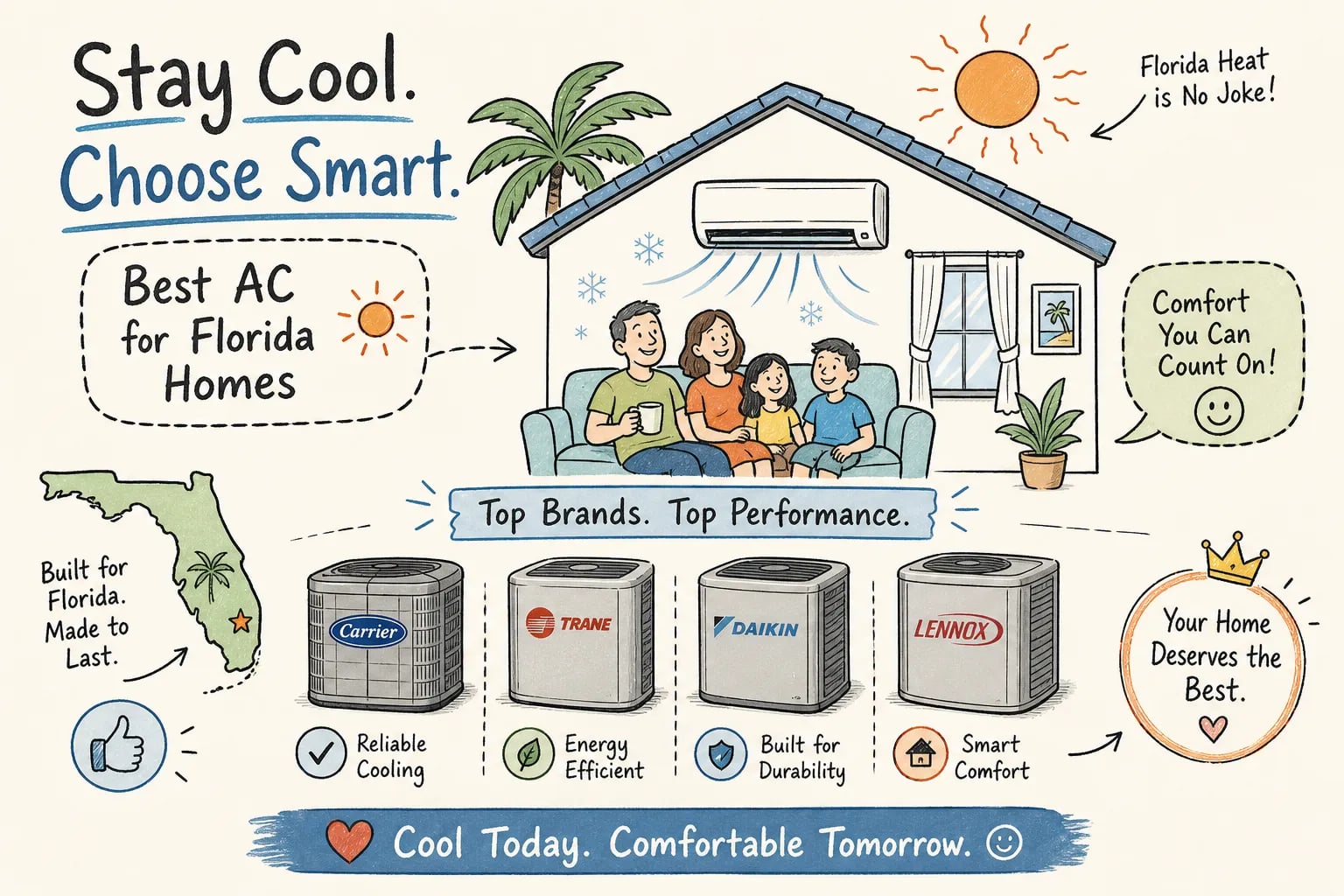
Best AC brands for Florida homes in 2026
Carrier: the most consistent performer in Florida conditions
Carrier earns the top spot for Florida primarily because of how consistently its coastal-spec models hold up in humid and salt-air environments. The Carrier Infinity 24VNA6 is the flagship recommendation: variable-speed compressor, welded aluminum coil construction, zinc base-pan protection, and a broad installer network across the state. Carrier structures its lineup across three tiers, Infinity, Performance, and Comfort, so homeowners at different budget levels can get coastal-appropriate protection. The Performance 24APB7 and Comfort 24ACC6 both appear in coastal Florida specs when the right options are selected at install time. For most Florida buyers, Carrier's combination of corrosion resistance, efficiency, and installer availability makes it the safest default choice.
Trane: built for durability in hostile climates
Trane's strongest Florida credentials come from its coil design. The all-aluminum Spine Fin coil used across the XV20i and XL18i lines is a genuine structural advantage in humid and salty air (aluminum doesn't corrode the same way copper-aluminum combinations do in coastal conditions). The Trane XV20i is the flagship recommendation for Florida, with variable-speed operation and a strong salt-spray reputation backed by factory coating options. The XL18i is a strong secondary choice, particularly for homes within a mile of the Atlantic or Gulf. Trane's reputation for longevity, grounded in coil design rather than coating alone, makes it a compelling alternative for Florida homeowners who prioritize durability above all else.
Ruud and other strong Florida contenders
The Ruud Ultra Series with the coastal protection package is the third consistent name in Florida coastal recommendations, but the key phrase there is "with the coastal package." Ruud's coastal offering performs well when properly specified at install time, which means your contractor needs to call it out explicitly on the order. Daikin with Blue Fin coating is a solid option for both central and mini-split coastal installs when specified correctly, and its Aurora and 19 Series lines are well-regarded for Florida heat and humidity. Lennox and American Standard both perform reliably in inland Florida applications, but neither carries the same consistent coastal corrosion ratings as Carrier, Trane, and Ruud when near-ocean exposure is the primary concern.
Best AC systems for coastal Florida homes
What salt air does to a standard outdoor unit
A standard outdoor condenser installed within two to three miles of saltwater without coastal-grade protection faces a specific sequence of failures. Fin corrosion reduces heat transfer efficiency first, which increases runtime and strain. Cabinet rust follows. Hardware degradation, screws, mounting brackets, electrical terminals, accelerates as moisture and salt work into every seam. The compressor, already under Florida's thermal load, takes more cycles to maintain the same output and wears faster as a result. A non-coastal unit in a beachside install can lose five or more years of service life compared to the same brand's coastal-rated version. That's not a warranty footnote, it's a real financial impact.
How to choose the best AC Florida coastal buyers can count on
The shortlist for coastal Florida in 2026 is the Carrier Infinity 24VNA6, Trane XV20i, and Ruud Ultra Series with the coastal package. When you're discussing specs with a contractor, ask specifically for:
- All-aluminum coils or factory-coated coils (blue-fin or gold-fin)
- Zinc or coated base pans
- Stainless steel hardware throughout
- Sealed electrical compartments
Blue-fin and gold-fin coatings are polymer layers applied to the aluminum fins that slow salt penetration and corrosion at the fin surface. They're not permanent and can wear over time, but they add meaningful protection compared to uncoated fins and are relatively standard on coastal-rated models from these brands.
Installation details that coastal buyers should verify
The unit itself is only half the equation. How it's installed determines how long the coastal protection actually holds. Condenser units should be elevated off the slab slightly to keep the base pan clear of standing water. Orientation matters: positioning the unit so the prevailing ocean breeze blows directly onto the coils accelerates salt deposition and shortens component life. Proper drainage from the condenser and air handler prevents moisture accumulation at connection points. Whole-home surge protection is especially valuable in coastal Florida, where afternoon thunderstorms bring frequent lightning activity that can spike voltage and damage control boards and compressor electronics. A contractor familiar with coastal installs, like the Infinity Legacy team, catches these details during the estimate phase rather than after the first service call.
How to size your AC system for a Florida home
The tons-per-square-foot rule for Florida climates
The standard sizing rule of thumb for Florida is approximately 400 to 600 square feet per ton of cooling capacity. A 2,000 square-foot Florida home typically falls between 3.5 and 4 tons using this guideline. However, that range shifts based on climate zone, insulation quality, window area, and ceiling height. The sizing chart below gives a practical reference by home size:
| Home size | Typical AC size |
|---|---|
| 600, 900 sq ft | 1.5 ton |
| 900, 1,200 sq ft | 2 ton |
| 1,200, 1,500 sq ft | 2.5 ton |
| 1,500, 1,800 sq ft | 3 ton |
| 1,800, 2,100 sq ft | 3.5 ton |
| 2,100, 2,400 sq ft | 4 ton |
| 2,400, 3,000 sq ft | 5 ton |
New construction vs. older homes: why the number changes
Construction quality changes the calculation significantly. Newer, well-insulated Florida homes can cool efficiently at around 22 BTU per square foot, which translates to roughly one ton per 550 square feet. Older Florida homes, particularly those with single-pane windows, minimal attic insulation, or leaky ductwork, often require 25 to 30 BTU per square foot, closer to one ton per 400 to 480 square feet. In practical terms, a newer 1,800 square-foot home may be correctly served by a 3-ton system, while the same square footage in a 1970s build with original windows likely needs 3.5 to 4 tons to maintain comfort and proper dehumidification.
Why oversizing your AC creates a humidity problem
Oversizing is one of the most common and consequential mistakes in Florida HVAC installs. A unit that's too large for the home reaches the thermostat's target temperature quickly, sometimes in just a few minutes, then shuts off. That short cycle doesn't give the evaporator coil enough contact time with return air to condense and drain moisture. The result is a home that feels cold and damp simultaneously, with elevated indoor humidity that creates conditions for mold and increases allergy symptoms. A proper Manual J load calculation, performed by a licensed contractor before equipment selection, is the only way to size a system correctly for your specific home. Don't accept a contractor who quotes a size based on square footage alone without checking insulation, window area, and ductwork condition.
What AC installation costs in Florida in 2026
Central AC installed cost: what to expect
Most Florida homeowners replacing a central AC system spend between $3,300 and $9,800 installed, with a statewide average around $5,600. That range reflects real variation: a straightforward 3-ton replacement in a standard home with good existing ductwork sits near the lower end. A 5-ton high-efficiency coastal install with ductwork repairs and a surge protector sits near the top. Efficiency tier, brand, unit size, and the condition of your existing air handler and ductwork all move the number. Coastal-specific models and the additional spec items those installs require, elevated mounting, coated hardware, sealed compartments, push toward the higher end of the range.
Heat pump installed cost and where the value is
Heat pump installations in Florida run $3,800 to $13,300 installed, with a statewide average around $6,175. The premium over a standard central AC system reflects the dual-function equipment and the higher efficiency components typical in modern heat pump designs. Variable-speed heat pumps in the 16 to 18 SEER2 range carry a higher upfront price but deliver meaningfully lower utility bills over Florida's extended cooling season, and Florida's runtime hours make that payback period shorter than national averages suggest. While the federal 25C tax credit expired after 2025, some Florida utility providers still offer rebates on qualifying high-efficiency heat pump installs. Ask your contractor whether your system and utility provider qualify.
PACE financing and the $0 down path to a new system
Florida's PACE financing program lets qualifying homeowners replace their HVAC system with no money down and no traditional credit requirement. Repayment is structured as a fixed assessment on your annual property tax bill, with no balloon payments and no interest rate adjustments. Terms vary by PACE provider and municipality, so it's important to confirm the specific fees, assessment structure, and any lender-consent requirements that apply in your area before committing.
Eligibility is property-based rather than credit-score-based: the home generally needs to be current on property taxes and mortgage payments, with no delinquent taxes in the last three years and no notices of default. The financed amount is typically capped at 20% of the property's assessed value for residential projects.
At Infinity Legacy, we're familiar with how PACE works across Florida and can walk you through whether your property and planned system qualify as part of your free estimate conversation. It's a practical path for homeowners who need a system now but prefer not to draw on savings or a home equity line.
Making your Florida AC last as long as possible
Corrosion-resistant features worth specifying before you buy
The time to request corrosion-resistant features is before the equipment is ordered, not after installation. Ask specifically for: coated coils (blue-fin, gold-fin, or manufacturer equivalent), all-aluminum coil construction if available in your chosen model, stainless steel fasteners and hardware, a corrosion-resistant condenser cabinet, and sealed electrical compartments. Read the warranty carefully before signing. Many standard parts warranties exclude corrosion-related component failure, meaning if your condenser coil fails due to salt corrosion rather than a manufacturing defect, you may not be covered. Coastal-rated models are more likely to include corrosion-related protection in their warranty terms, and an extended compressor warranty is worth evaluating given Florida's runtime demands.
Maintenance habits that protect your investment in Florida
For coastal homes, the single highest-value maintenance habit is rinsing the outdoor condenser with fresh water on a regular schedule, low pressure, garden hose, working from top to bottom to push salt deposits off the fins. Never use a pressure washer, which bends fins and reduces heat transfer. Change air filters every 30 to 60 days during Florida's cooling season to prevent airflow restriction and reduce strain on the blower. Keep the condensate drain line clear year-round; a blocked drain backs moisture into the air handler and causes pan corrosion and water damage. Schedule semi-annual professional tune-ups if you're within a few miles of saltwater, and annual tune-ups for inland homes. Add whole-home surge protection as well: Florida has among the highest lightning incidence in the country, particularly in Central Florida, and a single electrical surge can destroy a control board that costs more to replace than a year of maintenance.
What a good warranty should cover for Florida conditions
Standard manufacturer warranties cover parts defects but often carve out corrosion-related failure, which is exactly the failure mode that matters most in coastal Florida. Before purchasing, ask your contractor whether the warranty explicitly covers corrosion-related component failure or whether there are exclusions for salt-air exposure. If the manufacturer doesn't offer coastal corrosion coverage, factor in the likely service and replacement costs when comparing brands by price. An extended warranty on the compressor makes particular sense for Florida installs given the additional runtime hours the system accumulates each year. A licensed Florida HVAC contractor can advise you on which manufacturer warranty terms actually hold up in the field, not just on paper.
Choosing the right system starts with the right contractor
The framework for a sound decision when selecting the best AC for Florida homes comes down to four things: match the system type to your home's layout and ductwork, target 16 SEER2 or better with a strong EER2, choose a brand with proven coastal protection if you're within a few miles of water, and insist on a proper Manual J load calculation before committing to a size. No online guide replaces that last step. Oversizing, undersizing, and wrong-brand coastal installs are all avoidable mistakes that show up in your utility bills and service calls for the next decade.
The best air conditioner for a Florida home in 2026 is the one matched to your specific home, climate zone, budget, and property, not the one ranked highest in a national survey. Carrier, Trane, and Ruud lead the coastal shortlist. Variable-speed heat pumps in the 16 to 18 SEER2 range deliver the best long-term value for most Florida replacements. And PACE financing makes it possible to get there without upfront capital if that's the right fit for your situation.
Infinity Legacy offers free estimates across Florida, covering system selection, sizing, brand recommendations, and PACE financing eligibility in a single conversation. For help selecting the best AC Florida homeowners trust, reach out to our team before the next cooling season hits, getting ahead of the demand curve means faster scheduling, better pricing, and no emergency decisions made in the middle of July.