
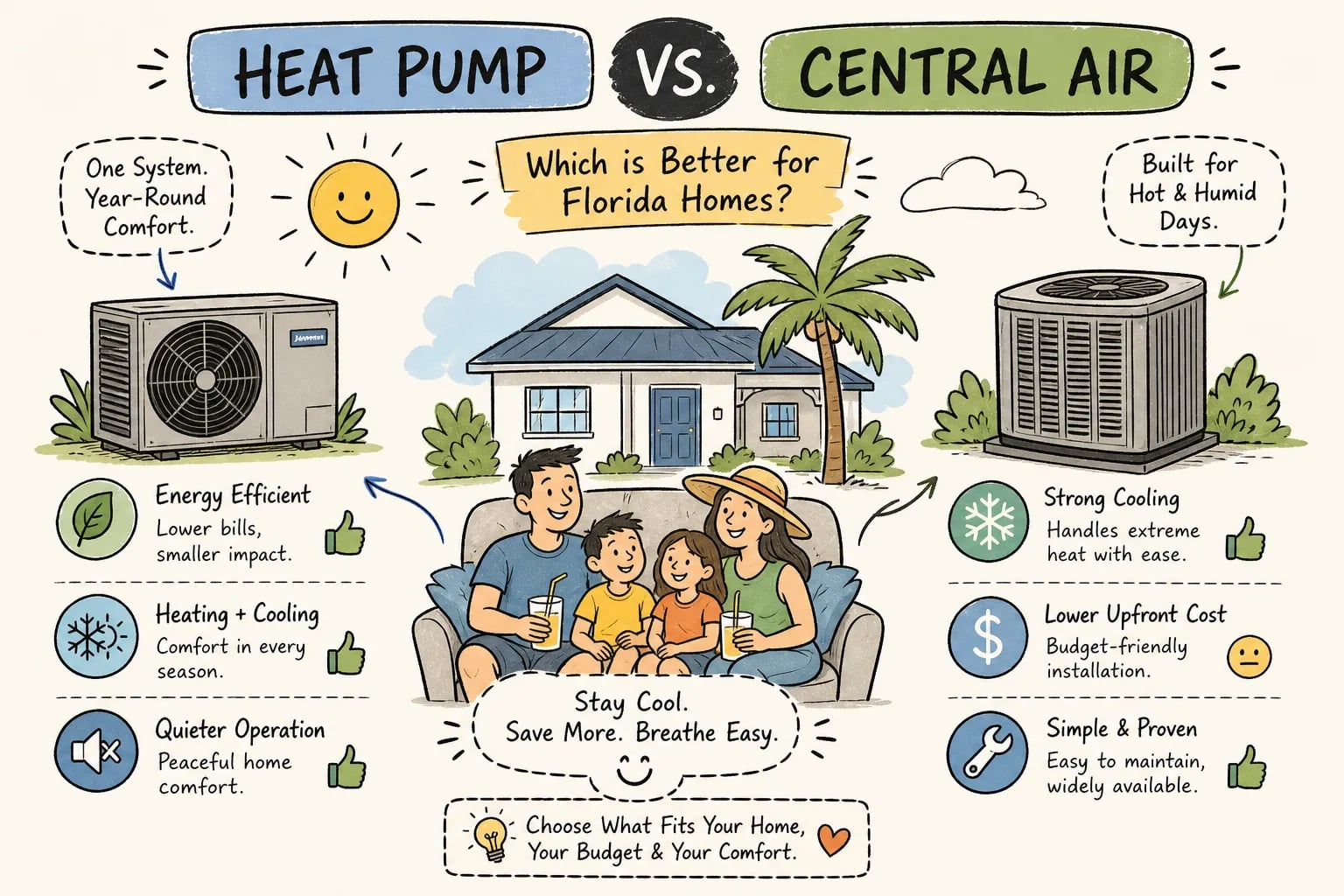
When your air conditioner finally gives out, the replacement decision feels simple at first: just get a new one. But choosing between a heat pump vs. a central air conditioner for Florida homes is one of the most consequential decisions a homeowner makes, and the wrong pick costs real money over the life of the equipment. A standard central air conditioner and a ducted heat pump both cool your home the same way in summer. The differences show up in your utility bill, your indoor humidity levels, your coastal durability specs, and your total cost of ownership over the next 10 to 15 years.
Florida's subtropical climate changes the math on this comparison significantly compared to northern states. The heat, the humidity, the salt air along the coast, and the mild winters all tilt the calculation in ways that a generic comparison won't capture. At Infinity Legacy, we install both systems across Northeast and Central Florida, and this guide is built on real installed cost data, 2026 Florida efficiency benchmarks, and what we've observed performing in this climate across our installations in the region.
How each system actually works in Florida's climate
A standard central air conditioner runs a one-way refrigerant cycle. It pulls heat from inside your home and dumps it outside, leaving cooled air to circulate through your ductwork. That's it. It works in one direction, and in summer, it works extremely well. A heat pump does the same thing in cooling mode, but it can reverse that cycle in winter to pull heat from outdoor air and push it inside your home. That reversibility is the core argument for heat pumps, because running a heat pump for winter heat costs significantly less than firing up electric resistance heat strips.
In cold-climate states, heat pumps lose efficiency as temperatures drop below freezing. Florida winters are typically mild, with infrequent subfreezing temperatures, which keeps the heat pump operating in its efficiency sweet spot nearly year-round. The efficiency penalty that makes northern homeowners hesitant about heat pumps simply doesn't apply here. Florida homeowners get the heating benefit without the cold-climate drawback.
Many Florida homes already have ductwork, so a ducted heat pump or a central AC replacement slots into the existing infrastructure without major structural changes. Ductless mini-splits are a separate category, better suited for home additions, garages, or homes without duct systems. This comparison focuses on ducted whole-home systems, the direct, apples-to-apples choice most replacement buyers face.
Upfront installation costs: heat pump vs. central air conditioner for Florida homes in 2026
The heat pump costs more to install than a central AC replacement. The premium reflects the additional heating-side equipment built into the unit. At the 3-ton size that fits most Florida single-family homes, a ducted heat pump runs approximately $8,000 to $11,000 installed, while a 3-ton central AC replacement comes in around $6,500 to $9,500. That's a gap of roughly $1,500 to $2,000 depending on the specific equipment and job conditions.
Here's the full size-by-size breakdown based on 2026 Florida installation data:
| System size | Ducted heat pump (installed) | Central AC replacement (installed) | Typical labor portion |
|---|---|---|---|
| 2 ton | $7,000, $8,500 | $5,500, $7,500 | $2,000, $3,500 |
| 2.5 ton | $7,500, $9,000 | $6,000, $8,000 | $2,000, $3,800 |
| 3 ton | $8,000, $11,000 | $6,500, $9,500 | $2,500, $4,000 |
| 3.5 ton | $8,500, $11,500 | $7,500, $10,500 | $2,700, $4,500 |
| 4 ton | $9,000, $12,300 | $8,500, $12,000 | $3,000, $5,000 |
| 5 ton | $9,500, $15,000 | $9,500, $13,000+ | $3,500, $5,500+ |
Labor is the wildest variable in any installation estimate. A straightforward like-for-like swap on a well-maintained system with clean ductwork lands at the lower end of those labor ranges. Costs climb quickly when ductwork needs repairs, electrical panels require upgrades for dedicated circuits, refrigerant lines need replacement, or attic access is difficult. Get a detailed written estimate that breaks out equipment from labor before you sign anything.
Is the heat pump's premium worth it?
For all-electric Florida homes, the answer is usually yes over a 10 to 15-year system life. The heat pump eliminates the need for electric resistance heat strips, and its efficiency advantage during winter heating cycles, based on typical Florida electricity rates, modest winter heating loads, and ENERGY STAR-rated equipment, typically pays back the upfront premium within 5 to 7 years. That's a math question, not a preference, and it depends on how long you plan to stay in the home. If your home relies on a gas furnace for heat, the calculus shifts; see the final section for a breakdown by scenario.
Energy efficiency ratings and what they mean for your monthly bill
Two ratings matter when you're comparing systems. SEER2 measures cooling efficiency: the higher the number, the less electricity the system burns to deliver the same cooling output. HSPF2 measures heating efficiency for heat pumps specifically. The 2026 minimum for new central AC equipment sold in Florida is 14.3 SEER2. Modern heat pumps meeting ENERGY STAR certification start at 15.2 SEER2, with premium variable-speed models reaching 17 to 22+ SEER2.
SEER2 vs. HSPF2 explained
Upgrading from the 14.3 SEER2 minimum to a 17 SEER2 unit yields roughly 10 to 20% in seasonal cooling savings. If your current system is still running on an old 8 to 10 SEER unit, the savings jump to 30 to 50%. For a 1,800 to 2,200 square foot Florida home, the practical dollar difference between a 14.3 SEER2 and a 17 SEER2 system works out to approximately $8 per month in cooling costs, or around $200 per year. That number sounds modest, but Florida's cooling season runs 10 months. The savings compound consistently over the system's life.
How ratings impact monthly bills
The payback from a higher-SEER system is directly proportional to how much you run it, and Florida homeowners run their systems for longer periods than in most cooler climates. Variable-speed equipment delivers the largest real-world efficiency gains by running longer at lower output rather than cycling on and off in short, inefficient bursts. Both heat pumps and central AC are available in variable-speed configurations, and both outperform their single-stage counterparts in Florida's climate.
Humidity control: the Florida factor that separates good systems from great ones
Florida homes don't just need to be cool. They need to be dry. Chronic indoor humidity above 60% relative humidity creates mold risk, makes 76°F feel like 82°F, and accelerates mold growth in wall cavities. This is where system design matters as much as the equipment type itself.
Both heat pumps and central AC remove humidity the same way in cooling mode: warm, humid indoor air passes over the cold evaporator coil, moisture condenses out, and drier air circulates back into the living space. Neither system has an inherent humidity advantage over the other based solely on whether you call it a heat pump or a central AC. The real differentiator is how the compressor operates.
Single-stage systems blast on at full power, hit the temperature setpoint quickly, and shut off. The indoor temperature is satisfied, but the run cycle was too short to pull enough moisture from the air. The home feels cool and clammy at the same time. Variable-speed and inverter-driven systems run longer at lower output, giving the evaporator coil more contact time with humid indoor air. Field data and manufacturer performance reports on variable-speed equipment consistently show indoor relative humidity held in the 50 to 52% range, compared to the 55 to 60% range typical of single-stage equipment during Florida summers. For Florida homeowners, this performance difference is often worth more than any SEER rating on paper.
For homes along the coast, in South Florida, or in particularly humid microclimates, even a well-configured variable-speed system may struggle to keep indoor RH below 60% during peak summer. A whole-home dehumidifier installed in the air handler is the most effective backup: it operates independently of the thermostat and maintains target humidity levels even when the system isn't actively in a cooling cycle. If you've dealt with chronic indoor humidity issues, plan to include a whole-home dehumidifier in your system replacement budget no matter which type of unit you choose.
Coastal Florida homes: what salt air does to HVAC equipment
Homes within several miles of the Florida coastline face accelerated corrosion on every exposed metal surface, and HVAC equipment is no exception. A standard residential condenser unit not rated for coastal exposure can degrade significantly in a high-salt environment, corroding coil fins, pitting hardware, and failing long before its rated service life. Manufacturers' warranty documents for standard residential equipment typically exclude salt-air damage. This applies equally to heat pumps and central AC units; the equipment type matters less than the corrosion-protection specification.
When specifying equipment for coastal installations, the key details are:
- All-aluminum or coated copper coils (aluminum resists salt corrosion better than copper in marine environments)
- Factory-applied epoxy or phenolic coil coatings tested to ASTM B117 salt-spray standards
- Heavy-duty galvanized or powder-coated cabinets
- Stainless steel fasteners throughout
Trane's coastal-series condensers use a factory-applied Blue Fin polyurethane coating on aluminum fins as a standard spec. Carrier offers a coastal coil package with polymer coatings and marine-grade hardware. Confirm that any quoted system explicitly includes the coastal-grade specification before accepting the estimate, not after equipment is on-site.
Coastal protection isn't only about what comes out of the box. Condenser pad height, clearance from landscaping that traps salt-laden moisture, post-install coil washing schedules, and the use of corrosion-inhibiting insulation on refrigerant lines all affect how long a coastal installation performs. A contractor who knows Florida coastal conditions addresses these details during the initial site assessment as standard practice, not as line-item upgrades. When you're evaluating bids, the quality of this conversation tells you a lot about the contractor's actual field experience.
Rebates, incentives, and financing in 2026
The federal picture changed significantly this year. The IRS Energy Efficient Home Improvement Credit (25C) covered air-source heat pumps placed in service through December 31, 2025. Installations completed in 2026 do not qualify for that credit. That's a meaningful shift: in 2025, the credit was worth up to $2,000 toward a qualifying heat pump. The one remaining federal credit for HVAC applies to geothermal heat pumps, which carry a 30% credit with no dollar cap through 2032, but that's a fundamentally different product from the ducted air-source systems most homeowners are evaluating.
Income-qualified households still have access to HEEHRA and HEAR point-of-sale rebates. Households below 80% of Area Median Income can receive up to $8,000 toward a qualifying heat pump installation; households in the 80 to 150% AMI range may qualify for up to $4,000. These are rebates applied at purchase rather than credits claimed at tax time, which makes them more immediately impactful. Florida's program rollout has been uneven by county, so confirming availability before signing a contract is essential.
Utility rebates vary by service territory and are worth checking before you finalize any equipment decision. Among the major Florida utilities, Duke Energy Florida currently offers up to $1,000 for qualifying heat pump replacements, including higher amounts for homes converting from electric resistance heat strips. Tampa Electric offers up to $550 for qualifying high-efficiency systems. FPL provides a $200 instant rebate for qualifying central AC or heat pump replacements. These amounts shift periodically, so confirm your utility's current rebate schedule directly before signing a contract.
For homeowners who need a new system now but can't cover the full upfront cost, PACE financing can remove the cash barrier. PACE program features, including eligibility criteria, credit requirements, and repayment structures tied to the property tax bill, vary by jurisdiction and program administrator. Infinity Legacy works with PACE financing options for eligible projects. Whether you choose a heat pump or a high-efficiency central AC, a qualified installation shouldn't have to wait because of a cash constraint, especially in a year when the federal tax credit is no longer available to offset the heat pump's higher price.
Which system actually makes more sense for your Florida home
A heat pump makes the most financial sense when the home currently relies on electric resistance heat strips for winter heating. The operating cost savings from switching to heat pump efficiency are immediate and significant, typically paying back the equipment premium within a few years of winter utility bills alone. It's also the stronger long-term choice for homeowners who plan to stay in the home for a decade or more, prioritize total cost of ownership over minimizing first cost, and want one system handling both cooling and efficient heating.
A standard central AC replacement is the better choice when the home already has a gas furnace in good condition handling winter heat. In that case, the heat pump's efficiency advantage in heating mode adds no value because the heating load is already covered by a separate, lower-cost fuel source. It's also the right call when budget constraints are significant and the ownership horizon is shorter. In these scenarios, the heat pump's premium doesn't have time to pay back, and a high-efficiency variable-speed central AC delivers excellent cooling performance without the added cost.
No comparison article can substitute for a proper Manual J load calculation on your specific home. Square footage, insulation levels, ceiling height, window type, and local climate zone all affect which system size and configuration is actually right. The Infinity Legacy team performs full system evaluations across Northeast and Central Florida, recommending either a heat pump or central AC based on what makes financial and mechanical sense for each home. Reach out for a free estimate that includes a written Manual J calculation and an itemized equipment-versus-labor breakdown, and ask about PACE financing options for eligible projects.
Making the right call before the next Florida summer
When weighing a heat pump vs. a central air conditioner for Florida homes, it comes down to a few clear variables. Heat pumps cost roughly $1,500 to $2,000 more upfront but deliver meaningful savings on heating costs during Florida's mild winters, with payback typically reached within five to seven years for all-electric homes based on standard electricity rates and modest winter heating loads. High-efficiency central AC is the stronger choice when heating is already handled by a gas system or when first cost is the primary constraint.
For both systems, variable-speed equipment is the right specification for Florida humidity. A single-stage unit, no matter the system type, will cool the home but struggle to keep it dry during peak summer months. Coastal homeowners need factory-applied corrosion-resistant coil coatings and marine-grade hardware on any system within several miles of salt water, no matter the equipment type or brand. And with the 25C federal tax credit expired for 2026, PACE financing and utility rebates are now the most accessible tools for making a quality installation financially workable.
The best system is the one sized and specified correctly for your home, your climate zone, your existing infrastructure, and your ownership horizon. If you're still weighing a heat pump vs. a central air conditioner for your Florida home, the Infinity Legacy team is ready to walk you through the numbers. Reach out for a free estimate and a straightforward conversation about which system actually makes sense for your situation.