Most homeowners start researching kitchen remodels expecting a single number, the cost of redoing a kitchen, only to find a range so wide it barely feels useful: $10,000 on the low end, $130,000 or more on the high end. Both figures are real, but they describe almost entirely different projects. The gap isn't padding or regional oddity; it comes from scope, material grade, layout decisions, and what gets uncovered once demolition begins.
This article breaks down the real cost of redoing a kitchen by tier, by line item, and by the decisions that push budgets up or down fast. At Infinity Legacy, our team fields these exact questions from homeowners across Florida every week. The numbers here reflect what we see quoted, contracted, and completed in 2026, drawn from our own project history, not national surveys. By the end, you'll know which tier fits your goals, how to build a working estimate, and what to do before you sign anything.
Cost of Redoing a Kitchen: The Three Budget Tiers
Before line items make sense, you need to identify which type of project you're actually planning. These three tiers cover the full range of kitchen renovation cost and give you an honest starting point.
Minor kitchen refresh ($10,000, $25,000)
A refresh works on kitchens that have solid bones but look dated. The scope includes paint, hardware swaps, lighting upgrades, a new backsplash, countertop replacement, and cabinet refacing. What it does not include: layout changes, plumbing relocation, or new cabinet boxes. If your kitchen functions well and the cabinets are structurally sound, a refresh delivers real visual impact without a gut-level price tag.
Mid-range remodel ($25,000, $65,000)
This is the most common project type. It covers semi-custom cabinets, stone countertops, new appliances, flooring, updated fixtures, and light electrical work, all within the existing footprint. Use $40,000, $50,000 as your planning midpoint. Keeping the layout intact is the single biggest cost-control lever at this tier: the sink stays where the sink is, and the range doesn't move across the room.
Full gut renovation ($65,000, $130,000)
A gut renovation means stripping to framing, relocating plumbing, moving electrical, potentially removing load-bearing walls, and finishing with custom or high-end materials throughout. Budget $85,000, $100,000 as a realistic baseline. High-cost metros like New York, San Francisco, and Washington, D.C. typically run 30, 50% above national averages, based on regional labor and permit cost data. If you're in those markets, adjust every figure in this article accordingly.
A Realistic Line-Item Breakdown of Kitchen Remodel Costs
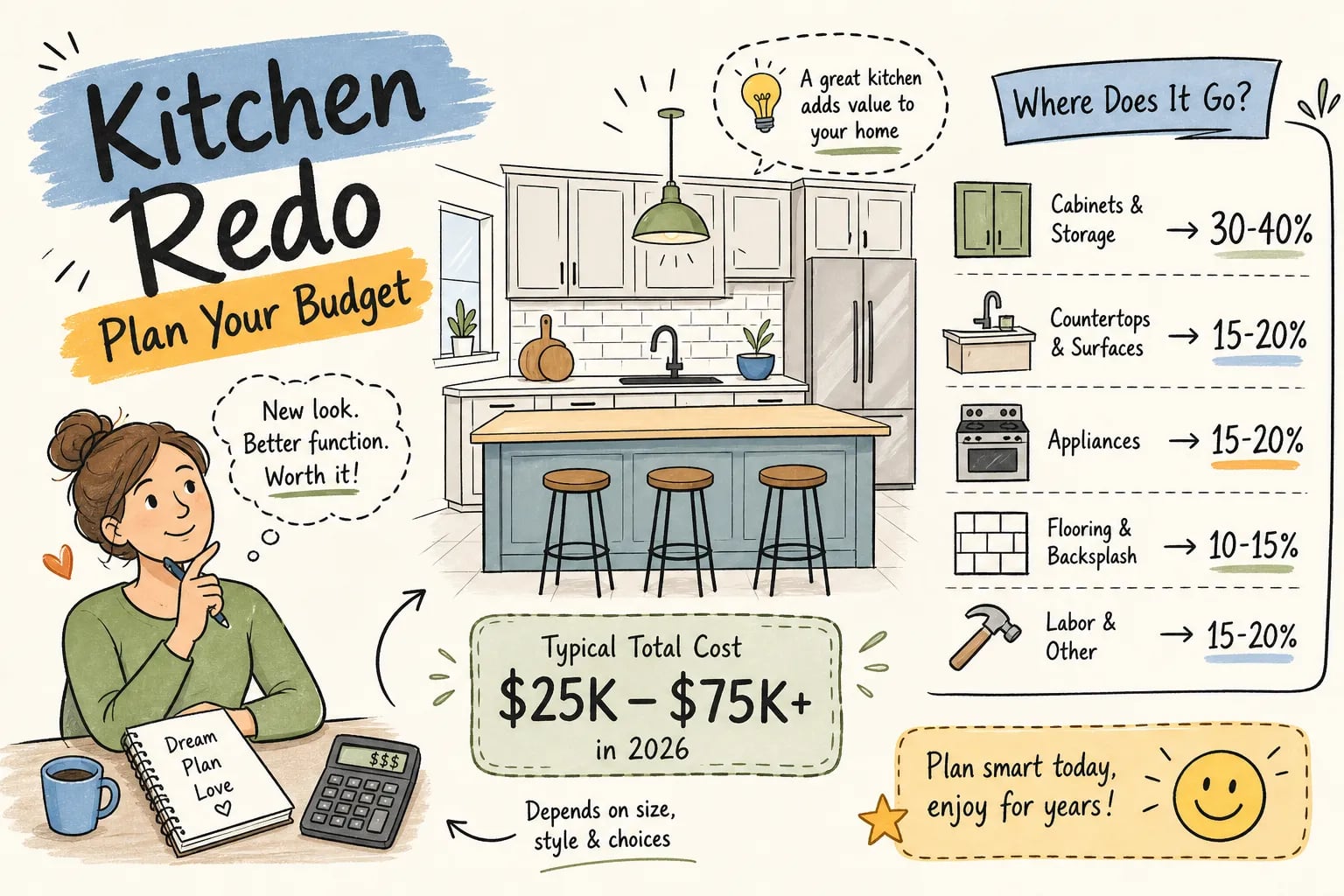
Ranges by tier are useful for orientation, but they don't tell you where the money actually goes. Most homeowners are surprised to learn how much of the budget lands on just two categories before a single appliance gets installed. Here's how a typical mid-range kitchen budget breaks down by category.
Cabinets and labor: the two biggest line items
Cabinets typically run $8,000, $30,000 depending on whether you choose stock, semi-custom, or fully custom boxes. General labor and installation runs $5,000, $25,000 separately. Combined, these two categories represent roughly 50, 65% of the total project budget. Labor scales with complexity: a cabinet-heavy kitchen with a large island and detailed finish carpentry adds hours fast, and those hours show up in your invoice.
Countertops, appliances, flooring, and fixtures
The remaining line items break down into ranges you can work with individually. Countertops run $2,000, $12,000 depending on material and edge profile. Appliances fall between $3,000, $15,000. Flooring adds $1,500, $8,000. Plumbing runs $1,500, $5,000; electrical $1,500, $6,000; permits $200, $1,500. Each of these represents roughly 10, 15% of a mid-range project. Appliances are the easiest category to flex without affecting installation complexity: moving from a $6,000 appliance package to a $10,000 one changes the brand, not the labor.
A sample mid-range budget totaled out
Here's what a concrete mid-range project actually looks like on paper:
- Cabinets: $15,000
- Countertops: $6,000
- Labor and installation: $12,000
- Plumbing: $3,000
- Electrical: $3,500
- Flooring: $4,000
- Permits: $800
- Appliances: $8,000
- Subtotal: $52,300
Add a 10, 15% contingency on top: $5,200, $7,800. That puts your realistic total at $57,000, $60,000. If a contractor has already quoted you in this range for a comparable scope, the number is credible. If the quote came in at $35,000 for the same work, something is either missing or underpriced.
What Drives the Cost of Redoing a Kitchen Up Fast
A few decisions multiply your total quickly. Knowing them in advance prevents the budget creep that catches homeowners off guard mid-project.
Layout changes vs. keeping the same footprint
Moving the sink, relocating the range, or opening a wall to another room can add $5,000, $20,000 before a single cabinet goes in. Plumbing relocation requires new rough-in work and inspections. Electrical circuits follow new appliance placement. Structural changes may require engineering drawings and additional permit review. Minor plumbing moves typically land at the lower end of that range; structural wall removal with beam work pushes toward the top. Keeping the existing footprint is the single most effective way to control your kitchen remodel budget. It sounds like a compromise; in most cases, it's a smart constraint.
Material grade and how it multiplies across the whole project
Choosing custom cabinets over stock shifts that line item from $8,000 to $30,000 alone. The cabinet-and-countertop cost combination is where grade decisions hit hardest: countertop material can swing $2,000, $12,000 depending on whether you choose laminate, quartz, or natural stone such as quartzite. These aren't isolated decisions. Higher-end finishes pull hardware, lighting, and fixture selections upward with them. The grade you choose at the cabinet level effectively sets the standard for the rest of the room.
Kitchen size and its effect on every category
Square footage affects labor hours, material quantities, and flooring cost proportionally. A 100-square-foot galley kitchen and a 300-square-foot open-concept kitchen aren't three times apart in total cost, but they're close. For planning purposes, mid-range remodels typically run $150, $250 per square foot; high-end finishes and custom work push that figure to $250, $400 per square foot. Use those bands as a sanity check against any quote you receive.
Hidden Costs That Catch Homeowners Off Guard
Surprise costs aren't accidents; they're predictable categories that simply aren't visible at quote time. Planning for them is how you avoid project-stopping conversations after demo begins.
What demo reveals behind the walls
In homes more than 20 years old, demolition regularly uncovers rotted subfloor, corroded plumbing lines, mold under old flooring, outdated wiring without ground fault protection, or termite damage in framing. Mold remediation alone runs $1,500, $4,500 before the rebuilding begins. Subfloor repair adds $2,000, $10,000 depending on extent. A load-bearing wall removal with beam installation typically costs $4,000, $12,000. These aren't rare edge cases; they're common findings in older homes and should be part of every pre-project conversation.
Permits, code corrections, and inspections
Most kitchen remodels that include electrical or plumbing work require permits. In Florida, total permit packages often run $800, $1,500 depending on county and scope. The bigger risk is code corrections: older homes may need panel upgrades ($2,000, $4,000), updated GFCI and AFCI protection, or duct rerouting to meet current Florida Building Code standards. These aren't optional line items. They surface during inspection and must be resolved before the project closes out.
How much contingency to actually set aside
A tiered recommendation based on project type:
- 10% for a same-footprint cosmetic update in a relatively modern home with limited demolition
- 15% for a typical mid-range renovation with appliance circuits and plumbing changes
- 20, 25% for an older home, a layout change, suspected water damage, or uncertain permit conditions
On a $50,000 project, those percentages translate to keeping $5,000 (10%) up to $12,500 (25%) liquid and separate from the contract price. Contingency is not an upgrade fund. It exists specifically to absorb what gets uncovered, not to buy better appliances when there's money left over.
Where to Splurge and Where to Cut Without Regret
Not every dollar in a kitchen remodel delivers equal value. Knowing where quality pays off and where you can pull back is a practical decision framework, not just advice to spend less.
Worth the investment every time
Cabinets are the one area where quality consistently pays off. Solid-box construction with dovetail joints and soft-close hardware lasts decades; cheaper boxes show wear within a few years. Countertops in high-use areas, particularly around the sink and prep zone, also warrant durable materials. A well-spec'd range hood ducted to the exterior matters for air quality and moisture control, especially in Florida's humidity. Dedicated appliance circuits prevent nuisance breaker trips for years and are required by code in most jurisdictions.
Where you can save without sacrificing quality
Appliances are the most flexible line item: mid-tier brands from major manufacturers perform comparably to premium labels in most kitchens, and the performance gap rarely justifies a $5,000 price difference in a home kitchen. Porcelain tile that mimics hardwood costs a fraction of real wood and holds up better in a kitchen environment. Subway tile and standard field tile for the backsplash look clean and classic at $3, $8 per square foot. Hardware is inexpensive to upgrade later if your taste changes. Pull back here if the budget is tight and put that margin toward cabinet quality instead.
DIY vs. Hiring Pros: What You Can Actually Save
There's real money to save on certain tasks. There's also real risk in overestimating what you can handle without trade licensing, permits, or code knowledge. The math on DIY holds in specific categories and fails badly in others.
Tasks that are genuinely worth doing yourself
Non-structural demolition, cabinet removal, flooring tear-out, and cosmetic drywall removal, can save $1,500, $3,000. The tradeoff is time: expect the work to take about 1.5 times longer than a professional crew. Painting saves $1,000, $2,500 versus professional labor on a full kitchen repaint. Backsplash installation is manageable for a methodical DIYer and can save $600, $1,100. All three tasks are forgiving of minor imperfection, don't involve permits, and carry no safety or code risk.
Work that should always go to licensed trades
Structural demolition, plumbing relocation, electrical rough-in, gas line work, HVAC rerouting, and waterproofing are not areas where DIY savings hold up under scrutiny. A misrouted drain or an improperly protected circuit doesn't surface until a home inspection at resale time, and the remediation then costs far more than the original savings. A $500 shortcut that requires $3,000 to fix isn't a savings; it's a deferred expense with interest. For Florida homeowners specifically, unpermitted work in these categories can also create problems with insurance claims after storm damage.
How Location Affects Your Kitchen Remodel Budget
A quote from a friend in another state is useful context, but it's not a direct comparison. Labor rates, permit requirements, and code conditions vary enough by market to move the total meaningfully.
How much market multipliers move the number
Using a $50,000 national baseline, here's how major U.S. markets compare: New York metro pushes that figure to $62,000, $72,000; Los Angeles to $60,000, $70,000; Chicago to $52,000, $60,000; Dallas to $47,000, $55,000; Atlanta to $45,000, $52,000. Labor accounts for roughly 35% of a kitchen budget, so local wage differences don't move the total as dramatically as people expect. Cabinets and appliances are mostly priced nationally. Permits, inspections, and code requirements are where regional variation hits hardest.
What this means for Florida homeowners specifically
Florida markets generally track near or slightly below the national average, but kitchen renovation costs vary by county, permit requirements, and whether the home sits in a flood zone or under HOA design restrictions. Moisture-resistant materials and proper ventilation are not optional upgrades in a Florida kitchen; they're functional necessities given the humidity. For homeowners in Northeast and Central Florida specifically, local contractor availability and permit processing timelines also affect total project duration and soft costs. Coastal properties may face additional county-level review requirements that add time, not just expense.
How to Get a Reliable Quote and What to Look for in a Contractor
The final step between knowing your budget and committing to a project is getting a quote you can actually trust. Most homeowners don't know what a trustworthy estimate looks like until they've seen a bad one.
What a solid kitchen remodeling estimate actually includes
A trustworthy quote is line-itemized, not a single lump sum. It should specify cabinet brand and box construction, countertop material and edge profile, appliance allowance or specific model numbers, permit fees, demo scope, and a defined contingency structure. A vague estimate ("full kitchen remodel, $45,000") protects the contractor, not the homeowner. Before signing anything, ask for a written scope of work with materials named. If the contractor can't produce that, find one who can.
Working with Infinity Legacy on your kitchen remodel
Infinity Legacy is a licensed Florida contractor (CGC1540795) based in Palm Coast, serving homeowners across Northeast and Central Florida. For kitchen remodels, Infinity Legacy provides free, transparent estimates broken down into clear line items so you know exactly what you're paying for and why. As a multi-trade contractor, the team handles cabinetry, countertops, electrical, plumbing coordination, and finish work under one accountable team, eliminating the coordination headache of managing separate subcontractors who each have their own schedule and communication style. For homeowners who need financing flexibility, the PACE program may offer low-down financing options repaid through the property tax bill; eligibility requirements and program terms vary by locality, so ask about current availability when you request your estimate.
Frequently Asked Questions: Cost to Redo a Kitchen
What is the average cost to remodel a kitchen in Florida?
Florida projects generally track near the national average. A minor kitchen refresh runs $10,000, $25,000, a mid-range remodel falls between $25,000, $65,000, and a full gut renovation starts at $65,000 and can reach $130,000 or more. Exact figures depend on county, scope, finish level, and permit requirements.
How do I know if my quote is accurate?
A credible quote is line-itemized and names specific materials. If a contractor quotes a lump sum without breaking out cabinets, countertops, labor, permits, and contingency separately, ask for the detail. Vague estimates protect the contractor, not you.
Does Infinity Legacy serve my area?
Infinity Legacy serves homeowners across Northeast and Central Florida from its Palm Coast base. Reach out directly to confirm service availability for your specific location and to request a free, itemized kitchen remodel estimate.
Know Your Tier, Build Your Estimate, and Take the Right Next Step
The cost of redoing a kitchen is wide-ranging for good reason: scope, size, material grade, location, and what gets uncovered during demo all pull the number in different directions. But you now have a framework. Identify your tier, build a line-item estimate using the ranges in this article, set aside a real contingency before the project starts, and understand which decisions move the needle most before committing to anything.
The path to an accurate number starts with a specific, written quote from a licensed contractor who can walk the space. Square footage estimates and online calculators get you oriented; they don't replace eyes on the kitchen. If you're in Florida and ready to move from research to a real number, reach out to Infinity Legacy for a free estimate. The goal isn't the cheapest kitchen remodel. It's the one that delivers lasting value without surprises along the way.