When homeowners start planning a kitchen renovation, the most expensive mistake they make is picking a budget number before understanding the actual scope of work. In our experience at Infinity Legacy, that mismatch, scope defined after the number is set, is what turns a $35,000 project into a $55,000 one by the time the last cabinet goes in.
Kitchen renovation costs in 2026 span a wide range: from around $10,000 for a cosmetic refresh to $150,000 or more for a full gut renovation. Most homeowners we work with across Northeast and Central Florida land somewhere in the middle. The ones who stay on budget consistently share one trait: they defined their scope before they set their number, not after. Across the projects our team sees in Florida, the pattern is clear about where money goes, where it gets wasted, and where smart decisions make a real difference.
By the end of this article, you'll know which budget tier fits your project, what each major cost category should run, where surprises tend to hide, and how to trim your total without sacrificing the things that matter most.
The three budget tiers every homeowner should understand first
Before any cost conversation makes sense, you need to know which tier you're actually in. These aren't marketing categories. They reflect meaningfully different scopes of work, and the gap between them isn't just a price difference, it's a project difference.
Minor refresh: cosmetic upgrades, big visual impact
The $10,000, $25,000 tier is the right scope when your kitchen's bones are solid. Cabinet boxes are structurally sound, the layout works, and your main complaint is that the space feels dated. This tier typically covers cabinet repainting or refacing, new hardware, updated countertops, a backsplash, new lighting, and selective appliance swaps. The key reason this scope stays affordable is that the existing layout doesn't change, no plumbing moves, no electrical rerouting, no structural work.
The constraint worth naming honestly: if you're dealing with water damage, aging plumbing that's starting to fail, or a layout that genuinely doesn't function, a refresh won't solve those problems. It will make the kitchen look better for a few years while the underlying issues continue to develop. That's a delay, not a fix.
Mid-range remodel: the most common scope in 2026
The $25,000, $65,000 range, averaging around $40,000, is where most homeowners land. This is also the most researched tier when homeowners look up the average kitchen remodel cost in 2026. At this scope, you're looking at semi-custom cabinetry, new countertops (typically quartz or granite), a full appliance replacement, new flooring, backsplash, updated lighting, and modest electrical or layout adjustments. This scope meaningfully improves both how the kitchen looks and how it functions, without requiring structural changes or major plumbing relocation.
For most households, this tier delivers a genuine transformation, the kitchen you start with and the one you finish with feel like different rooms. If you're building a kitchen remodeling budget around a realistic scope, this range gives you enough to work with without overcommitting to a gut renovation you may not need.
Full gut renovation: rebuilding the room from scratch
The $60,000, $150,000+ tier is for homeowners whose kitchens have a non-functional layout, significant existing damage, or who want a result that will outlast two or three design cycles. Custom cabinetry, premium stone countertops, luxury appliances, wall removal, plumbing relocation, and electrical panel work are all in play here. This scope requires a longer planning runway, more detailed design decisions upfront, and a contingency reserve that matches the complexity of the work.
This tier is not for everyone, and it shouldn't be approached as an aspirational upgrade to a mid-range project. The cost jump from mid-range to high-end is steep, and it's driven by real labor and material differences, not just finish choices.
Kitchen renovation costs: line-item breakdown by category
National averages are a useful starting point, but building an accurate kitchen renovation estimate requires line-item specifics. Here's what the major categories typically cost in 2026, based on current project data from contractors and industry sources.
Cabinets and countertops: where most of the budget goes
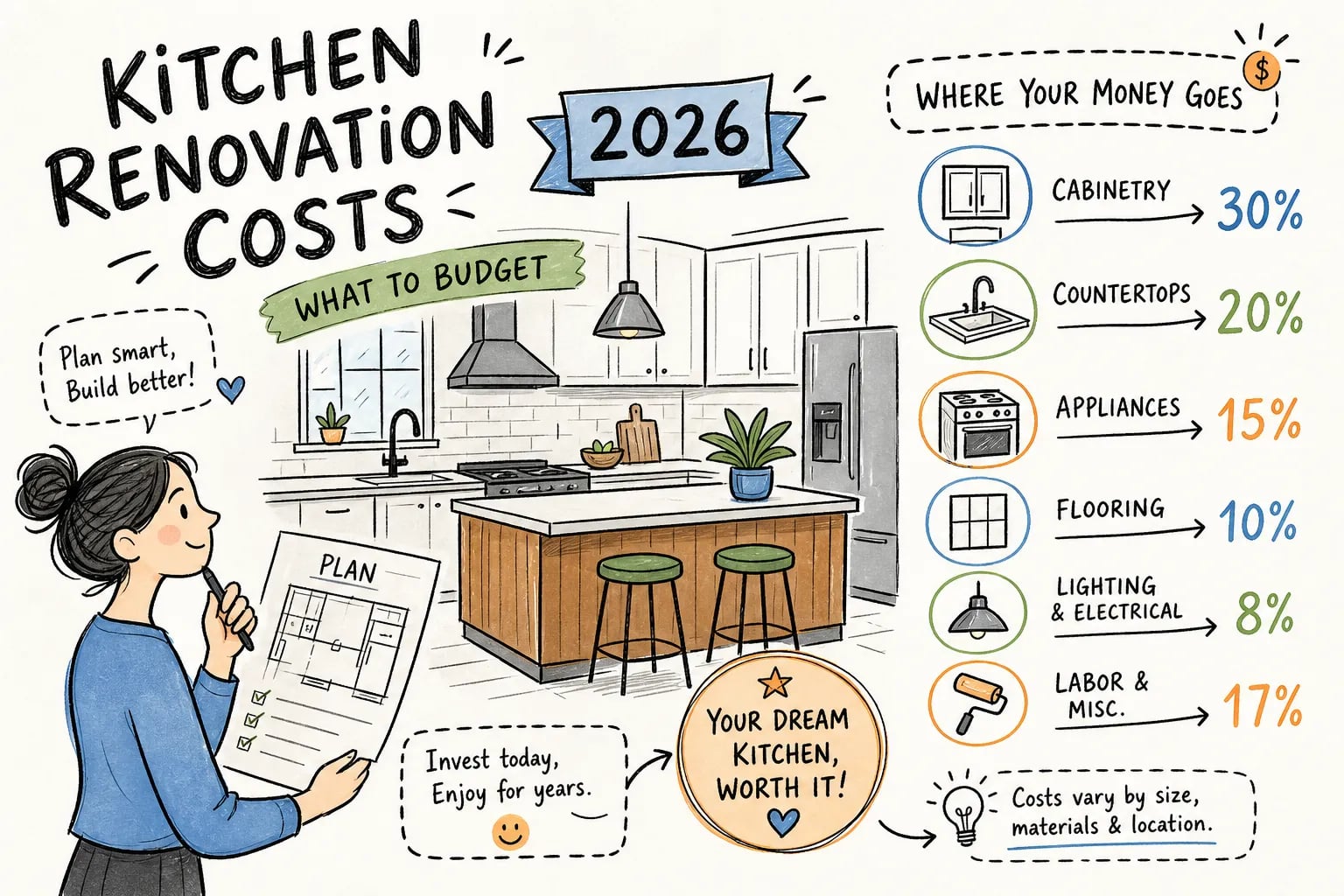
Cabinets are the single largest budget category in any kitchen renovation, typically consuming 30%, 40% of the total. Stock cabinets run $75, $200 per linear foot installed, semi-custom cabinets run $150, $500, and custom cabinetry ranges from $500, $1,200 per linear foot. For the full project, you're looking at $5,000, $25,000 depending on kitchen size and the tier you choose.
Countertops add $2,000, $15,000 overall, and the material choice alone can swing that number by $5,000, $10,000 on a mid-sized kitchen. Laminate installs at $20, $50 per square foot, butcher block at $30, $100, granite at $45, $200, quartz at $55, $150, and marble at $70, $250. These aren't just aesthetic decisions, they're budget decisions with a real dollar impact that should be locked in before the project starts.
Appliances, flooring, and backsplash
A standard appliance package runs $3,000, $15,000, with premium configurations reaching $20,000 for high-end ranges, refrigerators, and integrated appliances. Flooring lands between $1,500, $8,000 depending on material (LVP, hardwood, or tile) and whether the subfloor needs repair. Backsplash typically runs $1,000, $3,000 installed for a mid-range kitchen.
These categories feel secondary, but they add up fast. The most common budget leak here is appliance upgrades that happen mid-project, after the initial quote is signed. A homeowner who planned for a $4,000 appliance package and decides mid-project to add a $3,500 range has just increased the overall kitchen renovation cost by nearly 10% on a single decision. On a $40,000 project, that's a meaningful shift.
Labor, demo, plumbing, and electrical
General remodeling labor runs $50, $85 per hour; plumbers and electricians bill $75, $125 per hour. Demolition and disposal typically add $1,500, $3,500. Plumbing work runs $1,500, $6,000, with the higher end applying when the sink or dishwasher location changes. Electrical averages $1,500, $6,000, covering outlets, lighting, appliance circuits, and possible panel upgrades. General contractor markup sits at 15%, 25% of the total project cost and is often the least visible but most impactful budget category.
Labor and trades are where budgets most often slip, because they're the hardest to estimate precisely before demo begins. What's behind the wall determines what the trade work actually costs. That's not an excuse, it's a structural reality of renovation work, and it's why contingency reserves aren't optional.
How your zip code moves kitchen renovation costs up or down
Regional cost multipliers and what they mean in practice
Kitchen renovation costs vary roughly 20%, 40% across U.S. regions, which means the same scope can cost very different amounts depending on where you live. When you look at cost per square foot, kitchen projects in lower-cost Midwest and Southern markets might run a $40,000 mid-range remodel at $34,000, $36,000 (roughly a 0.85, 0.90× multiplier). Sun Belt cities like Dallas or Atlanta land at $41,600, $43,500, while high-cost coastal metros like Seattle or New York push that same scope to $52,000, $63,800. To get a rough local planning number, multiply your national baseline by your metro's approximate factor.
These are screening estimates, not bids. Two neighborhoods in the same metro can differ materially based on permit complexity, building age, and contractor availability. Use multipliers to orient your budget, then refine it with actual local quotes.
What actually drives the regional price gap
Three factors do most of the heavy lifting. First, labor rates: skilled trades earn $40, $60 per hour in lower-cost markets versus $75, $120 in major metros. Second, permitting complexity, especially in California, New York, and coastal markets with energy codes, seismic requirements, or historic-district rules. Third, logistical factors including urban access, building rules in condo or co-op properties, and freight distance for materials.
Florida markets, where Infinity Legacy operates across Northeast and Central Florida, generally fall in the 0.90, 1.05× range. That puts them more affordable than coastal Northeast or West Coast metros while still reflecting genuine demand for licensed trade work in the state. A 150-square-foot kitchen in Jacksonville or Palm Coast typically runs $22,500, $42,000; South Florida, which skews higher at $185, $340 per square foot, can run substantially more.
Hidden costs that catch most homeowners off guard
Budget overruns don't usually happen because a contractor made a mistake. They happen because demolition reveals what couldn't be seen before it started. Understanding what's commonly behind those walls changes how you plan.
What demolition typically uncovers
The most common discoveries during demo are water damage, mold, rotted framing, and outdated wiring. Water damage and mold remediation typically add $1,000, $6,000. Structural repairs for rotted framing or load-bearing wall modifications can reach $4,000, $15,000. Electrical rewiring, new circuits, and GFCI upgrades add $1,500, $8,000. Plumbing corrections, especially when pipes are dated or the sink location is changing, add $600, $5,000. None of these are contractor errors. They're conditions hidden behind walls and under floors that no pre-demo estimate can guarantee won't exist.
The frequency of these discoveries is higher in homes built before 1990, but they show up in newer construction too, particularly near plumbing fixtures and exterior walls where moisture and heat cycling take their toll over time.
Why a contingency reserve isn't optional
Most remodeling contractors and industry groups like the NKBA recommend a 15%, 20% contingency on top of your base budget. On a $50,000 renovation, that means reserving $7,500, $10,000 before the project starts, not treating it as whatever money is left over after finishes are chosen.
Smaller items also accumulate in ways that surprise homeowners: countertop fabrication extras like special edges and seam placements ($200, $1,500), delivery and storage fees (several hundred dollars), subfloor repairs ($500, $3,000), permit fees ($130, $2,770 depending on location), and the ongoing cost of eating out or running a temporary kitchen ($600, $1,500 per month for the duration of the project). Change orders from design revisions mid-project add another 5%, 15% to contract value on average. The cleaner your decisions before signing, the lower this number will be.
How to allocate your kitchen remodeling budget across the project
Knowing what things cost is useful. Knowing how to distribute your total across categories is what turns that knowledge into a working plan.
The percentage breakdown that works for most mid-range kitchens
A practical allocation for a mid-range kitchen looks like this: cabinets at 30%, 40%, countertops at 10%, 25%, appliances at 10%, 15%, flooring at 5%, 10%, plumbing and electrical combined at 5%, 10%, and labor at 15%, 20%. On a $45,000 project, that translates to roughly $13,500, $18,000 for cabinets, $4,500, $11,250 for countertops, $4,500, $6,750 for appliances, $2,250, $4,500 for flooring, $2,250, $4,500 for plumbing and electrical, and $6,750, $9,000 for labor.
One thing worth understanding: small kitchens cost more per square foot than large ones. Fixed costs, permits, demo, appliance installation, and contractor mobilization, are spread over fewer square feet, so the per-square-foot number climbs even when the absolute total is lower. Don't benchmark your project against a cost per square foot figure from a kitchen twice the size of yours.
Where most people overspend and what to do about it
The two most common overspend categories are cabinets and appliances. The trigger is almost always the same: upgrading after the budget is set. A homeowner who starts with semi-custom cabinets and decides mid-project to step up to custom has just increased that single cost category by $5,000, $10,000. The fix is straightforward: lock these decisions before signing the contract. Decide on cabinet tier and appliance selections before you agree to a contract price, not after you've seen the showroom samples and fallen in love with the wrong option for your budget.
Fund the contingency reserve before allocating anything to finishes. This one discipline, consistently applied, prevents more budget overruns than any other single practice.
Practical ways to cut costs without gutting your design
Every kitchen renovation has room to reduce spending without compromising the result. The key is knowing which cuts actually save money and which just delay costs or create new problems.
Cabinet alternatives that save the most money
Cabinet refacing, replacing doors and drawer fronts while keeping the existing boxes, saves 30%, 60% compared to full replacement. A typical refacing project runs $4,000, $9,500 versus $10,000, $25,000 for new cabinetry. Professional cabinet painting saves even more on cost, often $5,000, $12,000 compared to new cabinets, and is the right call when the boxes are structurally sound and the layout works as-is.
Ready-to-assemble (RTA) cabinets offer a strong middle ground, saving 40%, 70% over custom cabinetry when standard dimensions work for the space. The limitation is that RTA works best in kitchens with relatively conventional layouts; odd angles, unusual ceiling heights, or complex configurations may require custom sizing that eliminates the cost advantage.
Countertop swaps and the real cost difference
Laminate countertops at $20, $50 per square foot installed versus quartz at $55, $150 per square foot represent a $1,500, $4,000 difference on a typical kitchen. Butcher block is a popular middle-ground option at $30, $100 per square foot that delivers a higher-end look with 30%, 60% savings over quartz, though it requires sealing and periodic maintenance. The countertop choice is one of the few places in a kitchen renovation where choosing a more affordable material still produces a genuinely attractive result.
Unlike cabinetry, where cheap boxes show their age quickly through sagging shelves and failing hinges, a well-installed laminate or butcher block countertop can look intentional and current for years. The material decision carries less risk of making the whole kitchen feel low-quality than a similar downgrade on cabinets would.
What's worth doing yourself and what isn't
DIY painting, hardware swaps, simple backsplash tile work, and some flooring installation can save 20%, 30% of total labor costs, commonly $1,000, $4,000 depending on project size. That's a real number and worth doing if you have the time and basic skill level for the work involved.
The hard boundary is clear: don't DIY gas lines, electrical panels, new circuits, plumbing drain relocation, or structural work. These aren't just technically difficult, they require permits and inspections, and work done without permits creates problems at resale and costs more to correct than the original trade labor would have cost. One no-cost move that saves real money: keep the existing kitchen layout. Not moving the sink, stove, or refrigerator eliminates $1,500, $3,000 in plumbing and electrical relocation costs automatically, before you've made a single other decision.
Why a multi-trade contractor can lower your total project cost
Kitchen remodels don't happen in isolation. They touch plumbing, electrical, flooring, cabinetry, and often HVAC when ventilation or ductwork is involved. How those trades are coordinated has a direct effect on cost and timeline.
The coordination problem most homeowners don't price in
When a homeowner hires a general contractor who subcontracts a plumber, an electrician, and a tile setter separately, each trade adds its own markup and schedule. Miscommunication between trades causes delays, rework, and duplicate mobilization charges. The GC markup alone runs 15%, 25% of the project total, on a $50,000 renovation, that's $7,500, $12,500 in overhead before a single cabinet is installed.
If the kitchen remodel is part of a larger project, coordination costs compound. A bathroom renovation happening at the same time, or HVAC ductwork running through the kitchen ceiling, adds scheduling complexity that a fragmented contractor approach handles poorly. Delays on one trade stall the next, and the homeowner absorbs the cost of that inefficiency through a longer project timeline and the ongoing expense of living without a functional kitchen.
How Infinity Legacy handles kitchen remodels differently
Infinity Legacy is a licensed multi-trade contractor (CGC1540795) based in Palm Coast, handling remodeling alongside roofing, HVAC, and impact windows under one accountable team. For homeowners in Northeast and Central Florida, this means a kitchen remodel doesn't require a separate HVAC contractor if ventilation modifications are needed, or a separate roofer if structural work above the kitchen ceiling is involved. One team, one schedule, one point of contact throughout the project.
The reduction in coordination overhead, redundant site visits, and inter-trade miscommunication translates to real savings on complex projects and a shorter timeline for homeowners who don't want to spend months managing multiple vendor schedules. A direct multi-trade contractor typically runs 5%, 15% less than a traditional GC-plus-subcontractor arrangement on the same scope. Reach out for a free estimate. We scope the full project before you commit to any budget category.
What to nail down before you call anyone for a kitchen renovation estimate
The quality of your estimate is directly tied to the clarity of your brief. Contractors give better bids when homeowners come in with a defined scope, not a general desire to "redo the kitchen."
The four decisions that shape your estimate
Before calling a contractor, you need four answers: your actual scope (refresh, mid-range, or gut), whether the layout is changing, what your non-negotiable finishes are so you can protect those in the budget and flex on others, and what your realistic total budget is including the contingency reserve. These four decisions narrow the bid from a wide guess to a reasonably accurate kitchen renovation estimate. Without them, even a skilled contractor is quoting a moving target.
Also decide early whether any adjacent projects are happening at the same time. A bathroom remodel, an HVAC replacement, or impact window installation happening alongside the kitchen renovation changes the contractor conversation entirely, and creates real opportunities for coordination savings that disappear if you sequence the projects separately.
How to vet a contractor before signing anything
Verify the license number, confirm they pull permits for all applicable work, ask for references on projects at a similar price point, and get at least three itemized bids rather than a single lump-sum number. A lump-sum bid makes it nearly impossible to compare contractors fairly or identify where one is cutting corners on materials or labor hours.
Ask directly how they handle change orders. A contractor who can explain their change order process clearly is one whose projects run more predictably. A vague or evasive answer to that question is an early signal that budget surprises during the project are more likely than they should be.
Matching your scope to your budget from the start
Kitchen renovation costs in 2026 are predictable when you do the work of matching your budget to your scope before the first contractor walks through the door. The three tiers, refresh, mid-range, and gut renovation, exist because they reflect genuinely different projects with genuinely different price structures. Treating them as a single sliding scale is where most budget problems begin.
The biggest cost categories are cabinets and countertops, and the biggest savings come from keeping the existing layout, choosing refacing over replacement when the boxes are sound, and locking appliance decisions before signing the contract. Build your contingency reserve before allocating to finishes and treat it as a fixed cost, not a fallback. When you look at the cost to remodel a kitchen in the $40,000, $60,000 range, that reserve is $6,000, $12,000 you're hoping not to spend but genuinely need to have available.
For Florida homeowners, working with a multi-trade team simplifies the entire process. It reduces the overhead of managing multiple vendors, eliminates the scheduling gaps that extend timelines, and keeps the project accountable to one team rather than three or four. Reach out to Infinity Legacy for a free estimate and start with a clear scope. Defining what you're actually building before you set a number is the difference between a project that finishes on budget and one that doesn't.