
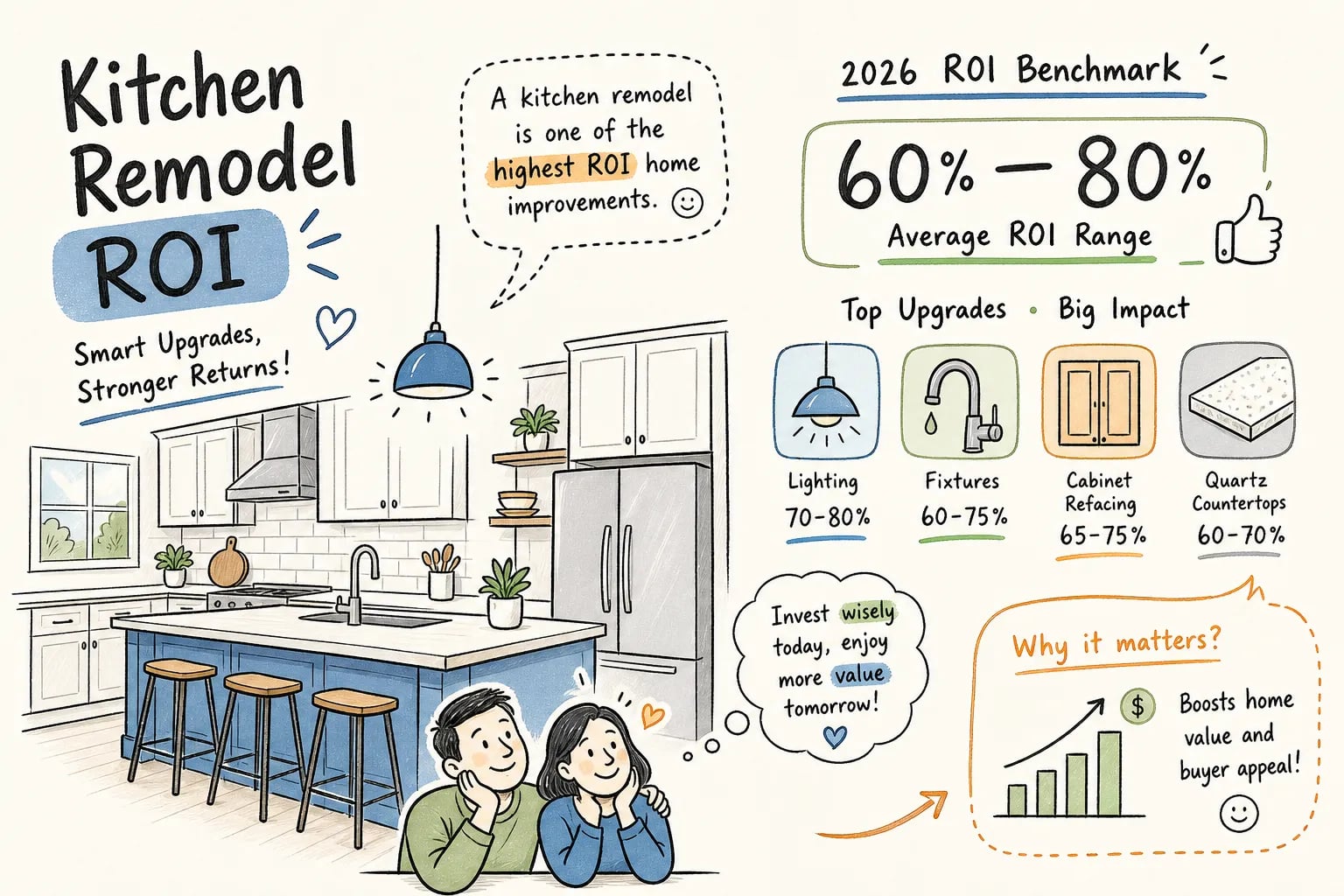
If you want the best ROI kitchen remodel results, start by understanding what the data actually shows. Spend four times more on your kitchen and you'll recoup four times as much at resale, that's the assumption most homeowners carry into a remodel, and it costs them. The 2025 Zonda/Remodeling Magazine Cost vs. Value Report, which covers 30 project types across 119 U.S. housing markets and serves as the industry's most reliable 2026 benchmark, tells a different story. A minor kitchen refresh returns an average of 112.9% nationally. A major upscale renovation returns about 36%. The gap between those numbers is the difference between a smart investment and an expensive lesson.
At Infinity Legacy, we've walked through enough completed kitchens to see this pattern play out in real projects. A well-planned minor refresh, done right and on budget, consistently outperforms a gut renovation at resale. That's not a knock on beautiful kitchens. It's a recognition that buyers pay for clean, functional, and updated, not necessarily custom or luxurious.
This article covers the actual ROI kitchen remodel benchmarks by project scope for 2026, the specific upgrades with the strongest payback, and the budget rules that keep your investment working in your favor. These are numbers and frameworks, not contractor marketing.
What ROI actually means for a kitchen remodel
Kitchen remodel return on investment has a precise definition in the context of resale: the resale value added divided by the project cost, expressed as a percentage. If a $28,000 project adds $32,000 in resale value, the ROI is approximately 113%. That's the question the Cost vs. Value Report answers, if you sold the day after finishing, how much of the cost would you get back?
This is different from two things homeowners often confuse it with. First, it's not the same as personal enjoyment value. A kitchen you love to cook in delivers real quality-of-life returns, but those don't appear in the resale column. Second, it's not a guaranteed home equity calculation. Adding $30,000 in renovation costs to your home does not automatically add $30,000 to its appraised value or sale price. The market sets the return, not the invoice.
The Zonda/Remodeling Magazine Cost vs. Value Report is the primary source for the benchmarks in this article. The NARI Remodeling Impact Report provides a secondary perspective focused on recovered cost and homeowner satisfaction, which is useful for owner-occupants weighing long-term enjoyment against resale. Both are the most defensible sources available for 2026 kitchen remodel planning.
ROI kitchen remodel benchmarks by project scope
Minor kitchen remodel: the highest-returning category
A minor kitchen remodel averages 112.9% ROI nationally, which means it returns more than its full cost at resale. The numbers: roughly $32,141 in resale value added on a $28,458 project. This is the strongest kitchen remodel ROI category by a significant margin, and the reason is structural. A minor remodel keeps the existing layout intact. Cabinets get refaced or repainted. Countertops are updated. Appliances are swapped within the existing footprint. Lighting and hardware are refreshed. There are no wall moves, no plumbing relocations, no structural surprises.
Labor and material costs stay controlled when the layout doesn't change, but the visual transformation is significant. Buyers see a clean, updated kitchen, they don't see the cost savings behind the decision. That's exactly the combination that produces a return above 100%.
Midrange kitchen update: solid returns with real trade-offs
A midrange kitchen update sits around 49.5% to 51% ROI nationally. This tier typically includes partial cabinet replacement, upgraded countertops, new mid-range appliances, and some flooring updates. The visual impact is greater than a minor refresh, but the percentage payback drops significantly because more components are being replaced rather than refreshed.
A midrange project makes sense when the kitchen is functionally outdated, not just cosmetically tired. If the cabinets are structurally compromised, the layout genuinely doesn't work, or the appliances are failing, a deeper update is justified. The lower ROI percentage doesn't mean it's a bad investment, it means the decision should be driven by functional need rather than resale math alone.
Major and upscale renovation: where diminishing returns set in
An upscale kitchen renovation averages about 36% ROI nationally, with roughly $58,592 in resale value added on a $164,104 project. In absolute dollars, you're recovering more than with a minor remodel. In percentage terms, you're recovering less than half of what you spent. That gap is where homeowners get hurt.
Custom cabinetry, high-end stone, luxury appliance suites, and full layout reconfigurations add cost far faster than they add buyer-perceived value. A buyer standing in a completed kitchen can't see that the range hood required a structural ceiling change. They can see whether the kitchen looks clean and modern. That's the insight behind the ROI gap: finishes create buyer appeal, but infrastructure changes create invoices.
Best kitchen upgrades for resale: where your dollars return the most
Surface-level changes that move the needle most
The pattern across 2025 and 2026 remodeling data is consistent: visible, cosmetic improvements return far more per dollar than structural or layout changes. The following upgrades represent the strongest performers for resale-focused kitchen remodel ROI.
- Cabinet refacing or repainting: 80, 100% ROI; $2,000, $9,000. Transforming the look of the cabinets without replacing the boxes is the single highest-leverage upgrade in the kitchen. It's cheaper than full replacement by 30, 70% and delivers nearly equivalent visual results.
- New hardware (pulls, handles): 90, 100% ROI; $200, $800. The lowest-cost upgrade on the list with one of the highest returns. New hardware changes the character of the entire kitchen for a few hundred dollars.
- Updated lighting fixtures: 80, 90% ROI; $400, $2,500. Buyers notice light. A dark kitchen reads as small and dated. Updated fixtures, under-cabinet lighting, and recessed lighting make a kitchen feel larger and more functional.
- Mid-range countertops (quartz): 75, 90% ROI; $2,500, $6,000. Quartz and similar mid-tier surfaces signal cleanliness and durability to buyers. This is a high-visibility surface that gets touched and examined during every showing.
- Mid-range appliance package: 65, 80% ROI; $4,000, $9,000. Stainless steel, matching finishes, and current models matter to buyers. High-end luxury appliances, however, do not return proportionally more than mid-range packages.
- Backsplash refresh: 70, 85% ROI; $600, $2,000. A dated backsplash is one of the first things buyers notice. A clean, neutral tile refresh updates the entire space for relatively low cost.
What to skip if resale is the primary goal
Full cabinet replacement returns approximately 55, 70% ROI at a cost of $10,000, $25,000. Compared to refacing, it adds significant cost without proportionally better resale results. Layout changes involving wall removal or plumbing relocation typically return 50, 65% ROI and cost $8,000, $20,000 or more. Luxury appliance packages sit at 40, 55% ROI and can run $15,000, $40,000 for appliances alone.
The pattern behind all three is the same: any work that moves walls, pipes, or electrical adds cost far faster than it adds perceived buyer value. Infrastructure changes are invisible at resale. The buyer standing in your kitchen doesn't know what's behind the walls or under the floor. They see surfaces, light, and layout. Spending the budget where buyers can actually see it is the discipline that separates high-return remodels from expensive ones.
How location and home price affect your kitchen remodel ROI
Regional variation is real and significant
The 2025 Cost vs. Value Report shows that minor kitchen remodel ROI ranges from approximately 94.5% in the West North Central region to approximately 129% in the Pacific region. Most other regions fall between 101% and 134%. For major midrange projects, the Pacific averages around 73% while East South Central markets average around 57%. The spread between the highest and lowest regions is meaningful enough to affect your planning decisions.
What drives the regional variation is inventory and price-per-square-foot. In tight coastal markets where homes sell quickly and buyers compete, a well-finished kitchen commands a premium that's easier to recoup. In slower inland markets, buyers have more options and less urgency to pay up for finishes. This doesn't mean remodeling doesn't pay in those markets, it means the return ceiling is lower, which should inform how much you spend.
Matching your project scope to your home's price tier
For homes under $300,000, overcapitalizing on an upscale remodel is a real financial risk. The neighborhood market sets a price ceiling regardless of finish level. A $40,000 kitchen remodel in a neighborhood where homes sell for $280,000 won't recover at resale, because buyers in that market aren't paying for it. A well-executed $15,000, $20,000 minor refresh in the same home is far more likely to return its cost.
For homes in the $300,000, $600,000 range, midrange projects typically align best with buyer expectations. This is the tier where buyers notice a dated kitchen and factor it into their offer, but they're not expecting custom cabinetry and imported stone. For homes above $600,000, higher-end finishes are appropriate, but the Cost vs. Value data still shows that percentage ROI declines as project scope grows. Even at the top of the market, spending discipline matters. The 5, 15% of home value rule discussed in the next section is the practical guardrail for every price tier.
Budget rules to protect your kitchen remodel investment
The 5-to-15% of home value rule and how to apply it
The widely used budgeting framework for kitchen remodels is straightforward: keep spending between 5% and 15% of the home's current market value. For a $300,000 home, that's $15,000 to $45,000. For resale-focused projects, staying at the conservative end of that range, 5, 10%, is the safest approach. For owner-occupants who plan to stay for five or more years, the upper range is more defensible because personal enjoyment offsets a lower resale ROI.
Here's how to make the math concrete. A $350,000 home has a kitchen remodel budget of $17,500 to $52,500 under the full range. If the goal is resale within two years, the working budget is $17,500 to $35,000. That comfortably covers a well-executed minor remodel with cabinet refacing, quartz countertops, updated lighting, new hardware, and a mid-range appliance package. That's the project tier that returns above 100% nationally. Staying within that range isn't a constraint; it's the strategy.
Signs you're about to overcapitalize
The warning signs show up before the project starts, not after. If the planned project cost exceeds 15% of the home's current market value, that's the first signal. If the finishes are significantly above what comparable homes in the neighborhood offer, buyers won't pay the premium back. If the project scope involves layout changes that push the budget into upscale territory, the ROI math shifts sharply against you.
Overcapitalization isn't just a problem at resale. A home that's been over-improved for its neighborhood often sits longer on the market and sometimes sells for less than expected because buyers at that price point are shopping in different neighborhoods. The goal is a kitchen that makes your home competitive in its market, not one that competes with homes in a higher price tier.
Why contractor coordination is a hidden ROI killer
The real cost of managing multiple vendors
Most homeowners don't anticipate that a kitchen remodel involves more than one trade. Cabinet work, countertop installation, plumbing for the sink, electrical for new lighting and appliances, and HVAC adjustments for range hood ventilation all have to happen in sequence. When a homeowner coordinates multiple separate contractors, scheduling gaps, miscommunication, and rework are common outcomes. Each delay adds carrying cost if the home is vacant, and rework eats directly into the project's return.
The sequencing problem is real. A countertop fabricator needs to measure after cabinets are set. An electrician needs access before drywall is finished. A plumber needs to rough in before cabinets go in. When each of those contractors operates on their own schedule and answers only to their own calendar, the project timeline stretches. For a seller, time is money, a vacant home carries mortgage, insurance, and utility costs every month it sits unfinished.
How a multi-trade contractor protects your investment
A licensed multi-trade contractor handles cabinetry, electrical, plumbing rough-in, and HVAC-related work under one accountable team. One project manager, one schedule, one point of contact. At Infinity Legacy, that's how we approach kitchen remodels: the work moves in sequence because all the trades answer to the same team. There's no finger-pointing between vendors when something needs to be adjusted, and the project doesn't stall waiting for one subcontractor to open a slot on their schedule.
For homeowners focused on resale, this coordination directly protects your kitchen remodel ROI, the project finishes faster, on budget, and without the re-do costs that come from poor hand-offs. Infinity Legacy also offers PACE financing with $0 down for qualifying projects, which allows homeowners to move forward without waiting to free up capital. The financing is repaid through the property tax bill and requires no traditional credit qualification, making it a practical option for homeowners who want to complete the remodel before listing.
A pre-remodel checklist to maximize your kitchen's resale return
Before you spend a dollar: the decisions that drive ROI
The decisions you make before a contractor ever sets foot in your kitchen determine most of the financial outcome. Skipping this phase is where homeowners most often lose money. These six checkpoints take an afternoon and can save tens of thousands.
- Get a current market valuation. You need to know your home's actual price tier before you set a budget. A real estate agent's comparative market analysis is free and gives you the data you need.
- Set a firm budget using the 5, 15% rule before any contractor conversations. Once a contractor is in front of you, scope creep starts. Go in with a number.
- Define the goal clearly. Resale preparation, long-term living, or both, these lead to different project scopes and different ROI expectations.
- Identify the specific buyer pain points your current kitchen creates. Dated cabinets, no counter space, poor lighting, and a lack of storage are the most common. Fix what buyers will actually notice.
- Confirm the existing layout works before assuming it needs to change. Most kitchens that feel small or dated are neither. A layout change is expensive and returns poorly at resale.
- Decide on minor refresh or midrange update before the design phase begins. Letting a design conversation drive scope is how minor projects become major ones.
During planning: what to confirm with your contractor before signing
Once you're in planning conversations, the checkpoints shift from strategy to execution. Confirm the contractor is licensed and insured before anything else. In Florida, verifying the contractor's license number is simple and takes two minutes. Ask for a written scope that specifies materials and finishes by name, not by category. "Quartz countertop" is not a specification; "Silestone Eternal Calacatta Gold, 2 cm thickness" is a specification.
Verify that permits are included in the scope and that the contractor handles the permit process. Ask specifically how multi-trade coordination is handled if electrical, plumbing, or HVAC work is part of the project. A vague answer to that question is a warning sign. Clarify the warranty on both labor and materials in writing. Change orders are how project budgets fail, a specific scope agreed on before work begins is the single most effective protection against them.
What your kitchen remodel will actually return
The data is clear on which project tier wins. A minor kitchen refresh produces the strongest percentage return of any category, above 100% nationally, while major renovations recover less than 40 cents on the dollar. The specific upgrades you choose and how tightly you control scope matter more than the total dollar amount you spend. Budget discipline tied to your home's actual market value is what separates a smart remodel from an expensive one.
Where homeowners most often lose money is not in the finishes they pick but in scope creep, layout changes they didn't actually need, and disorganized project execution across multiple vendors. The financial outcome of a kitchen remodel is largely decided before the first cabinet door comes off. The planning decisions, the budget guardrails, and the contractor coordination structure all determine whether the roi kitchen remodel investment pays off or becomes a cautionary tale.
If you're planning a kitchen remodel in Florida and want a single, accountable team that handles the full scope, reach out to Infinity Legacy for a free estimate. We work across roofing, HVAC, windows and doors, and remodeling under one license and one team, so your project moves in sequence and finishes the way it was planned. Get in touch with our team to start the conversation.