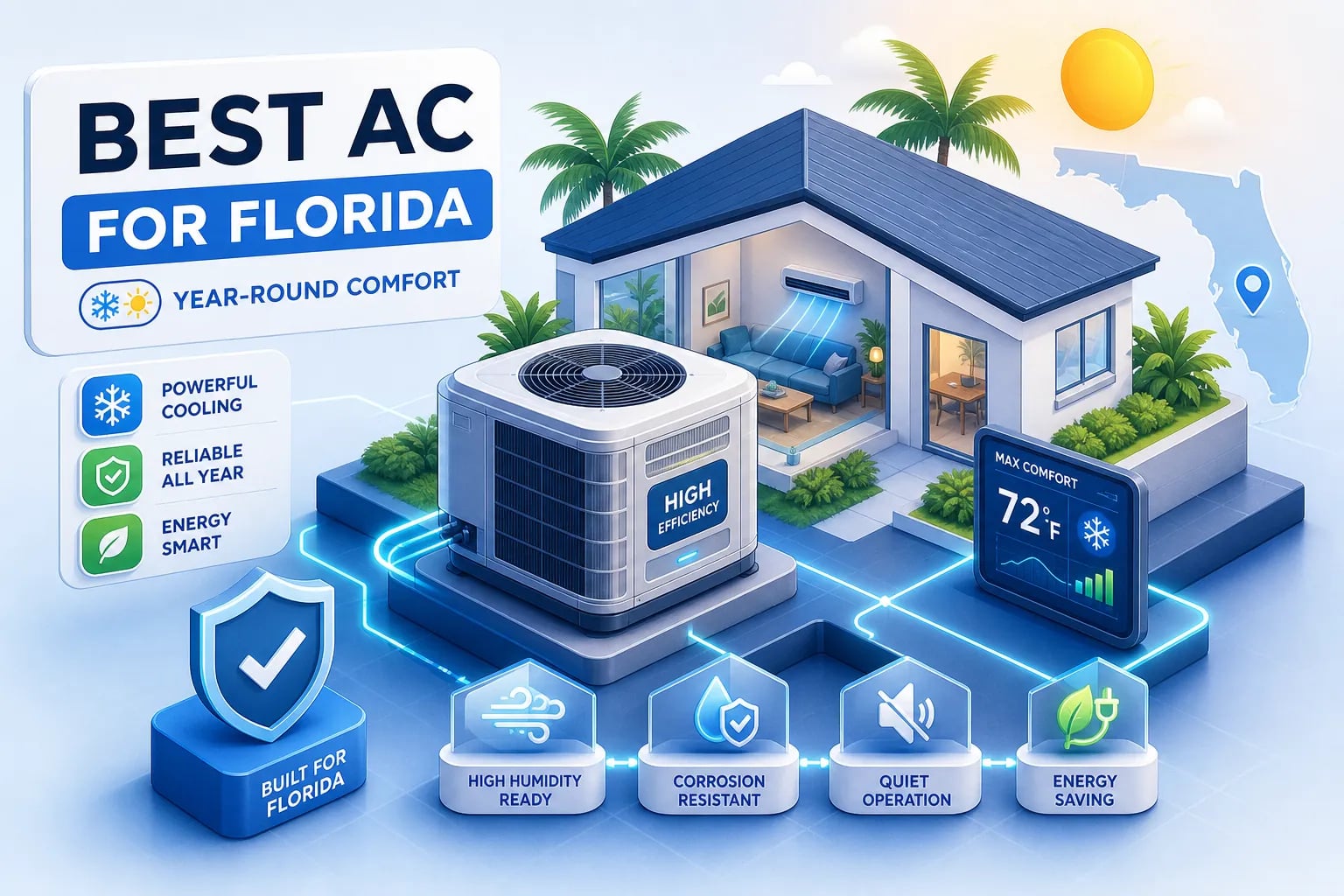
Florida homeowners don't get an off-season. While the rest of the country fires up the AC in June and shuts it down by September, your system runs through every month of the year, contending with heat, humidity, and coastal salt air that make Florida's climate among the most demanding in the continental United States. The wrong equipment choice doesn't just mean higher electric bills, it means a system that fails early, struggles to control moisture, and leaves your home feeling clammy even when the thermostat reads 74°F. For homeowners shopping for top-rated AC units for Florida's year-round climate in 2026, equipment selection is one of the highest-stakes decisions you'll make for your home.
This guide is built specifically for 2026 Florida conditions, not adapted from a generic national ranking. The team at Infinity Legacy has installed and replaced systems across Northeast and Central Florida, and what you'll find here reflects what actually performs in the field. We cover the criteria that matter most for this climate: SEER2 efficiency ratings, humidity control, corrosion resistance, and system type selection. By the time you finish reading, you'll know which AC systems belong in a Florida home, how to size them correctly, and how to get one installed without any money down.
Why Florida's climate punishes the wrong AC choice
The year-round cooling reality most buyers underestimate
Florida AC systems average more than 2,800 cooling hours per year. By comparison, homeowners in northern states typically run their systems for roughly 1,200 to 1,500 hours annually, an illustrative contrast, though actual figures vary by climate zone and household habits. That difference is significant. Your compressor, fan motor, and refrigerant circuit accumulate wear at nearly double the pace, energy bills compound month after month with no real break, and equipment selection carries far more financial and comfort consequences than it does in most markets. A mediocre system that might last 15 years in a cooler, drier state could have a noticeably shorter service life in Orlando's operating environment.
Humidity as a structural load, not just a comfort issue
Most buyers focus on cooling capacity in tons, but in Florida, dehumidification capacity matters just as much. The industry term for this is latent load: the energy required to remove moisture from the air, separate from lowering air temperature. Florida's subtropical humidity means latent load can represent 25 to 35 percent of your total cooling demand, and in homes with older building envelopes or high infiltration rates, it can run even higher. A system that handles sensible heat well but struggles with moisture removal will leave your home feeling muggy regardless of the thermostat setting.
What coastal and near-coastal conditions add to the equation
You don't need to live beachfront to face corrosion risk. Salt air travels inland for miles along Florida's coasts, and outdoor condenser units are particularly vulnerable. UV exposure accelerates material degradation, and the combination of heat, humidity, and airborne salt attacks coil fins, cabinet hardware, and electrical components. Without factory-applied corrosion protection, a standard condenser unit installed within ten miles of the ocean can fail years ahead of its expected lifespan.
How to read SEER2 ratings when choosing top-rated AC units for Florida's year-round climate
SEER vs. SEER2: what changed and why it matters for 2026 buyers
The Department of Energy transitioned from SEER to SEER2 ratings, which use more realistic test conditions that better reflect real-world operating pressures. The practical result is that SEER2 numbers run slightly lower than the old SEER rating for the same piece of hardware. As a rough, model-dependent approximation, a 16 SEER2 unit is in the general range of a 17 to 18 SEER system under the old standard, though the exact equivalence varies by test point and equipment design. If you're comparing a new equipment quote to a proposal from two or three years ago, account for this shift before drawing conclusions about efficiency differences. The federal minimum for new split-system installations in Florida is 14.3 SEER2 for units under 45,000 BTU/hr. That floor is a regulatory baseline, not a performance target, and lifecycle cost comparisons consistently show that Florida homeowners pay for low-efficiency equipment many times over through elevated utility bills.
Variable-speed vs. single-stage compressors: why staging beats raw numbers
Here's something most online comparisons miss: a 20 SEER2 variable-speed system will outperform a 22 SEER2 single-stage system in Florida conditions. Variable-speed units modulate their output, running longer at lower capacity rather than cycling on and off at full blast. Those extended low-capacity runtimes are precisely what pulls moisture out of the air. A single-stage system that cycles frequently may cool the air quickly but leaves humidity behind. In Florida, the compressor's ability to run slow and steady is a humidity control feature, not just an efficiency detail.
The minimum SEER2 threshold worth buying in Florida's climate zone
Based on Florida's annual cooling hours and long equipment run times, anything below 16 SEER2 is a difficult value proposition. The energy cost difference between a 14 SEER2 and an 18 SEER2 system compounds across 2,800 cooling hours every year, and with equipment expected to run 10 to 15 years, that gap adds up to thousands of dollars. For most Florida homeowners replacing an aging system in 2026, 18 SEER2 is a reasonable minimum target, with 20+ SEER2 worth the premium for anyone planning to stay in the home for the next decade or more. These thresholds reflect an advisory recommendation based on payback analysis rather than a regulatory standard.
Top-rated AC units for Florida's year-round climate in 2026
Every system on this list uses variable-speed or variable-capacity operation, which is essential for Florida's humidity demands. Raw efficiency numbers matter, but variable-speed performance in the field is the real separator between good and great.
Lennox SL28XCV and SL25KCV: the efficiency ceiling in residential AC
The Lennox SL28XCV carries a 28 SEER rating, placing it among the highest-efficiency residential central AC systems available in North America. The SL25KCV follows at 26 SEER2. Both use variable-capacity operation, meaning they continuously modulate output to match the load rather than cycling between fixed stages. In practice, this produces the long, slow runtimes that are most effective at pulling moisture out of Florida air. These are premium-priced systems best suited for energy-conscious homeowners who plan to stay in the home long-term and want to extract maximum utility savings over a 15-year equipment life.
Carrier Infinity 26: a strong performer for humidity control
The Carrier Infinity 26 reaches up to 24 SEER2 and uses Greenspeed variable-speed technology. In a Florida context, this system stands out for its emphasis on enhanced humidity control as a defining feature of the product line. For homeowners where dehumidification is the primary complaint alongside high utility bills, it's a strong match. Carrier also offers welded aluminum coils and zinc-cladding options on coastal-rated outdoor units, making it a well-rounded package for buyers within range of salt air.
Trane XV20i and Bryant Evolution 24: solid all-around performers
The Trane XV20i reaches 23.6 SEER2. Start with its footprint: reliable humidity management, a strong service network across Florida, and a track record in the state's climate. The Bryant Evolution 24, which reaches 24 SEER2, covers similar ground with its own variable-speed platform. Neither carries the top-line efficiency numbers of the Lennox SL series, but both deliver consistent real-world performance. For homeowners who want a proven system with a well-established dealer and service network, either represents a sound long-term investment.
Value-tier options that still meet Florida's demands
The American Standard AccuComfort Platinum 20 delivers up to 21.5 SEER2 with variable-speed operation. It's well-suited to budget-conscious buyers who want the humidity control advantages of a variable-speed compressor without reaching the upper end of the price range. Utility savings over 15 years won't match the top-tier systems, but it significantly outperforms any fixed-stage or single-stage unit in Florida's year-round operating conditions.
When a ductless mini-split outperforms central air in Florida
Florida homes where mini-splits make more sense than central systems
Central air isn't automatically the right answer. For homes without existing duct infrastructure, additions, garage conversions, sunrooms, or situations requiring independent zone control, a ductless mini-split often delivers better performance and lower operating costs. One reason is duct losses. In Florida's hot attics, duct systems can waste 20 to 30 percent of cooling energy before air even reaches the living space. Mini-splits eliminate that loss entirely. They also tend to outlast central systems, with typical Florida lifespans of 12 to 18 years compared to 10 to 15 for central split systems, though coastal exposure and maintenance practices can materially affect both ranges.
Coastal mini-split considerations: Blue Fin, Gold Fin, and marine coatings
Not all mini-splits are built to survive salt air. For coastal Florida installs, look specifically for units with Blue Fin or Gold Fin anti-corrosion fin coatings, factory-applied hydrophilic treatments that protect the outdoor coil from salt spray. Mitsubishi and several other manufacturers offer these as part of coastal-rated product lines. Factory coastal protection on mini-splits matters just as much as it does for central condensers. An uncoated mini-split in a salt-air environment faces substantially elevated corrosion risk, regardless of the brand's broader reputation.
Package units: the one system type Florida homeowners should approach cautiously
Rooftop package units house all components outdoors, which makes them particularly vulnerable to Florida's combination of UV exposure, rain, heat, and storm debris. Typical lifespans run 7 to 12 years in Florida conditions, compared to 10 to 15 for a central split system. They have legitimate applications in specific commercial replacement scenarios or situations where interior space is extremely limited, but for residential buyers with a choice, a split system will almost always provide better long-term value.
Humidity control: the feature that separates good from great in Florida
Latent load and why oversized AC makes Florida homes feel muggy
This is one of the most counterintuitive truths in HVAC. An oversized system cools the air so quickly that it satisfies the thermostat before completing a full dehumidification cycle, then shuts off. The temperature looks right on the display, but relative humidity stays elevated and the home feels clammy. This short-cycling problem is one of the most common complaints we hear from homeowners who purchased systems sized by rule of thumb rather than proper load calculation. Getting the tonnage right through a Manual J calculation isn't just about efficiency, it's what determines whether your home actually feels comfortable.
The compressor and blower features that actually control humidity
Humidity removal happens during extended low-capacity runtimes, not during short, full-speed cycles. The systems that do this best share three characteristics: variable-speed blowers, multi-stage or inverter-driven compressors, and dedicated dehumidification modes that allow the system to extend runtime independent of the thermostat setpoint. Availability of these modes varies by model, so confirm specifics with your contractor when evaluating equipment. When you're comparing systems, these features matter more than the top-line SEER2 number alone, and they're precisely why a well-matched variable-speed system reliably outperforms a higher-rated single-stage unit in real Florida conditions.
Coastal corrosion protection: what your outdoor unit needs to survive salt air
The coatings and materials that stop salt air from destroying your condenser
Factory-applied protection is the standard you should demand, not aftermarket treatments applied at the job site. The most durable outdoor units in salt-air environments rely on a combination of factory coatings and materials: epoxy, phenolic, or polymer coil coatings that form a chemical barrier between fin metal and salt spray, along with welded aluminum coils that eliminate the galvanic corrosion points present in dissimilar-metal assemblies. Stainless steel fasteners and zinc cladding on coil surfaces round out the most corrosion-resistant packages. Aftermarket coatings applied in the field can provide some incremental protection, but they don't replicate the bond strength and coverage uniformity of factory-applied treatments.
Which manufacturers offer real coastal protection and how to ask for it
Carrier offers a comprehensive coastal package combining welded aluminum coils, zinc cladding, a two-layer coating process, and thicker polyester powder coat on fan guards. Trane uses a Spine Fin coil design and WeatherGuard cabinet construction. Lennox applies an exclusive Quantum coating to coils. Bryant offers coastal-rated covered-coil options. Ruud provides a factory coastal protection package through certified partners. The critical detail with all of these brands: the coastal package must be requested explicitly at quote time. A standard model from any of these manufacturers does not automatically include these features. If your contractor doesn't mention coastal-rated equipment and you're within ten miles of the ocean, bring it up yourself.
What it actually costs to run a top-rated AC in Florida
Annual cooling cost estimates for 3-ton and 4-ton systems in 2026
Using Florida's current average residential electricity rate of approximately 15.1 cents per kWh and 2,800 annual cooling hours as a baseline, a top-rated 20 to 25+ SEER2 variable-speed 3-ton system costs roughly $650 to $850 per year to run. A 16 to 18 SEER2 system of the same size runs closer to $920 to $1,050 annually. For a 4-ton system, plan for approximately 33 percent higher kWh consumption across the same SEER2 tiers, since the additional capacity draws proportionally more power under equivalent conditions. These figures assume a properly sized and correctly installed system, an oversized unit cycling frequently will perform below its rated SEER2 in real conditions.
What a higher-efficiency system saves over a 10, 15 year lifespan
The annual cost difference between a 16 SEER2 and a 22 SEER2 system in Florida typically falls in the $200 to $400 range for a 3-ton unit. Over a 10-year period, that's $2,000 to $4,000 in accumulated savings, which meaningfully offsets the premium price of a top-tier system. Higher-efficiency variable-speed systems also tend to have longer service lives in Florida conditions due to gentler compressor operation, which strengthens the financial case for moving up in efficiency. The upfront cost difference between a mid-tier and premium system is usually recovered well within the expected equipment lifespan.
Sizing, installation, and how to access a $0 down system upgrade
Why proper sizing determines how your system actually performs in Florida
A Manual J load calculation is the professional standard for HVAC sizing, and it accounts for everything a square-footage rule of thumb misses: ceiling height, insulation levels, window area and orientation, infiltration rates, duct location, and Florida's significant latent heat load. For a typical Florida home, the calculation generally lands in the range of 400 to 600 square feet per ton, with older or poorly insulated homes falling toward the lower end. The latent component is what makes Florida sizing different from the national average, indoor design conditions are typically set at 75°F and 50 percent relative humidity, and the grains-of-moisture difference between outdoor and indoor air determines the moisture removal demand placed on the equipment. A properly sized variable-speed system is more valuable than the most expensive system on the market installed at the wrong tonnage.
Why a licensed Florida HVAC contractor changes the outcome
Florida law requires permits for HVAC installation and replacement, and the work must be performed by a licensed contractor. Permit compliance isn't just a legal formality. It protects your manufacturer warranty, ensures the installation meets Florida Building Code requirements, and documents that the work was done correctly. Improper sizing or installation by an unlicensed contractor voids most manufacturer warranties and is one of the leading causes of the humidity and comfort problems covered throughout this guide. At Infinity Legacy, licensed multi-trade contractor CGC1540795, we handle Manual J load calculations, equipment selection, permit submissions, and installation under one accountable team serving Northeast and Central Florida from Palm Coast to Orlando. You deal with one point of contact from estimate to completed installation.
PACE financing: how to get a top-rated system installed for $0 down
The upfront cost of a premium HVAC system shouldn't be what keeps your home uncomfortable and your utility bills high. Infinity Legacy provides access to the PACE financing program, which allows qualified Florida homeowners to fund a full HVAC replacement with no money down. Repayment is structured through the property tax bill, spreading the cost over time without requiring a traditional bank loan or cash out of pocket at installation. Program eligibility and credit assessment requirements vary by administrator, so our team will walk you through the specifics for your situation. If you're ready to move forward or just want to understand your options, reach out for a free estimate. We'll assess your home, calculate the correct system size, and walk you through equipment options and financing before you make any decision.
The bottom line on selecting top-rated AC units for Florida's year-round climate
Florida's climate doesn't forgive equipment that was designed for somewhere else. A system selected from a generic national best-of list, installed at the wrong tonnage, without coastal protection, and without variable-speed operation will underperform from the first summer and deteriorate faster than the manufacturer's warranty period predicts. When selecting top-rated AC units for Florida's year-round climate in 2026, prioritize SEER2 above 18, variable-speed compressor and blower operation, Manual J sizing that accounts for Florida's latent load, and factory coastal protection if you're anywhere near the ocean. These aren't preferences, they're the criteria that determine whether a system actually performs in this state.
The top performers for central air installations are the Lennox SL series, the Carrier Infinity 26, and the Trane XV20i. For homes where ductless installation makes more sense, quality mini-splits with Blue Fin or Gold Fin coastal coatings from reputable manufacturers are the right call. In every case, the quality of installation determines whether the equipment lives up to its rated performance.
Infinity Legacy offers free estimates across Northeast and Central Florida, from Jacksonville and St. Augustine down through Daytona Beach, Orlando, and beyond. Our team handles equipment selection, sizing, permits, and installation as one unified contractor, and PACE financing means you don't have to wait until you've saved the full cost of a system upgrade. Get in touch with our team, we'll put the right system in your home this year.