
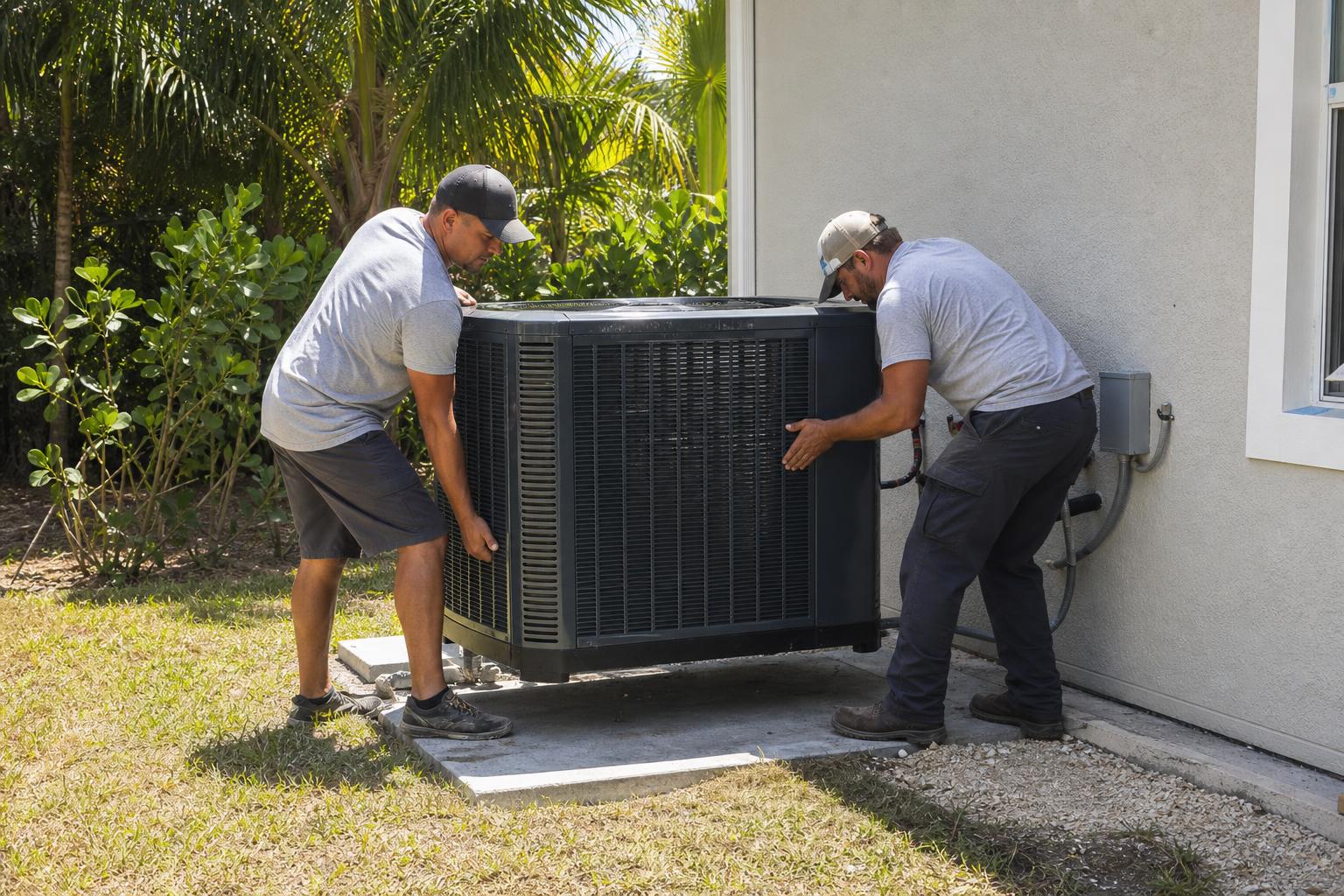
Planning an AC replacement in Florida means making a high-stakes decision under real pressure. When your system struggles to hold 78°F while the thermostat reads 95°F outside, every hour it runs costs you more than it should. For most Florida homeowners, a full AC replacement isn't a question of if but of when, and whether you'll be ready when that moment comes. According to the U.S. Department of Energy, air conditioning accounts for more than 40% of home energy use in hot-humid climates like Florida's, which makes an aging, inefficient system an expensive problem to postpone.
This guide gives you the real 2026 numbers: installed cost ranges by system size, what drives prices up beyond the base unit, what Florida permits actually require, and which financing tools can make a full replacement possible without draining your savings account. Homeowners who work with a multi-trade contractor like Infinity Legacy, licensed and serving Northeast and Central Florida, often get a clearer picture of total project costs upfront because all trades (HVAC, electrical, and ductwork) are handled under one roof.
By the time you finish reading, you'll know what questions to ask, what numbers to expect, and how to move from decision to done without second-guessing every step.
Signs your AC needs full replacement, not just another repair
Florida's climate is brutal on mechanical equipment. The combination of year-round heat, coastal salt air, and near-constant humidity means central AC units in Florida typically last 8 to 12 years, compared to the national average of 13 to 15 years. If your system is approaching that range, the math starts working against continued repairs.
Age and the 10-year rule in Florida's climate
Most homeowners don't realize how much Florida's environment accelerates mechanical wear. A system that might last 15 years in Ohio runs significantly more hours annually in Daytona Beach or Jacksonville, grinding away nearly year-round against heat and humidity that never fully relent. When you start noticing rising energy bills despite normal usage, uneven cooling across rooms, or frequent short cycling, those aren't random glitches. They're the system telling you it's running out of runway.
When repair costs stop making sense
Use this simple framework: if a repair costs more than 50% of what a replacement would cost, and the unit is over 10 years old, replacement wins financially. A $1,200 compressor repair on a 12-year-old unit isn't a fix; it's a delay. That same $1,200 goes toward a new system that carries a 10-year parts warranty and runs at significantly higher efficiency from day one.
Refrigerant red flags and efficiency decline
If your system uses R-22 refrigerant (common in units installed before 2010), any refrigerant leak is a practical end-of-life signal for that unit. R-22 is no longer manufactured, and sourcing it is expensive and increasingly difficult. Beyond refrigerant issues, running a low-SEER system in Florida's eight-month cooling season compounds energy costs every single year. That efficiency gap is real money leaving your wallet monthly. For a practical checklist of warning signs that replacement is overdue, refer to this vendor guide on warning signs you need AC replacement.
Real 2026 AC replacement costs in Florida by system size
The installed cost to replace a central residential AC unit in Florida ranges from $6,500 to $15,000+ depending on system size, efficiency level, and site conditions. Labor typically accounts for 30 to 50% of your total quote, which means the contractor you choose affects your price almost as much as the equipment itself. For a recent market price breakdown and 2026 cost context, see this AC replacement costs in Florida, 2026 price breakdown.
Cost by tonnage: from small homes to large properties
Here's how the 2026 Florida market breaks down by system size, including equipment and installation labor:
- 1.5 to 2 tons: Average installed cost around $7,250, with a typical range of $6,000 to $8,500. This covers smaller homes and condos under 1,200 square feet.
- 2.5 to 3.5 tons: Average installed cost around $9,750, with a typical range of $8,000 to $13,000. This is the most common range for Florida single-family homes.
- 4 to 5 tons: Average installed cost around $12,750, with a typical range of $10,500 to $15,000+. Larger homes and two-story properties fall here.
These figures reflect a standard like-for-like replacement under current R-410A pricing. If you're upgrading to a higher-efficiency inverter heat pump at SEER2 18+, expect to add $1,500 to $3,000 to these baselines. The payback on that upgrade is real in Florida's long cooling season, but you need to know the upfront cost going in.
What drives AC replacement costs higher in Florida
Several predictable cost adders show up on Florida installs, and none of them should be a surprise if you get a thorough site evaluation before signing. Here's what to budget for beyond the base unit:
- Ductwork sealing and patching: $300 to $1,000
- Full duct replacement (varies by square footage): $2,000 to $7,500
- Electrical upgrades for newer high-efficiency systems: $500 to $2,000
- Permit and inspection fees (varies by county): $100 to $600
- Old unit disposal (if not bundled into the quote): $300 to $600
Always ask for an itemized estimate so you know exactly what's included.
Regional price variation across Florida
South Florida homeowners in Miami-Dade can expect to pay $1,000 to $2,000 more than the state average for the same installation. The gap comes from stricter local code amendments, wind-resistance hardware requirements, and higher operational costs in South Florida markets. Central and Northeast Florida, where Infinity Legacy primarily operates, tend to sit closer to the mid-range figures above, which is one reason a free, site-specific estimate matters more than any online ballpark.
Central air, heat pump, or mini-split: which system fits your home
Many homeowners assume replacement means a straight swap of the same system type. That's often the right call, but not always. Understanding your options takes five minutes and can save you thousands over the next decade.
Central AC: still the standard for most Florida homes
Ducted central AC remains the go-to for single-family homes with existing ductwork in good condition. It cools large square footage evenly, it's familiar to every HVAC technician in the state, and the installed pricing is competitive. The main vulnerability is duct leakage: according to ENERGY STAR estimates, older Florida homes with uninsulated or deteriorating attic ducts can lose 25 to 30% of conditioned air before it reaches the living space, which undercuts even the most efficient new unit.
Heat pumps: efficiency that makes sense in Florida's climate
A heat pump handles both heating and cooling through a single system, which is a natural fit for Florida's mild winters. Modern inverter heat pumps rated SEER2 18 to 20+ can reduce annual energy costs by 15 to 25% compared to a standard central AC, and Florida's typically mild winter temperatures (usually above 40°F) mean these systems run at peak efficiency year-round. The upfront cost is higher, but the operating savings compound quickly in a state where the AC runs eight months a year. Heat pumps also deliver better humidity control, which matters enormously in Florida's high-humidity climate. For practical, local strategies to manage humidity and improve AC efficiency, read Florida Humidity vs AC: 7 Fixes to Lower Energy Bills.
Mini-splits: the right tool for specific situations
Mini-split systems make the most sense for home additions, converted garages, older homes without existing ductwork, or situations where you need precise zone cooling in one area without cooling the whole house. The per-ton cost is higher than central systems, but you avoid the labor cost of duct installation entirely. For whole-home cooling in a house with good existing ductwork, a central system or heat pump will almost always pencil out better.
Florida AC replacement permits, inspection requirements, and timelines
Florida law mandates a mechanical permit for all residential AC replacements, including simple like-for-like swaps. This surprises a lot of homeowners, but the requirement exists to protect you. Skipping the permit creates real risk: code violations, complications during insurance claims, and problems at resale when the work can't be documented properly.
What Florida law requires for residential AC replacement
Under the Florida Building Code, your licensed HVAC contractor pulls the permit on your behalf before installation begins. You don't file paperwork; they do. A post-installation inspection confirms the work meets Florida Building Code Mechanical standards before the system is signed off. Any contractor who suggests skipping the permit to save time or money is putting your home and your insurance coverage at risk.
Permit fees by county: what to expect
Permit fees vary by jurisdiction and should always be confirmed with your contractor before signing a quote. In Hillsborough County (Tampa), fees typically run $100 to $500. Orange County (Orlando) and Duval County (Jacksonville) fall in the $100 to $450 range for standard replacements. Miami-Dade's stricter amendment requirements push fees to $150 to $600+, with additional wind-resistance hardware costs in some cases. Ask directly whether the permit fee is included in your installation quote or billed separately.
Typical installation timeline from quote to cool air
For a standard central AC swap with no ductwork or electrical complications, expect a total timeline of two to five business days. Permit approval typically takes one to three business days in most Florida counties. The physical installation runs four to eight hours on-site. A post-installation inspection can add another 24 to 48 hours before the system is fully signed off. Complex projects involving ductwork replacement or electrical panel upgrades add one to three additional days. The process is straightforward when you're working with a contractor who handles permitting as a standard part of the job.
Financing your AC replacement in Florida without draining your savings
A full HVAC replacement is a significant purchase, but paying for it all upfront isn't the only option available to Florida homeowners. Knowing what's on the table before you get your first quote puts you in a much stronger position.
PACE financing: $0 down based on home equity, not credit score
Florida PACE (Property Assessed Clean Energy) is one of the most accessible financing tools available for home improvement in the state. Approval is based on home equity rather than a traditional credit score check, so homeowners who wouldn't qualify for conventional financing often qualify for PACE instead. Check with your specific PACE provider for eligibility requirements. There's no down payment required, and repayment is added as a special assessment to your property tax bill over a 5 to 20 year term. Eligibility generally requires being current on your mortgage and property taxes for the past three years, with the financed amount limited to up to 20% of your existing home equity. Infinity Legacy works with PACE financing programs for qualified AC replacements across Florida; contact us for a free estimate to review your options before you commit to anything. For official program details and HVAC project eligibility, review the Florida PACE home improvement resources at Florida PACE, HVAC and home improvement.
Utility rebates still on the table in 2026
FPL (Florida Power and Light) offers a $150 to $200 rebate for systems rated SEER2 16 or higher, and TECO and Duke Energy run similar programs for their service areas. These rebates may be stackable with PACE or contractor financing depending on program rules, confirm stackability with your utility, PACE provider, and contractor before assuming you can combine them. Worth noting: the federal tax credits under Section 25C expired at the end of 2025 and are not available for 2026 installations. The upcoming Florida Energy Saver Program, aimed at low-to-moderate income households, is worth monitoring as it rolls out, with rebates potentially reaching $8,000 for qualifying upgrades.
Contractor financing and personal loan options
Several lenders offer $0 down contractor financing programs with fixed-rate installment loans starting around 9.99% APR. GoodLeap provides flexible monthly payments with fast approval and no down payment requirement. Hearth accepts lower credit profiles down to approximately FICO 550, which broadens access for homeowners who don't qualify for traditional bank products. Where possible, stack a utility rebate on top of any financing program to reduce your effective out-of-pocket cost further.
How to hire the right HVAC contractor for AC replacement in Florida
Your AC replacement is only as good as the contractor who installs it. A quality system installed poorly will underperform and fail early. The vetting process doesn't have to be complicated, but it does have to happen before you sign anything.
License, insurance, and what the permit process reveals
Every HVAC contractor operating in Florida must hold an active state license, and the permit process itself is your built-in verification: licensed contractors pull permits, unlicensed contractors avoid them. Verify any contractor's license at MyFloridaLicense.com through the DBPR's license search portal. Search by business name or license number, confirm the status reads "active," and confirm the license category covers air conditioning contracting (Class A or Class B). For a step-by-step resource on how to verify a contractor's license, see this guide on how to verify a contractor's license. Any legitimate Florida HVAC contractor should display their license number openly on their website, truck, and written estimates.
Questions to ask before signing any quote
These questions separate contractors who have done this properly hundreds of times from those who rush through to the next job. Ask whether the permit fee is included in the quote. Ask for the labor warranty term in writing. Ask what SEER2 rating is being proposed and why that system was selected for your home's square footage and duct condition. Ask whether ductwork assessment and disposal of the old unit are included in the scope. A contractor who can answer all of these clearly and without hesitation has earned your consideration.
Why a single-point contractor simplifies the whole project
AC replacement rarely happens in complete isolation. Ductwork, electrical panels, drainage, and sometimes roofing or structural concerns are all connected to the HVAC project. Coordinating three separate vendors across a two-week project is how timelines slip and costs go sideways. Working with a multi-trade contractor like Infinity Legacy means one licensed team handles the full scope, one free estimate covers the complete picture, and one point of contact sees the project through to final inspection without handoffs or gaps. Learn more about the full HVAC services we provide at New HVAC Systems for Florida Homes | ILB.
AC replacement in Florida: get a real number for your home
AC replacement in Florida is a significant investment, and the homeowners who navigate it best are the ones who walk in knowing the numbers. The 2026 installed cost range runs from $6,500 to $15,000+, permit fees run $100 to $600 depending on your county, and PACE financing offers a $0 down path for homeowners who qualify based on home equity. Factor in age, run the repair cost math, and weigh the long-term savings from a SEER2 upgrade, that's the decision framework that holds up in every situation.
The best time to start this process is before your system fails, not after. Emergency replacements in July narrow your options and compress your timeline, peak season typically means longer lead times for both equipment and available installers. Getting a free estimate now, while the system is still running, gives you the information to make the right call on your schedule instead of the equipment's.
Infinity Legacy offers free AC replacement estimates across Northeast and Central Florida, with no obligation and no pressure. Our licensed team combines HVAC expertise, multi-trade capabilities, and access to PACE financing to take you from decision to done, without the handoffs or surprises. Call or request your free estimate today, and stop paying more than you should to cool a home that deserves better. Learn more About, Infinity Legacy Builders Inc | Florida Contractor.
Frequently asked questions about AC replacement in Florida
How much does AC replacement in Florida cost in 2026?
The installed cost for a central AC replacement in Florida ranges from $6,500 to $15,000+ depending on system size, efficiency rating, and site conditions. Most single-family homes fall in the $8,000 to $13,000 range for a 2.5 to 3.5 ton system including labor.
Do I need a permit for AC replacement in Florida?
Yes. Florida law requires a mechanical permit for all residential AC replacements, including direct like-for-like swaps. Your licensed HVAC contractor pulls the permit on your behalf. Skipping the permit risks code violations, insurance complications, and problems at resale.
How long does AC replacement take in Florida?
A standard central AC swap with no ductwork or electrical complications typically takes two to five business days from permit approval to final inspection. The physical installation runs four to eight hours on-site.
What financing options are available for Florida AC replacement?
Florida homeowners can access PACE financing (approval based on home equity, not credit score), contractor financing programs through lenders like GoodLeap and Hearth, and utility rebates from FPL, TECO, and Duke Energy for qualifying high-efficiency systems. Confirm rebate stacking eligibility with your provider before combining programs.
How do I verify an HVAC contractor's license in Florida?
Search the contractor's name or license number at MyFloridaLicense.com through the DBPR portal. Confirm the status reads "active" and that the license category covers air conditioning contracting (Class A or Class B).