If you're wondering what affects the price of a new roof in Florida, start here: two quotes for the exact same roof replacement, same house, same neighborhood, same week, can come in at $18,000 and $30,000 respectively. Neither contractor explains the gap beyond a vague shrug about "materials and labor." That difference isn't random; it's the result of a dozen specific cost drivers that most homeowners never get a clear explanation of before they sign anything.
Florida roofing is its own category of construction. Hurricane codes, year-round heat and humidity, strict permitting requirements, and a labor market that tightens every storm season all push costs in directions you won't see in a national pricing guide. At Infinity Legacy, our Palm Coast team itemizes every estimate line by line so Florida homeowners can see exactly where their money is going before a single nail gets pulled. What follows is that same breakdown, written so you can walk into any contractor conversation already knowing what questions to ask.
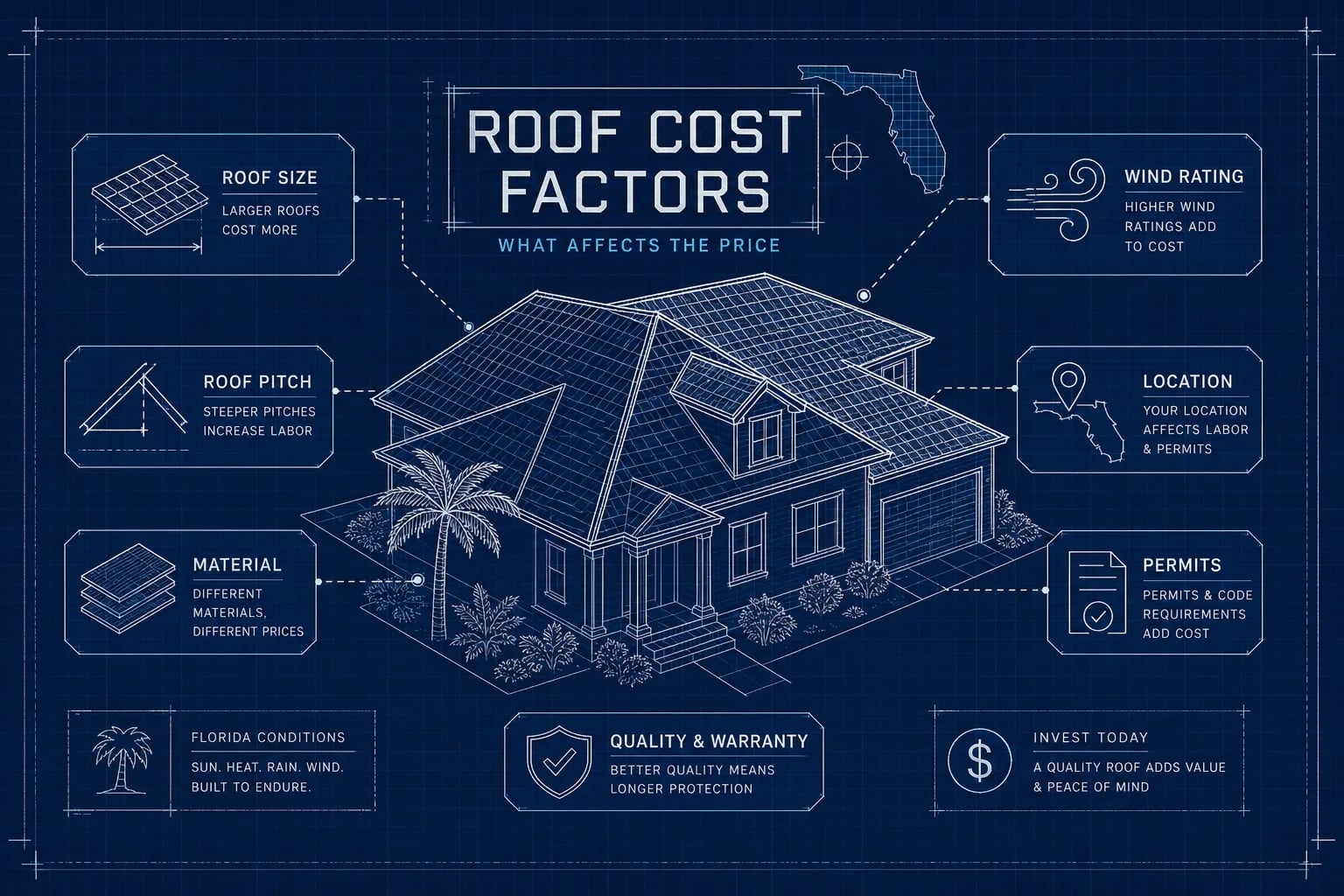
Here are the eight factors that most directly shape what you'll pay for a roof replacement in Florida, along with realistic 2026 numbers you can use right now to build a working budget.
What Affects the Price of a New Roof in Florida: Key Drivers
The material you choose sets the price ceiling (and the floor)
The single biggest variable in any Florida roof replacement quote is the material. Get this number anchored first, and everything else becomes easier to evaluate.
Asphalt shingles remain the most affordable option, running roughly $4.50 to $8.00 per square foot installed. On a 2,000-square-foot roof, that puts your baseline between $9,000 and $16,000. Shingles cost less because installation is faster, labor is widely available, and the material itself is lighter than the alternatives. That said, not all shingles perform equally in Florida. Impact-rated Class 4 shingles carry a meaningful premium over standard three-tab shingles, and in a state that averages multiple named storms per year, that premium is worth it.
Metal roofing occupies the mid-to-premium tier, with installed costs typically landing between $9 and $20 per square foot, or $18,000 to $40,000 for a 2,000-square-foot roof. The wide range reflects real variables: standing seam systems cost more than exposed-fastener panels, aluminum is priced differently than steel or Galvalume depending on market conditions, and gauge thickness affects both price and performance. For Florida homeowners focused on longevity, metal's 40- to 70-year lifespan and heat-reflective surface make it a strong long-term value despite the higher upfront cost.
Tile is the most expensive option at $12 to $25 per square foot installed, pushing a 2,000-square-foot roof into the $24,000 to $50,000 range. The cost reflects the weight of the material, which sometimes requires structural verification before installation, the specialized labor that clay and concrete tile demand, and a longer installation timeline. The trade-off is real durability: tile handles Florida's UV exposure and heat cycling better than almost anything else on the market.
Roof size, pitch, and complexity are hidden cost multipliers
Material price gets the attention in every roofing conversation, but the geometry of your roof can swing your final number by thousands of dollars in either direction. Most homeowners don't realize how much the shape of their roof factors into a contractor's labor calculation.
Pitch is where the surprises usually start. A moderately steep roof, roughly 5/12 to 8/12, adds about 15% to 25% to total labor cost because the crew works more slowly and with more caution than on a walkable surface. A steep pitch above 9/12 can add 30% to 50% or more, requiring safety harness systems, a slower installation pace, and sometimes additional crew members to manage the work safely. Run the math on a $12,000 base quote: pitch alone can push that number to $15,600 to $18,000 before you've accounted for anything else.
Roof complexity compounds the pitch premium. Hip roofs, multiple valleys, dormers, and skylights typically add 10% to 30% to the total quote because each penetration and transition requires custom flashing work and significantly more labor time per square. A steep roof with dormers and multiple valleys can realistically run 50% or more above a simple gable roof at the same square footage. When you're getting estimates, ask each contractor specifically how they're pricing your pitch and complexity. That question alone will tell you a lot about how thorough their estimate is.
Florida's hurricane codes and wind ratings shape what goes on your roof
No state has stricter residential roofing requirements than Florida, and those requirements carry a real price tag. Understanding what the code actually demands will help you recognize a compliant estimate from one that's cutting corners.
Statewide, the Florida Building Code requires all roofs to meet local wind-load design speeds. In coastal areas or wind zones above 120 mph, enhanced fastening patterns, specific underlayment types, and approved drip edge and flashing details are all mandatory. Common code-driven upgrades include ring-shank nails for deck attachment and peel-and-stick secondary water barriers. The secondary water barrier alone runs $1,000 to $3,000 or more on an average single-family home, and it's required on virtually all permitted re-roofs in Florida. In total, code compliance upgrades typically add 5% to 15% to a standard reroof cost.
Miami-Dade and Broward counties operate under the High-Velocity Hurricane Zone designation, which applies a separate and stricter layer of requirements on top of the statewide code. Every roofing product used in the HVHZ must carry a Miami-Dade Notice of Acceptance or Florida Product Approval, and wind design speeds in this zone can reach 170 to 175 mph for residential buildings. That means documented uplift resistance, approved assemblies, and additional inspection requirements, all of which add cost. A basic reroof in South Florida runs meaningfully higher than the same scope of work in Flagler or Volusia County, and that difference is entirely code-driven.
Permits, inspections, and tear-off fees add up faster than most homeowners expect
These line items rarely appear in a headline quote, but they belong in every homeowner's budget before the conversation with contractors even starts. A licensed contractor is required to pull permits for reroof work in Florida. This is not optional, and any contractor who suggests skipping the permit process is creating liability you'll carry as the property owner.
Permit fees for residential reroof projects run roughly $150 to $600 across Florida, depending on county fee schedules and how your county calculates project valuation. Miami-Dade uses a per-square-foot rate, typically $0.10 to $0.13 per square foot of roof area. Hillsborough County and the City of Tampa have documented residential reroof permit fees around $220. Broward generally lands between $150 and $300. Failed inspections add reinspection fees, usually $75 to $150 per visit, which is entirely avoidable when you hire a crew experienced enough to pass the first time.
Tear-off and disposal is a separate line item from the permit fee and one of the costs most often buried or understated in low-ball estimates. Florida Building Code allows only one layer of roofing before a full tear-off is required, so overlay re-roofs that skip disposal costs aren't a legal option for most homes. Disposal costs depend on shingle weight, the number of layers coming off, dumpster size, and local tipping fees. Budget several hundred to well over a thousand dollars depending on your roof size and material type, with heavier tile roofs toward the top of that range.
What's hiding under your old roof can change the entire quote
Every experienced roofer will say the same thing: the number on the estimate is based on what they can see. What they find under the old shingles is a separate conversation, and in Florida, that conversation happens more often than homeowners expect.
Moisture intrusion, improper ventilation, and years of Florida heat-and-humidity cycling can degrade the plywood or OSB decking underneath the shingles without any visible sign from the ground. Deck replacement is typically priced per sheet, and in Florida the going rate runs $75 to $150 per installed sheet for smaller spot repairs, with some contractors quoting $100 to $150 as a standard assumption in coastal or HVHZ counties where thicker plywood and stronger nailing patterns are required. A badly neglected roof can need dozens of panels replaced, adding several thousand dollars to the project scope. Storm-damaged roofs are especially prone to hidden deck damage because what looks like surface-level impact from the street may have pushed moisture into the decking for months before anyone noticed.
Set aside 10% to 20% of your base estimate as a contingency specifically for deck damage and structural discoveries. This isn't pessimism; it's practical math in a state where roofs absorb enormous abuse from heat, humidity, and storm cycles year after year. If your roof has been leaking without repair, factor in the possibility of damage extending below the deck into insulation and framing. A contractor who communicates clearly throughout the tear-off process, including documenting scope changes before they proceed, is worth every dollar of their premium over one who calls with surprises after the old roof is already off.
Labor rates and when you schedule your project both move the number
Labor is the second-largest line item in most roof replacement quotes, and unlike material prices, it's highly sensitive to timing and market conditions. Florida's climate creates a demand pattern that directly affects what contractors charge depending on the time of year.
Consumer-facing roofing labor rates in Florida, meaning what actually shows up in your quote, run approximately $40 to $90 per crew member per hour or $75 to $150 per square for asphalt shingle installations. Metal and tile labor runs higher due to specialized skill requirements and slower installation pace. According to Bureau of Labor Statistics data, the average roofer earns around $22 to $24 per hour, but that wage is a fraction of the quoted rate because the difference covers contractor insurance, equipment, fuel, overhead, and margin. Demanding that a licensed, insured contractor match a cash-only quote ignores all of those real costs.
Florida's peak roofing season runs May through September. Contractors book up fast during this window, schedules get tight, and prices firm up accordingly. After a major hurricane or tropical storm, post-storm demand surges can push quotes toward the top of the labor range or beyond as materials get allocated and emergency premiums apply. If your roof is aging but not actively failing, scheduling your replacement in late fall or winter, roughly October through February, often gets you better availability and more competitive pricing. That window also gives you leverage to negotiate on timeline, which matters when crews aren't stacked up three jobs deep.
Contractor experience and licensing directly affect what you pay (and what you get)
The cheapest quote in your inbox isn't always the best one. In Florida, the gap between a detailed estimate from a licensed contractor and a low-ball number from an unlicensed crew can look like savings on day one and look very different six months later.
Florida requires roofing contractors to hold a state-issued license. A certified or registered roofing contractor license number is publicly verifiable through the Florida DBPR's license search. Infinity Legacy operates under license number CGC1540795, and any contractor you're evaluating should be just as transparent about their credentials. Unlicensed work means no permit gets pulled, no inspection gets passed, and if something goes wrong after installation, there's no recourse through the state licensing system and no insurance claim support tied to the work. Licensed, insured contractors build permit fees, insurance costs, and code compliance into their quotes, which is why their number is sometimes higher than a cash-and-handshake alternative.
A trustworthy estimate breaks down material cost, labor cost, permit fees, tear-off and disposal, and contingency items separately rather than presenting a single lump-sum number. At Infinity Legacy, every roof estimate we deliver across Florida is itemized exactly this way, no surprise line items added after tear-off, and no vague "labor and materials" totals that leave you guessing. Before signing anything with any contractor, ask these specific questions: What brand and grade of materials are included? Is the permit fee already in the quote? What is the process if deck damage is found during tear-off? What are the separate warranties on labor versus materials?
How to build a realistic roofing budget before you call a single contractor
Once you understand what affects the price of a new roof in Florida, you can build a working budget range on your own before the first estimate lands in your inbox. That puts you in a fundamentally stronger position in every conversation that follows.
Start with your actual roof square footage, not your home's living area. Measure the roof surface, or pull it from a previous inspection report or insurance estimate. Apply the material range you're targeting: $4.50 to $8.00 per square foot for asphalt shingles, $9 to $20 for metal, $12 to $25 for tile. Multiply by your square footage to get a baseline. Then layer on the adjustments: add 20% to 50% if your roof has a steep pitch or complex layout, add 5% to 15% for Florida code compliance upgrades, add $150 to $600 for permit fees, and budget $500 to $1,500 for tear-off and disposal depending on your roof size and material type.
From that adjusted number, set aside 10% to 20% as a contingency for deck damage discovered during tear-off. This is not a worst-case scenario budget; it's a realistic one for Florida homes, especially those over 15 years old or with any history of leaking or storm impact. When comparing multiple quotes, confirm each one includes the same scope: same material grade, same permit handling, same tear-off coverage. A $3,000 gap between two quotes often dissolves when you realize one contractor excluded the permit fee and disposal cost entirely.
Get at least three written, itemized estimates and verify every contractor's license number through the DBPR before signing. Treat vague single-number quotes as a reason to ask more questions, not a reason to sign faster.
Know your numbers before the contractor arrives
Roof replacement pricing in Florida isn't arbitrary. It's driven by a predictable set of factors: the material you choose, the geometry of your roof, the code compliance requirements for your county, permit and disposal costs, the condition of what's underneath your current shingles, the timing of your project, and the licensing and transparency of the contractor you hire. Understanding each one gives you real leverage before a single estimate arrives. In short, knowing what affects the price of a new roof in Florida is the single best preparation you can do before picking up the phone.
The lowest quote in your inbox is not automatically the right choice. A detailed, itemized estimate from a licensed contractor is worth more than a vague low-ball number that grows by $5,000 after tear-off reveals deck damage nobody accounted for. The difference between a good roofing project and a stressful one usually comes down to how much you knew going in and how clearly your contractor communicated throughout.
Infinity Legacy provides free, fully itemized roof replacement estimates to homeowners and commercial property owners across Florida, from Jacksonville and Palm Coast to Orlando, Tampa, Daytona Beach, and beyond. No hidden line items, no guesswork, and no surprise charges after the work begins. Reach out to our team before any work starts and get a clear picture of your project from a licensed contractor who will walk you through every number.