
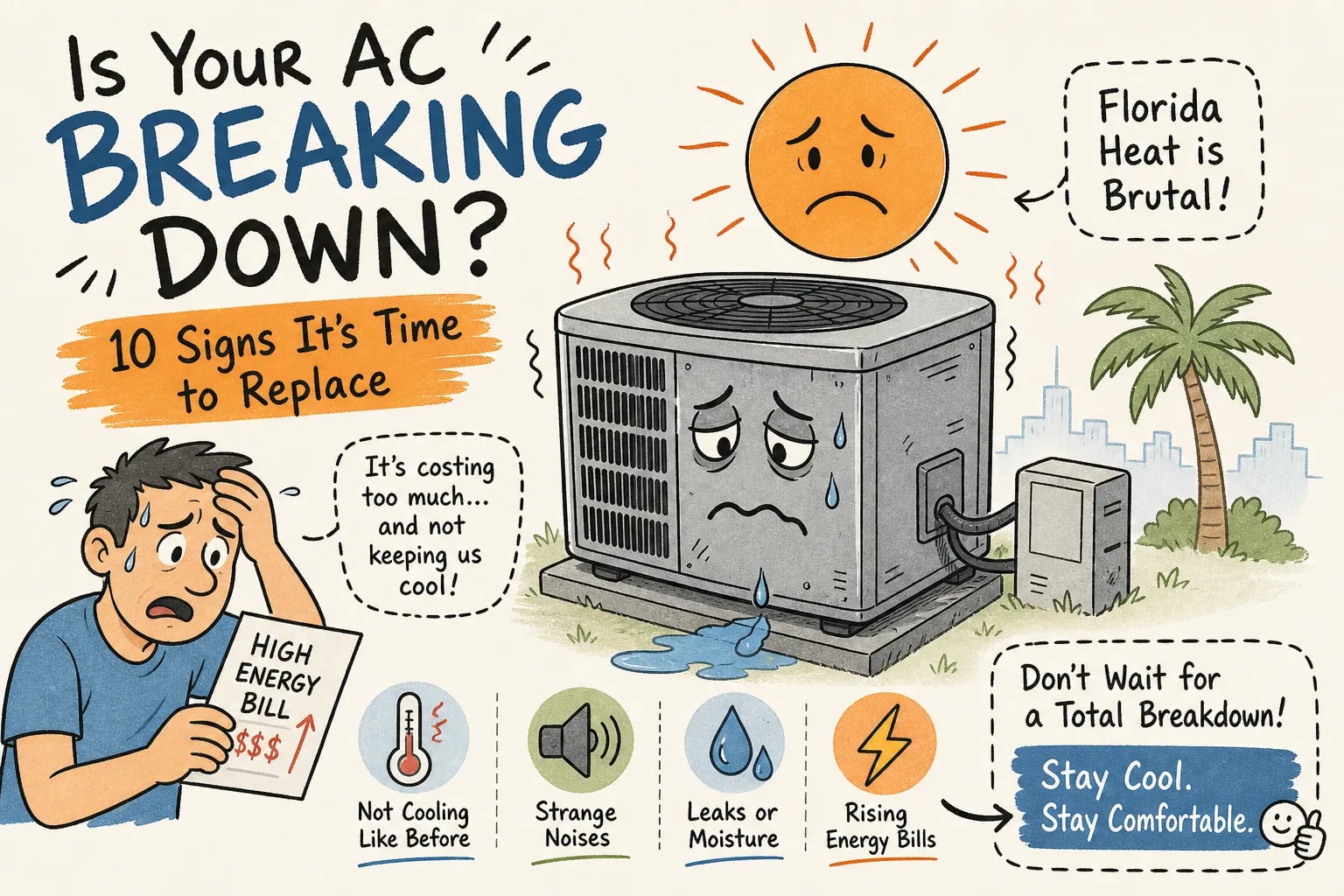
Picture this: it's 95 degrees outside, the humidity is sitting at 80%, and your home feels more like a sauna than a sanctuary. You've dropped the thermostat to 72, then 70, then 68, and the air coming out of the vents is barely keeping up. In most parts of the country, a struggling air conditioner is an inconvenience. In Florida, it's a genuine safety concern that can escalate within hours during a summer heatwave.
Knowing the signs your air conditioner needs replacing in Florida heat can mean the difference between a planned upgrade and an emergency call in the middle of August. At Infinity Legacy, our team has evaluated and replaced thousands of AC systems across Florida. The same failure patterns show up again and again, some obvious from the moment you walk in the door, others subtle enough that homeowners dismiss them as "just the Florida heat" for months before the system finally quits. Neither approach serves you well when temperatures outside are doing their best to cook everything in sight.
This article walks through all 10 warning signs so you have real information to work with, not guesswork. By the end, you'll know whether to repair or replace, what the numbers actually look like, and how to move forward even if budget is a concern right now.
Why Florida Burns Through AC Systems Faster Than Anywhere Else
A central air conditioner in most U.S. states lasts 15 to 20 years. In Florida, that number drops to 8 to 14 years, and coastal systems often land closer to the lower end of that range. This isn't a matter of brand quality or bad luck. It's the climate working against every component in your system, every single day of the year.
Florida ACs run two to three times more hours annually than systems in northern states. That's not simply double the wear over a decade, it's double the wear compressed into five years. Every additional cycle stresses the compressor, capacitor, fan motor, and contactor, all of which have finite lifespans. More runtime means those limits arrive sooner.
High humidity compounds the problem significantly. Your air conditioner doesn't just cool the air; it removes moisture from it, which requires additional energy and longer run times. For coastal properties, salt air corrodes outdoor coils and electrical contacts, often shaving years off the unit's life before any other symptom appears. Inland Florida homes aren't immune. The year-round subtropical heat pushes every system harder than the national average, and the math on lifespan reflects that reality.
Three factors push a system toward the shorter end of that 8-to-14-year window: poor maintenance history, coastal location, and original equipment that was improperly sized for the home. If any of those apply to your system, use the shorter end of the lifespan range as your planning baseline.
Performance Red Flags: Signs 1 Through 4
These are the symptoms you feel and live with every day. Most homeowners write them off as normal Florida summer behavior when they're actually your air conditioner telling you something is wrong. Pay attention to patterns, not individual bad days.
Sign 1: The AC Runs All Day but the House Won't Cool Down
A properly sized, functioning system should reach your target temperature within a reasonable time frame after the hottest part of the afternoon. When it runs continuously without ever hitting that target, the system is losing capacity. In Florida heat, this pattern often points to a refrigerant issue, a failing compressor, or a coil that has degraded significantly. The key distinction is a system that never catches up, not just one that takes an extra hour on a record-breaking afternoon.
Sign 2: Weak or Warm Airflow from the Vents
Reduced airflow from your supply vents usually points to a failing blower motor, collapsed ductwork, or a severely clogged evaporator coil. Warm airflow while the system is running is a near-certain sign of a failure in the refrigeration cycle itself. Both symptoms deserve a professional evaluation rather than a thermostat adjustment.
Sign 3: Indoor Humidity Levels Keep Climbing
Your air conditioner handles two jobs simultaneously: cooling the air and pulling moisture out of it. When a system can no longer manage indoor humidity, it's telling you something specific, either the unit is no longer sized adequately for the home's current conditions, or it's losing capacity due to age and wear. Sticky, muggy air inside your home on a day when the system has been running for hours is a real diagnostic sign, not just a feature of Florida living.
Sign 4: Frequent Short Cycling
Short cycling happens when your system turns on, runs for two or three minutes, shuts off, and repeats rapidly. It can mean the unit is oversized for the space, causing it to satisfy the thermostat too quickly and never fully dehumidify the air. It can also indicate a failing compressor or refrigerant pressure problems. Either way, short cycling is hard on every moving component and dramatically accelerates the decline of whatever useful life your system has left.
Mechanical and Cost Warning Signs Your Air Conditioner Needs Replacing: Signs 5 Through 7
These next signs move beyond how the house feels and into symptoms you can hear, see, or measure directly on your utility bill. They're harder to rationalize away, and for good reason.
Sign 5: Strange Noises from the Unit
Banging or clanking from the outdoor unit often points to a loose or broken part inside the compressor. Screeching is typically a failing motor bearing. Hissing or bubbling sounds are refrigerant leak indicators. Occasional clicking at startup and shutdown is completely normal; repeated clicking during operation is not. Florida's heat keeps AC components under constant stress, so these sounds tend to appear more frequently here than in milder climates, and they tend to get worse quickly once they start.
Sign 6: Ice Buildup or Visible Refrigerant Leaks
Ice forming on your refrigerant line or indoor unit looks counterintuitive, but it always signals a problem: low refrigerant, severely restricted airflow, or a failing expansion valve. Oil stains near the outdoor unit or a faint sweet chemical smell indoors are signs of an active refrigerant leak. Because Florida systems run so many more hours annually, coils and connections face greater cumulative pressure, making leaks more common here than in other states. If you see ice or staining, don't just turn the system off and back on. Get it evaluated.
Sign 7: Energy Bills Keep Climbing with No Clear Explanation
A 10-to-15-year-old AC unit can cost 30 to 50% more to operate than a modern high-SEER2 system doing the same job. When your electricity bill climbs $80 to $120 per month over a few consecutive summers with no change in usage habits, that's not a rate hike. That's a degrading system working harder to produce less cooling. The math becomes very clear when you compare ongoing operating costs against what a replacement would actually save you each month.
The Tipping Point: Signs 8 Through 10
These final three signs aren't about how the system feels or sounds. They're about the unit's fundamental condition and history, and they often tell you more than any single symptom could on its own.
Sign 8: The System Is 10 or More Years Old
A 10-year-old Florida AC is middle-aged to old, depending on its maintenance history and proximity to the coast. At 12 to 15 years, most systems are well past their reliable operating window given Florida's runtime demands. Age alone isn't a reason to replace a functioning, efficient system. But age combined with any other sign on this list changes the conversation significantly, because you're no longer asking whether the system will fail. You're asking when.
Sign 9: You've Had Multiple Repairs in the Past Two Years
Repeated repairs on an aging system follow a predictable pattern: fix one component and another fails within a season. At that point, each repair bill is money spent delaying an outcome that isn't going to change. A useful rule of thumb is the $5,000 rule: multiply the repair cost by the system's age. If the result exceeds $5,000, replacement is typically the smarter financial move. A $900 repair on a 12-year-old system gives you 900 times 12, which equals $10,800. That number points clearly toward replacement, not another patch job.
Sign 10: Your System Still Runs on R-22 Refrigerant
R-22, once known as Freon, was phased out federally, and the remaining supply comes from reclaimed stock. That scarcity drives prices up sharply. A refrigerant recharge that once cost a few hundred dollars now commonly runs $400 to $1,500 or more in Florida, with some larger systems reaching $2,500 for a full recharge. If your system uses R-22, you're dealing with a compounding cost problem: expensive refrigerant, aging components, and poor efficiency all stacking on top of each other. This is one sign that doesn't require a second opinion. Start planning for replacement.
Repair vs. Replace: Making the Call with Confidence
Not every sign on this list means your system needs to be replaced immediately. Some failures are minor and inexpensive. Others make replacement the obvious financial choice. The goal here is giving you a clear framework so you can evaluate any contractor's recommendation with your own eyes.
The Components Worth Repairing
Capacitors are the most common summer failure point for Florida AC systems. They work hard, they're exposed to intense heat, and they eventually wear out. A capacitor replacement typically runs $200 to $450 installed. On a system under 8 years old with no other symptoms, that's a straightforward repair worth making. Contactors fall in a similar cost range and are equally common. These small electrical components don't mean the whole system is failing, they indicate normal wear on a part that's designed to be replaced.
The Components That Tip the Scale Toward Replacement
Compressor replacement is the most significant repair call you'll face. In Florida, that job typically runs $1,500 to $2,500. On a system older than 10 years, that cost almost never makes financial sense because the rest of the system's components are equally aged. Evaporator coil replacement runs $600 to $1,200 or more, and on an aging unit, you're essentially investing in a failing platform. When major components fail on an older system, a five-year cost comparison almost always favors replacement.
How to Run the Numbers Honestly
Apply the $5,000 rule to every contractor estimate you receive. Take the repair cost, multiply it by the system's age in years, and compare that result to $5,000. Above the threshold, replacement wins financially. Well below it, the repair is likely worth making on a younger system. This tool works regardless of what a contractor recommends, so run it every time a repair estimate lands on your kitchen table.
What a New System Actually Saves in Florida
Most homeowners think of replacement as pure expense. The energy savings data tells a different story, especially in a climate where the AC runs as long and as hard as it does here.
Real Energy Bill Reductions for Florida Homeowners
Upgrading from a 10 SEER unit to a modern 16-to-18 SEER2 system cuts cooling costs by roughly 30 to 45% in Florida conditions. For a household spending $200 per month on electricity with a significant share going to air conditioning, that translates to $60 to $90 in monthly savings. Over five years, that's $3,600 to $5,400 in reduced utility costs, meaningful savings that offset the price of a new system before you even factor in avoided repair bills.
What Replacement Costs Look Like in 2026
Installed replacement costs in Florida follow a predictable structure based on system size and efficiency rating. A standard 3-ton system at 14 to 15 SEER2 runs approximately $7,200 to $8,500 installed. At 16 to 17 SEER2, that same 3-ton system lands around $8,500 to $10,400. A 2-ton unit starts around $5,800 at the lower efficiency tier, and a 5-ton high-efficiency system can reach $14,800 installed. These reflect what Florida homeowners are actually paying in 2026 for a fully permitted, properly installed system.
Florida Power and Light currently offers a $200 instant rebate for qualifying high-efficiency systems at SEER2 15.2 or higher, installed by an approved contractor. That rebate won't close a large budget gap on its own, but it's worth capturing on a qualifying installation. For homeowners who need to act before their system fails completely, Infinity Legacy offers PACE financing to qualifying homeowners, covering the full replacement cost with $0 down and no traditional credit requirement, repaid through the property tax bill. It removes the "I can't afford it right now" barrier before a partial failure becomes a crisis.
Emergency Cooling Steps When Your AC Fails Mid-Summer
In Florida, an AC failure in July or August can become dangerous within hours for children, elderly residents, and anyone with cardiovascular or respiratory conditions. Knowing what to do in the first hour buys critical time while you wait for a technician.
What to Do in the First Hour
Close all sun-facing blinds and curtains immediately to block radiant heat from south- and west-facing windows. Move to the lowest, coolest room in the home, heat rises, and interior spaces with fewer windows hold temperature better. Switch ceiling fans to counterclockwise rotation to create a direct cooling effect rather than simply circulating warm air. Avoid using the oven, dryer, dishwasher, or any appliance that generates significant heat indoors.
Cool your body directly with cold damp towels on the neck and wrists, and stay well hydrated throughout the day. If you have elderly family members, young children, or anyone with a heart or breathing condition in the home, get them to a cooler location before the indoor temperature climbs further.
Who to Call and What to Tell Them
A complete system failure with indoor temperatures rising and vulnerable people present is a genuine emergency call. Have your system's model and serial number ready before you call, technicians often need this to confirm parts availability before dispatching. Note the age of the unit and describe exactly what happened before it stopped working: unusual sounds, a burning smell, whether it simply stopped responding, or whether it's running but producing no cooling. That information helps a technician arrive prepared rather than diagnosing from scratch on your doorstep.
Your Next Step: Evaluation, Financing, and Moving Forward
Recognizing the signs your air conditioner needs replacing in Florida heat is only half the work. The other half is knowing what to do about it, and doing it before a partial failure becomes a complete one in the middle of August.
Getting a Licensed Florida HVAC Contractor to Evaluate Your System
A proper evaluation covers the compressor, evaporator and condenser coils, refrigerant levels, capacitors, ductwork condition, and electrical components. It should end with a clear written recommendation, repair or replace, with specific cost estimates for both paths. At Infinity Legacy, we provide free evaluations for Florida homeowners across our full service footprint, including Jacksonville, St. Augustine, Daytona Beach, and Orlando. The evaluation includes a written cost estimate with no obligation attached. You leave with real data to make a decision, not a sales pitch to navigate.
Florida AC replacements require a mechanical permit, licensed contractor documentation, and a final inspection under Florida Building Code requirements. When you work with a licensed multi-trade contractor like Infinity Legacy (CGC1540795), the permit process is handled for you as part of the project, not something you have to manage separately or understand in detail.
How PACE Financing Makes $0 Down Replacement Possible
PACE financing is a Florida-available program that allows qualifying homeowners to fund major property improvements with no money down and no traditional credit requirement. The cost is repaid through your property tax bill over time, making it accessible to a much wider range of homeowners than a conventional loan or credit card. For anyone facing a failing AC with a replacement cost between $5,800 and $14,000, this program means you can act now, before the system fails completely, rather than waiting until a crisis forces the decision under worse conditions. Reach out to our team to find out if your property qualifies and to get a free estimate before you commit to anything.
The Bottom Line on Florida AC Replacement
Florida's heat and humidity don't give air conditioners the same lifespan that homeowners in other states take for granted. The 10 signs covered here are the real-world patterns that appear before a system quits entirely. Some show up as changes you feel in the house. Others appear on your utility bill or make themselves known through sound and smell. A few require a trained eye to catch before they escalate.
The most important takeaway: don't wait for a complete breakdown. Spotting the signs your air conditioner needs replacing in Florida heat early gives you options. You have time to compare estimates, explore financing, and plan a replacement on your terms rather than scrambling during a heat emergency with no leverage and no time to think.
If any of these signs sound familiar, get in touch with our team at Infinity Legacy for a free evaluation. You'll get a clear answer, a written cost estimate, and honest guidance on whether repair or replacement makes sense for your specific system and situation. If budget is the barrier, ask about PACE financing, $0 down, no traditional credit check, and a path to a modern, efficient system before the Florida heat makes the decision for you.