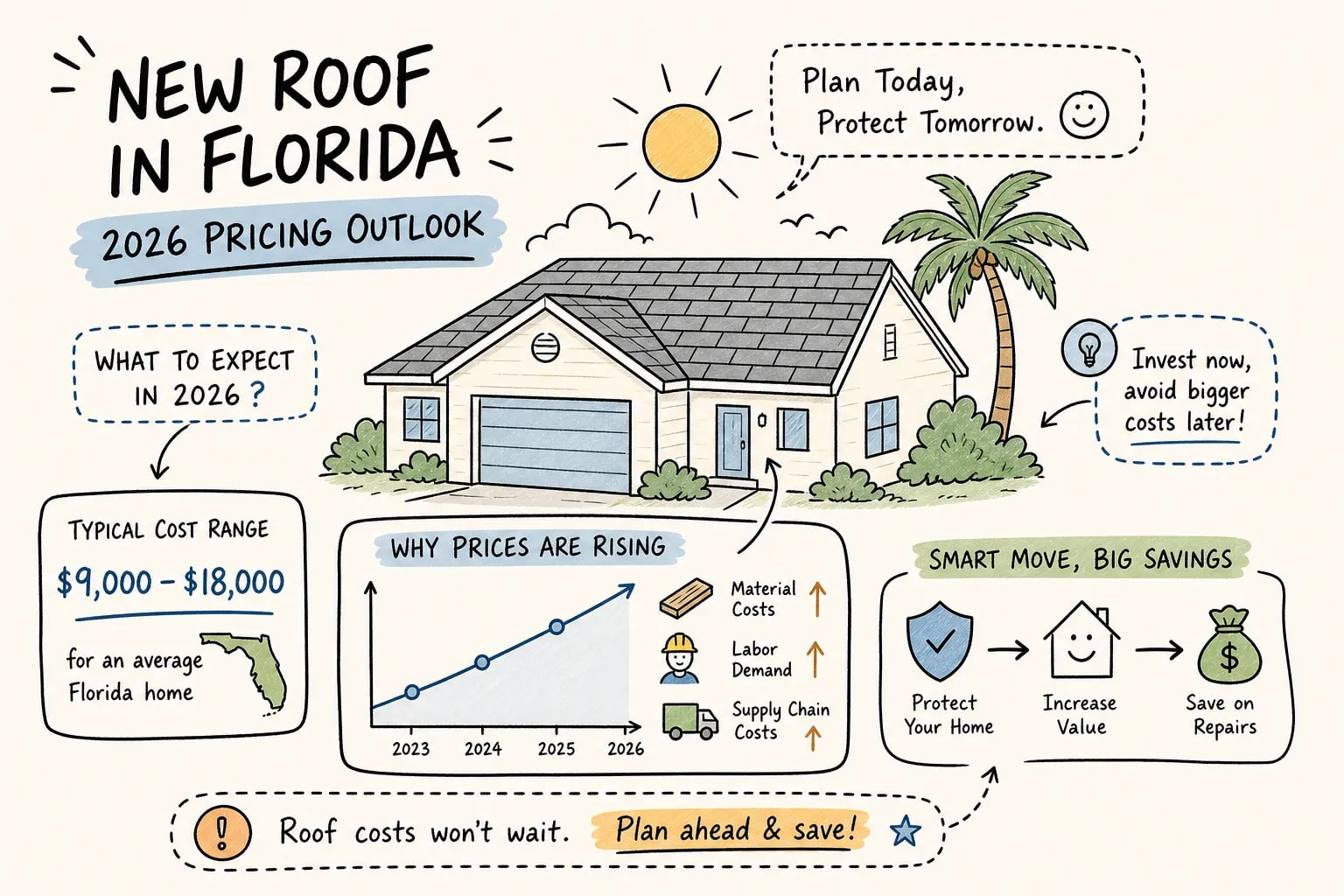
The new roof price Florida homeowners encounter in 2026 is one of the first numbers that stops people cold. The national average for a roof replacement sits around $9,530. Here in Florida, that same project typically runs between $18,000 and $32,000, with tile or metal roofs on larger homes pushing well past $45,000. That gap isn't a contractor padding his margin. It reflects hurricane-code requirements, subtropical material specs, and a labor market that stays busy year-round because Florida weather doesn't take breaks.
At Infinity Legacy, we've been delivering free estimates across Florida for over a decade, working with homeowners from Jacksonville down to Tampa and across Central Florida. We've seen the full range of projects, the straightforward ones and the ones that turned complicated after tear-off. What we've learned is that the homeowners who feel good about their investment are the ones who understood the pricing before the first contractor showed up. This article gives you that foundation: real cost ranges by material, a way to estimate by home size, the line items most quotes don't explain upfront, and practical steps to keep your final number as low as possible.
Why Florida roofs cost nearly twice the national average
If you've ever compared a Florida roofing quote to what your cousin paid in Ohio, the difference can feel like sticker shock. The truth is that Florida roofing is a fundamentally different product than roofing in a non-hurricane state, and the cost reflects that from the foundation up.
The weight of the Florida Building Code
Every roof replacement in Florida must meet current Florida Building Code wind-resistance standards. That means specific fastening patterns, mandated underlayments, and sealed deck requirements in many counties. These aren't optional upgrades you can decline to save money. They're the floor, not the ceiling. A contractor in a non-hurricane state can nail down shingles with standard patterns and move on. A licensed Florida contractor has to meet a much higher technical bar, and that bar adds both labor time and material cost to every job.
Material selection in a subtropical climate
Florida's heat, intense UV exposure, salt air, and seasonal storm cycles push most experienced contractors away from standard 3-tab asphalt shingles, which are the dominant choice in northern states. Concrete tile, standing-seam metal, and architectural shingles rated for 130+ mph winds are better suited to Florida conditions. They cost more upfront, but they're the right choice for a state where a weak roof gets tested every summer. When you pay Florida prices, you're getting a roof that's actually engineered for where you live.
Labor market and post-storm demand
South Florida labor rates run roughly 10, 25% above rural counties, and hurricane seasons create statewide demand spikes that keep contractor rates firm. After a major storm event, roofing crews are booked out for months, and the contractors with strong reputations fill up first. This isn't price gouging. It's the basic economics of a market where skilled, licensed labor is in genuine demand.
New roof price in Florida by material type
Material choice is the single biggest variable in your final quote. Here's how each major system pencils out in Florida's 2026 market, shown by cost per square foot, per roofing square (100 sq ft), and what a typical 2,000 sq ft home looks like.
Asphalt shingles: the entry-level option
Installed asphalt shingles in Florida run roughly $4.50 to $10.00 per square foot, or $450 to $1,000 per roofing square. On a 2,000 sq ft home, expect to pay somewhere between $9,000 and $16,000. Florida architectural shingles rated for wind speeds of 130 mph or higher sit at the upper end of that range, and they're the version worth buying in this state.
One important caveat: asphalt shingles have a shorter lifespan in Florida's heat and UV exposure than they do in cooler climates. A 30-year shingle might realistically deliver 15, 20 years of performance here, which affects the true cost-per-year calculation when you're comparing materials.
Metal roofing: the long-term investment
Metal roofing runs $9.00 to $22.50 per square foot installed, putting a 2,000 sq ft home in the $16,000 to $30,000 range. That spread is wide because metal is not one product. Exposed-fastener metal panels sit at the lower end of that range, while standing-seam metal, where fasteners are hidden and panels interlock, occupies the higher end and delivers better storm performance. The 40-to-70-year lifespan of a properly installed metal roof changes the math significantly when you're comparing it to asphalt that may need replacement in 15, 20 years. For homeowners who plan to stay in their home long-term, metal is often the most cost-effective choice over time.
Tile roofing: the Florida standard
Tile runs $10.00 to $27.50 per square foot installed, with a 2,000 sq ft home ranging from $22,000 to $45,000 and beyond. Concrete tile sits at the lower end of that range; clay tile occupies the upper end. Part of what makes tile more expensive isn't just the material itself. Tile is heavy, and Florida homes being reroofed in tile often require a structural load assessment and additional framing work to handle the weight. That labor scope adds cost that doesn't appear in a simple per-square-foot number. Tile is the dominant roofing material in much of Florida for a reason: it handles heat and storms well and carries excellent longevity when maintained properly.
Flat and low-slope roofs (TPO/EPDM membranes)
Flat roofing membranes like TPO and EPDM typically run $5.00 to $14.00 per square foot installed. This system is relevant for commercial properties, modern flat-roof homes, porch roofs, and additions. TPO carries a meaningful advantage in Florida because its light-colored, heat-reflective surface reduces solar heat gain, which matters in a state where cooling costs are a year-round concern. If your project involves a flat or low-slope surface, membrane roofing is the right conversation to have with your contractor.
How roof size translates into real dollar totals
Per-square-foot figures are useful context, but what you actually need is a number tied to your home. Here's how the math plays out across three common size tiers.
Small homes: 1,000 to 1,500 sq ft
Asphalt shingle roofs on smaller Florida homes typically run $6,000 to $12,000; tile comes in at $14,000 to $26,000. One thing that surprises homeowners is that a small footprint doesn't always mean a simple job. A 1,200 sq ft home with a steep pitch or multiple valleys can cost more per square foot than a flat 2,000 sq ft ranch because of the additional labor involved in working on complex geometry.
Mid-size homes: 1,500 to 2,500 sq ft
This is the most common Florida homeowner scenario. Shingle roofs in this range run $10,000 to $18,000; metal runs $16,000 to $32,000; tile runs $22,000 to $45,000. The Central Florida average of roughly $25,000 lands squarely in this range, which reflects how common tile and higher-end shingle systems are among mid-size Florida homes. If you own a typical Florida home and budget $20,000 to $30,000 for a quality replacement, you're in the right neighborhood for most material choices.
Larger homes: 2,500+ sq ft
Costs scale with square footage but increase further with complexity. Multiple levels, steep pitch, dormers, and complex rooflines all add labor hours that don't show up proportionally in a simple size estimate. Tile and metal roofs on larger homes in South Florida regularly exceed $60,000. If your home falls into this category, getting three detailed, itemized bids matters more than it does on a straightforward mid-size job. The spread between quotes on complex large homes can be substantial, and the differences tell you something real about what each contractor plans to do.
The hidden costs that push your estimate higher
A quote that looks clean on paper can grow significantly once work starts. Knowing which line items are commonly buried or excluded protects you from unpleasant surprises after a contract is signed.
Tear-off and disposal fees
Removing and hauling away your old roof adds roughly $1 to $3 per square foot, which works out to $1,000 to $4,000 or more for most Florida homes. Multi-layer roofs and heavy tile tear-offs cost more because they require more labor and generate more debris by weight. Some contractors exclude tear-off entirely from their headline quote. Always ask whether the quote includes full tear-off and disposal before you compare numbers across bids.
Permit fees and required inspections
Florida roofing permits typically run $150 to $500 depending on the county and project scope, with some municipalities running higher. More importantly, permits and inspections aren't optional on a full replacement. Florida law requires them, full stop. A contractor who offers to skip the permit is offering to put you at legal and financial risk, not save you money. Ask every contractor directly: "Are permits included in this quote, and are you pulling them?"
Roof deck repairs discovered after tear-off
This is the most unpredictable line item on any Florida reroof. Rotten or water-damaged decking is invisible until the old roof comes off, and the extent of the damage is genuinely unknown until that moment. Budget $2 to $5 per square foot for deck repair ($50 to $150 per sheet of plywood), and understand that extensive rot can add $2,000 to $5,000 or more to the total. Reputable contractors will document damage with photos and walk you through what they found before charging extra. If a contractor calls with a verbal-only deck repair upcharge and no documentation, that's worth pressing on.
What Florida's hurricane building codes add to the bill
Most national cost guides don't account for Florida's specific code requirements. These aren't optional upgrades. They're structural requirements tied to Florida's wind exposure, and they have real dollar figures attached.
Sealed roof deck requirement
A self-adhered peel-and-stick underlayment or spray-foam-sealed deck is required or strongly recommended in many Florida counties. The cost runs roughly $1,000 to $3,500 depending on roof size and method. This layer is what keeps water out of your home if shingles blow off in a storm. It's the difference between a roof that fails structurally and one that loses some surface material but keeps the interior dry. This is not a place to cut corners, and the insurance savings it generates make it worth understanding clearly.
Hurricane straps, clips, and enhanced fastening
Structural connectors between roof framing and wall framing add roughly $500 to $1,500 to a typical reroof when retrofitting or upgrading. These connections are what keep the roof attached to the house when sustained winds are testing every joint. In major code-compliance work, the full scope expands further and can involve more comprehensive structural tie-downs. Homes built to current Florida code sustain significantly lower windstorm damage than older construction, a fact borne out repeatedly in post-storm assessments across the state.
The 25% rule and when full code compliance kicks in
Here's a code detail that surprises many Florida homeowners. If a replacement or repair exceeds 25% of the roof area, the entire roofing system must come up to current code. That means a homeowner expecting a partial shingle repair can end up with a full code-compliance scope that covers underlayment, fastening pattern, deck attachment, and roof-to-wall connections. On the financial side, code-compliant work can yield 10, 20% reductions in insurance premiums on the windstorm portion of your policy. Over five to ten years, those savings meaningfully offset the added upfront cost of doing the work correctly.
Regional price differences across Florida you need to know
Florida isn't one market. Labor rates, material costs, and code enforcement intensity vary enough across the state that your location meaningfully affects your quote.
Northeast and North-Central Florida: Jacksonville, Palm Coast, Gainesville
Labor in Jacksonville runs around $55 per hour, which is among the more affordable metro rates in the state. A standard 2,000 sq ft shingle roof in Northeast Florida typically lands between $11,000 and $18,000. This region also tends to have shorter post-storm backlogs than South Florida, which can mean faster project timelines. For Northeast Florida homeowners, we offer free on-site estimates from St. Augustine to Gainesville and beyond, so you know exactly what your project looks like before you commit to anything. Infinity Legacy is based in Palm Coast and serves the full Northeast Florida corridor.
Central Florida: the Orlando area
Orlando labor averages around $56 per hour. Most Central Florida homeowners report replacement costs clustering around $25,000 for mid-size homes with tile or higher-end shingle systems. Tile is common in this region, which pulls the average up from what you'd see in a shingle-dominant market. The Central Florida roofing market stays active year-round, and post-storm demand from hurricane season can create backlogs that push timelines out by weeks.
South Florida: Tampa, Miami, Fort Lauderdale
This is where pricing jumps most sharply. Tampa labor runs about $58 per hour; Miami comes in around $62 per hour; Fort Lauderdale tops the state at approximately $74 per hour. Tile roofs in the Tampa market commonly run $32,000 to $65,000, and Miami-specific pricing carries a 10, 20% premium over statewide baselines because of High-Velocity Hurricane Zone product approval requirements, more complex permitting, and labor scarcity. If you're in South Florida, getting three detailed bids is essential, and verifying contractor licensing before you engage anyone is non-negotiable.
How to read a roofing estimate and avoid getting burned
A roofing quote is only as useful as what it actually specifies. Knowing what to look for, and what to walk away from, is how you separate quality contractors from low-ball bids that will cost you more in the end.
What a complete roofing estimate must include
A legitimate Florida roofing estimate should specify the exact material (brand, product line, and wind rating), total roofing square count, tear-off scope, permit and inspection fees, deck repair allowance or policy, underlayment type, and warranty terms covering both the manufacturer's product warranty and the contractor's labor warranty. If any of these items are missing, ask before you sign anything. A contractor who can't or won't answer those questions clearly is showing you something important about how the project will go once work starts.
Red flags in unusually low bids
Some contractors win bids by excluding permits, using unlicensed subcontractors, or simply omitting tear-off and deck repair as line items. A quote that comes in 30, 40% below every other bid usually means something is missing, not that the contractor found a magic efficiency. The consequences of unpermitted work in Florida range from fines to having to redo the entire roof at your expense when you sell. Always verify a contractor's Florida license number and active insurance coverage before signing. Infinity Legacy operates under CGC1540795 and is fully licensed and insured, so you can verify exactly who you're working with.
Questions to ask your contractor and your insurer
Before you commit to any roofing project, get clear answers from your contractor on these points:
- Is this price all-in, or are there charges that could be added?
- Are you pulling the permit?
- What wind rating does this specific product carry?
- What is your policy when deck damage is discovered after tear-off?
From your insurer, ask:
- Does my homeowner's policy cover any portion of this replacement?
- What documentation do you need from a code-compliant reroof to adjust my windstorm premium?
Getting these answers upfront eliminates the most common sources of project friction and unexpected costs.
How to lower the new roof price in Florida
There's no secret shortcut to a cheap Florida roof, but there are legitimate strategies that can reduce your total cost or improve the return on what you spend.
Time your project outside peak storm season
Contractor demand spikes after hurricane season, which runs from August through October. Scheduling a replacement during late winter or early spring, January through April, often means better crew availability, faster project timelines, and in competitive markets, more room for negotiation. The savings won't be dramatic, but getting a more attentive crew and a faster start date has real value, especially if your current roof is already showing age.
Use wind mitigation reports to lower insurance premiums
After a code-compliant reroof, hire a certified Florida wind mitigation inspector to document your upgrades. A sealed roof deck and reinforced connections can reduce the windstorm portion of your insurance premium by 25, 35%, which often translates to hundreds of dollars per year. Over ten years, those savings can offset a meaningful portion of the code-upgrade costs you paid upfront. This is one of the few situations in home improvement where spending more on quality now directly reduces your ongoing cost of ownership.
Ask about PACE financing for $0 down
Florida's PACE program (Property Assessed Clean Energy) lets qualified homeowners finance a new roof with $0 down and no traditional credit requirement. Repayment is structured through the property tax bill, which means no loan application, no bank approval process, and no upfront capital required. Infinity Legacy works with PACE-eligible projects and can walk you through whether your home and project qualify during a free estimate visit. For homeowners who need a roof now but aren't in a position to fund it entirely out of pocket, this program changes the conversation significantly.
Start with a real number, not a guess
Florida roof replacement costs more than the national average for reasons that are clear and verifiable: stricter hurricane codes, subtropical material requirements, and labor markets shaped by genuine demand. The price range is wide, from around $9,000 for basic shingles on a small home up to $45,000 and beyond for premium tile on a larger one. Home size, regional labor rates, code-required upgrades, and hidden costs like deck repair are the primary variables that move your number up or down.
The fastest way to stop estimating and start planning is a detailed, itemized quote from a licensed Florida contractor who knows your area and your roof type. Infinity Legacy provides free, no-obligation estimates across Florida, from Jacksonville and Palm Coast down through Orlando, Tampa, and beyond. Our team handles roofing in all major systems, shingle, metal, tile, and flat membrane, under a single licensed contractor (CGC1540795), with PACE financing available for qualified homeowners.
If you want an accurate new roof price Florida homeowners can trust, the next step is simple. Reach out to our team and schedule your free estimate. You'll know exactly where you stand before you make any decisions.