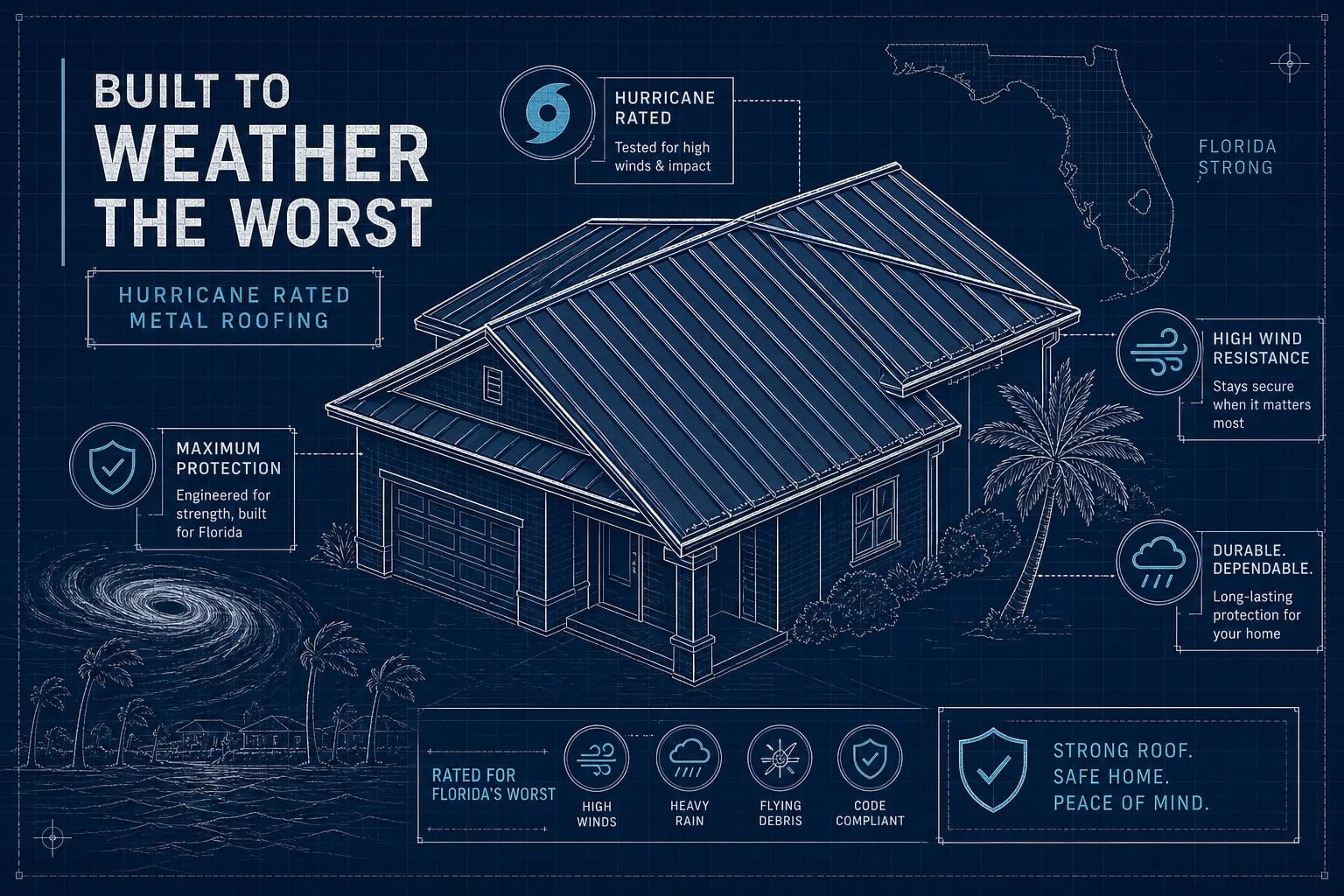
Florida homeowners shopping for a metal roof encounter terms like "160 mph rated" and "Miami-Dade approved" on nearly every contractor proposal. Most bids throw those numbers out without explaining what they actually guarantee, or what conditions have to be met for that rating to hold when a real storm hits your house. A metal roofing hurricane rating is not a single number stamped on a panel. It is the combined result of panel profile, attachment method, deck substrate, edge detailing, and code compliance working together as one integrated system.
At Infinity Legacy, we install Florida Building Code (FBC)-compliant metal roofing systems across Northeast and Central Florida, and we see firsthand how often homeowners sign contracts without understanding a single certification on the proposal. That gap matters because a roof installed to the wrong standard, or correctly rated but incorrectly installed, will not perform when it counts. This walkthrough covers every rating, test, and question worth asking before you commit to a system.
Metal roofing hurricane rating: what it actually measures
The most important number in metal roofing wind testing is not a miles-per-hour figure. It is uplift pressure measured in pounds per square foot (psf). Laboratories do not generate a 160 mph wind over a test panel and see what happens. They apply controlled positive and negative air pressure to a mounted roof assembly, cycling load upward until the system holds or fails. The mph figure you see on a product brochure is a simplified translation from that pressure data, not a direct measurement of wind speed resistance.
This matters because two products both labeled "150 mph rated" can behave very differently depending on how that number was derived. The test standard used, the clip spacing during testing, the deck type, and the fastener pattern all affect the result. A system tested under UL 580 follows a different protocol than one tested under ASTM E1592, and a panel that earned its metal roofing hurricane rating with 12-inch clip spacing will not perform the same when clips are installed at 24 inches in the field.
The test process itself is straightforward in concept: a representative roof assembly is mounted on a test frame, pressure is applied from below and above to simulate the suction forces a hurricane creates, and load cycles increase in stages until the system either holds at the rated pressure or fails. Standards like UL 580, ASTM E1592, and UL 1897 all test the whole assembly, panels, clips, fasteners, and deck together, not the panel in isolation. That distinction is critical, because a panel that looks strong on paper is only as good as the weakest component in the assembly it belongs to.
One term worth separating out is the UL 2218 rating. This measures resistance to hail and flying debris, not wind uplift. A Class 4 UL 2218 rating matters for insurance discounts in hail-prone areas and is part of any serious storm-resilience conversation. But it tells you nothing about how well the roof holds under sustained uplift pressure. Many homeowners conflate the two, and some contractors let that confusion stand unchallenged.
The certifications and test standards that actually matter in Florida
Florida uses two main approval pathways for roofing products: the Miami-Dade Notice of Acceptance (NOA) and the Florida Building Code (FBC) Product Approval. A Miami-Dade NOA carries extra weight because it is specifically issued for use in Florida's High Velocity Hurricane Zone (HVHZ), which covers Miami-Dade and Broward counties, the most demanding wind environment in the continental United States. Design wind speeds in Miami-Dade reach 175 mph for standard residential buildings and 186 mph for critical facilities. An NOA means the product assembly has been tested and accepted for those conditions specifically.
Outside the HVHZ, the FBC Product Approval is the standard documentation path. The City of Miami accepts either one, but jurisdictions in the HVHZ frequently require the NOA by name. Both approvals are assembly-level documents, not product-level branding. The approval applies to a specific combination of panel, clip, fastener, spacing, and deck, and a change to any of those variables can invalidate the metal roofing hurricane rating.
The underlying test standards behind those approvals are where the engineering lives. UL 580 tests uplift resistance for roof assemblies broadly. UL 1897 is a companion uplift test used with metal roofs over specific deck types. ASTM E1592 evaluates structural performance of sheet metal systems under uniform static air pressure and is particularly relevant for standing seam systems. TAS 125 is a Florida-specific testing protocol used in HVHZ approvals. None of these is a standalone pass/fail grade you can compare side by side; they are the test methods referenced inside an approval report that defines exactly what was tested and at what pressure.
The approval document is more useful than any product brochure. The brochure lists the ceiling performance under ideal tested conditions. The approval document defines the exact configuration that produces it: fastener pattern, clip spacing, panel gauge, deck type, and substrate requirements. If the proposed installation does not match that configuration, the metal roofing hurricane rating does not transfer. Always request the approval number and verify the configuration against what the contractor is actually proposing to install.
How different metal roof profiles perform in major storms
Standing seam is the benchmark for wind uplift resistance among metal roof profiles, and mechanically field-seamed standing seam systems sit at the top. The reason is structural: the panel locks together at the seam without exposed fasteners in the field, and a floating clip system transfers load without puncturing the panel. Under ASTM E1592 testing, the mechanically folded double-lock seam resists separation far better than a snap-fit seam because the failure point shifts from the seam itself to the clip and structural capacity, which are both engineered to be stronger. Tested mechanically seamed assemblies regularly achieve equivalent ratings of 150 to 180-plus mph depending on gauge, clip spacing, and substrate conditions.
Snap-lock standing seam performs well but typically carries lower tested ratings than mechanically seamed systems, often falling in the 130 to 150 psf range versus the 170 psf or higher that mechanical seaming can reach. Snap-lock seams can disengage under high uplift loads before the clips or deck reach their limit, which is why most high-wind specifications in Florida call for mechanical seaming. The distinction rarely appears on a brochure; you find it in the approval document and in the proposed installation specification.
Stone-coated metal shingles occupy a strong position for combined impact and wind performance. They frequently carry Class 4 UL 2218 ratings and are engineered for interlocking attachment, which distributes load across multiple contact points. Wind performance is competitive but depends heavily on the attachment pattern and substrate, which varies by manufacturer system. If hail exposure is part of your risk calculus alongside hurricane wind, stone-coated metal is worth evaluating seriously.
Exposed-fastener and corrugated profiles can be engineered for hurricane zones, but they carry more inherent risk. Every fastener penetration in the field is a potential failure point: screws back out under repeated cyclic uplift loads, and pull-through failure at those points can cascade quickly. Corrugated panels sit in the middle of the range depending on gauge and fastener density. These profiles are not the first choice for high-velocity hurricane exposure, but they can perform adequately in lower wind zones when the assembly is properly engineered and the approval documentation supports the design pressure for the specific site.
Why your attachment system is just as critical as the panel
The panel earns the headline rating, but the attachment system determines whether that rating holds in the field. Wind uplift is always highest at roof corners and perimeters, and code-compliant installation requires tighter fastener spacing in those zones because the pressure differential is greater there. A single field fastener pattern applied uniformly across the entire roof is a red flag in any proposal; corners and perimeters need their own spacing specification.
Perimeter vs. field fastener spacing
For standing seam systems, floating clips allow thermal expansion and contraction without creating stress points in the panel, while maintaining uplift resistance through the clip-to-deck connection. Fixed clips save cost but can generate stress concentrations that degrade performance under cyclic loading. Anti-backout fasteners matter for any exposed-fastener system because standard screws work loose under the repeated load cycles a Florida storm delivers over several hours.
Clip types, deck substrate, and edge detailing
Deck substrate quality changes the entire equation. A metal roof assembly's rated pressure is only valid if the installed deck matches the tested assembly specification. Field experience and post-storm engineering reports indicate that upgrading deck gauge or fastener diameter can increase uplift performance by roughly 10 to 15 percent in tested assemblies. If a proposal does not mention deck condition or deck upgrade potential, ask directly. A deck that cannot transfer load effectively will fail before the panel does.
Some tested assembly configurations that incorporate air barriers show meaningful improvements in uplift performance by distributing load more evenly across the system, a detail worth confirming in the specific approval report for any proposed assembly. Edge metal and flashing are where most real-world metal roof failures actually initiate. Code requires perimeter securement that performs at roughly double the field load requirement, but improper flashing details routinely undermine an otherwise well-rated system. This is the detail that separates a contractor who understands wind engineering from one who is simply selling a product name.
What post-hurricane reports reveal about where metal roofs fail
Post-storm engineering investigations in Florida tell a consistent story: metal roof failures almost always begin at eave and rake edges, not in the field of the roof. Poor flashing, inadequate edge metal, and improperly secured gutters create a weak point where wind pressure begins peeling panels back progressively. Once perimeter integrity breaks, the rest of the roof can follow in a cascade that happens fast.
The second major failure driver is internal pressurization. When windows, doors, or garage doors fail during a storm, internal pressure builds dramatically and combines with external suction to overload the roof system. The roof's rated uplift capacity is calculated for a specific pressure differential. A failed opening changes that calculation mid-storm, often pushing the system past its design limit from the inside. This is why impact windows and doors belong in the same storm-resilience conversation as roofing: they are not separate upgrades, they are part of the same pressure envelope.
Post-hurricane investigations also document specific installation errors as the root cause of most failures: clip spacing installed wider than specified, wrong fastener type or size, fasteners placed outside the approved zone, and improper flashing at eaves and penetrations. What the investigations consistently find is that many metal roof failures trace back to improper installation rather than any deficiency in the metal panel itself. A correctly rated product installed incorrectly will not perform to its metal roofing hurricane rating, and no certification on the product box changes that.
Florida wind zones and the design pressure your roof needs to meet
Florida divides into wind speed zones based on county and proximity to the coast, and the Florida Building Code uses ultimate design wind speed (Vult) as the basis for structural calculations. Miami-Dade sits at 175 mph for standard residential construction. Broward requires 170 mph. Palm Beach ranges from 160 to 170 mph. Moving up the Atlantic coast, Brevard sits around 130 to 140 mph, Flagler and Volusia fall in the 130 mph range, and Duval runs around 120 to 130 mph. Inland counties like Orange and Alachua work from 110 to 130 mph depending on exact location. These are not arbitrary tiers; they reflect decades of hurricane track data and storm surge modeling.
The wind speed number is the starting point, not the finish line. From that speed, an engineer calculates the design pressure in psf for the specific roof, accounting for roof height, roof shape, and exposure category. A legitimate contractor uses that design pressure to select a system whose allowable uplift pressure meets or exceeds the requirement at every zone: field, perimeter, and corner. Each zone carries a different load, and each must be addressed separately in the approval documentation.
Some homeowners chase HVHZ-rated products for locations that do not require them. An NOA-rated system installed in Palm Coast or Daytona Beach does provide a meaningful safety margin above the local code minimum, and that margin is not wasted. The goal is matching the right system to the right wind zone and ensuring the approval documentation supports the design pressure at the specific address. Overengineering slightly is acceptable; underengineering is not recoverable after a storm.
How to verify a metal roofing hurricane rating and confirm installer credentials
Before signing any contract, request three documents: the FBC Product Approval number or Miami-Dade NOA number for the specific panel system, the product approval report showing the tested assembly configuration, and written confirmation that the proposed installation matches the tested assembly. A contractor who cannot produce all three within a day of the estimate is not in a position to guarantee code compliance, regardless of what the brochure says.
The conversation during the estimate should cover specific ground. Ask what the design wind pressure is for your address. Ask what the system's allowable uplift pressure is at the perimeter and at the corners, not just in the field. A third question worth pressing on: whether the panel gauge, clip type, fastener spacing, and deck specification in the proposal are consistent with the approval document. Then ask who pulls the permit and who schedules the inspection. A contractor confident in their product and installation process answers all of these without hesitation or deflection.
The warning signs worth walking away from before the deposit clears are equally clear. A bid that lists a panel brand and an mph number without referencing a specific approval document offers no verifiable standard. A proposal that does not mention edge metal, perimeter detailing, or deck condition skips the details that actually prevent failures. A contractor who discourages pulling a permit is eliminating the one third-party checkpoint that confirms the installation was inspected against code requirements. None of these are negotiating points. They are structural.
Getting a Florida Building Code-compliant metal roof installed
FBC compliance is the minimum expectation for any licensed Florida contractor, not a premium feature. Every roofing contractor operating legally in Florida is required to install systems that meet the code for the applicable wind zone. What differentiates contractors is whether they document that compliance, pull permits, schedule inspections, and stand behind the installation with a workmanship warranty. The paperwork matters as much as the panels.
At Infinity Legacy, we approach metal roofing the way it should be approached: starting with the specific wind zone for the address, calculating the required design pressure, and selecting a system whose FBC Product Approval or Miami-Dade NOA supports that pressure at every roof zone. We are a licensed Florida contractor (CGC1540795) serving Palm Coast, Jacksonville, St. Augustine, Daytona Beach, Orlando, and across Northeast and Central Florida. Free estimates include a detailed conversation about the right metal roofing hurricane rating for the specific property, not a one-size recommendation based on what is easiest to install. For homeowners who need a hurricane-grade metal roof but are working with budget constraints, PACE financing with $0 down means that decision does not have to be delayed. The upgrade gets done on the right schedule, not whenever capital happens to align.
The framework that protects your roof and your investment
Understanding your metal roofing hurricane rating means looking past the mph figure on a brochure and examining the full picture: panel profile, attachment system, substrate condition, edge detailing, and code compliance all have to align with the tested assembly that generated the rating. The number becomes a reliable guarantee only when the installed assembly matches the tested configuration, the attachment pattern accounts for perimeter and corner loads, the deck can transfer the forces, and a licensed inspector has confirmed compliance with the Florida Building Code for the applicable wind zone.
Homeowners who understand wind uplift pressure, know how to read an approval document, and ask the right questions before signing are far better positioned to make a decision they will not regret after the next storm. The questions are not complicated, and any contractor worth hiring should welcome them. The ones who do not are telling you something important about what happens after the check clears.
Infinity Legacy offers free estimates and no-pressure consultations for Florida homeowners who want a code-compliant metal roofing system and a contractor who can explain every detail of the proposed assembly. Reach out to our team to schedule yours.