
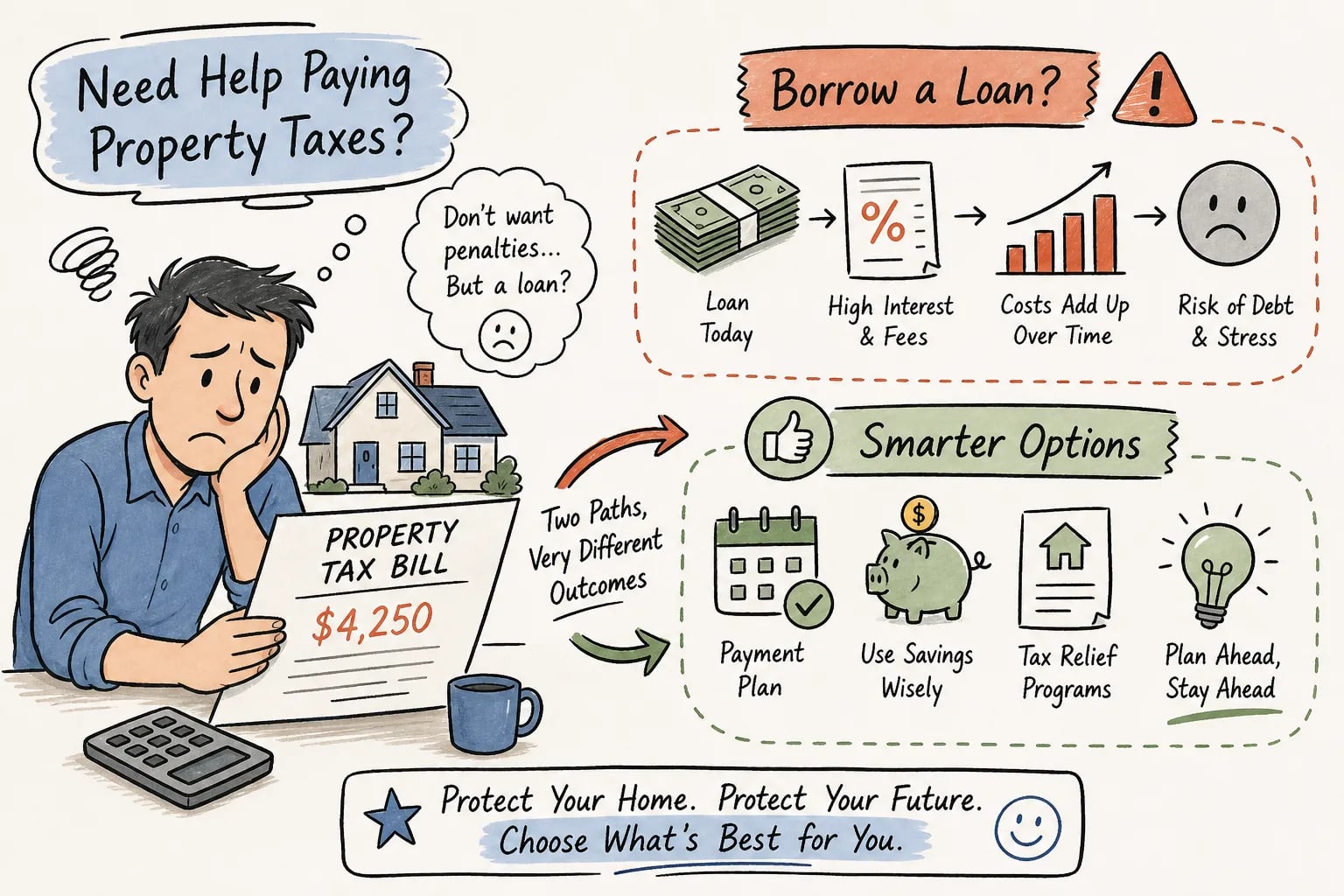
When the property tax bill arrives and the number on it exceeds the cash you have available, the due date starts to feel like a countdown. If you're searching for a loan for property taxes, you need to understand what these products actually cost, what legal rights you give up at signing, and whether smarter options are sitting right in front of you before you call a private lender. This article covers all of it: how property tax loans work, what they charge, who qualifies, the legal protections available to you, and a clear set of alternatives, including one that actually improves your home rather than just servicing a debt. Infinity Legacy's PACE financing program is one example of how property-tax-bill repayment can work in your favor, and we'll get to that after covering the product most private lenders are selling.
What a property tax loan actually is
A property-tax loan is a private financial product, not a government program. A licensed lender pays your overdue or upcoming tax bill directly to the county, and you repay that lender over time with interest and fees. The transaction sounds simple, but the details underneath it carry significant financial and legal weight. The property itself secures the debt, which means the stakes are considerably higher than a standard personal loan.
How the money moves from lender to county
The process runs in four stages. The lender reviews your application, verifies your tax balance, confirms property ownership, and may check income and credit. If approved, the lender pays the taxing authority directly, clearing the delinquency on record. A lien transfer or security interest is then recorded against your property, giving the lender a legal claim to it. You make monthly payments until the balance is paid in full, at which point the lien is released. That third stage, the lien recording, is where most borrowers underestimate what they've agreed to, and it deserves careful attention before you sign.
When the tax lien shifts to the lender
In states that allow lien-transfer loans, primarily Texas, the government's legal claim on your property doesn't disappear when the lender pays the county. It transfers to the lender. That means the private company now holds the same foreclosure authority the county originally had. This is the central risk of a delinquent property tax loan, and understanding it before you sign changes how you evaluate the entire transaction.
What happens when payments stop
If you miss payments on a property-tax loan, the lender can initiate foreclosure proceedings even if you're completely current on your mortgage. Your mortgage lender holds a separate lien, and being up to date on one obligation does not protect you from default on another. These are parallel debts secured by the same asset, and either one can trigger foreclosure independently.
What a loan for property taxes really costs in 2026
The advertised rate is never the full cost. When you finance property taxes through a private lender in 2026, you're looking at a combination of interest, origination charges, closing fees, and recording costs that can push the effective cost well beyond the number on the marketing brochure. Understanding the full picture before comparing lenders is the only way to make a genuinely informed decision.
Interest rates and APR ranges to expect
Typical interest rates from property-tax lenders currently run between 9% and 15%, with some lenders approaching the statutory Texas ceiling of 18% APR. The APR matters more than the stated rate, because origination fees, closing costs, and underwriting charges are often rolled into the financed balance. A loan quoted at 12% can carry a true APR considerably higher once all costs are factored in. Always ask for the annual percentage rate and the total of payments, not just the monthly figure.
Fees that quietly inflate what you owe
Origination fees typically run 1% to 3% of the financed balance. Closing and administrative fees often fall between $200 and $500, though some lenders charge substantially more. Recording and transfer charges add additional cost depending on the jurisdiction. In Texas, the statutory closing-cost cap for residential property-tax loans is $900, with an extra $100 charge permitted per additional parcel, plus a late fee of up to 5% of any scheduled payment unpaid after the tenth day. Two lenders quoting similar interest rates can produce very different total repayment amounts when their fee structures are compared side by side.
A real cost comparison at $10,000
Consider a $10,000 balance financed over five years. At 10% APR, you'd pay roughly $212 per month and about $2,728 in total interest. At 18% APR, that climbs to approximately $254 per month and $5,253 in interest. At 30% APR, the numbers reach $324 per month and $9,463 in total interest over the same period. A county payment plan or tax deferral frequently costs less than the lowest of those three scenarios, a comparison that's worth a phone call to your tax collector before you sign anything.
Who qualifies and what documents lenders require
Eligibility for a property tax payment loan is more straightforward than a traditional mortgage, but it's not automatic. Lenders apply a consistent set of criteria, and knowing them in advance saves time and avoids surprises during the application process.
Basic eligibility rules most lenders apply
You must own the property, have verifiable delinquent or upcoming taxes, and meet the lender's minimum balance threshold, which commonly falls between $1,500 and $3,500. Active bankruptcy proceedings will disqualify an application at most lenders. In Texas, homeowners 65 and older who qualify for a homestead tax deferral are generally barred from obtaining a private property-tax loan for that property. The law recognizes that a government deferral option exists for them, and it takes priority.
Documents you'll need to gather
Most lenders require a government-issued photo ID for every person on the title, proof of ownership through a deed, title record, or mortgage statement, the current tax bill or delinquency notice, Social Security numbers for all owners, and the name and contact information for your mortgage servicer. For commercial or entity-owned properties, expect additional requirements: articles of incorporation, partnership agreements, corporate tax returns, financial statements, and potentially environmental reports or property surveys. Preparing these documents before you apply keeps the process moving and reduces the risk of delays that let penalties accumulate.
Circumstances that can disqualify an application
Beyond bankruptcy, other factors can close the door: the property is in a state where the lender isn't licensed, the equity in the property is insufficient relative to the loan amount, or the outstanding tax balance falls below the lender's minimum. If you find yourself disqualified, treat that as a clear signal to pivot directly to county alternatives. Your tax assessor-collector can tell you about installment plans, hardship arrangements, and deferral programs that don't require private lender approval.
State rules and the consumer protections you're entitled to
The legal framework governing these loans varies significantly by state. Texas has the most developed and clearly regulated private property-tax loan market in the country, operating under Tax Code sections 32.06 and 32.065, Finance Code Chapter 351, and 7 TAC Chapter 89. Other states handle tax delinquency primarily through government processes, and private lending into this space is far less common or structured.
Texas: the most developed private tax-loan market
In Texas, lenders must be licensed by the Office of Consumer Credit Commissioner (OCCC). Borrowers receive written disclosures including APR and total repayment amount, protection against prepayment penalties, and a three-day right to rescind, a protection specific to Texas property-tax loans under state law. Lenders cannot require borrowers to waive statutory consumer protections, and advertising that mimics official government correspondence is prohibited. If a lender can't confirm their OCCC license number on request, that alone is reason to walk away.
What protections borrowers have regardless of lender
Across most regulated markets, borrowers are entitled to written loan disclosures with APR and total payment amounts, foreclosure notice and cure rights before a lender can take action, licensed originator requirements, and, in most jurisdictions, the right to prepay without penalty. These protections require you to actually read the paperwork, not just sign it. In Texas specifically, the statutory three-day rescission window is particularly valuable: if any term changes between application and closing, you have the right to cancel. Check your state's specific rules, since rescission rights and other protections vary by jurisdiction.
What other states offer instead
Outside Texas, most states don't have a robust private property-tax loan market. Delinquent taxes are typically handled through government-administered tax-lien sales, tax-deed procedures, or installment agreements. If you live outside Texas and a private lender is aggressively marketing a tax loan for homeowners to you, scrutinize that pitch carefully. Your first call should always be to your county tax assessor-collector, not a private lender, to understand exactly what government-administered options exist before considering private financing.
Smarter alternatives to a loan for property taxes
A private property-tax loan is rarely the most cost-effective path. The options below move from lowest cost and risk to higher, giving you a practical hierarchy to work through before you commit.
County payment plans and tax deferrals: always ask first
County installment plans are typically the lowest-cost path available. In Florida, for example, the county tax collector's installment plan applies statutory discounts to the first three quarterly payments, which means you're paying less than the face value of your annual bill if you plan ahead. Tax deferrals allow qualifying homeowners, often seniors, disabled residents, or low-income households, to push tax payments to a lien against the property rather than paying immediately. The interest on deferred amounts is usually far lower than any private lender would charge. Call the county tax assessor-collector before doing anything else; that single call is the most financially sound first step available to you.
Personal loans, HELOCs, and home equity loans compared
A personal loan doesn't put your home into the collateral equation, which is a meaningful protection if your income is uncertain. Rates run 8% to 36% APR depending on credit, a wide range, but the foreclosure risk is removed. A home equity line of credit typically offers lower rates than a personal loan, but it's variable and secured by your home, meaning rising rates and missed payments create real exposure. A fixed home equity loan gives you predictable payments and a lower rate but carries the same foreclosure risk as the property-tax loan itself. The practical rule: use a personal loan when protecting your home from additional lien risk is the priority. Consider a HELOC or home equity loan only when your income is stable, your repayment margin is clear, and you've confirmed the total cost is lower than the county alternative.
A decision framework before signing anything
Work through this hierarchy before committing to any financing. Start by calling the tax collector and asking about installment plans, hardship arrangements, exemptions, and deferrals. Then verify whether you qualify for a senior, disability, or veteran deferral program that removes the immediate payment obligation entirely. If protecting your home from additional liens is the priority and the monthly payment fits, compare a personal loan next. Only after exhausting those options should you evaluate a private property tax loan, and only after reviewing the full APR, all fees, the total repayment amount, and the exact foreclosure terms in writing. If any of those numbers aren't available in writing, stop and consult a HUD-approved housing counselor for free, unbiased guidance before proceeding.
How PACE financing works differently, and what Florida homeowners can do with it
There's another side of property-tax-connected financing worth knowing about, and it operates in the opposite direction from a delinquent-tax loan. Instead of borrowing to pay a bill you already owe, you're funding improvements to your home and repaying through your property tax assessment over time. For Florida homeowners facing major upgrade needs, this changes the conversation entirely.
PACE vs. a traditional property tax loan: the key difference
A conventional property-tax loan pays a debt you already owe, typically under financial stress, with foreclosure risk attached. PACE financing funds approved home improvements, and repayment is added to your property tax assessment and spread over 5 to 20 years. There's no upfront cost at closing, and eligibility criteria vary by program and provider, some PACE programs include underwriting or verification steps, so confirm requirements with your specific provider. The assessment is tied to the property rather than following the borrower personally, which is a structurally different arrangement than a mortgage lien.
What Florida homeowners fund through PACE financing
PACE-eligible improvements in Florida include roofing systems, full HVAC replacement, impact windows and doors, solar panels, insulation upgrades, hurricane shutters, and standby generators. These aren't cosmetic upgrades, they directly address Florida's storm exposure, year-round energy costs, and insurance considerations. A new roof before hurricane season, impact windows that may reduce insurance costs depending on your insurer and policy, or a high-efficiency heat pump that cuts summer utility bills are investments that can pay returns over time. That's a fundamentally different outcome than a tax-delinquency loan, which is purely a cost to exit a problem.
Infinity Legacy works with PACE financing programs for these upgrades across Northeast and Central Florida. Qualified homeowners can move forward on roofing, HVAC, or impact windows with $0 down and no out-of-pocket cost at the time of service. The project gets done, the lender pays the contractor directly, and repayment is folded into the property tax bill on a schedule the homeowner can plan around.
How Infinity Legacy's PACE program works in practice
Consider a Palm Coast homeowner who needs a full roof replacement before hurricane season arrives, no savings available, no HELOC equity built up, and a traditional loan carries more risk than they're comfortable taking on. Through a PACE program facilitated by Infinity Legacy, the project moves forward without delay. The financing covers the full cost, the lender pays Infinity Legacy directly, and the homeowner repays through their annual property tax bill at a fixed rate over the agreed term. Rates on Florida PACE programs generally run between 6% and 12.99% depending on the provider, term, and project scope.
Because Infinity Legacy handles roofing, HVAC, and impact windows under one licensed team, a homeowner can bundle multiple upgrades into a single PACE-financed project, one contractor, one financing agreement, one property tax line item, and a home that's genuinely more storm-resilient when the work is done. That outcome stands in sharp contrast to a delinquent-tax loan, which leaves the home exactly as it was before, just with a smaller tax balance and a private lender's lien attached.
Red flags to spot and your checklist to apply safely
If you've worked through the alternatives and a private property-tax loan is genuinely the right path for your situation, protecting yourself during the process is essential. Predatory players operate in this space, and knowing the warning signs keeps you from signing something you'll regret.
Warning signs of a predatory property tax lender
Watch for mailers designed to look like official government correspondence, this is illegal in Texas and a serious red flag anywhere. Lenders who pressure you for a same-day signature or manufacture urgency are another warning sign: rescission rights exist precisely because these decisions deserve time for reflection. Any quote that doesn't include a clear APR, total repayment amount, and itemized fee schedule is incomplete, and you should treat it as such. A lender who can't confirm their state regulator license number on request should not receive your application. Any pitch that glosses over foreclosure risk reveals exactly how that lender intends to operate with you.
Your checklist before signing any property-tax loan
Confirm the lender's license status with your state regulator before sharing any personal information. Request the complete loan disclosure in writing, including APR, total of all payments, all fees itemized, and the exact prepayment terms. Verify whether the county offers a lower-cost installment plan and compare the total payoff amount directly with the private loan. Read every default and foreclosure provision in the loan agreement, not just the payment schedule. If any term changes between application and closing, exercise your rescission right and reconsider. These steps take time, but they protect you from signing away far more than the original tax bill.
When to call a HUD counselor instead of a lender
If the math between a private loan and a county alternative is close, or if you feel any pressure during the process, contact a HUD-approved housing counselor before proceeding. These counselors provide free, unbiased guidance on delinquent-tax situations, mortgage concerns, and financing options. They have no financial stake in what you decide, which makes their perspective genuinely useful when the numbers are ambiguous. You can find HUD-approved counselors through the HUD website. When your home is on the line, this is not a step to skip.
Conclusion
A loan for property taxes can solve a real problem. When taxes are overdue, penalties are mounting, and no other path is available, a private property-tax lender can stop the clock. But the cost of that solution, measured in interest, fees, and lien risk, makes it a last resort rather than a first call. The decision hierarchy is clear: start with the county tax office, check deferral and exemption eligibility, consider a personal loan if protecting the property from additional liens matters most, and only then evaluate a private loan for property taxes with full cost and foreclosure-term disclosure in hand.
If the deeper issue is a home that needs major improvements you can't afford upfront, that's a different conversation with a different answer. PACE financing through a contractor like Infinity Legacy turns the property tax bill into a tool for building real resilience. A new roof or impact windows funded through PACE can cut insurance costs and hold up through future storm seasons, improvements that pay forward, unlike a tax-delinquency loan, which is purely a cost to exit a problem.
Whichever path fits your situation, take the next step today. Contact your county tax office for installment and deferral options, or reach out to Infinity Legacy to explore what PACE financing could fund for your home.