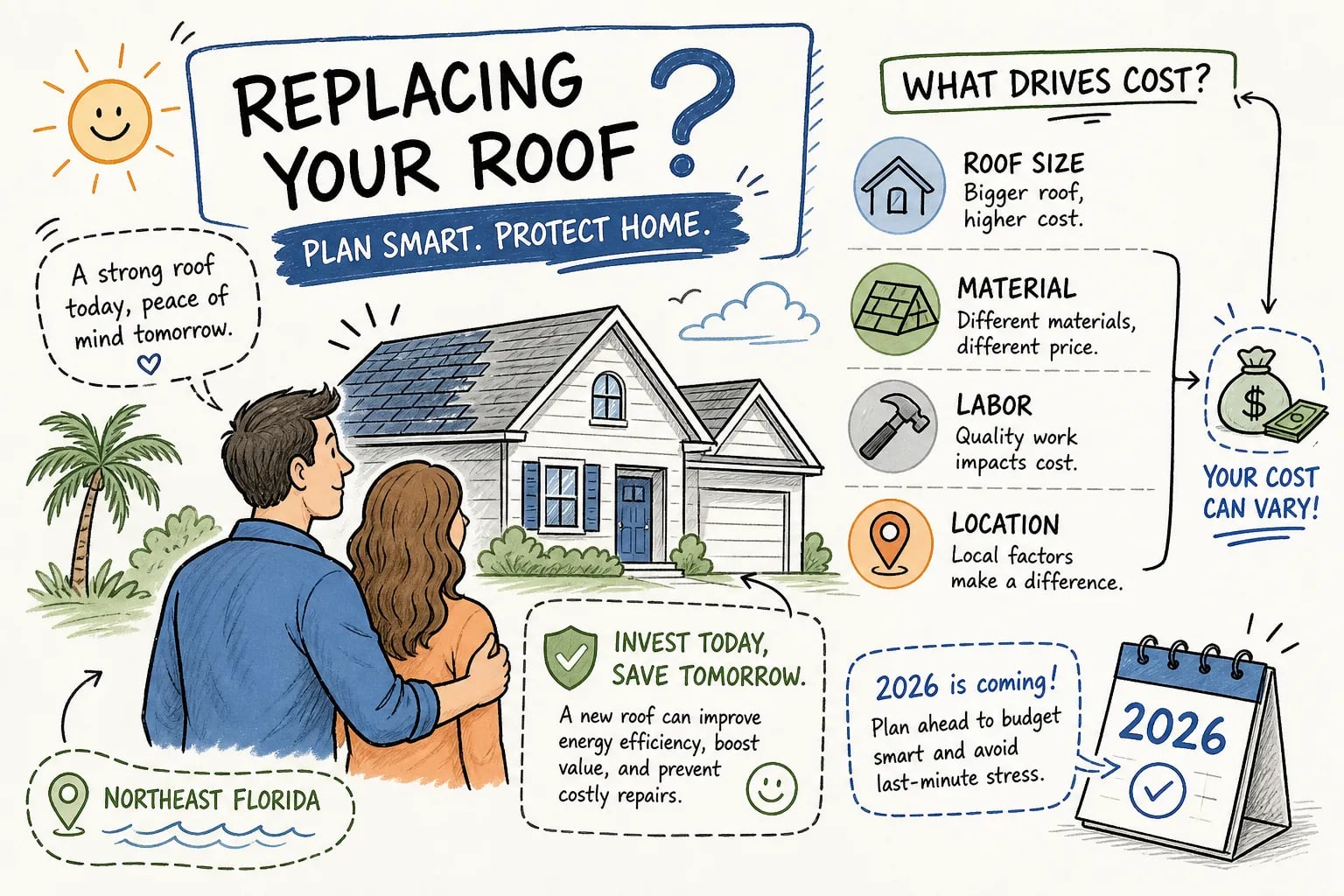
The average cost to replace a roof in Northeast Florida is one of the most searched, and most misunderstood, numbers in local home improvement. Homeowners in Palm Coast, Jacksonville, and St. Augustine who research roof replacement costs online consistently run into the same problem: national averages that have nothing to do with their actual market. A figure pulled from Midwest pricing data doesn't account for Northeast Florida's hurricane-grade material requirements, coastal labor rates, county permit schedules, or Florida Building Code compliance standards. These factors push local prices in a specific direction, and understanding them before you call a contractor is the difference between a realistic budget and a frustrating surprise.
Infinity Legacy is a licensed roofing contractor based in Palm Coast, serving Flagler, Duval, St. Johns, Clay, Nassau, and surrounding counties. We see these numbers daily on real jobs across the region. This guide breaks them down clearly so you can walk into any contractor conversation with a grounded understanding of what your project will actually cost and why.
Average Cost to Replace a Roof in Northeast Florida (2026)
Before getting into the variables, you need anchor numbers. For 2026, the Northeast Florida market breaks down across three primary roofing systems. Asphalt shingle replacements, installed with tear-off, permits, underlayment, and labor included, typically run $8,000 to $22,000 for most residential homes. Metal roofing spans a much wider range, from about $14,000 on the budget end up to $60,000 for premium standing-seam systems on larger homes. Tile roofing represents the top of the residential market, with most concrete and clay tile jobs falling between $22,000 and $90,000 depending on home size, pitch, and tile type.
These are installed totals. They include labor, materials, underlayment, tear-off of the existing roof, permit fees, and disposal. Any estimate you receive that covers only materials or only labor is not a complete number and shouldn't be treated as one when you're budgeting.
Why National Averages Mislead Florida Homeowners
Most roofing cost guides published at the national level aggregate data from lower-cost inland markets, and the resulting "average" reflects those conditions. Northeast Florida sits in a coastal high-velocity wind zone, which drives up material specifications, nailing requirements, fastener grades, and inspection complexity. A generic national average of $12,000 simply doesn't price in any of that. It describes a different product in a different market, not a starting point for your local budget.
The Range Is Wide, and Here's Why
Four variables pull a price from one end of the range to the other: home size, material choice, roof complexity, and local permit requirements. Each of those gets its own section below because each one can independently move your estimate by thousands of dollars. Understanding them individually is the only way to make sense of the quotes you receive.
Average Cost to Replace a Roof in Northeast Florida by Material
Material selection is the single biggest lever in your estimate. The per-square-foot difference between a standard shingle job and a standing-seam metal installation can exceed $10. Here's how each material category breaks down in the 2026 Northeast Florida market.
Asphalt Shingles: Still the Most Common Choice
Asphalt shingles come in three tiers. Three-tab shingles, the thinnest and least expensive option, run approximately $4.50 to $6.00 per square foot installed. Architectural or dimensional shingles, which represent the majority of Northeast Florida jobs, run $5.50 to $9.00 per square foot. Premium luxury shingles at the top of the asphalt category can reach $9.00 to $17.00 per square foot for higher-end profiles and extended warranties.
Architectural shingles dominate local jobs for a clear reason: they meet higher wind rating requirements than 3-tab products and carry better manufacturer warranty terms. In a coastal market where wind uplift is a real design consideration, the modest price premium over 3-tab is almost always worth it. Many contractors in this region prefer architectural shingles for new installations and avoid recommending 3-tab in high-wind coastal markets.
Metal Roofing: Higher Upfront, Better Long-Term Math
Metal roofing covers a wide spectrum. Screw-down metal panels represent the entry point, typically starting around $14,000 to $24,000 for a mid-size home. Standing-seam metal, which is the preferred system for storm performance and longevity, runs approximately $20,000 to $40,000 for a typical residential job, with larger or more complex homes pushing toward $60,000.
Metal makes the strongest financial case for homeowners who plan to stay in the property long-term, who have experienced repeated storm damage on asphalt systems, or who are actively working to reduce insurance premiums through documented wind mitigation. The upfront cost is real, but when compared across a 40-plus-year service life versus a 20-to-25-year shingle system, the per-year math often shifts significantly in metal's favor.
Tile Roofing: The Cost and the Commitment
Concrete tile jobs in Northeast Florida typically run from $22,000 to $42,000 for a standard residential footprint. Clay tile, which tends to be more refined and higher in cost, often reaches $50,000 to $90,000 on larger or steeper homes. Note that both concrete and clay tile add significant structural load compared to shingles or metal, so a structural assessment is required before installation to confirm the framing can support the added weight. Tile is a long-term commitment in more ways than one: the material itself lasts 50-plus years, but that structural verification step is non-negotiable.
Labor for tile installation is more skilled and significantly more time-intensive than shingle work. That skill premium is built into every tile estimate you receive, and it's non-negotiable. A tile crew that cuts corners on installation technique creates a moisture and wind vulnerability that won't show up until the next storm season.
How Your Home's Square Footage Changes the Total Price
Per-square-foot rates only become useful when they're applied to your actual home size. Here's how the math translates at three common residential footprints in Northeast Florida.
Smaller Homes Under 1,500 Square Feet
Installed asphalt shingle replacements for smaller homes typically fall in the $8,000 to $13,000 range. Metal systems on the same footprint usually start around $14,000 to $20,000. This covers the bungalows, beach cottages, and older mid-century homes that are common across parts of Flagler and Duval counties. Smaller homes benefit from lower absolute costs but still carry the same per-square-foot permit, tear-off, and code-compliance expenses as larger jobs.
Mid-Size Homes from 1,500 to 2,500 Square Feet
This is the most common residential footprint across Northeast Florida, and it's the range where most of our project estimates land. Asphalt shingle replacements for this size typically run $11,000 to $20,000. Metal systems come in at $20,000 to $40,000. Tile falls in the $22,000 to $50,000-plus range. These figures represent a standard full re-roof with tear-off of one existing layer on a moderately simple roof plane.
Larger Homes Over 2,500 Square Feet
Costs scale with square footage, but also with the complexity that larger homes tend to carry: more roof planes, additional valleys, extra penetrations, and steeper pitches are all more common on larger footprints. Asphalt shingle jobs on homes in this range can easily reach $22,000 and beyond. Metal systems push toward $40,000 to $60,000. Tile on a large home with a steep pitch can hit $70,000 to $90,000 in the Northeast Florida market. Complexity adds more dollars per square than any other single factor for large homes.
Local Cost Drivers That Set Northeast Florida Apart
National roofing guides skip the details that actually matter to a Palm Coast or Jacksonville homeowner. Permit fees, county inspection requirements, and local labor market rates all have a direct dollar impact on your final estimate. Here's what the local picture looks like.
Permit Fees in Duval, Flagler, and St. Johns Counties
Roofing permits in the Jacksonville and Duval County area typically run $150 to $375, with most real-world jobs landing around $180 to $250 for a standard residential re-roof. Flagler County, where Infinity Legacy is headquartered in Palm Coast, uses a fee schedule based on project valuation with a $75 minimum, plus inspection fees and reinspection charges if work requires a second visit. St. Johns County and its incorporated municipalities each maintain their own fee schedules, so the permit cost for a home in unincorporated St. Johns County may differ from one within the City of St. Augustine. We recommend checking directly with your county or municipal permitting office for current fee schedules before finalizing your budget.
Permit fees are non-negotiable, and any contractor offering to skip the permit is not offering you savings. They're offering you liability. An unpermitted roof replacement can void your manufacturer warranty, create problems during a future insurance claim, and expose you to code enforcement action. The permit is a small line item that protects the entire investment.
Labor Rates in the Coastal Northeast Florida Market
Labor for standard asphalt shingle installation runs approximately $1.50 to $3.00 per square foot in the Northeast Florida market, which works out to roughly $75 to $150 per roofing square (one square equals 100 square feet). Labor typically accounts for 30 to 40 percent of the total installed price on a shingle job. For tile, labor climbs to approximately $300 to $500 per roofing square due to the skill level and installation time required.
Coastal proximity, certified applicator requirements, and sustained trade demand in the Jacksonville-to-Palm-Coast corridor keep local labor rates higher than inland Florida markets. That's not contractor markup; it's the cost of doing licensed, code-compliant work in a market with real hurricane exposure and consistent demand.
How the Insurance and Claims Environment Affects Pricing
Northeast Florida's active storm history means roofing demand spikes after each hurricane season. Post-storm surges in contractor demand extend scheduling timelines and, in some cases, push labor costs higher as crews get stretched across more jobs simultaneously. Homeowners with active insurance claims need to understand one additional dynamic: their carrier's approved scope of work may not match the full cost of a code-compliant replacement. The gap between what insurance covers and what the code requires typically falls on the homeowner, and that difference should be built into your budget before you finalize coverage expectations with your adjuster.
What Florida's Hurricane Code Requirements Add to Your Estimate
Florida Building Code requirements for a full re-roof are stricter than most other states, and those requirements have a direct and measurable cost impact. Understanding what the code actually requires helps you evaluate whether a low bid reflects smart efficiency or missing line items.
What a Code-Compliant Re-Roof Requires in Florida
Full re-roofs in Florida require sealed roof deck systems, specific underlayment grades, corrosion-resistant fasteners, proper drip edge installation, and tighter nailing schedules than were common in older installations. These requirements apply across all roofing material types, with exact specifications varying by material, wind zone designation, and coastal proximity. A compliant job also requires sequenced inspections: typically a dry-in inspection, a nail-off inspection, and a final inspection before the permit closes.
The Dollar Impact of Wind-Compliant Materials and Installation
Code-compliant upgrades add roughly $500 to $2,000 to a baseline shingle job, driven primarily by enhanced underlayment, additional fasteners, and drip edge requirements. Impact-resistant Class 4 asphalt shingles cost more per square than standard architectural shingles, but they often qualify for homeowner's insurance premium discounts through Florida's wind mitigation credit system. That credit typically runs 10 to 20 percent off the wind-coverage portion of your premium, which can offset a meaningful share of the upfront material cost over time.
Metal and Tile as the Long-Game Hurricane Options
Both metal and tile, when properly installed to Florida Building Code standards, outperform asphalt shingles in sustained wind events. That performance advantage comes with higher upfront cost, but for homeowners in coastal Flagler, Duval, and St. Johns counties, the durability and potential insurance benefits make the comparison worth running before defaulting to the least expensive option. A shingle roof replaced every 20 years in a high-storm-exposure location represents a different lifetime cost than a metal roof that lasts 40-plus years with proper maintenance.
Hidden Cost Multipliers: Pitch, Complexity, and Tear-Off
Two homeowners with identical square footage can receive estimates that differ by $5,000 or more. Roof complexity is usually the reason. The variables below are the ones that push a baseline estimate higher and that are frequently underexplained in initial contractor conversations.
Steep Pitch and Multi-Plane Roof Premiums
Steep roofs require additional safety equipment, slower material placement, and more labor time per square than a simple low-slope job. Expect a 10 to 35 percent premium over a baseline estimate depending on pitch severity. Multi-plane roofs with many valleys, dormers, or hip returns require significantly more flashing work and material cutting, typically adding 15 to 40 percent to a baseline. If your home has both a steep pitch and multiple planes, those percentages can stack.
Skylights, Penetrations, and Flashing Details
Each skylight, pipe boot, chimney, or HVAC curb penetration adds labor and flashing material cost to the job. No single penetration is a huge line item, but a roof with five or six of them pushes the estimate noticeably higher than an otherwise similar clean roof plane. This is particularly relevant in older St. Johns and Duval County homes with original skylight installations, where flashing replacement adds both labor time and material cost that a basic estimate template may not fully capture.
Tear-Off Cost and What Extra Layers Add
Removing the existing roof before installation adds roughly $1 to $3 per square foot to the project. Florida Building Code limits asphalt shingle installations to two layers; if your home already has two existing layers, a full tear-off is required before the new roof can go on. Double-layer tear-offs take longer, generate more disposal weight, and frequently reveal hidden deck damage beneath the old roofing. Any estimate that doesn't include a clear tear-off and disposal line item is incomplete, and the number you're comparing against is lower than the real job will cost.
What to Look for in a Contractor Estimate Before You Sign
A roofing estimate is only useful if it's specific enough to compare fairly against other bids. Here's what a complete written estimate should include and what missing information should tell you about the contractor submitting it.
What a Complete Written Estimate Should Include
A professional roofing estimate should specify the material brand and product line, shingle or panel grade, and wind rating. It should also document the underlayment type, nailing schedule, manufacturer warranty terms, and workmanship warranty duration. Finally, it needs to address permit responsibility, tear-off inclusion, deck repair pricing structure, and a clear payment schedule. If you're handed a document that lists only a total price and a material category, that's not a complete estimate. You can't compare it fairly against anything, and it leaves you with no written protection if the scope of work changes mid-job.
Red Flags in Low-Ball Quotes
Unusually low bids in this market almost always reflect something missing: no permit, no tear-off, lower-grade material than the estimate implies, or unlicensed labor performing the installation. Ask every contractor for their Florida contractor license number and verify it through the Florida Department of Business and Professional Regulation before signing anything. A licensed contractor's estimate will typically be higher than an unlicensed one, and that difference represents the code compliance, insurance coverage, and accountability that protect your investment when something goes wrong.
Questions Worth Asking Every Contractor
A few targeted questions will separate prepared contractors from unprepared ones quickly. Ask who pulls the permit and who attends the inspections. Ask what underlayment system they're specifying and why that product suits your wind zone. Ask whether the nailing schedule is documented in writing in the estimate. Ask what happens to the price if they find deck damage during tear-off, and get that answer in writing before work begins. Contractors who can answer those questions specifically and immediately are contractors who actually understand what they're agreeing to build.
Getting an Accurate Estimate for Your Northeast Florida Roof
With a clear understanding of pricing ranges, cost drivers, and what to look for in a written estimate, the next step becomes straightforward: get an on-site assessment from a licensed local contractor who works in your county and knows your specific wind zone requirements.
What a Local Licensed Contractor's Estimate Process Should Cover
A proper on-site estimate includes a roof measurement, a visual inspection of the deck condition from inside the attic and outside, an assessment of existing flashing and penetrations, and a material recommendation based on your home's exposure level and your budget. Online quote calculators and square-footage formulas can't replace this process because they can't see your pitch, your existing layers, or the condition of your deck. A contractor who quotes without seeing the roof is guessing, and you shouldn't be making a $15,000 to $60,000 decision based on a guess.
Serving Palm Coast, Jacksonville, St. Augustine, and the Surrounding Counties
Infinity Legacy performs full roof replacements across Flagler, Duval, St. Johns, Clay, Nassau, and surrounding counties in Northeast and Central Florida. Every estimate we provide is free, delivered in writing, and includes a clear material specification, permit plan, and warranty breakdown. For homeowners comparing multiple bids, that level of specificity makes the comparison honest. You can see exactly what each contractor is and isn't including, and the price differences start to explain themselves.
Reach out to our team to schedule your free on-site estimate. No pressure, no obligation, and no vague numbers. Just a written breakdown of what your roof replacement will actually cost and why.
The Bottom Line on Northeast Florida Roof Replacement Costs
The average cost to replace a roof in Northeast Florida depends on material choice, home size, local permit requirements, hurricane code compliance, and roof complexity. There is no single number that applies to every home, which is exactly why a written, on-site estimate from a licensed local contractor is the only accurate way to know what your project will cost. National averages and online calculators will get you in the ballpark for a different market in a different state, they won't price your actual roof in Palm Coast, Jacksonville, or St. Augustine.
When you review estimates, verify that every bid includes the same scope: tear-off, permit, underlayment specification, nailing schedule, and warranty terms in writing. Verify the contractor's Florida license number before you sign. Confirm the permit is being pulled and that a licensed crew is attending inspections. A lower number that reflects missing line items isn't a better deal; it's a deferred cost that will show up later.
If you're in Flagler, Duval, St. Johns, or the surrounding counties, Infinity Legacy offers free written estimates with a full line-item breakdown and no pressure to sign on the spot. Get in touch with our team and find out exactly what your cost to replace a roof in Northeast Florida looks like for your specific home in 2026.