What is the most durable roof type for hurricane-prone areas in Florida? It's the question every Florida homeowner should be asking before the next storm season, not after one passes through. The roof either holds or it doesn't, and what's above your head right now was likely chosen based on price rather than performance. At Infinity Legacy, our team has completed post-storm inspections and roof replacements across Northeast and Central Florida, and that field experience consistently confirms which materials come through major storms structurally sound and which ones end up as debris in the yard.
This article answers the question directly: which roof type is most durable when a storm bears down on a Florida home? It covers real wind resistance ratings, how each material actually performed in Hurricanes Irma and Michael, what installation details separate a roof that survives from one that fails, and how your choice affects your insurance premiums. By the end, you'll have a clear picture of which roof fits your property, your location, and your budget.
Why Florida Holds Its Roofs to a Completely Different Standard
Florida sits at the convergence of Atlantic and Gulf storm tracks. The Florida Building Code sets stricter minimum wind-speed design requirements than the International Building Code, which means roofing materials that meet code in Georgia or the Carolinas may not be engineered for the sustained wind speeds, wind-driven rain, and repeated storm events that Florida properties face. A roof here has to perform under conditions most of the country never experiences. That's not a marketing claim; it's a structural reality built into state code.
The High-Velocity Hurricane Zone (HVHZ), which covers Miami-Dade and Broward counties, adds another layer on top of statewide requirements. Products approved for use statewide may not be legal in the HVHZ. This is not bureaucratic fine print: it's the line between a roof system that holds during peak winds and one that fails when the pressure differential is greatest.
Roof geometry matters just as much as material. Hip roofs consistently outperform gable roofs in Florida hurricane assessments because they distribute wind loads more evenly across the structure. No material fully compensates for a vulnerable roof shape, which is why the geometry of your home matters when choosing a replacement system. Engineering studies and FEMA field reports have noted that rake edges on gable-end roofs concentrate stress in ways that hip roof geometry avoids, regardless of the covering material above them.
What Is the Most Durable Roof Type for Hurricane-Prone Areas in Florida? Start with Wind Ratings.
Wind uplift ratings measure the negative pressure, or suction force, that a roof system can resist before it separates from the structure. The number on a product label is only part of the story. That rating applies to a specific installation configuration, fastening pattern, and deck condition. A product rated at 160 mph installed incorrectly can fail at 100 mph. The label is the starting point, not the guarantee.
Three approvals carry the most weight for Florida homeowners:
- TAS (Test Application Standard) covers Miami-Dade's testing requirements for the HVHZ, including TAS 100 for wind-driven rain and TAS 107 for asphalt shingles.
- NOA (Notice of Acceptance) is the Miami-Dade approval document required for any product installed in the HVHZ; it is stricter than statewide Florida product approval.
- ASTM standards such as D3161, D7158, and D1970 apply to shingles, underlayments, and self-adhered membranes. For any roof outside the HVHZ, a Florida product approval number is required.
The single most important question to ask every roofing contractor is simple: does this product have a valid NOA or Florida product approval for my specific wind zone? A licensed, reputable contractor produces that documentation without hesitation. If the answer is vague or delayed, that is a signal to walk away. This verification protects your home, your insurance claim after a storm, and your contractor's liability. It's non-negotiable on any project we handle at Infinity Legacy, and it should be on any project you're considering regardless of who does the work.
Metal Roofing: The Most Durable Roof for Hurricane-Prone Florida Homes
Standing-seam metal systems can achieve wind ratings of 160 to 180 mph and often reach Class 4 impact resistance, the highest rating available. The difference between standing-seam and exposed-fastener metal panels is significant in a high-wind environment. Standing-seam systems use concealed clips that allow the metal to move thermally without stressing the fastener points, and the absence of exposed screws eliminates a primary wind-driven water intrusion path. Exposed-fastener panels are more affordable but carry more risk at each penetration point under sustained hurricane winds.
Storm Performance Data
FEMA's Hurricane Michael MAT report noted that metal roof coverings appeared to perform better than other roof coverings on Florida Building Code-compliant buildings. IBHS field data from a Southwest Florida hurricane assessment found metal roofs showing roughly a 12% damage rate, with most failures traced to adjacent structure failures rather than the roof system itself. That is the most honest reading of the data: metal performs best, but installation quality and the load path beneath it determine the final outcome. Some metal roofs in the Panhandle did fail after Michael, and in nearly every case, the problem traced back to deck attachment or edge detailing rather than the metal covering itself.
Cost and Lifespan
Installed cost for metal roofing runs roughly $9 to $20 per square foot statewide, with Northeast Florida coastal markets often pushing toward the upper range due to wind and corrosion requirements. A lifespan of 40 to 60-plus years changes the math considerably. A metal roof costs more upfront than shingles but amortizes far better than a system replaced every 20 to 25 years. When you factor in insurance premium savings for qualifying systems and the reduced likelihood of catastrophic storm damage, the long-term cost of ownership for metal frequently favors the homeowner over a 30-year horizon when insurance savings and avoided replacement cycles are included in the calculation.
Concrete Tile and Clay Tile: Long-Lived, Heavy-Hitting Options
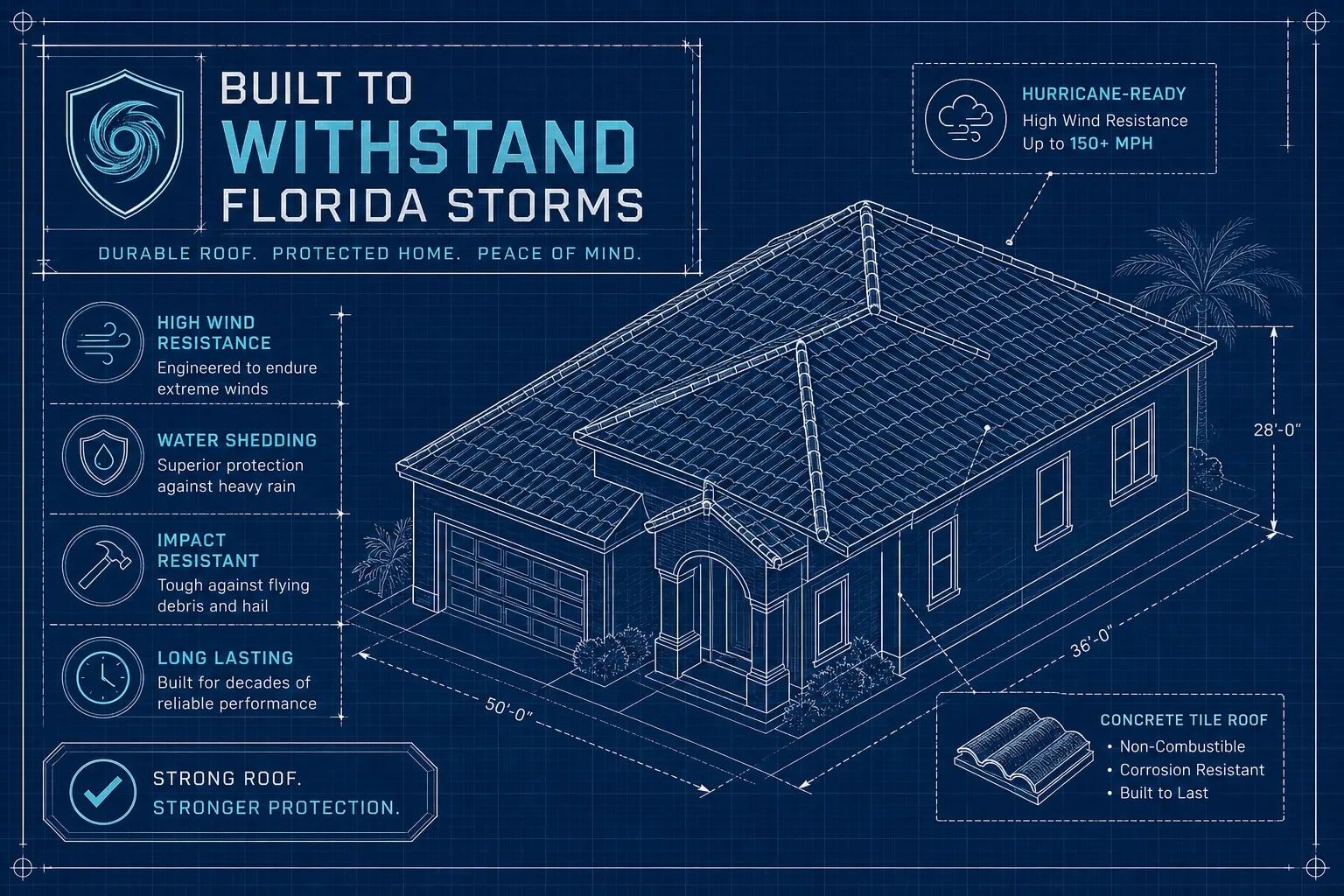
Both concrete and clay tile can achieve wind ratings in the 150 to 180 mph range with Class 4 impact resistance in premium products. Tile works differently from metal: its mass and interlocking design resist uplift, but individual tiles can crack or dislodge under extreme impact. System-level performance depends heavily on the mortar, fastening, and underlayment beneath the tiles. A tile roof with a compromised underlayment is effectively a metal roof with no deck sealant; the outer layer can survive while water finds its way through.
Storm Performance Data
IIBEC field investigations after Hurricane Irma found that tile roofs in Naples and the Keys showed no catastrophic losses in RICOWI assessments. IBHS data from a later Florida hurricane assessment found roughly 40% of tile roofs experiencing some damage, but significant damage was rare on roofs under 20 years old. Damage concentrated at hips, ridges, and edges rather than in the field of tile itself, pointing directly to the importance of edge and transition detailing rather than the tile product as a whole.
Cost and Structural Considerations
Concrete tile runs roughly $7 to $12 installed per square foot, while clay tile typically falls in the $9 to $25 range depending on the product and market. Clay lasts 50 to 100-plus years but weighs more and generally costs more. Concrete tile offers nearly equivalent hurricane performance at a lower price point. Either way, the home's structure must be assessed for load capacity before tile installation. Tile roof dead loads can reach 9 to 12 pounds per square foot, compared to roughly 2.5 to 4.5 pounds for asphalt shingles. A Florida-licensed engineer or architect typically reviews the rafter or truss size, span, connections, and load path before the permit is issued for a tile conversion. Skipping that step creates structural risk that no tile product can fix.
Architectural Asphalt Shingles: Where They Hold Up and Where They Fall Short
Class 4 impact-rated architectural shingles represent the best-performing asphalt option for Florida homes, rated at roughly 130 to 150 mph when properly installed. That ceiling is meaningfully lower than metal or tile. Many shingles carry 130 mph ratings on the label but achieve far less in field conditions if nailed incorrectly or if the roof deck beneath is not properly attached. The rating assumes a complete, code-compliant system. The shingle product alone tells only part of the story.
Storm Performance Data
The post-storm data on shingles is the hardest in this category. FEMA's Hurricane Michael MAT documented widespread poor wind performance of asphalt shingles. IIBEC field inspectors found that roughly 90% of asphalt-shingled roofs they surveyed in the 130 to 150 mph wind corridor were at least partially tarped after Michael, indicating functional damage even where the structure survived. IBHS found about half of shingle roofs sustaining damage in a later Florida hurricane assessment, with roofs over 10 years old especially vulnerable.
Cost, Lifespan, and When Shingles Make Sense
Installed at $4.50 to $9 per square foot with a 20 to 30-year lifespan, shingles are the most accessible entry point for budget-constrained homeowners. They are not the wrong choice for every property in Florida. In lower wind-speed zones, with Class 4 rated products, a proper six-nail high-wind installation pattern, and a sealed deck beneath, they can be a reasonable decision. The trade-off has to be understood clearly before signing, not discovered after the storm passes through.
Flat Roofing Systems: What Works for Low-Slope and Commercial Properties
TPO and EPDM are the standard for flat and low-slope roofs on commercial properties and some Florida residences, with wind ratings of 120 to 150 mph achievable in properly installed systems. Performance depends more heavily on fastening and adhesive systems than any steep-slope category. Flat systems have no geometry working in their favor the way a hip roof shape helps distribute wind loads. The installation quality margin for error is narrower, and the consequences of a substandard installation show up sooner.
Modified bitumen offers a 15 to 25-year lifespan at installed costs of roughly $6 to $14 per square foot. It performs adequately in Florida's subtropical climate when properly installed and maintained. Regular inspections matter more for flat systems than for steep-slope roofs because ponding water and seam integrity are the primary failure points. A small seam separation on a flat roof can introduce as much water into a building as a missing tile on a steep-slope system, but it is far harder to identify before a storm makes it obvious.
Many Florida commercial and mixed-use properties have both flat and steep-slope sections on the same structure. Proper flashing and transition details at the junction of those systems are where failures concentrate. A well-installed metal steep-slope roof can still fail at the interface with a poorly flashed flat section during wind-driven rain. The system has to be planned and installed as a whole, with each transition detailed as carefully as the field of each material type. When those two scopes are divided between separate contractors, post-storm disputes about responsibility are a predictable result, which is why unified project management at that interface matters.
What Installation Details Actually Decide Whether Your Roof Survives a Storm
The roof deck attachment is the foundation everything else depends on. Louisiana State University's AgCenter research specifies 8d ring-shank nails at 6 inches on center in the field and 4 inches on center at gable ends. Staples are not acceptable. The sheathing-to-rafter or sheathing-to-truss connection determines whether the entire roof deck stays attached during peak wind loads. A premium metal or concrete tile system installed over a weakly nailed deck can still fail catastrophically, because the outer covering is only as secure as the structure underneath it.
Sealing the roof deck matters even on hurricane-resistant roof systems. If the outer covering sustains damage during a storm, a sealed deck, whether a self-adhered membrane over the full deck or flashing tape over panel seams combined with underlayment, prevents catastrophic interior flooding. Florida code revisions since Hurricane Irma have increasingly reflected this requirement, but homes built before those updates rarely have it. A reroofing project is the right time to add this layer, and it should be part of every scope of work in a high-wind zone.
Roof-to-wall connections are the third critical element. Hurricane straps or structural screws tying each rafter or truss to the wall top plate complete the load path from the outer roof covering down through the structure to the foundation. LSU's AgCenter guidance specifically recommends straps over clips for this connection. For asphalt shingles, the manufacturer's high-wind nailing pattern of six nails per shingle must be followed; fastener placement, depth, and type account for a significant share of post-storm failures where the covering material itself was physically sound. These are not optional details. They are the details that define whether your roof investment survives the next major storm to cross your zip code.
How Your Roof Choice Directly Affects Your Florida Homeowners Insurance
Florida insurers evaluate four variables when pricing a roof: age, material, impact resistance classification, and structural connection details. The 15-year rule means insurers cannot deny coverage or require replacement solely because a roof is under 15 years old, provided it passes a physical inspection. Older roofs face more scrutiny and more restrictive underwriting. Metal and tile materials are viewed most favorably by Florida carriers. Older asphalt shingles face higher premiums and, in some cases, tighter eligibility for coverage. The material choice made at replacement time has premium consequences for the next two decades.
A wind mitigation inspection is what converts a strong roof into documented insurance savings. The inspector completes the state's standardized OIR-B1-1802 form, verifying deck attachment, roof-to-wall connections, roof covering type, and roof shape. Those verified features translate directly into insurance credits. The inspection costs roughly $75 to $150 in most Florida markets and remains valid for five years. A new roof installed to high-wind standards without a completed mitigation inspection leaves premium savings on the table every renewal period.
The combined value of a durable roof system is the clearest argument for investing at the higher end of the material spectrum. A metal or concrete tile roof installed to high-wind standards, with a sealed deck and hurricane straps, can reduce insurance premiums, extend coverage eligibility, and eliminate repeated replacement costs over a 40-plus-year lifespan. The upfront cost gap between shingles and a more durable system shrinks considerably when premium savings and avoided replacement cycles are factored across 30 years. For most Florida homeowners, the math moves in favor of the stronger system when all of those variables are on the table at once.
Choosing the Most Durable Roof for Your Hurricane-Prone Florida Home
When asking what is the most durable roof type for hurricane-prone areas in Florida, the field evidence consistently points to metal and concrete tile as the top performers when installed to high-wind standards. Metal roofing leads on wind resistance and long-term storm performance. Concrete tile follows closely as the best all-around balance of durability, lifespan, and value. Architectural shingles can work in the right conditions but carry documented risks in high-wind zones that homeowners need to understand before selecting them. Flat systems depend on installation quality above everything else, and the transition details between flat and steep-slope sections deserve as much attention as the materials themselves.
Every material decision has to be combined with the right ratings for your wind zone, proper deck attachment, a sealed underlayment layer, and strong roof-to-wall connections. One weak link in that system, whether it's a product without a valid Florida approval, an underlayment skipped to cut cost, or deck nailing that doesn't meet the high-wind pattern, creates the failure point the storm will find.
If you're unsure which system fits your home and your specific Florida location, Infinity Legacy offers free roof assessments across Northeast and Central Florida. As a licensed multi-trade contractor (CGC1540795), we inspect what's there, review your wind exposure zone, check structural capacity for tile if that's the direction, and give you a straight answer on the most durable replacement option for your property. We give you a clear picture of what you're working with and what makes sense for where you live, with no sales pressure and no vague estimates. Reach out to our team to schedule your free assessment.