Picture this: you request three roofing estimates after a bad storm season, and when they arrive, no two of them look anything alike. One is a single page with a dollar amount and a signature line. Another lists 14 line items but doesn't name a single material. The third is from a company you've never heard of and comes in $4,000 lower than the others. None of them answers the same questions, and you have no idea which one is honest, which one is missing something critical, and which one will hold up once work actually begins. That confusion is exactly how homeowners end up paying more than they should or signing a contract that leaves them exposed to surprise charges halfway through a job.
Understanding roofing estimates is less about memorizing formulas and more about knowing what belongs in a professional bid, what questions reveal the difference between a solid contractor and a risky one, and what silence in a quote actually signals. A good roofing estimate is transparent, itemized, and specific enough that you could hand it to a second contractor and they'd know exactly what's being proposed. Any contractor worth hiring will walk you through it without pressure, answer your questions directly, and put every detail in writing. At Infinity Legacy, a licensed and insured Florida contractor (CGC1540795), every estimate is free, written, and detailed enough that homeowners know exactly what they're getting before a single shingle is touched.
What a professional roofing estimate should always include
A roofing quote isn't just a price, it's a written commitment about what will be done, with what materials, and under what terms. When that commitment is vague, it protects the contractor, not you. The more specific the estimate, the more leverage you have if something goes sideways during the project.
The core line items every bid must show
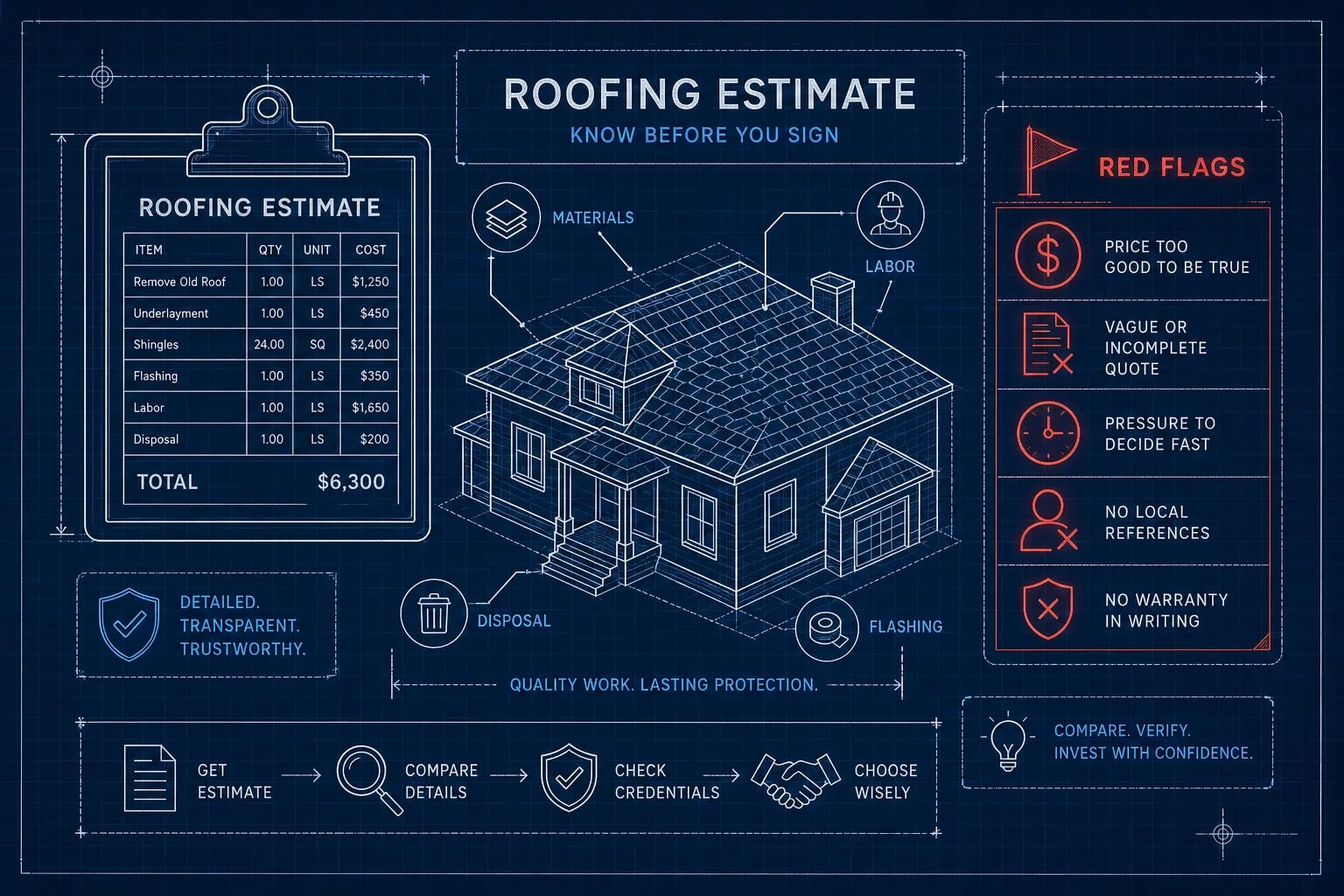
Every professional roofing bid should state the roof area in squares (a roofing square equals 100 square feet of roof surface), a full scope of work, and materials specified by brand and grade, not just "architectural shingles," but which manufacturer, which product line, and what warranty class. Beyond that, the estimate should itemize tear-off and disposal, underlayment type and the coverage area it applies to, flashing details at valleys, pipe penetrations, drip edge, and the ridge line, plus ventilation and permit responsibility. A vague estimate with no quantities and no material specs isn't a courtesy to you, it's a liability.
What "included" and "conditional" actually mean
There's an important distinction between a line item that's priced into the base total, one that's listed as a conditional allowance, and one that simply doesn't appear anywhere in the document. An allowance is not the same as an inclusion. For example, if an estimate says "decking replacement, $X per sheet if needed," that's a conditional allowance with a defined unit price, and that's responsible contracting. Decking unit prices vary by market and material, so the exact figure should reflect your contractor's local cost basis. If the estimate says nothing about decking at all, you have no idea what you'll be charged when damaged boards are discovered after tear-off.
Why decking replacement is almost never in the base price
Roof deck damage can't be fully assessed until the existing material is removed. Responsible contractors price it as a per-sheet or per-square allowance with a defined unit cost and a written approval requirement before extra work begins. A contractor who either buries deck replacement in a vague total or doesn't mention it at all is setting up a situation where you get a change order mid-job with no reference point to push back against.
Roofing estimates: how contractors calculate costs
Most homeowners try to benchmark a quote by dividing the total by their home's square footage. That approach doesn't work, and understanding why will immediately make you better at evaluating any roofing bid you receive.
Roofing squares and why that unit matters
Roofing is priced per "square," which equals 100 square feet of actual roof surface area. A 2,000-square-foot home does not have a 2,000-square-foot roof. Pitch, overhangs, and roof geometry all add surface area beyond the floor footprint. Depending on pitch and complexity, a 2,000-square-foot home might measure anywhere from 22 to 32 squares or more, your contractor should confirm the exact count with an on-site measurement, since square counts shift significantly with overhang, geometry, and slope. This is one of the most common reasons homeowners feel confused when comparing quotes that seem to be measuring different roofs. They often are, even on the same house, if the square count hasn't been confirmed in person.
2026 installed cost ranges by roof type
Based on current 2026 national industry data, installed roofing costs run roughly $350, $900 per square for asphalt shingles, with a practical midpoint around $600. Metal roofing falls in the $800, $1,500 range, averaging about $1,150. Tile roofing runs $1,000, $1,800 or more, averaging around $1,400 per square. These figures include both labor and materials. Within each category, premium products, architectural shingles versus three-tab, standing-seam metal versus exposed-fastener panels, clay tile versus concrete, cost meaningfully more. In Florida specifically, asphalt runs closer to $480, $700 per square, metal at $1,000, $1,550, and tile at $950, $1,500, with coastal high-wind zones pushing those numbers significantly higher.
How labor and materials split the total
Industry data consistently shows labor accounting for roughly 50 to 60 percent of a roofing project's final cost. This is the primary reason quotes vary so much by region and why a Florida roof replacement estimate shouldn't be compared directly to what someone paid in a lower-cost market. Regional wage rates, contractor availability, and permit environments drive most of the difference between bids, not material costs alone. If two quotes use the same shingle and are $3,000 apart, the gap is frequently in labor scope, crew structure, or what one contractor quietly excluded. Request itemized breakdowns from both to identify the specific source of the difference.
Online roof calculators: useful starting point or rough guess?
Roof cost calculators have become a popular first step for homeowners doing early research. They're genuinely useful for orientation, but they come with limitations that matter when you're actually comparing roofing bids.
How satellite-based calculators actually work
These tools pull overhead satellite or aerial imagery of your address, trace the visible roof perimeter, and estimate pitch using photogrammetry, AI modeling, or user-entered data. A pitch multiplier then converts the flat footprint into actual sloped surface area. More advanced tools identify individual roof planes, hips, valleys, and ridges to generate a material estimate. This is a reliable orientation process when the inputs are accurate, but it's not a substitute for an on-site measurement by an experienced contractor.
Accuracy range and when to trust the number
Basic consumer satellite tools carry roughly a 5 to 15 percent error margin compared to on-site measurements. Professional aerial measurement services such as EagleView publish accuracy benchmarks indicating performance around 98 percent on standard roofs, putting error in the 2 to 5 percent range. The largest sources of error are incorrect pitch estimation, tree canopy obstruction, complex roof geometry, and outdated satellite imagery. A 2,500-square-foot roof with a 5 percent error swings by 125 square feet, more than one full roofing square. That's a meaningful difference when pricing materials.
What online calculators can't account for
No roofing cost estimator accounts for existing layers, decking condition, flashing replacement needs, local permit fees, or regional labor rates. These are the variables that actually determine whether a contractor's quote is fair. Use a calculator to set general expectations and screen out obviously inflated bids, but never use one to judge whether a contractor's detailed quote is too high or too low. A trained estimator standing on your roof will always produce a more reliable number than any satellite tool.
How roof complexity changes your final estimate
Two homes with identical square footage can produce roofing quotes that differ by 30 to 50 percent, and the reason is almost always roof complexity. Pitch, geometry, and penetrations all change how long the job takes and how much material it consumes.
Pitch premiums: what steep roofs actually cost
A moderate pitch, roughly 5/12 to 7/12, adds about 10 to 20 percent to labor costs compared to a low-slope baseline. Steep pitches in the 8/12 to 9/12 range add 15 to 25 percent, and very steep roofs at 10/12 to 12/12 push labor premiums to 25 to 40 percent. Steep roofs require fall protection equipment, a slower work pace, and often a larger crew. Omission of pitch in a roofing bid is a common risk factor for later change orders, always ask the contractor to document pitch in writing before you sign anything.
Valleys, chimneys, dormers, and penetrations
Each valley typically adds 4 to 10 percent to the total, depending on length and flashing requirements. A chimney or skylight can add $300 to $1,500 or more each on an asphalt roof, and considerably more on tile or metal. A hip roof adds 8 to 15 percent over a simple gable. Multiple dormers or heavy step-flashing work can push total complexity premiums to 15 to 30 percent of the base price. These should be itemized separately so you can see exactly what you're paying for and verify it makes sense given your roof's layout.
How to budget for a complex roof without overpaying
For planning purposes, a $12,000 estimate on a simple gable roof becomes $13,200 to $13,800 with moderate complexity, $13,800 to $15,600 for a hip-and-valley layout, and $15,600 to $18,000 or more for a steep, heavily detailed roof with multiple penetrations. These are planning ranges, not formulas. The only number worth trusting is an itemized bid from a licensed contractor who has physically measured your roof and documented every complexity factor in writing.
Why location changes your roofing estimate more than you'd expect
Roofing costs across the United States vary by a factor of two or more depending on where you live. A quote that seems high compared to national averages may be entirely reasonable for your specific market, and vice versa.
State-to-state cost swings in 2026
A roof replacement estimate for a 2,000-square-foot asphalt shingle job runs roughly $7,700 to $10,000 in lower-cost Southeast markets like Mississippi and Alabama, while the same job in Massachusetts or New York reaches $14,000 to $22,000. Labor rates alone range from $50 to $80 per roofing square in rural, low-cost markets to $100 to $160 per square in high-cost metro areas. Knowing this range helps homeowners stop comparing their Florida roofing estimate to what a family member paid in a completely different labor market, those numbers simply aren't comparable.
Florida-specific cost factors homeowners should know
Florida sits near the national average for inland markets, but coastal high-wind zones push prices 30 to 50 percent higher. Miami-Dade and Broward counties fall under the High-Velocity Hurricane Zone, which mandates code-approved products, enhanced fastening patterns, and more rigorous inspection sequences. These requirements add real cost and real protection. Contractors operating under Florida's building code, including the team at Infinity Legacy serving Northeast and Central Florida, factor wind-zone requirements into their roofing estimates from the start, so there are no code-compliance surprises after permits are filed.
When to request a re-quote if the area matters
If a contractor provides a number without asking about your proximity to the coast, your wind zone designation, or your local permit environment, that estimate may not survive the permitting process intact. Always confirm that the bid reflects the specific code requirements for your property's location. A number that doesn't account for local building standards isn't a real estimate, it's a placeholder that will change.
Comparing roofing estimates side by side
The instinct to pick the lowest number is understandable, but it's the most reliable way to end up with a project that costs more than the highest bid you received. Here's how to compare roofing estimates in a way that actually means something.
Normalizing bids for an apples-to-apples comparison
Three quotes on the same roof can show three different square counts, three different material grades, and three different assumptions about what's included. Direct price comparison without normalization is meaningless. Start by confirming that the measured roof area matches across all three bids. Then verify that the same material grade is being quoted, not just the same material category. Check whether tear-off, disposal, permits, and flashing are itemized separately or buried in a single line with no visibility into what's actually being charged for each.
What a detailed, trustworthy roofing bid looks like
A solid roofing estimate covers the essentials in clear, written form. That means measured roof area in squares, material specified by brand and grade, and labor broken out from materials. It should also include separate line items for tear-off and disposal, a defined allowance for decking replacement, and permit fees with clear responsibility for who pulls them. Flashing locations should all be addressed, along with warranty terms for both the manufacturer's material warranty and the contractor's workmanship warranty. A clear payment schedule tied to project milestones rounds it out. If a bid doesn't answer those questions in writing, ask for a revision before you compare price.
The lowest quote is rarely the cheapest job
Missing exclusions translate directly into change orders. A bid that's $2,000 lower but excludes flashing replacement, a second tear-off layer, or permit fees frequently ends up costing more in total once the gaps are filled during the job. Use cost per roofing square as a gut check: if a quote comes in dramatically below the regional average for the material being specified, ask specifically what's not in it. The answer will tell you everything about how that contractor operates.
Red flags in roofing bids that should make you pause
Contractor fraud and poor workmanship don't always announce themselves obviously. In many cases, the warning signs are in the estimate itself, before any work begins. Knowing what to watch for gives you a meaningful filter before you sign anything.
Vague scope and missing quantities
A bid that says "install new roof, $9,500" without a square count, material specification, or line items isn't a roofing estimate. It's a number on a page. Without specific scope in writing, there's nothing to hold the contractor to when they claim the job required more than what was discussed. A vague estimate protects the contractor in every dispute, not you.
Pressure to sign quickly or pay cash upfront
Reputable contractors don't manufacture urgency. Door-to-door solicitation immediately after a storm, requests for 50 percent or more of the project total upfront, and cash-only payment terms are consistently flagged by consumer protection agencies and contractor associations as indicators of fraud risk and incomplete work. A legitimate payment structure ties draws to project milestones: deposit at contract signing, partial payment at material delivery, and balance due at verified completion.
Missing license, insurance, and permit information
In Florida, roofing contractors are legally required to be licensed and to pull permits for full roof replacements. A bid that doesn't mention permit responsibility, or suggests that permits aren't necessary, is a liability for the homeowner if code violations surface during or after the project. Always verify a contractor's license number independently through Florida's licensing board before signing anything. A contractor who won't provide that number or gets evasive when asked isn't someone you want managing a major project on your home.
Questions to ask before you sign a roofing estimate
The questions you ask before signing reveal more about a contractor than their references do. A skilled, honest contractor will answer these without hesitation. Evasive or annoyed responses tell you something important about what the working relationship will look like once your money is on the table.
Questions about scope, materials, and warranties
Ask what happens if damaged decking is found after tear-off, and what the unit price per sheet is. Ask whether the estimate includes all flashing replacement or only some of it, and which penetrations are addressed. Find out what manufacturer warranty the specified material carries and how you register it directly. Ask what the workmanship warranty covers, for how long, and what the process is if a leak appears after the job is finished. These aren't aggressive questions, they're the baseline a professional contractor should answer without hesitation.
Questions about permits, licensing, and timeline
Ask who pulls the permit and who is responsible if an inspection fails or requires rework. Ask for the contractor's Florida license number so you can verify it independently. Ask how long the project runs from start to final inspection sign-off, and who your direct point of contact is if a problem comes up mid-project. A contractor who hedges on any of these questions is signaling how they'll handle problems once they have your deposit. The time to learn that is before you sign, not after.
How a free, no-obligation estimate changes your position
Homeowners who collect at least three detailed, itemized roofing estimates are in a fundamentally stronger position than those who don't. They're comparing scope, materials, and terms, not just price. Any contractor offering a free, detailed estimate with no pressure to sign is doing you a legitimate service. That process should include a physical roof inspection, documented measurements, and a written scope of work handed to you at no cost and with no strings attached. That's the standard, not a selling point.
Now you're ready to evaluate any roofing estimate
You now know what belongs in a professional roofing estimate, how costs are calculated and why they vary, what complexity adds to the base price, and which warning signs are worth walking away from. That knowledge puts you in a position to evaluate any contractor's bid on its actual merits, rather than guessing which number is the honest one.
The core rules are simple to apply: get at least three itemized roofing estimates, normalize them before comparing price, and never sign anything that doesn't specify scope, materials, and exclusions in writing. If a bid doesn't answer the basic questions, ask for a revision. If the contractor won't revise it, that's your answer.
For Florida homeowners who want a free, written, no-obligation roofing estimate from a licensed and insured contractor, Infinity Legacy provides detailed bids that break down scope, materials, flashing, and warranties clearly, so you know exactly what you're getting before any work begins. Serving Northeast and Central Florida from Palm Coast to Orlando and beyond, Infinity Legacy (CGC1540795) is available for a thorough on-site evaluation and a written estimate with no pressure and no obligation. Get in touch with our team to schedule yours.