When evaluating roofing companies in JAX, FL, Jacksonville homeowners face a market unlike most cities. Northeast Florida gets clipped by Atlantic storms regularly, faces intense year-round UV exposure, and sits within a wind zone that demands materials and installation methods most inland roofers have never had to think about. When you hire the wrong contractor here, you don't just get a bad roof. You get a roof that may fail during the one event it was built to survive.
Not every company advertising roof repair or replacement in Jacksonville carries the credentials, storm experience, or material knowledge to back up that advertisement. Florida's licensing system creates real accountability for qualified contractors, but it also means there are plenty of operators who haven't earned that accountability and are banking on the fact that most homeowners won't check. That's exactly what this article is designed to fix.
What follows is a practical framework for evaluating roofing companies in Jacksonville, FL, understanding what your project should realistically cost, spotting the tactics that should disqualify a contractor immediately, and following a clear 6-step process to hire someone you can trust. Infinity Legacy is a licensed multi-trade Florida contractor (CGC1540795) currently serving the Jacksonville area with free estimates, and we'll mention our role in this process where it's relevant. The checklist works regardless of who you hire.
Why hiring from roofing companies jax fl is higher stakes than most people realize
The storm exposure reality in Northeast Florida
Jacksonville takes direct hits and close calls from Atlantic storms every season, and the city's coastal and near-coastal neighborhoods face genuine wind uplift risks during major events. A roofer who has built their experience in non-coastal markets may not have ever needed to think about wind uplift ratings, Florida Building Code fastening requirements, or the specific underlayment specs that make a difference in a 130 mph gust. That's not a knock against good contractors from other regions. It's a functional reality about what northeast Florida roofing demands.
"Local experience" isn't just a marketing phrase on a roofer's website. In this market, it's a baseline qualification. A contractor who can't speak fluently about Florida Product Approval numbers, Duval County wind zone requirements, and storm-resistant material options during an estimate conversation is telling you something important about their preparation.
What's at stake when the wrong contractor does the work
Roofing mistakes rarely announce themselves immediately. A roof improperly installed today may hold up for two seasons before a slow leak develops behind a wall. At that point, an insurer can pull coverage because the installation doesn't meet code, or a buyer's inspector can flag unpermitted work at the worst possible moment during a sale. The cascade that follows an installation failure, out-of-pocket repairs, insurance complications, and resale headaches, costs far more than the margin a homeowner saved by going with the lowest bid.
Framing this as risk management rather than price shopping changes the questions you ask. The goal isn't to find the cheapest option among roofing companies in JAX. It's to find the contractor whose work won't create a larger problem later.
Florida licensing requirements: what every Jacksonville homeowner should verify first
Certified vs. registered contractors: the difference that matters
Florida uses two licensing categories for roofing contractors, and both are legal options in Jacksonville. A certified roofing contractor holds a statewide license issued by the Florida Department of Business and Professional Regulation (DBPR) and can legally work anywhere in Florida. A registered roofing contractor holds a local certificate of competency and is limited to the specific jurisdiction where that registration was issued. Both types carry real accountability, but certified status generally signals broader experience and a higher bar of state-level review.
What does not count: a handyman license, a local business tax receipt, or an occupational license. These documents prove someone is operating a business legally, but they do not authorize that person to replace your roof. This distinction matters because some contractors present these documents during the estimate process and hope homeowners don't know the difference.
How to look up a roofer's Florida license in minutes
The Florida DBPR's license lookup tool, available at MyFloridaLicense.com, is free and takes less than two minutes to use. Search by the contractor's license number or business name, then confirm the following: the license status reads "Current/Active" rather than expired, inactive, or delinquent; the license type is categorized correctly for roofing; and the business name and qualifying agent match what the contractor told you. If there's a disciplinary history on the record, read it before you proceed. A contractor who hesitates to share their license number isn't worth calling back, that 90-second check is the single most protective action you can take before any contract conversation begins.
Insurance minimums and workers' comp coverage
Florida requires roofing contractors to carry public liability and property damage insurance, with common minimums around $100,000 for public liability and $25,000 for property damage, plus workers' compensation coverage or a valid state exemption. Ask for a certificate of insurance before any work begins, and verify the coverage is current directly with the insurer if you have any doubt. If a worker is injured on your property and the contractor doesn't have valid workers' comp, your homeowner's insurance may be on the hook.
Infinity Legacy (CGC1540795) is a licensed and insured multi-trade contractor serving Jacksonville with both credentials in place. We mention this not as a sales point but as a demonstration of what the standard should look like.
How roofing companies jax fl handle storm damage
Emergency response and temporary protection done right
After a storm, the first priority is stopping water intrusion before permanent repairs can begin. Experienced local roofing companies in JAX respond quickly, apply emergency tarps to exposed areas, and document the roof condition with photographs before any mitigation work starts. That pre-mitigation documentation is not optional from your insurer's perspective. It establishes the baseline condition the carrier needs to process your claim accurately.
A contractor who skips the documentation step, or who encourages you to avoid contacting your insurer until after temporary repairs are done, is creating a problem for you downstream. Legitimate contractors coordinate with your process, not around it.
Insurance claim documentation and adjuster coordination
Reputable roofing companies in Jacksonville, FL, understand that their job after a storm includes more than physical repairs. It includes a free inspection with photos, a written damage summary, and in many cases, attendance at the adjuster appointment to make sure nothing gets missed in the initial assessment. Adjusters work fast, and a qualified contractor who can walk the roof alongside them will often catch damage that would otherwise be left off the scope.
Contrast that with storm-chasing crews that appear in JAX after every named storm and are largely unreachable six months later. The tell is straightforward: do they have a local address, a verifiable Florida license, and a track record you can read in Google or BBB reviews? If not, the urgency they're selling you isn't worth the risk you're taking.
Roofing material options for Jacksonville homes
Asphalt shingle, metal, tile, and flat roofing systems
Architectural asphalt shingles are the most common starting point in Jacksonville, and for good reason. They're cost-effective, widely available, and when installed correctly on approved systems, they perform well in Florida wind conditions. Their typical lifespan runs 20 to 30 years, depending on exposure and maintenance. The trade-off is that they require more active maintenance than harder materials and are more susceptible to algae growth in Florida's humidity.
Metal roofing is a strong performer in this market. Standing seam metal systems carry excellent wind ratings, can last 40 to 50 years with minimal maintenance, and reflect radiant heat effectively, which matters for Florida energy bills. The upfront cost is higher, but the lifecycle math often favors metal over multiple asphalt replacements. Tile is a Florida classic with strong curb appeal and solid longevity, but it adds substantial structural load, so any tile installation requires confirming the roof deck can handle that weight.
Flat roofing systems are standard on commercial properties and some residential additions. They require specific low-slope membrane systems engineered for ponding resistance, and the installation demands a contractor with dedicated flat-roof experience, a different skill set from pitched residential work.
Florida Building Code compliance and wind ratings
Jacksonville falls under Duval County's wind zone requirements, which set design wind speeds at 125 mph west of the demarcation line and 130 mph east of it for standard residential buildings. Every roofing system installed in this city must carry a Florida Product Approval for the applicable wind speed, and the fastening pattern used during installation must match the approved system exactly. These aren't suggestions, they're the standard any inspector will check, and a licensed contractor handles permit pulling as part of the project scope.
An unpermitted roof installation doesn't just violate code. It creates insurance complications and resale problems that can cost more to resolve than the original project was worth. If a contractor suggests skipping the permit to "save time" or reduce cost, walk away.
Comparing roofing companies jax fl: costs and warranties
Typical price ranges by material type
In 2026, Jacksonville roof replacement pricing generally runs in the following ranges: asphalt shingle systems fall between $4.50 and $7.50 per square foot installed; metal roofing runs from $8 to $16 per square foot; tile comes in at $9 to $20 per square foot or higher depending on the tile system. Roof repair on asphalt typically runs $3 to $5 per square foot for standard patch and flashing work.
These are reference ranges, not quotes. A 2,000-square-foot roof with a steep pitch, multiple penetrations, and two layers of tear-off will cost more than a simple single-story replacement on a straightforward hip roof. What these ranges give you is a sanity check: if an estimate lands dramatically below the low end, ask what's not included. If it's well above the high end without a clear explanation, ask for an itemized breakdown before you sign anything.
What drives your final estimate up or down
The variables that legitimately move a roofing estimate include roof pitch and complexity, the number of existing layers that need to come off, the condition of the decking underneath, the material grade selected, permit fees, and any specialty work around skylights, chimneys, or HVAC penetrations. A low estimate that ignores several of these line items isn't a deal. It's a sign the contractor plans to cut corners or add charges mid-project when you have less leverage to push back.
Always request a written, itemized estimate before agreeing to anything. Get at least three estimates from licensed contractors. One estimate gives you a number. Three give you context, a pricing range, and a clear sense of which contractors can explain their numbers.
Warranty coverage: what good looks like and what to watch out for
Manufacturer warranty vs. contractor workmanship guarantee: two separate protections
Most homeowners don't realize that a roofing warranty is actually two distinct documents. The manufacturer warranty covers material defects: shingles that delaminate prematurely, metal coatings that fail ahead of schedule, tile that cracks under normal conditions. Depending on the product tier, these warranties run from 25 years to lifetime coverage. The contractor workmanship warranty covers installation errors, improper flashing, fastening failures, leaks caused by the crew's technique rather than the material itself.
Contractor workmanship guarantees vary widely among roofing companies in Jacksonville. Standard coverage often runs one to two years on repair work and up to five to ten years on full replacements. Premium manufacturer-certified installation programs can bundle stronger workmanship coverage, sometimes 15 to 25 years, as part of a tiered system. Get both documents in writing, understand what each covers, and confirm the term before signing the contract.
Warning signs in warranty language
A contractor who offers a "lifetime warranty" verbally during the estimate but won't put the specifics in writing is not offering a lifetime warranty. Read the fine print on any warranty document with these questions in mind: Is the warranty transferable if you sell the home? What specific conditions void it? What is the actual process for filing a claim if something goes wrong?
A vague one-paragraph "satisfaction guarantee" with no defined term is a red flag, not a selling point. A well-written contractor workmanship guarantee spells out the term, the covered defects, and the claims process in plain language. Legitimate contractors stand behind their work with documents that reflect that commitment clearly.
Red flags that should disqualify a Jacksonville roofer immediately
Storm chasers, door-to-door pressure, and no local presence
After every named storm, out-of-state crews move through the Jacksonville market. Some are capable, but many carry no Florida license, no local accountability, and no realistic plan to honor a warranty six months after they've left the state. The pattern is consistent: they show up at your door within hours of a storm, describe serious damage on your roof whether or not they've been on it, and pressure you to sign a contract the same day. That pressure is a warning signal, not a sales tactic.
Roofing companies worth hiring will give you time to verify their credentials. They'll share their Florida license number without hesitation, provide proof of insurance on request, and give you a written estimate you can take to two other contractors for comparison. No legitimate roofer needs your signature today to do your job properly.
No permit, no written estimate, no defined warranty
Three things a reputable Jacksonville roofing contractor provides without being asked: a written, itemized estimate; a plan to pull permits through Duval County; and a warranty document you can read in full before signing the contract. If any of these are missing from the conversation, slow down. A contractor who avoids permits isn't saving you money, they're shifting risk onto you, and that risk shows up at the worst possible moments: during insurance claims, home inspections, or storm damage assessments.
Other disqualifying behaviors include demanding full payment upfront, accepting only cash, offering to waive your insurance deductible (which is insurance fraud in Florida), or providing a contract so vague it leaves the scope open to interpretation. These aren't edge cases. They're documented patterns in the Florida roofing market after storm events.
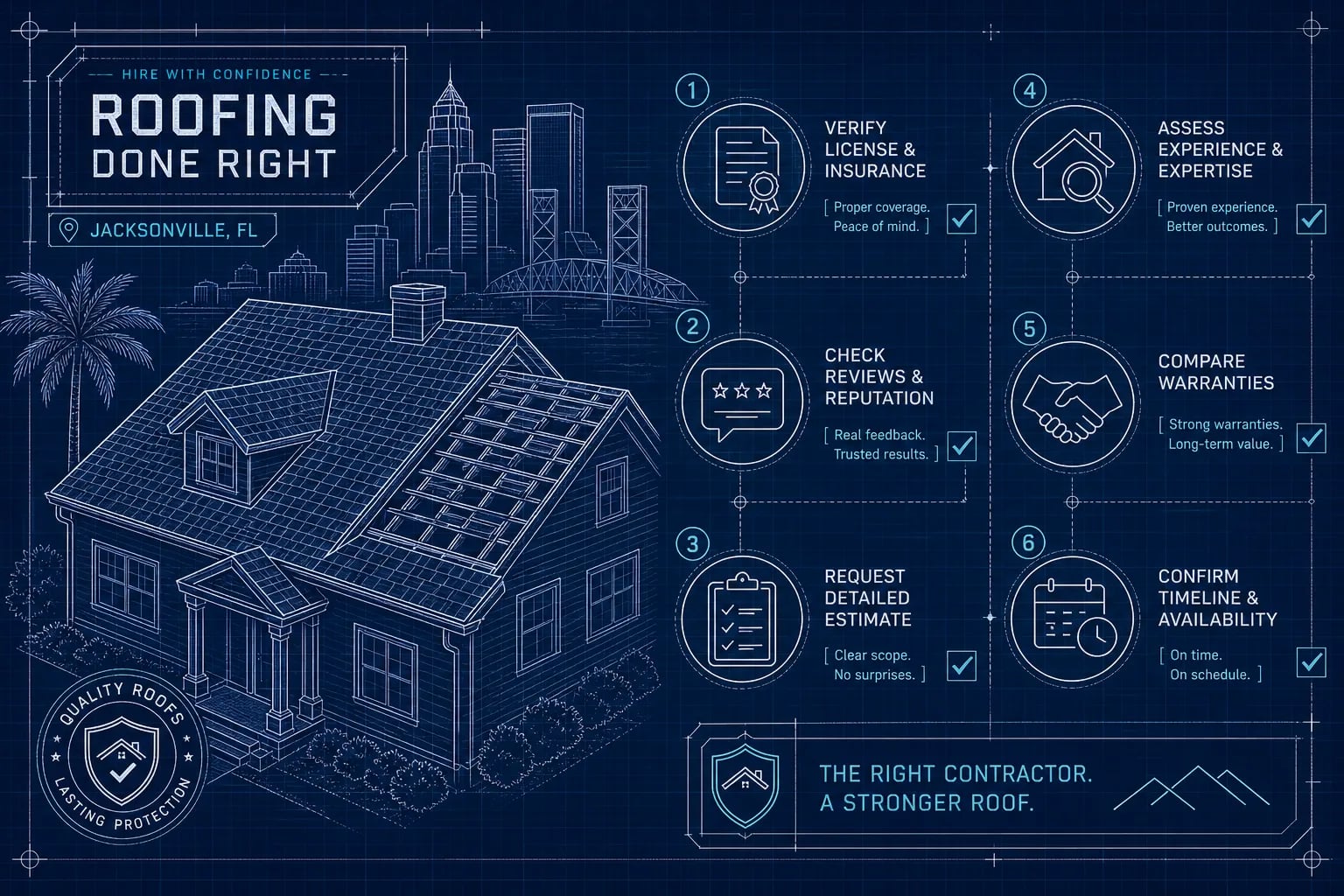
The 6-step process to hire trusted roofing companies in Jacksonville, FL
Steps 1 through 3: verify, confirm, and investigate
Step 1: Verify the Florida license. Before the first phone call goes further, search the DBPR's license lookup and confirm Current/Active status for the contractor's license number. Check that the license type is appropriate for roofing and that the business name matches. If the result is anything other than Current/Active, expired, inactive, or delinquent, stop there and move to the next contractor on your list.
Step 2: Confirm insurance coverage. Ask for a certificate of insurance showing both liability and workers' compensation coverage. Verify the policy is current. If there's any doubt, call the insurer directly to confirm the policy is active and valid for the type of work being performed. A passing result means the certificate names the correct business, shows adequate coverage limits, and has a current expiration date.
Step 3: Check recent reviews across multiple platforms. Look at Google, the Better Business Bureau, and local community forums. Focus on patterns rather than individual ratings: how does the company handle callbacks, warranty claims, and cleanup? A contractor with 400 reviews averaging 4.9 stars has demonstrated consistency. A contractor with 12 reviews and a perfect score has demonstrated much less.
Steps 4 through 6: compare, read, and commit
Step 4: Get three written, itemized estimates. One estimate tells you a price. Three estimates tell you whether that price is reasonable, which contractor can explain their numbers, and which line items other companies handle differently. An estimate that's missing tear-off costs, permit fees, or underlayment specs is incomplete regardless of how the total looks.
Step 5: Review the warranty documents before signing. Ask for both the manufacturer warranty information and the contractor's workmanship guarantee in writing. Read them both. Check the term, the exclusions, the transferability, and the claims process. Don't accept a verbal warranty summary as a substitute for the actual document.
Step 6: Confirm the permit process explicitly. Ask directly who pulls the permit, when it will be submitted, and whether a final inspection will be completed before the job closes. A qualified contractor answers this question without hesitation. One who hedges or suggests the permit isn't necessary is telling you something important about how they operate.
If you're ready to start the process, Infinity Legacy offers free estimates for Jacksonville homeowners and commercial property owners with no pressure to sign on the spot. As a licensed multi-trade Florida contractor (CGC1540795), we handle roofing, HVAC, impact windows and doors, and remodeling under one accountable team. For property owners dealing with storm damage across multiple systems, that means one point of contact instead of four separate contractors competing for your attention during a stressful time. Reach out to our team to get a licensed contractor on-site to assess your roof's condition.
Start with the checklist, not the pressure
The Jacksonville roofing market has strong, reputable contractors who do excellent work in difficult conditions. It also has enough bad actors that skipping your homework creates real financial risk. The good news is that the framework for hiring safely isn't complicated: verify the license, confirm the insurance, read the reviews, collect three itemized estimates, review the warranty documents, and confirm the permit process before anyone gets on your roof.
If you want to start with a contractor who already has the license verified, the insurance in place, and the storm experience to back it up, Infinity Legacy offers free roof assessments across the Jacksonville area with no obligation. We're one of the local roofing companies in JAX built specifically for this market, licensed, insured, and ready to put eyes on your roof before the next storm season gives you less time to decide. Get in touch with our team and let us show you what that standard looks like in practice.