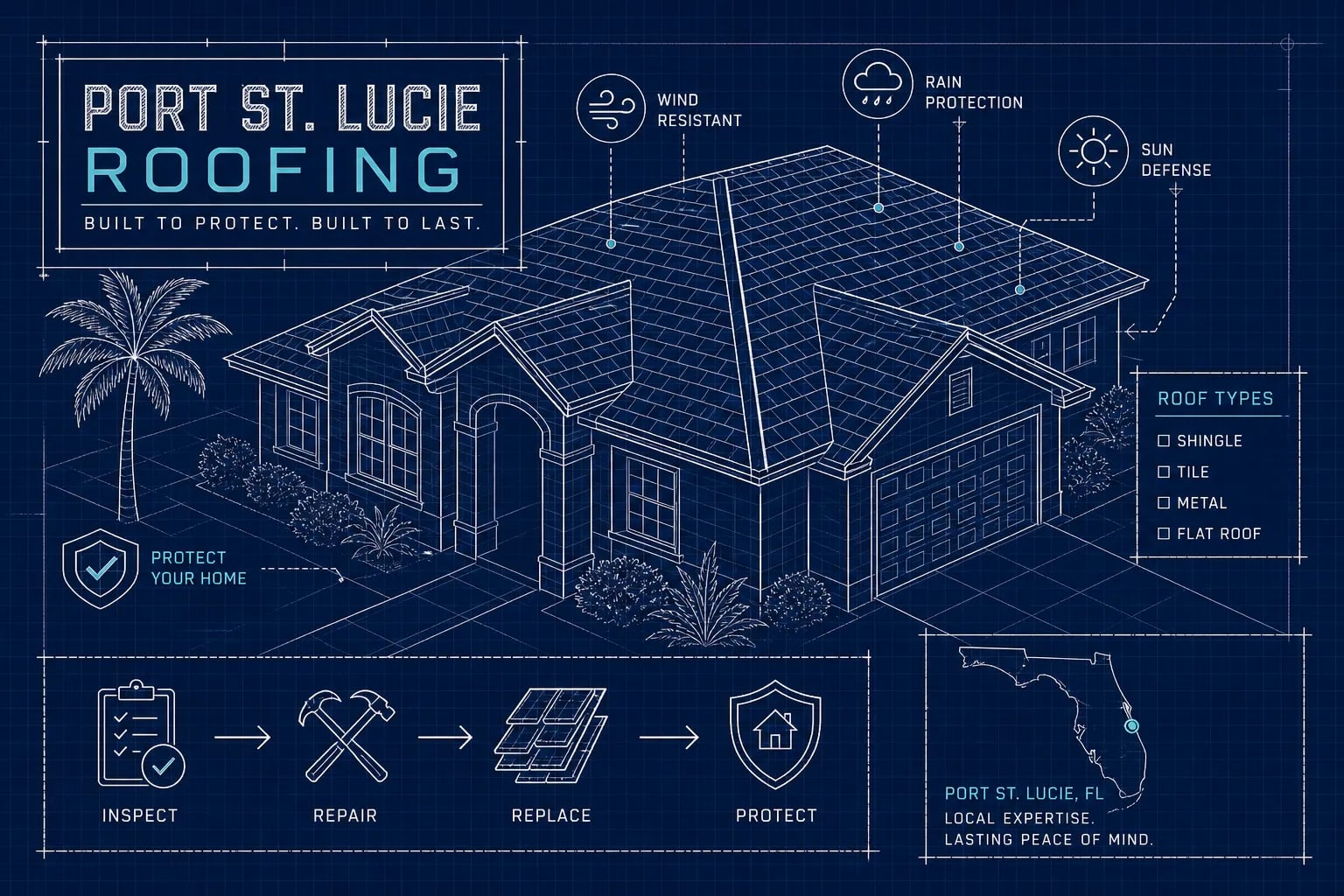
Port St. Lucie roofing demands a level of planning that most other Florida markets simply don't require. The city sits squarely in Florida's hurricane corridor, and that single fact changes every decision a homeowner here needs to make. This isn't a climate where you pick a shingle color, get a quote, and call it done. Your roof is the first and most critical line of defense against tropical storms, relentless year-round UV exposure, and coastal humidity that degrades materials faster than most people realize. Get it right, and a new roof here can last 40 to 50 years. Get it wrong, and you risk starting over after the next named storm.
This guide covers what Port St. Lucie homeowners actually need to know before signing anything: which materials survive this specific climate, what realistic costs look like in 2026, how permits and wind-rating requirements work under the current Florida Building Code, which local roofing contractors in Port St. Lucie have proven track records, and how to handle a storm-damage insurance claim without getting burned. If you also need HVAC work, impact windows, or a remodel, some Florida-licensed multi-trade contractors offer bundled services under one team, verify their licensing and references to confirm they can deliver the full scope.
Why Port St. Lucie Roofs Face a Harder Job Than Most
Port St. Lucie isn't just warm, it's a coastal, wind-borne-debris zone that combines sustained hurricane-force winds, intense UV radiation, high humidity, and salt air into one of the most demanding roofing environments in the country. That combination shortens roof lifespans, elevates material standards, and raises the performance bar for every contractor who works here. Lifespans commonly cited for the same materials are shorter in coastal Florida than in many inland climates, largely because of wind, UV, humidity, and salt air working in combination. A system that's adequate elsewhere may not survive a direct hit from a Category 2 storm.
The Hurricane Exposure Reality
Port St. Lucie sits in a high-wind, wind-borne-debris region where roofing systems must be engineered for significant uplift forces, not just installed according to general manufacturer guidance. Under the 8th Edition (2023) Florida Building Code, residential Risk Category II properties in Port St. Lucie are generally required to comply with a 160 mph ultimate design wind speed, though the controlling value can vary by exact address and exposure category, so verify your site-specific Vult with the City of Port St. Lucie Building Division or through the ASCE 7-22 wind speed maps during permit design. What matters practically is the tested assembly: the fastening pattern, underlayment, product approval, and deck attachment all work together. The surface material's marketing wind rating alone means nothing if the rest of the system isn't engineered to match.
How Salt Air and Humidity Compound the Problem
The coastal environment here degrades metal fasteners, promotes algae and mold growth on asphalt shingles, and compromises adhesives and sealants faster than inland climates. A product that performs well in Orlando or Jacksonville may still underperform near the Treasure Coast without corrosion-resistant coatings, proper ventilation, and algae-resistant treatments. That's why material selection and installation quality are both critical here. Either element alone leaves you exposed.
Port St. Lucie Roofing Materials: Which Options Actually Hold Up
There are four realistic material options for residential roofs in Port St. Lucie: standing-seam metal, concrete or clay tile, architectural asphalt shingles, and TPO for flat or low-slope sections. The ranking below reflects real-world hurricane performance in this specific climate, not marketing claims. In every case, the installed assembly determines how the roof performs, not just what's on top of the deck.
Standing-Seam Metal: The Long-Game Choice
Properly specified standing-seam metal is the strongest performer in this climate. Concealed-fastener systems with corrosion-resistant coatings, aluminum or properly coated Galvalume steel near the coast, can achieve wind ratings well above code requirements and last 40 to 60 years or more with minimal maintenance. Metal also reflects heat, resists algae and insects, and sheds water fast. The upfront cost is higher than any other option, typically running $13 to $23 per installed square foot. Inferior metals or exposed-fastener R-panel systems are a fundamentally different product: cheaper, but weaker, and far more vulnerable to corrosion and uplift failure.
Concrete and Clay Tile: Heavy, Durable, and Built for Florida
Tile has been the dominant roofing material in South Florida for decades, and for good reason. Concrete and clay tile roofs routinely last 40 to 50 years, resist heat and salt air effectively, and carry the thermal mass that helps buffer interior temperatures. The catch is weight: tile requires a structure designed or reinforced to handle the load, and the installation, whether using high-wind adhesive or batten systems, must be engineered for current uplift requirements. There's also a hidden cost worth knowing: the underlayment beneath tile typically needs replacement at 20 to 30 years, long before the tile itself fails. Budget for that when evaluating total lifecycle cost.
Architectural Asphalt and TPO: When They Make Sense
High-wind architectural shingles are the legitimate budget option for Port St. Lucie homes, but only when specified correctly. That means algae-resistant products, a six-nail fastening pattern where the product approval requires it, and a tested high-wind underlayment system. Three-tab shingles have no place in this wind zone. Expect a lifespan of roughly 15 to 20 years in this climate, shorter than metal or tile, but the lower upfront cost makes them the right call for many homeowners. TPO, on the other hand, is the correct choice for flat or low-slope roof sections only; it is not a steep-slope substitute, and its hurricane performance depends heavily on edge securement, seam quality, and perimeter detailing.
Repair or Full Replacement: Reading the Signs Correctly
Going into a contractor conversation without knowing which question to ask costs homeowners money. A repair-versus-replacement decision comes down to four factors: the roof's current age, the extent and pattern of the damage, how your insurance policy treats aging roofs, and whether repeated small repairs on an aging system are compounding into a larger long-term cost.
Signs a Repair Is Enough
Localized damage on a roof under 12 to 15 years old, five or fewer missing shingles, a single flashing failure, a handful of cracked tiles, is usually worth repairing, provided the roof is otherwise in sound condition. These thresholds are practical rules of thumb rather than hard limits; the underlying condition of the deck and underlayment matters just as much as the surface damage count. The same logic applies when the repair cost is well under 20% of a full replacement quote and there's no evidence of systemic underlayment failure. Minor leak repairs in Port St. Lucie typically run $350 to $1,500, while moderate work involving underlayment can reach $750 to $2,000. Small, targeted repairs on a young, healthy roof make financial sense.
When Replacement Is the Smarter Financial Move
A roof approaching or past 20 years in this climate deserves honest scrutiny. Widespread granule loss, systemic underlayment failure, multiple leak events in the same season, or storm damage affecting more than one section are all signs that repair costs will keep stacking up. There's also an insurance angle: many Florida homeowners' policies treat aged roofs differently, paying out on an actual cash value basis rather than replacement cost, which can leave a significant gap when a major storm hits. A full replacement can reset your coverage terms and qualify the home for wind-mitigation credits that reduce future premiums.
Port St. Lucie Roofing Costs: What to Expect in 2026
Roofing quotes based on living square footage are misleading. Actual roof area includes overhangs, slopes, and pitch multipliers, so a 2,000-square-foot home commonly has 2,200 to 2,500 square feet of roofing surface. Always get quotes based on measured roof squares, one square equals 100 square feet, and confirm the proposal includes tear-off, disposal, underlayment, flashing, decking, permits, and any code-required upgrades.
Repair and Patch Cost Ranges
For common repair work in 2026, expect the following ranges for Port St. Lucie roof repair projects:
- Minor shingle patch: $300, $750
- Small leak repair: $350, $1,500
- Cracked or slipped tile repair (5, 20 tiles): $250, $2,500
- Moderate shingle repair with underlayment: $750, $2,000
- Larger leak, valley, or localized membrane repair: $1,200, $3,500
- Extensive repair involving decking and storm damage: $3,500, $8,500+
Full Replacement by Material and Roof Size
For full roof replacement in Port St. Lucie in 2026, installed costs break down roughly as follows:
- Architectural asphalt shingles: $5, $9 per sq. ft., a 1,500 sq. ft. roof runs approximately $7,500, $13,500; a 2,000 sq. ft. roof runs $10,000, $18,000.
- Concrete tile: $11, $16 per sq. ft., a 2,000 sq. ft. roof typically lands at $22,000, $32,000.
- Clay tile: $12, $18+ per sq. ft., making it the most expensive tile option.
- Standing-seam metal: $13, $23 per sq. ft., a 2,000 sq. ft. roof typically falls between $26,000 and $46,000.
Permits, tear-off, decking repairs, and code-upgrade requirements are additional line items that can meaningfully change the base quote. Any proposal that doesn't itemize these separately deserves a follow-up question before you sign.
Permits, Wind Ratings, and What Port St. Lucie's Code Actually Requires
The permitting process catches homeowners off guard more often than it should, largely because contractors don't always explain it upfront. A building permit is required before a roof replacement or substantial repair begins in Port St. Lucie. The City of Port St. Lucie Building Division administers the 8th Edition (2023) Florida Building Code for properties within city limits, and requirements differ from unincorporated St. Lucie County, verify your address before contracting.
The Florida Building Code Requirements That Apply to Your Project
Port St. Lucie is in a high-wind, wind-borne-debris region, not the Miami-Dade/Broward High-Velocity Hurricane Zone (HVHZ), but still subject to significant uplift requirements. Roofing assemblies must carry a current Florida Product Approval matched to the project's design wind speed and installation method. For asphalt shingles, that may mean a six-nail fastening pattern; for metal, it means the complete tested assembly including panel profile, clip type, fastener schedule, and deck attachment. During a reroof, Florida law may also require mitigation measures like improved deck attachment or a secondary water barrier, depending on the existing roof's condition and age. The Building Division makes the final call on what's required for your specific permit.
How the Permit Process and Timeline Typically Work
A standard reroof permit package includes the permit application, the contractor's Florida license information, applicable Florida Product Approvals and installation details, and a Notice of Commencement for projects over $2,500. The inspection sequence typically runs dry-in, nail-off, and final roofing inspection. In 2026, a complete, straightforward application generally takes in the range of two to three weeks for approval, simple, complete submittals may move faster, while missing or mismatched product approvals and correction cycles can extend the timeline to several weeks or more. Permit applications can be abandoned after 180 days without action, so don't let a project stall mid-stream.
Top-Rated Port St. Lucie Roofing Companies Worth Knowing
The list below reflects verified review data and reported specialties for roofing contractors in Port St. Lucie. Treat this as a practical starting point, not a definitive ranking. Review scores change, directories use different methodologies, and the best company for a shingle repair isn't automatically the best fit for a tile-to-metal conversion. Verify every contractor's current Florida license through the Department of Business and Professional Regulation (DBPR) and get at least three itemized estimates before deciding.
Companies With Strong Review Volume and Broad Service Range
All Area Roofing and Construction earned a high composite score in a 2026 contractor directory listing, with a 4.8-star average across 253 reviews. They handle residential, commercial, industrial, and government projects across the Treasure Coast. Alliance Group Roofing Company holds a 4.9-star average from 247 reviews and serves general residential and commercial needs. Ace Pro Roofing carries 4.9 stars from 228 Google reviews and an A+ BBB rating; their service range covers replacements, repairs, coatings, waterproofing, ventilation, gutters, insulation, and storm-damage work.
Specialists and Best Fits by Project Type
Best Choice Roofing focuses on asphalt shingles with Owens Corning warranty options and over 15 years of Treasure Coast experience. FIXD Roofing LLC (Florida license CCC1332497) handles tile, metal, flat, and specialty roofing systems and is worth considering for material conversions or anything beyond standard asphalt. Solace Roofing LLC and Diversified Roofing Solutions both serve general repair and replacement needs. For urgent leak response, Roof Leaks Hunters earns consistent customer reviews for rapid turnaround and clear explanations on tile repairs, fascia work, and soffit issues. Match the company to the project type: high review volume is a useful signal, but specific material expertise matters more when the job is complex.
Navigating a Storm-Damage Insurance Claim Without Getting Burned
A storm-damage claim is a process the homeowner should control, not one to hand off entirely to a contractor. The steps below reflect how experienced Port St. Lucie homeowners handle these situations, and the warnings are based on the patterns that consistently lead to disputes, underpayments, and contractor fraud.
What to Do Before the Adjuster Arrives
Document from the ground before any cleanup. Time-stamped photos and video of missing or displaced shingles, exposed underlayment, damaged flashing, gutters, vents, and interior stains are your primary evidence. Arrange emergency tarping to stop active water intrusion and keep all receipts, reasonable loss-mitigation expenses may be covered. Report the loss to your insurer promptly with the storm date and a description of apparent damage, then request a claim number and the adjuster's contact information. Review your policy before any conversation: confirm whether your roof is covered on an actual cash value (ACV) or replacement cost value (RCV) basis, what your deductible is, and whether a separate windstorm deductible applies. Under an ACV policy on a 12-year-old roof with 40% depreciation, an $18,000 replacement claim might net roughly $7,300 after deductible. Under an RCV policy with the same deductible, the same claim could produce $14,500 after the work is documented and complete.
How to Hire a Contractor for an Insurance Job
Verify the contractor's Florida license through DBPR and request proof of current liability and workers' compensation coverage before any signature. Get a detailed written proposal that identifies scope, materials, warranties, permits, payment milestones, and responsibility for code-required upgrades. Red flags to walk away from: deductible waivers, guaranteed coverage promises, immediate-signature pressure, and broad assignment-of-benefits language. Every scope change and payment milestone should be in writing, and the insurer should be kept informed throughout. The safest arrangement keeps everyone accountable: you report the claim, the insurer determines coverage, a verified contractor documents and performs the work, and everything stays on paper.
Financing Your Roof, and Why Multi-Trade Contractors Change the Math
A roof replacement in Port St. Lucie commonly runs $10,000 to $55,000 depending on material and size. Most homeowners don't have that sitting in savings, and even those who do often prefer not to liquidate it. The main financing paths are insurance proceeds, home equity, personal loans, and PACE financing, each with different trade-offs on cost, qualification, and repayment structure.
What PACE Financing Actually Offers Port St. Lucie Homeowners
PACE (Property Assessed Clean Energy) financing provides up to 100% project funding with no down payment and no traditional credit score requirement. Repayment runs through annual installments on the property tax bill, secured as a non-ad valorem assessment on the property itself rather than as a personal loan. Terms for roof replacements can extend up to 20 years, with fixed interest rates typically ranging from 6% to 12.99% depending on the provider and transaction. Eligibility generally requires current property taxes, no mortgage defaults in the prior three years, and total annual PACE payments not exceeding 10% of household income. For St. Lucie County specifically, verify that the county's PACE authorization is current and confirm which administrator serves your address before contracting, Florida's post-2024 local-approval framework means county authorization must be confirmed at the time of application.
Working With a Multi-Trade Contractor on Your Port St. Lucie Roofing Project
This is where Infinity Legacy enters the picture. As a Florida-licensed multi-trade contractor (CGC1540795) based in Palm Coast, Infinity Legacy handles roofing alongside HVAC, impact windows and doors, and remodeling, all under one accountable team, with PACE financing available and free estimates offered statewide. For Port St. Lucie homeowners who also need an AC replacement or impact window upgrade alongside a new roof, bundling these projects with a single contractor simplifies permitting, eliminates the coordination burden of managing multiple vendors, and allows the financing to cover the full scope in one assessment. Contact Infinity Legacy to request a free estimate and discuss which combination of upgrades makes the most sense for your property.
Your Action Plan Before Signing Anything
Replacing a roof in Port St. Lucie requires more than picking a contractor with good Google reviews. The climate demands the right material for a high-wind zone, the code requires a properly approved assembly and permitted installation, and the cost range is wide enough that three itemized estimates are essential before committing. Skipping any of these steps creates real exposure, financially, structurally, and from an insurance-coverage standpoint.
Here's the sequence that protects you: start by honestly assessing your current roof's age and condition. Use the repair-versus-replacement criteria above to go into contractor conversations with a clear question. Shortlist two to three companies from the vetted list, verify their DBPR licenses, and request itemized proposals that include product approval numbers, warranty terms, tear-off, permits, and code-upgrade responsibility. Confirm in writing who pulls the permit and who is responsible for the inspection sequence. If upfront cost is the barrier, explore PACE financing through a contractor already set up to facilitate it.
For Port St. Lucie roofing projects that involve more than just the roof, HVAC, impact windows, or a full remodel, working with a single multi-trade contractor like Infinity Legacy keeps permitting straightforward and the project on one timeline. Free estimates are available statewide. Contact Infinity Legacy to start the conversation and get a clear picture of your options before signing anything.