
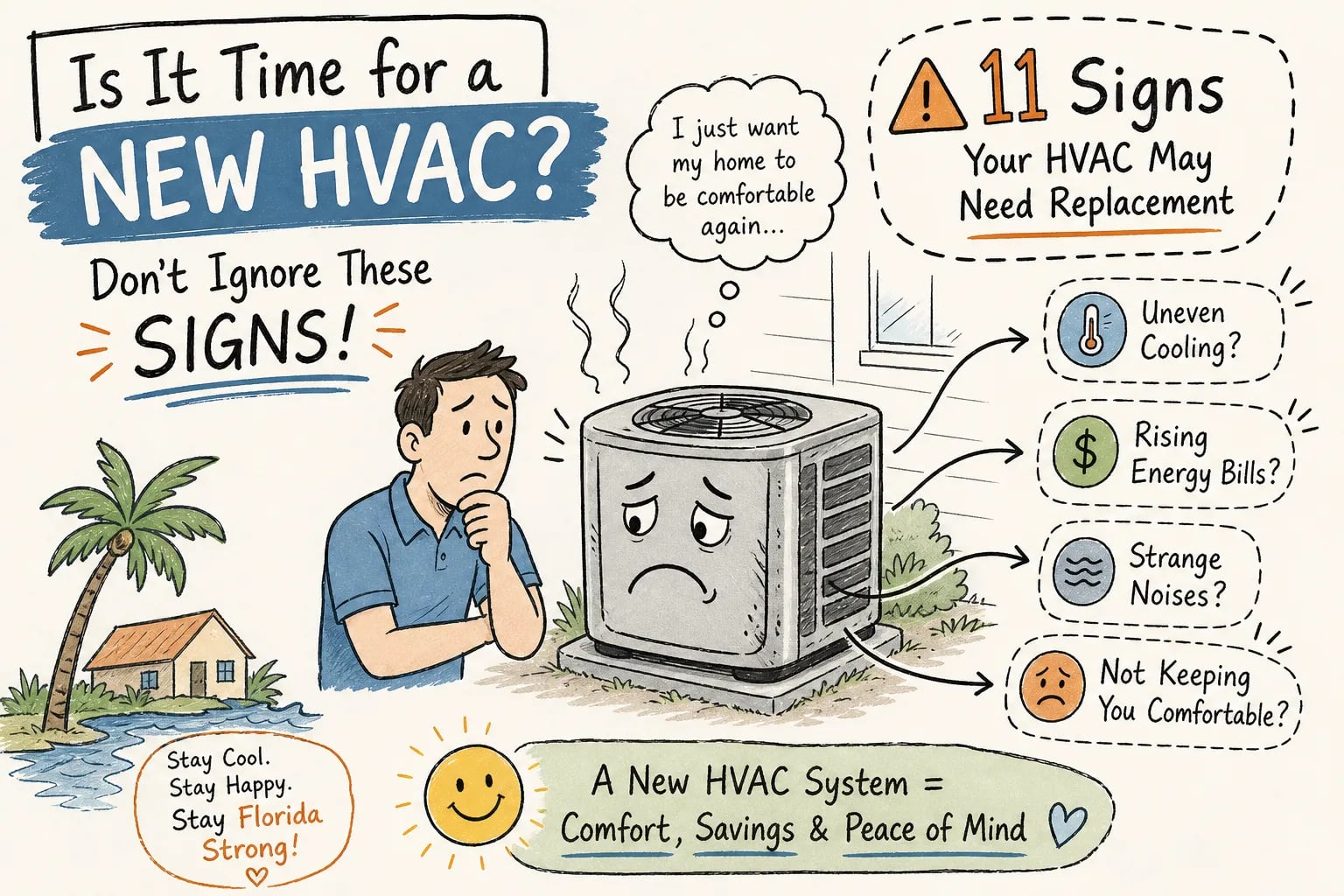
It's August in Florida. The thermostat reads 84 degrees inside. The AC has been acting up since last spring, and you've already called for service twice. The system runs constantly but never quite catches up. If you're watching those hvac replacement signs stack up one by one, here's the hard truth: the problem isn't this week's heat. The system crossed the point of no return months ago, and each repair bill was just buying a little more time on borrowed equipment.
Florida HVAC systems don't age the way they do in Minnesota or Connecticut. They run hard, year-round, against heat and humidity that exhaust equipment far faster than cooler climates do. When a Florida system starts declining, the signs stack up quickly, and the window between "still repairable" and "completely failed" is narrower than most homeowners expect.
The 11 signs below cover the full range: gradual performance problems you might notice on your energy bill, mechanical symptoms you hear or smell, and a few safety emergencies that require immediate action. Seeing two or three of these together means you already know something is wrong, this guide helps you understand exactly what you're dealing with.
Florida's climate ages HVAC systems faster than most homeowners expect
In most U.S. states, air conditioners run seasonally. Florida homeowners run theirs ten to eleven months a year. That continuous runtime puts dramatically more hours on the compressor, fan motors, and electrical components compared to a system in the Midwest or Northeast. A unit that might last 15 to 17 years in Ohio often shows end-of-life symptoms after 10 to 14 years in Florida. This context matters when you're weighing whether a repair is worth the money.
Florida's humidity compounds the wear on every component. High moisture forces your system to work as a dehumidifier in addition to a cooling unit, straining coils, drain lines, and the blower motor. Moisture also accelerates corrosion on copper refrigerant lines and electrical contacts. Coastal properties deal with salt air on top of that. This is why Florida-specific HVAC contractors assess systems differently than technicians in drier climates. The calendar age of your unit is just the starting point for the conversation.
HVAC replacement signs to know: performance red flags your bills and comfort reveal
Sign #1: your system's age has crossed the replacement threshold
Central air conditioners in Florida typically last 8 to 14 years under normal use. Heat pumps generally reach end-of-life between 8 and 12 years in the state's subtropical conditions. These windows are shorter than national averages because of the year-round runtime and humidity load discussed above. Age alone isn't a reason to replace a functioning system, but age combined with any additional symptom from this list changes the calculation significantly.
You can find your system's manufacture date on the nameplate of the outdoor unit, usually embedded in the serial number. Most manufacturers encode the production year and week in the first four to six digits. If you can't decode it yourself, any licensed technician can read it in seconds. Knowing that number before your next service call gives you real context for every decision that follows. A repair on an eight-year-old system hits differently than the same repair on a thirteen-year-old system.
Sign #2: energy bills climbing with no clear explanation
Older HVAC systems running at 8 to 10 SEER cost significantly more to operate than modern units rated at 16 to 20 SEER. Florida homeowners who replace an aging system with a high-efficiency unit often see cooling costs drop by 20% to 50% annually. If your utility bills have climbed over the past two or three summers with no change in your habits or your electricity rate, declining system efficiency is the most likely cause. That gradual cost increase is one of the quietest AC replacement signs there is, easy to rationalize until you actually do the math.
Sign #3: rooms that won't cool evenly and humidity that won't drop
A properly functioning system should maintain consistent temperatures throughout your home and keep indoor humidity at comfortable, non-mold-promoting levels, generally below the mid-50% range. When certain rooms stay warm while others cool normally, or when the air feels muggy even with the system running constantly, the unit is losing its ability to manage both temperature and moisture. In Florida, chronic indoor humidity is more than a comfort problem. It creates conditions for mold growth and serious air quality issues. When that pattern shows up on a system over ten years old, it's a replacement signal, not a maintenance call.
Sign #4: short-cycling, where the system turns on and off constantly
Short-cycling is when the system starts, runs for a few minutes, shuts off, and repeats the cycle. Sometimes this is a fixable issue: a dirty filter, a faulty thermostat sensor, or low refrigerant. But when short-cycling continues after those components have been checked and addressed, it usually points to compressor failure or a deeper capacity problem. On an aging Florida system, recurring short-cycling after troubleshooting is one of the clearest signals that replacement is the right call, not another repair attempt.
Mechanical HVAC replacement signs: what you hear, smell, and see
Signs #5 and #6: noises that shouldn't be there
Banging or clanking usually points to a loose or broken component inside the air handler or compressor. Grinding means worn motor bearings. High-pitched squealing can indicate a belt problem or a failing motor. A single noise from one identifiable component is often repairable. The replacement signal comes when multiple sounds appear together, or when the same noise returns shortly after a repair. That pattern tells you the failures are systemic, not isolated, you're patching a system that's running out of components worth patching.
Signs #7 and #8: odors, refrigerant leaks, and frozen coils
A burning or electrical smell from your vents indicates overheating components, a motor, a capacitor, or deteriorating wiring insulation. A sweet or chemical smell often points to a refrigerant leak. Both require prompt service. Refrigerant leaks in older systems using R-22 (phased out and now scarce) are particularly expensive because the refrigerant itself costs significantly more than modern alternatives. A leak repair on an R-22 system can easily run $1,500 or more just for the refrigerant charge, before any repair labor, and that figure can climb higher depending on current supply.
Frozen coils, visible as ice on the outdoor unit or the evaporator coil inside, are a common symptom of refrigerant loss or severe airflow restriction. They signal that the system is working against itself at a fundamental level. Defrosting and recharging may buy a few months, but if the underlying cause is a compressor losing capacity or a coil that's corroded through, you're spending money to delay the inevitable.
Sign #9: weak airflow throughout the house even after maintenance
If air returns feel weak throughout your home after you've replaced the filter and had the system serviced, the blower motor, ductwork, or overall system capacity may be degrading. Ongoing poor airflow that doesn't respond to normal maintenance is a mechanical signal, not a filter problem. When you combine that with age and two or three other symptoms on this list, the system is telling you it can no longer deliver what your home needs to stay comfortable through a Florida summer.
The repair bill pattern: when spending money becomes a warning sign
Sign #10: the 50% rule and why it matters
The 50% rule, a standard guideline cited by ENERGY STAR and most HVAC trade organizations, works like this: if a repair costs more than 50% of what a new system would cost, replacement is the smarter financial decision. A new system for a typical Florida home runs $7,000 to $15,000 depending on size, system type, and whether ductwork needs to be addressed. That means any single repair approaching $3,500 to $7,500 on an aging unit deserves serious scrutiny. The repair might hold for a year, or the next component might fail three months later, leaving you back at the same conversation with a smaller gap between what you've spent and what a replacement would have cost.
Track your service history as a decision-making tool. If you've called for service two or more times in the past twelve months, write down what was replaced and what you paid. That cumulative number tells a clear story. A pattern of escalating repairs on a system over twelve years old is a stronger replacement indicator than any single breakdown.
The frequency of failure matters more than the cost of any one repair. Each service call also means time without reliable cooling in a Florida summer, which carries its own cost in discomfort and risk.
Safety warning signs that require immediate shutdown
Sign #11: carbon monoxide risk, electrical hazards, and burning smells
Some HVAC warning signs are not about comfort or cost. They're about safety. A burning or electrical odor from the unit, repeated breaker trips, smoke, sparks, or any visible arcing from the system are fire hazards that require immediate shutoff at the breaker. These are not symptoms you schedule a service call around. They require the system to stop running now, while you're still in control of the situation.
Carbon monoxide risk in gas-burning systems is a separate but equally serious concern. If a CO alarm sounds, or if anyone in the home experiences unexplained headaches, dizziness, or nausea near the air handler or furnace, leave the home immediately and call emergency services from outside. Do not reset the equipment and wait for a technician. An HVAC system can be replaced. The alternative outcomes cannot be undone.
When to shut it down before the technician arrives
The practical rule is simple: if the symptom could cause fire, poisoning, shock, or a gas hazard, treat it as an emergency. Shut off the system at the breaker if it's safe to do so. Evacuate if there's any sign of CO or gas. Call for service from a safe location.
The symptoms that require this response include burning smells from vents or the unit itself, smoke or sparks from electrical components, a CO alarm, a gas odor, and water pooling near electrical equipment. These are not judgment calls. Get out first, then make the call.
What HVAC replacement actually costs in Florida, and what you get back
In Florida, a full central AC or heat pump replacement typically runs $7,000 to $15,000, depending on system type, home size, and whether ductwork needs to be addressed. For a 1,500 to 2,000 square foot home, most homeowners are looking at $7,500 to $12,500 for a complete system replacement with proper permitting and Florida-code-compliant installation. Heat pump systems tend toward the higher end of that range. Ductless mini-splits, common in Florida additions and older homes without existing ductwork, start around $3,000 per zone. If ductwork needs replacing alongside the system, plan to add $1,500 to $5,000 depending on the home's layout and duct condition.
The energy savings are real and worth calculating. Replacing a system running at 10 SEER with a 16 to 20 SEER unit cuts cooling energy costs by 20% to 50% annually. In Florida, where the AC runs ten or eleven months a year, those savings accumulate faster than in most other states. A homeowner paying $2,400 a year in cooling costs who cuts that by 30% saves $720 annually, over ten years, that's $7,200, which meaningfully offsets the replacement cost. Based on Florida-specific usage patterns, homeowners upgrading from a 10 SEER system to a 16 to 20 SEER unit commonly see $400 to $675 in annual cooling savings. Actual savings vary by electricity rate, home size, and runtime.
PACE financing is available in Florida and funds the project with no money upfront. Homeowners repay through a fixed assessment on the annual property tax bill. Eligibility and specific terms vary by county and provider, so it's worth confirming your property qualifies. For homeowners who need a replacement now but aren't in a position to write a check for $10,000, it's a practical path. Infinity Legacy works with PACE financing and can walk you through the eligibility and process as part of any assessment, in the same direct, informational way they handle every evaluation.
Your next move: get an assessment before the system fails completely
A thorough HVAC assessment from a licensed Florida contractor covers more than a quick look at the outdoor unit. It includes system age, refrigerant charge, electrical connections, airflow measurements, duct integrity, thermostat calibration, coil condition, and a review of the unit's service history. A complete picture tells you whether you have one year left, three years left, or whether the next brutal week in July is likely to be the unit's last. That information changes every repair decision you make between now and then.
Infinity Legacy is a licensed Florida contractor (CGC1540795) based in Palm Coast, serving homeowners across Northeast and Central Florida. HVAC assessments are free and conducted by technicians who understand Florida's specific climate demands, not generalized national standards applied to a subtropical environment. As a multi-trade contractor handling roofing, impact windows and doors, and remodeling under the same team, Infinity Legacy is also the right call if a full home assessment makes sense alongside your HVAC evaluation.
If you've spotted more than two or three signs from this list, the right move is an evaluation before the system fails on the hottest day of August. Waiting costs money in rising energy bills and repair calls. A failed system in peak summer also means longer lead times for replacement equipment and installation, because every other homeowner in Florida is making the same call at the same time. Acting now, while you're still in the decision-making phase, puts you ahead of that timeline and gives you control over the contractor, the equipment, and the financing terms. Reach out to the Infinity Legacy team for a free assessment and get a clear answer on where your system actually stands.
The bottom line on these 11 HVAC replacement signs
The hvac replacement signs covered here range from gradual and easy to dismiss, rising bills, uneven cooling, short-cycling, to urgent and undeniable: burning smells, CO alarms, sparking components. What they share is that they rarely show up alone. When two or three appear together on a system that's 12 years old or older, you're not in repair territory anymore. You're in replacement territory, and the only real question is whether you replace it on your schedule or your system's schedule.
Florida homeowners who act on early HVAC replacement indicators save money, avoid emergency situations during peak summer heat, and get to choose their equipment, their contractor, and their financing terms rather than scrambling in a crisis. The difference between a planned replacement and an emergency replacement is often just a few months of paying attention to the signs your system is already showing you.
If any of these hvac replacement signs look familiar, start with a free assessment from Infinity Legacy. You'll know exactly where your system stands, what your options are, and what a replacement would actually cost, which is a far better place to make decisions than standing in a sweltering house in August waiting for a callback.