If you're a Florida homeowner researching energy efficient windows, you're already ahead of most. Windows are one of the most overlooked energy drains in the state, and one of the most rewarding upgrades when you get the specs right. Single-pane glass and poorly rated window assemblies act like solar collectors, pulling radiant heat into your living space every hour the sun is up. Your air conditioner then spends the rest of the day trying to undo that damage.
Energy efficient windows for Florida homes aren't a luxury upgrade. They're one of the most practical investments you can make, especially when you factor in storm protection, insurance savings, and the financing tools that make the project accessible without a large upfront payment. This guide walks through the specs that matter, the rebates and grants still active in 2026, what the project realistically costs, and why impact-rated glazing often delivers more value per dollar than almost any other upgrade on your list.
Why Florida's Climate Makes Windows Your Biggest Energy Problem
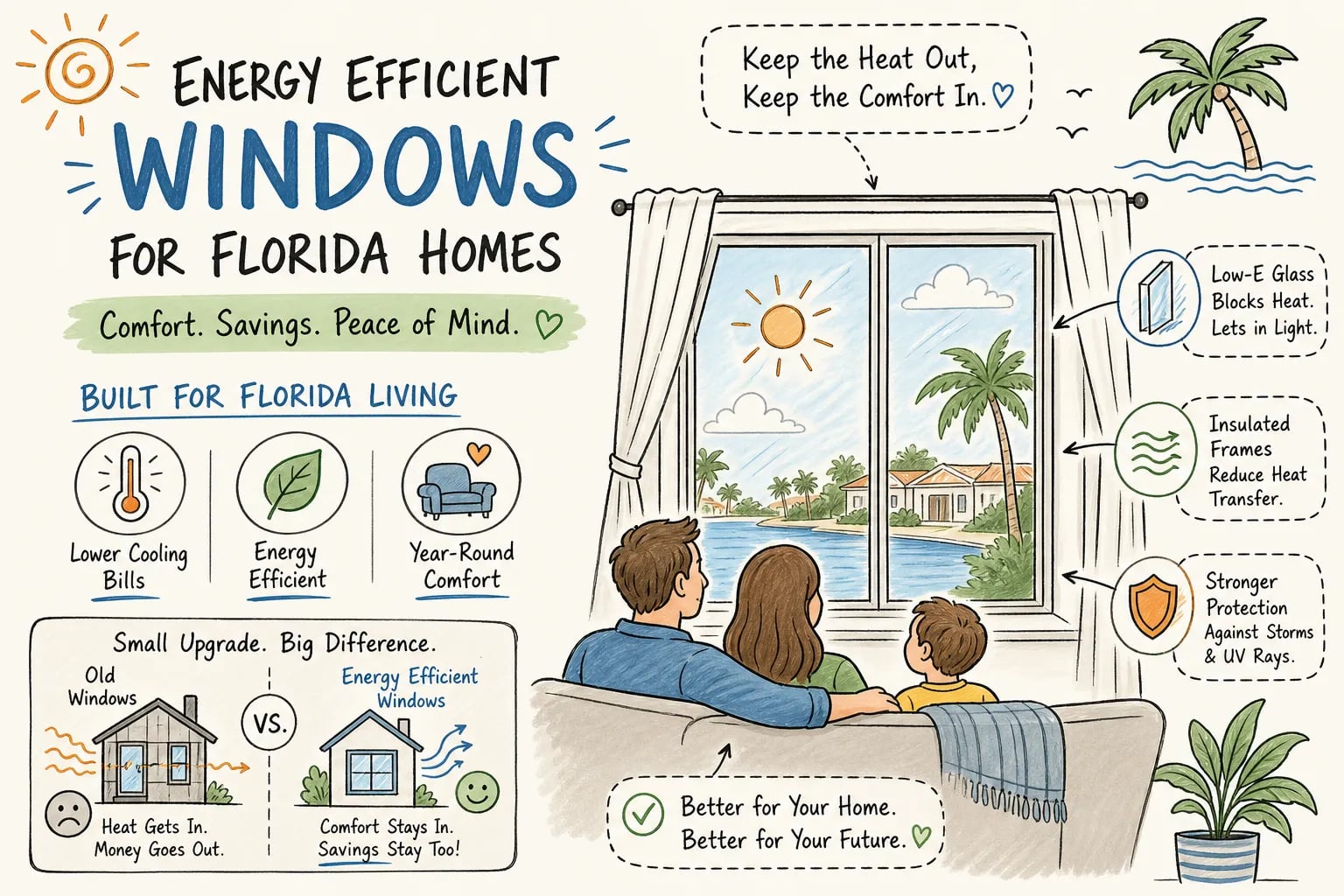
Florida's long, warm season typically demands air conditioning for most of the year, in many parts of the state, that means running the AC well into what other regions consider fall and winter. The state's intense solar radiation doesn't just warm outdoor surfaces; it passes directly through standard glass and heats interior walls, floors, and furniture, which then radiate that heat back into the room. Your AC system has to overcome both the outdoor temperature and all that stored interior heat, running longer and harder than it ever should.
The result is that most Florida homeowners are effectively paying to cool their windows, not just their rooms. A poorly rated window assembly with no low-E coating and a high solar heat gain coefficient functions like a magnifying lens pointed at your thermostat. According to the U.S. Department of Energy, replacing single-pane windows with ENERGY STAR-certified units can save $150 or more per year on energy costs alone. That number climbs considerably when insurance premium discounts and avoided storm-damage costs enter the calculation.
Humidity compounds the problem. Florida's moisture-laden air stresses window seals, degrades frame materials, and contributes to the air leakage that forces conditioned air out and unconditioned air in. Older windows that have lost their seal, or were never rated for Florida's conditions, are doing active harm to your indoor comfort and your utility budget every single month.
The Specs on Every Window Label and What They Mean for Florida Homeowners
Every qualifying window carries an NFRC label, and understanding that label gives you the information you need to compare energy efficient windows in Florida intelligently. The NFRC (National Fenestration Rating Council) independently tests and certifies whole-window performance, which means the numbers reflect the entire assembly, including the frame and edge spacers, not just the glass center.
U-factor measures how much heat flows through the entire window assembly. Lower is better. In Florida, U-factor matters because conducted heat moves through window frames and glass even without direct sunlight, particularly during those warm nights when indoor temperatures still need managing. ENERGY STAR's Southern climate zone requires a whole-window U-factor of 0.32 or lower for certified products.
SHGC (Solar Heat Gain Coefficient) controls how much solar radiation passes through the glass into your living space. For Florida homeowners, this is the most critical spec on the label. A practical target for windows in direct sun exposure is SHGC of 0.25 or lower; if you want to qualify for ENERGY STAR Southern zone certification, the threshold is 0.23 or lower (per published ENERGY STAR requirements). The lower that number, the less work your air conditioner does.
Frame material also matters more than most homeowners realize. Vinyl, fiberglass, and composite frames resist heat conduction far better than aluminum, which transfers heat directly into the home. Air leakage ratings (AL) round out the label: look for AL of 0.30 or less. The practical takeaway for Florida shoppers is clear: check SHGC first, U-factor second, and choose a non-metallic frame whenever possible.
Low-E Glass and Double-Pane Insulated Glazing: What Florida Homes Actually Need
Low-emissivity (low-E) glass has a microscopic metallic coating applied to one of the glass surfaces that reflects radiant heat rather than absorbing it. Invisible to the eye, the coating has a significant effect on solar heat gain. Not all low-E coatings are the same, and that distinction matters a great deal when you're buying energy efficient windows in Florida.
Passive low-E coatings are engineered to let solar heat in while keeping interior heat from escaping, exactly what you want in a cold climate, and exactly what you don't want in Florida. Solar-control low-E coatings are tuned to block solar heat gain while still allowing visible light transmission. That's the correct specification for the Southern climate zone. When a salesperson or product sheet mentions "low-E," confirm it's a solar-control formulation before proceeding.
Double-pane insulated glass is the baseline for any energy-efficient replacement in Florida. The air or inert gas gap between the two panes reduces conducted heat transfer, lowering the whole-window U-factor. Impact-rated laminated glass assemblies can raise U-factor slightly because the laminate interlayer adds thermal mass, which is why checking the whole-window NFRC rating rather than just the center-of-glass value is essential. A window that looks good on the glass spec sheet may perform differently as a complete assembly.
Impact-Resistant Windows Florida: The Upgrade That Earns Its Money Twice
Standard energy-efficient windows and impact-resistant windows are not mutually exclusive. The right impact window, with a proper glazing package, does two jobs simultaneously: it meets Florida Building Code requirements for hurricane-rated fenestration, and it delivers meaningful energy performance. That dual function changes the payback math completely.
On energy savings alone, window replacement payback periods can be long. But impact windows with qualifying wind mitigation features can generate homeowners insurance discounts on the windstorm portion of your premium, published ranges vary widely, roughly 10% to 45% depending on the insurer, your location, and the specific wind mitigation credit applied. In dollar terms, Florida homeowners in moderate-risk areas typically see savings of $450 to $1,200 annually; in South Florida and coastal counties, that range climbs to $900 or more. Stack those insurance savings on top of energy savings, and payback timelines compress significantly in many scenarios.
At Infinity Legacy, a licensed multi-trade Florida contractor (CGC1540795) serving Northeast and Central Florida, impact window installations are selected specifically for Florida's coastal and inland conditions. That means choosing glazing packages with SHGC ratings as low as 0.17 to 0.22 depending on the product, frames rated for the applicable wind pressure zone, and assemblies that carry HVHZ (High Velocity Hurricane Zone) approval where required. In HVHZ areas, the Florida Building Code requires impact-rated or protected openings, so the energy performance those products deliver comes on top of a code-mandated investment rather than as a standalone expense.
The "double-duty" value of impact-resistant windows is why most Florida contractors and insurance professionals recommend them over standard energy-efficient replacements for homes in hurricane-prone areas. One investment covers storm protection, lowers monthly energy costs, and reduces insurance premiums, every line of your household budget benefits from a single project decision.
What Energy Efficient Window Replacement Realistically Costs in Florida
Honest cost ranges help you plan without surprises. For standard energy-efficient replacement windows in Florida, expect $700 to $1,500 per window installed, depending on size, style, and frame material. Impact-rated windows run $900 to $2,500 per window installed, with South Florida and HVHZ projects typically landing at the higher end due to stricter code requirements and more complex installation conditions.
Whole-home projects covering 10 to 20 windows range from roughly $10,000 to $45,000, with wide variation based on size, configuration, and product choice. Custom shapes, larger openings, and structural modifications push costs higher. The presence or absence of existing permits and code-compliant framing also affects total project cost.
For energy savings, the U.S. Department of Energy's established benchmark is $150 or more per year when replacing single-pane windows with ENERGY STAR-certified units. If you're replacing double-pane windows that are simply old and leaky, savings will be lower because the baseline performance was already better. Use this simple formula to estimate your own payback: total project cost minus rebates and grants, divided by annual savings from energy plus insurance, equals payback in years. For most Florida homeowners replacing single-pane windows with impact-rated, low-E products, that calculation produces a payback period they're comfortable with, especially when resale value appreciation is factored in.
Florida Rebates and Utility Incentives Still Available in 2026
Several active programs can reduce your out-of-pocket cost significantly, but each requires matching your window specs to the program's requirements before you order. Getting the product specification right before you order is what prevents losing those rebates after installation is complete.
Here's what's currently active by utility territory, along with the qualifying specs for each program:
- Duke Energy Florida: $4 per square foot, up to $800, for east-, west-, and south-facing windows meeting SHGC of 0.21 or lower and U-factor of 0.27 or lower. A free Home Energy Check through Duke is required before the rebate path proceeds.
- Orlando Utilities Commission (OUC): $1.50 per square foot for installed qualifying windows through the Go Green / Get Green rebate program.
- Tampa Electric (TECO): $0.76 per square foot for windows with SHGC of 0.35 or lower and U-factor of 0.60 or lower, installed within conditioned space with NFRC labeling confirmed.
- Florida Power and Light (FPL): No dedicated window replacement rebate is currently available through FPL.
Beyond utility rebates, the My Safe Florida Home program offers a matching grant of up to $10,000 for qualifying storm-hardening improvements, which can include window replacements. To qualify in 2026, your home must be a Florida homesteaded primary residence, a site-built single-family home or townhouse, permitted before January 1, 2008, and have an insured value of $700,000 or less. The program requires a free hurricane mitigation inspection through the portal before grant applications are processed.
The practical action step: check your utility territory first, confirm your window specs meet that program's exact SHGC and U-factor requirements before ordering, and retain all receipts, spec sheets, and NFRC labels for your rebate submission. Documentation failures are the most common reason rebates get denied after installation.
The Federal Tax Credit Situation in 2026: What Changed
The federal Section 25C Energy Efficient Home Improvement Credit offered Florida homeowners a 30% credit on qualifying window costs, capped at $600 per year, for products placed in service through December 31, 2025. That credit applied to product costs only, not labor, and required ENERGY STAR Most Efficient certification for the Southern climate zone. It was a meaningful incentive while it lasted.
For windows installed in 2026, that credit no longer applies. Florida homeowners should not plan their project budgets around a 25C credit for work done this year. The credit expired with the 2025 tax year, and as of this writing there is no replacement federal credit structure in place for residential window replacement.
The practical effect of that change is a shift in financial strategy. Because the federal credit is off the table for 2026, utility rebates, the My Safe Florida Home grant, and PACE financing become the primary tools for reducing project costs and improving payback. Stacking a utility rebate with a My Safe Florida Home grant and financing the remaining balance through PACE can make a substantial window project manageable without a large upfront cash commitment.
PACE Financing: How to Replace Your Windows With $0 Down
Property Assessed Clean Energy (PACE) financing lets Florida homeowners fund qualifying energy efficient windows and storm-hardening replacements with no upfront payment and no credit score minimum. The financed amount is repaid through a fixed assessment added to the property tax bill, which means repayment fits within an existing bill rather than requiring a separate loan payment each month.
Here's how the process moves from application to installation: apply through a PACE program, confirm property eligibility, select a PACE-approved contractor, Infinity Legacy works with PACE programs for impact window installations, complete the project, and begin repayment through your property tax bill. Payment is released to the contractor only after project completion and your confirmation of satisfaction, which protects the homeowner throughout.
Eligibility requirements to know before applying:
- Property taxes must be current with no delinquency in the prior three years.
- No mortgage default or involuntary liens on the property.
- No notices of default in the prior three years.
- For most residential projects, lender consent is not required unless the financed amount exceeds 20% of the property's assessed just value.
Be transparent with yourself about the cost structure. PACE interest rates run 6% to 12.99%, and closing fees are typically around 6.99% of the financed amount. Repayment terms range up to 20 to 30 years depending on the program and project. The assessment attaches to the property, which can come up during a home sale, so disclose it clearly if you plan to sell before the assessment is paid off. Florida residential PACE carries no early payoff penalty, giving you full flexibility to pay it down faster if your situation changes.
For homeowners who need a major window upgrade now but prefer to preserve cash, PACE is often the most accessible path. The combination of $0 down, no credit requirement, and long repayment terms makes it possible to complete a full impact window installation without waiting years to save enough capital. That's particularly meaningful for homeowners with aging single-pane windows heading into hurricane season.
FAQ: Energy Efficient Windows Florida Homeowners Ask Most
What SHGC should I look for on Florida energy efficient windows?
Target SHGC of 0.25 or lower for windows in direct sun exposure. To qualify for ENERGY STAR Southern zone certification, the threshold is 0.23 or lower. The lower the SHGC, the less solar heat enters your home and the less your AC runs.
Do impact-resistant windows qualify as energy efficient windows in Florida?
Yes, the right impact window with a solar-control low-E glazing package meets both hurricane code requirements and energy performance targets. That dual function is what makes impact-rated products particularly valuable in Florida's climate.
Are there still rebates available for energy efficient windows in Florida in 2026?
Yes. Duke Energy Florida, OUC, and TECO all offer active rebate programs in 2026. The My Safe Florida Home program offers matching grants up to $10,000 for qualifying storm-hardening improvements including windows. The federal 25C tax credit expired after 2025 and is not available for windows installed this year.
What is PACE financing and how does it work for window replacement?
PACE (Property Assessed Clean Energy) financing lets you fund qualifying energy efficient or impact window installations with no upfront payment. Repayment is handled through an assessment on your property tax bill, and no credit score is required to qualify.
Making Your Move: A Clear Path From Research to Installation
Thermally efficient, impact-rated windows are one of the highest-leverage investments a Florida homeowner can make. The right glazing package, SHGC of 0.25 or lower as a practical target, U-factor of 0.32 or lower to meet ENERGY STAR Southern zone standards, solar-control low-E coating, and full NFRC certification, paired with available utility rebates and PACE financing makes this a project most homeowners can act on without a large upfront payment. The federal tax credit is no longer in play for 2026, but stacking state grants, utility incentives, and PACE financing achieves a similar financial result through different tools.
The permitting process is manageable. Florida residential window replacement requires a building permit, manufacturer documentation submitted with the permit application, and a final inspection by the local building department. For same-size replacements in the same opening following manufacturer instructions, sealed engineering drawings are generally not required. A licensed contractor handles all of this as part of the project scope.
For homeowners in Northeast and Central Florida, Infinity Legacy offers free estimates on impact window installations, manages the permitting process from start to finish, and works directly with PACE financing programs so the upgrade is accessible from day one. Reach out to get your free estimate for energy efficient windows, Florida homeowners in our service area can confirm which rebate and financing programs apply to their specific utility territory and property. With hurricane season a recurring reality, there's no advantage to waiting on an upgrade that pays you back across energy, insurance, and storm protection simultaneously.