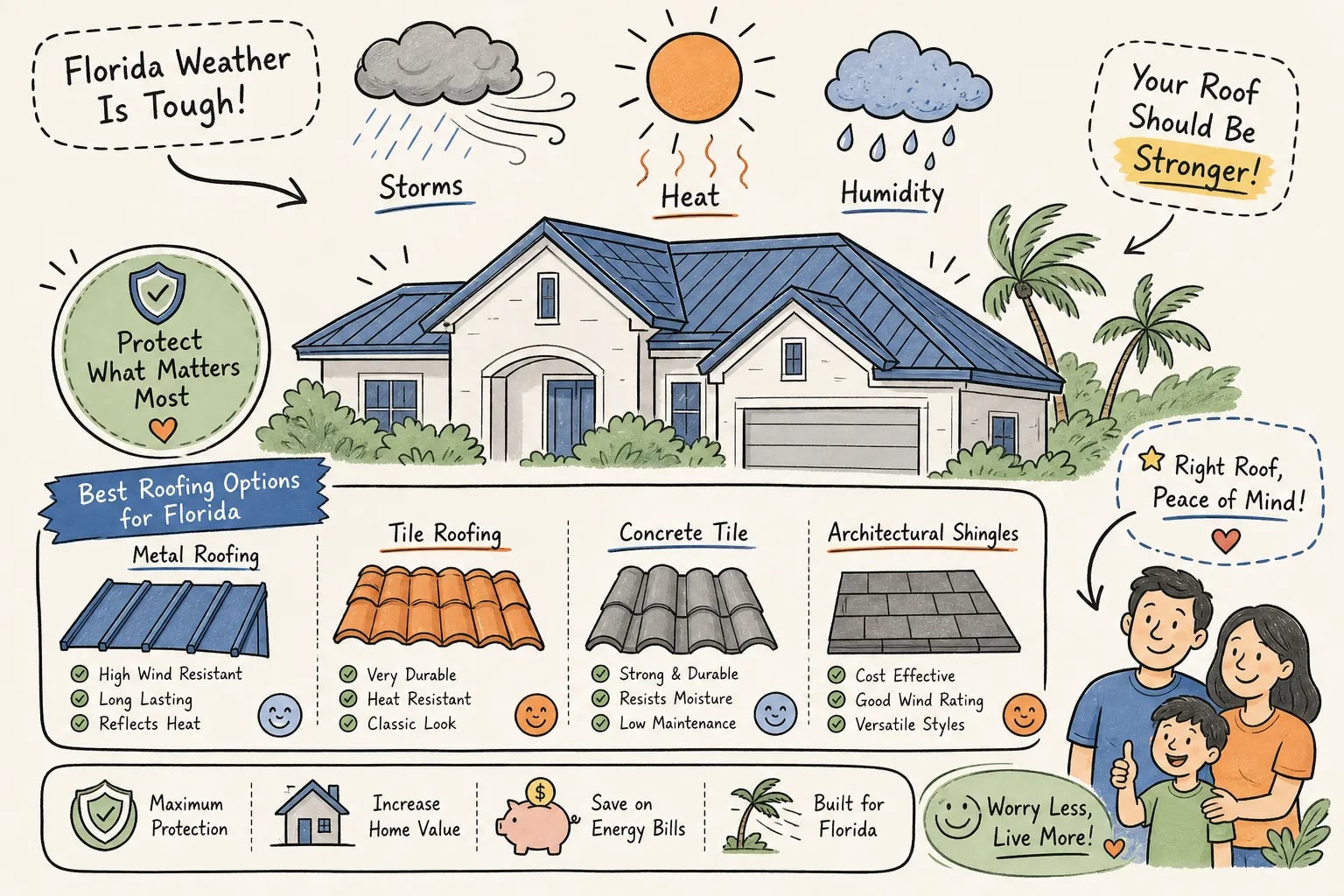
Choosing the best roofing type for Florida storm and heat resistance is one of the most consequential decisions a homeowner in this state will make. Florida uniquely combines high hurricane exposure with prolonged hot, humid summers, forcing you to evaluate both wind performance and thermal efficiency at the same time. Most roofing guides tackle one problem or the other. This one handles both, using real wind ratings, thermal performance data, and 2026 cost ranges to give you an honest comparison of every major system built for this climate.
At Infinity Legacy, our team has worked with all major Florida-approved roofing systems across Northeast and Central Florida, from standing seam metal on coastal homes in Palm Coast to concrete tile reroof jobs in Orlando and flat TPO systems on commercial properties in Jacksonville. That field experience shapes every recommendation here. What you'll get is a ranked breakdown of metal, tile, asphalt shingles, and flat membrane systems, a side-by-side comparison, and the specific questions to ask any contractor before you sign a contract.
Why Florida roofing is a different challenge than the rest of the country
Florida doesn't let roofing be simple. The state runs two entirely different rating systems that matter to you as a homeowner, one for storm performance and one for thermal performance, and most contractors lead with only one of them.
The storm problem: what "wind-rated" actually means in Florida
When a shingle package says "150 mph," that number refers to ASTM D7158 Class H, a standardized wind-uplift test. The number itself is not the approval. What Florida Building Code cares about is the full assembly: the specific combination of underlayment, fasteners, fastening pattern, edge metal, and roofing material that was tested together and listed in an approved assembly. Change any element of that assembly during installation and the approval no longer applies, even if the shingle itself is the same one that was tested. In the High Velocity Hurricane Zone, every assembly must carry a Miami-Dade Notice of Acceptance, and that NOA specifies the exact installation method down to the nail size and row spacing.
The heat problem: solar reflectance and what it does to your energy bill
Roofing surface temperature research conducted in Florida has measured readings running up to 40°F hotter on dark asphalt shingles than on white metal or white TPO roofs under identical conditions. That difference translates directly into how hard your HVAC system works every afternoon from May through October. High-reflectance roofing systems with solar reflectance values above 0.65 can deliver roughly 18 to 26 percent cooling energy savings compared to dark baseline shingles, which works out to approximately 1,000 to 1,600 kWh per year for a typical Florida home, based on DOE field data for the Southeast. Those numbers frame every material discussion below.
Which roofing type offers the best Florida storm and heat resistance? A breakdown by material
Metal roofing: a top all-around performer for Florida
When it comes to combining storm resilience with thermal efficiency, metal roofing sits at or near the top of the field. The trade-off is upfront cost and the need to specify the right system for your coastal exposure. Get those two things right and a metal roof is genuinely the last roof a Florida home needs.
Wind resistance: why standing seam leads the category
Metal roofing systems carry tested wind ratings in the 120 to 180 mph range, with standing seam systems at the top. Standing seam uses concealed fasteners with no roof penetrations in the field zone, which eliminates one of the most common failure points in high-wind events. Premium standing seam assemblies with Miami-Dade NOA approval commonly show design pressures in the range of negative 70 psf in the field zone and up to negative 165 psf or more at perimeter and corner zones, corresponding to the 160 to 180 mph range marketed to homeowners. Exposed-fastener metal panels cost less but carry lower ratings, so the system type matters as much as the material category.
Thermal performance: the cool roof advantage
Metal roofs with PVDF or Kynar-type coatings in light colors achieve solar reflectance around 0.65 to 0.75, placing them in the top tier of Florida cool-roof performance. Color and coating matter as much as the metal itself. A dark bronze standing seam roof underperforms a white concrete tile roof on thermal metrics, so if energy savings are a priority, color selection needs to be part of the specification conversation, not an afterthought.
Metal cost and lifespan: what to expect in 2026
Installed cost for metal roofing in Florida runs from about $7 to $30 per square foot, with standing seam systems typically falling in the $10 to $18 range in North and Central Florida and exposed-fastener panels at the lower end. Expected lifespan is 40 to 70 years. For coastal properties within a few miles of salt air, aluminum and Galvalume panels with quality coatings outperform bare steel, and stainless steel fasteners throughout the assembly are non-negotiable. The higher upfront cost of metal can offset a portion of its premium through insurance wind-mitigation discounts, though savings vary by carrier and location.
Concrete and clay tile: Florida's classic still earns its reputation
Tile roofing dominates Florida neighborhoods for good reason. It handles the heat well, resists the coast's salt-laden air at the tile surface, and properly installed systems carry impressive wind ratings. The nuance is in the word "properly." Tile is more installation-dependent than any other system on this list.
Storm performance: assembly-dependent, not just the tile
Tile systems carry tested wind ratings from roughly 110 to 180 mph, but the rating belongs to the assembly, not the tile. The approved combination of underlayment system, attachment method (foam adhesive, mechanical fasteners, or both), clip type, fastener penetration depth, and perimeter and ridge details is what the NOA actually covers. Common failure points during hurricanes are perimeter rows and ridge details, exactly the areas where installation quality separates a roof that holds from one that doesn't. When evaluating a tile proposal, ask to see the specific NOA number and confirm the installation method matches it precisely.
Heat performance: reflective tile outperforms terra cotta
White and light-colored tile achieves solar reflectance near 0.65 to 0.75, producing cooling savings of roughly 17 to 20 percent based on Florida field performance data. White S-tile systems have measured around 1,380 kWh per year in cooling savings in South Florida climate studies. Uncoated terra cotta performs noticeably worse, falling closer to the 3 to 9 percent savings range. If thermal performance matters to you, the color and finish of the tile need to be part of the product specification, not a cosmetic choice made at the end.
Cost, lifespan, and maintenance realities for coastal homes
Installed cost for tile runs from about $12 to $25 per square foot, with concrete tile at the lower end and clay tile at the upper end. Clay typically lasts longer and commands a higher price, but both materials resist salt air well at the surface level. The vulnerable points for coastal tile roofs are the flashings, fasteners, and the underlayment beneath the tile. Salt air and persistent humidity work on those components even when the tile looks perfect from the street. Per Florida Roofing and Sheet Metal Contractors Association guidance, regular soft washing to control algae and annual inspection of the underlayment and metal accessories are important maintenance items on a coastal Florida tile roof that should not be deferred.
Impact-rated asphalt shingles: the practical middle ground
Asphalt shingles are the most common roofing material in the United States, and they have a legitimate place in Florida when the situation calls for them. The key is understanding exactly what you're getting and what you're not.
Wind ratings and what "impact-resistant" actually means
Two separate ratings apply to shingles, and they don't automatically come together. Wind resistance (ASTM D7158 Class H) means a shingle is tested to 150 mph wind-uplift forces. Impact resistance (Class 4) means the shingle passed a hail impact test. A shingle can carry one without the other, so you need to ask for both ratings and confirm the full assembly holds those numbers. In Florida's High Velocity Hurricane Zone, even Class H shingles must be installed with a specific NOA-approved fastening pattern, often six nails per shingle rather than the standard four, along with the matching underlayment system. The shingle alone doesn't get you the approval.
Thermal performance: the weak point of this category
Dark asphalt shingles have solar reflectance as low as 0.05 to 0.15. They absorb the majority of solar energy striking the roof surface and can run 40°F hotter than outdoor air temperature on a Florida summer afternoon. White or "cool" shingles improve on this, but Florida climate research puts the cooling savings for even the best reflective shingles at only 3 to 5 percent, a significant step below what metal or reflective tile delivers. For a home where energy efficiency and long-term comfort are high priorities, this is the primary trade-off to weigh honestly before choosing shingles.
Where asphalt shingles make sense in Florida
Installed cost for impact-rated architectural shingles runs from about $4.80 to $7.40 per square foot, making this the lowest upfront option on the list. Lifespan in Florida conditions ranges from 15 to 30 years, shorter than tile or metal, which means the 20-year total cost is closer to the competition than the initial price suggests. Asphalt shingles are the right fit for budget-constrained replacements, homes with complex rooflines where tile or metal fabrication costs increase significantly, or situations where a homeowner has a defined shorter ownership horizon. Installed correctly to a Miami-Dade approved assembly, they're a legitimate choice for the best roofing materials Florida's budget buyers need, though they rank lower on both storm and heat performance than metal or tile.
TPO and flat membrane roofing: the right choice for low-slope structures
Flat and low-slope roofs require a completely different system category. TPO (thermoplastic polyolefin) membranes are the dominant choice for Florida low-slope applications, and they're genuinely strong on both storm resilience and thermal performance when the assembly is specified correctly.
Storm performance on flat and low-slope roofs
TPO and EPDM membranes are rated by uplift pressure rather than wind speed, using UL classifications of Class 15, 30, 60, or 90. Homeowners accustomed to mph figures for pitched roofs often find this confusing. A Class 90 assembly represents very high wind resistance, roughly equivalent to the upper end of the rated systems described for pitched roofs. The actual performance depends entirely on the specific assembly: fastening pattern, edge-zone reinforcement, seam welding method, and flashing details must all match the approved configuration. A Miami-Dade NOA for a TPO system covers the membrane, adhesive or mechanical attachment method, and the exact termination and flashing system together.
Heat performance: white TPO leads the flat roof category
White TPO achieves solar reflectance around 0.78 to 0.85 with thermal emissivity near 0.90 to 0.95, making it one of the highest-performing cool-roof options available. Florida field studies on reflective white membrane systems consistently report cooling energy savings in the 10 to 20 percent range versus dark flat roof surfaces, comparable to the best metal roof systems. For commercial buildings and Florida homes with flat roof sections, a white TPO membrane is the strongest thermal choice in this system category.
Cost, lifespan, and coastal maintenance considerations
Installed cost for TPO runs from about $5 to $8 per square foot. Lifespan is typically 15 to 25 years. The membrane material itself resists salt air well, but seams, terminations, and penetrations around rooftop HVAC equipment are the points where coastal humidity and UV degradation create problems over time. Bi-annual inspections focused on seam integrity and drainage clearance, with prompt resealing of any compromised joints, are what extend service life in Florida's coastal environment.
Side-by-side comparison: cost, lifespan, wind, and heat performance
Putting all four systems next to each other makes the trade-offs clear. The table below uses 2026 Florida cost data and the wind and thermal performance ranges discussed above.
| Roof type | Wind rating (typical) | Installed cost (per sq ft) | Lifespan | Solar reflectance | Cooling savings |
|---|---|---|---|---|---|
| Standing seam metal | 120, 180 mph | $10, $18 | 40, 70 years | 0.65, 0.75 | 18, 26% |
| Concrete / clay tile | 110, 180 mph | $12, $25 | 25, 50+ years | 0.65, 0.75 (white/reflective) | 17, 20% |
| Impact-rated shingles | 110, 150 mph | $4.80, $7.40 | 15, 30 years | 0.05, 0.25 | 3, 5% |
| White TPO (flat) | Class 60, 90 uplift | $5, $8 | 15, 25 years | 0.78, 0.85 | 10, 20% |
The hidden cost: what maintenance adds to your 20-year total
The cheapest upfront option, asphalt shingles at $4.80 to $7.40 per square foot, requires more frequent full replacement cycles than tile or metal. A homeowner who replaces a shingle roof twice in the time a metal roof would last once effectively pays for the same square footage twice, plus two rounds of tear-off and permitting labor. Wind-mitigation-qualified roofing systems, specifically metal and impact-rated tile assemblies meeting specific design pressure thresholds, can qualify for meaningful insurance premium discounts in Florida. Those annual savings may offset a significant portion of the higher upfront cost for metal or tile over a 10 to 15 year window.
Miami-Dade approval and what to ask your contractor before signing anything
Florida homeowners often assume that if a roofing product is advertised as "Miami-Dade approved," the job is done. It isn't. Understanding what an approval actually covers puts you in a much stronger position before you sign any contract.
What a Notice of Acceptance (NOA) actually covers
In Florida's High Velocity Hurricane Zone, an NOA does not approve a product. It approves an assembly. The specific tile or metal panel, the underlayment system, the fastener type and size, the clip design and spacing, the edge metal, and the installation method must all be listed in the NOA together. If your contractor substitutes a different underlayment because the specified one is back-ordered, or skips the edge-zone fastening reinforcement because it adds labor time, the assembly is no longer the approved one and the roof may fail inspection, or, worse, fail during a storm. This is the single most important concept in Florida roofing compliance, and it is the one most commonly glossed over in sales conversations.
Three questions to ask any Florida roofing contractor
These questions work as a practical filter. Qualified contractors answer them immediately and specifically. Contractors cutting corners deflect, generalize, or promise to "get back to you" on the details.
- "Can you show me the specific NOA or Florida Product Approval number for this exact assembly?" The answer should be a document number and a product control sheet, not a brand name.
- "What underlayment system and fastening pattern does your approval require?" A legitimate answer specifies the underlayment product, the nail type, the nail count per shingle or tile, and the edge-zone requirements.
- "What is the design pressure rating for the field zone and the edge and corner zones of my roof?" Florida building code requires different design pressures for these zones, and any properly engineered installation accounts for all three.
The answers to these questions also give you a direct way to verify the installation as the job progresses. If the contractor told you the approved underlayment is Product X with 6-inch cap fasteners, you should be able to see that product on the pallet when the crew shows up.
One contractor for every Florida-approved roofing system
Comparing roofing materials is a necessary first step, but the contractor who can competently install all of them is the variable that actually determines the outcome.
Why homeowners use Infinity Legacy for every major roofing type
Infinity Legacy installs all four major Florida-approved roofing systems: standing seam and exposed-fastener metal, concrete and clay tile, impact-rated architectural shingles, and flat TPO membrane systems. When you call us for an estimate, we're not steering you toward the one system we happen to specialize in. We evaluate your home's slope, your storm exposure zone, your budget, and your timeline, then recommend the system that actually fits. One license, one team, one point of contact for permits, inspections, and warranty conversations throughout the life of your roof.
For homeowners who want to move into a higher-performing system but aren't positioned to pay for it all at once, PACE financing programs are available in many Florida jurisdictions and can allow repayment through your property tax assessment with no traditional credit requirement. Eligibility and terms vary by program and county, so ask our team about what's currently available in your area. It's one of the more accessible paths to a metal or tile replacement for homeowners ready to stop cycling through shingle replacements every 15 years.
Getting your free estimate and next steps
When you request a free estimate from Infinity Legacy, you'll receive the specific wind-rating specs, the NOA or Florida Product Approval numbers, and the installed cost breakdown for the system we recommend for your property. Our team serves homeowners and commercial property owners across Northeast and Central Florida, including the Jacksonville, St. Augustine, Daytona Beach, Palm Coast, Orlando, Kissimmee, Ocala, and Gainesville areas. You'll know exactly what you're getting and why before any work begins. Reach out to schedule your free assessment.
Choosing the best roofing type for Florida storm and heat resistance
Florida roofing is not about finding one universally perfect material. It's about matching the right system to your roof's slope, your storm exposure level, your thermal performance goals, your budget, and how long you plan to own the property. Metal leads on combined storm and heat performance, with the longest lifespan and the strongest case for long-term total cost. Tile delivers long-term value for pitched roofs when installation is done correctly to an approved assembly. Impact-rated shingles earn their place for budget-driven replacements and shorter ownership horizons, as long as the full Miami-Dade approved assembly is installed, not just the shingle. White TPO flat systems lead the low-slope category on both storm and thermal performance.
The consistent thread across all four systems is the same: the best roofing type for Florida storm and heat resistance is only as good as the assembly it's installed in, and the assembly is only as good as the contractor installing it. The material choice and the contractor choice are equally important decisions. Get both right and your roof handles whatever Florida throws at it. Get one wrong and neither the product warranty nor the wind rating offers much protection when the next storm rolls through.
Before the next hurricane season puts your current roof to the test, get in touch with the Infinity Legacy team for a free estimate and a straight answer on which system makes the most sense for your home.