For Florida homeowners searching for the best no credit home upgrade financing, the answer isn't a dead end, it's knowing where to look. Picture this: your roof is losing shingles after the last tropical storm, your AC is struggling to keep up with August heat, and your single-pane windows rattle every time a storm rolls through. You call a lender. They run your credit. You don't qualify. You call another. Same result. What happens next is where most Florida homeowners get stuck, and it's more common than any lender will admit.
Florida is one of the most demanding states in the country when it comes to home maintenance. Between hurricane season, year-round heat and humidity, and flood zone requirements, upgrades here aren't optional luxuries. They're structural necessities. But the mainstream financing system wasn't designed for homeowners with thin, damaged, or nonexistent credit histories. It was designed to serve borrowers who already have everything working in their favor.
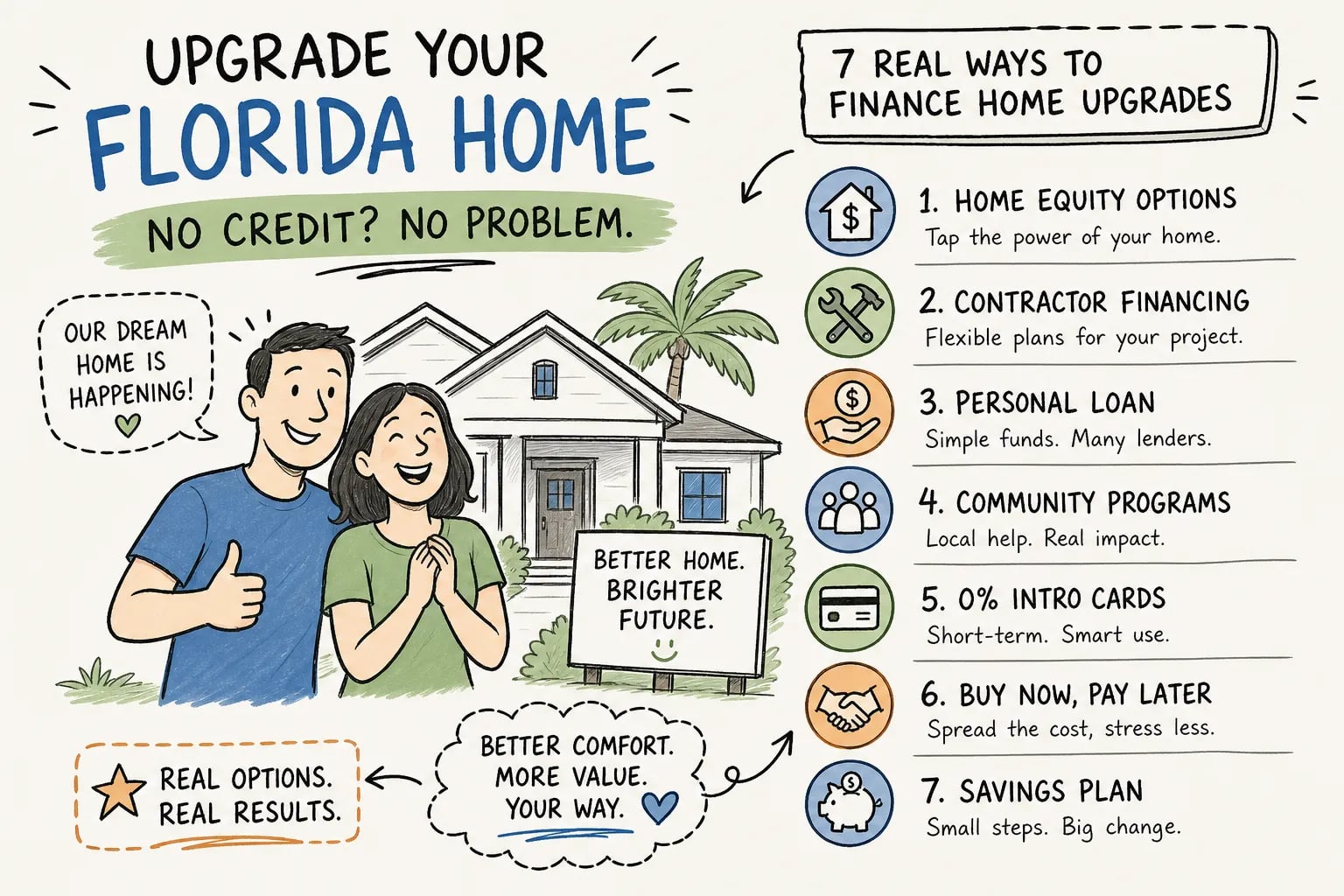
The good news: you have real options. This guide covers seven financing paths that Florida homeowners can pursue without a strong credit score, ranging from PACE financing, which sidesteps the credit check entirely, to federal programs, state rebates, and nonprofit lenders. Contractors like Infinity Legacy connect homeowners directly to several of these programs, including PACE, so the upgrade and the financing conversation happen in the same place. Here's what's available and how to find the right fit for your situation.
Best No Credit Home Upgrade Financing Options for Florida Homeowners
Florida's home upgrade needs don't wait for convenient timing. A roof deck compromised by water intrusion before hurricane season is a liability. An AC system running past its lifespan in a subtropical climate isn't just uncomfortable. It's a health risk. Windows that don't meet Florida Building Code standards can affect your insurance coverage and your ability to sell. The urgency is real, but the traditional financing system doesn't account for it.
The credit score wall most lenders put up
Many HELOCs, cash-out refinancing products, and conventional personal loans require a minimum credit score in the mid-600s or higher for the best terms. For homeowners who are retired and living on fixed income, self-employed with inconsistent paper income, recently relocated from another country, or still recovering from a setback like a medical event or divorce, that threshold is a hard stop. The lender doesn't ask about your payment history on your mortgage or property taxes. They look at one number, and if it's too low, the conversation ends there.
Why Florida makes "waiting on repairs" especially risky
Delaying a roofing or HVAC upgrade in Florida has real financial consequences beyond discomfort. An aging roof may trigger insurer action, higher premiums or non-renewal in some cases, leaving you exposed heading into hurricane season. An inefficient AC system running in Florida heat can significantly increase your monthly cooling costs. Single-pane windows offer no meaningful wind protection and leak conditioned air constantly. Every season you wait, the cost of the problem compounds.
What "no credit check" actually means in practice
Most of the programs in this guide don't run a FICO score, but that doesn't mean they ask nothing. Programs like PACE and many rebate programs avoid a FICO pull entirely, while others like SELF use an ability-to-pay model. Qualification criteria vary by program and typically include things like property equity, whether your mortgage and property taxes are current, household income, and property location. Understanding what each program actually looks at lets you walk in with the right documents and accurate expectations, rather than being caught off guard by requirements you didn't anticipate.
PACE Financing: One of the Strongest No Credit Home Upgrade Financing Paths in Florida
PACE, which stands for Property Assessed Clean Energy, is one of the most powerful tools available to Florida homeowners who need home upgrades without a credit-based loan. For most programs, approval is typically based on your property equity and whether you're current on your property taxes and mortgage, not your FICO score. There is no credit pull, no income requirement in most cases, and no monthly payment to a lender. Infinity Legacy works with PACE programs and can coordinate the process, from estimate through installation, as part of a single project engagement.
How PACE qualification works in Florida
To qualify for PACE in Florida, your property must be in a participating county. As of 2026, active residential PACE programs are available in Flagler, St. Johns, Duval, Volusia, Marion, Hillsborough (unincorporated areas), Manatee, Sarasota, Miami-Dade (unincorporated areas), Broward, Palm Beach, Nassau, and additional counties, check the Florida PACE Funding Agency's site for the current complete list. You must have sufficient equity in the property, be current on your property taxes and mortgage, and have no active bankruptcy proceedings. Some programs require that the PACE assessment stay under 20% of your home's just value, and specific requirements can vary by county. There is no minimum credit score for these programs.
How repayment works through the property tax bill
PACE financing is repaid as a voluntary non-ad valorem assessment added to your annual property tax bill in fixed installments. Interest rates currently range from approximately 6% to 12.99%, with repayment terms from 5 to 20 years depending on the program and project scope. You're not making monthly payments to a bank; the payments are built into your property tax cycle. One important detail: the PACE lien stays with the property, so if you sell your home before it's paid off, the balance must either be satisfied at closing or assumed by the buyer.
Which upgrades qualify and how Infinity Legacy facilitates the process
Through the PACE programs Infinity Legacy works with, qualifying upgrades include roofing, HVAC replacement, impact windows and doors, and insulation. The structure is $0 down. A free estimate from Infinity Legacy is the starting point, and from there, the team assists with paperwork, county approvals, permits, and installation. For Florida homeowners facing a major upgrade without a qualifying credit score, working with a contractor that coordinates the PACE process means fewer handoffs and a clearer path from eligibility check to project completion.
FHA Title 1 Loans: A Federal Option With More Flexibility Than You Think
FHA Title 1 home improvement loans are backed by the federal government and are significantly more flexible than conventional personal loans when it comes to credit. HUD does not set a hard minimum credit score for this program. Individual lenders set their own thresholds, and while many look for around 580 to 620, the program's flexibility makes it worth pursuing if your credit history is thin but not entirely absent. This is a solid secondary option for no credit home upgrade financing in Florida for homeowners who don't qualify for PACE due to their county or equity situation.
Credit requirements, loan limits, and what you can finance
For loans under $7,500, no equity is required because they're issued unsecured. Single-family homes can qualify for up to $75,000 under the program. Eligible projects include structural repairs, roofing, HVAC systems, and accessibility improvements. The program does not cover luxury upgrades or cosmetic-only projects, so it's purpose-built for the kind of functional home improvements Florida homeowners typically need most. Rates are set by individual lenders, so shopping multiple approved lenders matters.
How to find an FHA-approved lender in Florida and apply
Start by searching HUD's online lender lookup tool to find FHA Title 1 approved lenders in Florida. Gather your income documents, proof of homeownership, and a written project estimate from your contractor before you apply. Pairing an FHA Title 1 loan with a licensed multi-trade contractor like Infinity Legacy keeps everything on one track, since a credible written estimate from a licensed CGC is required as part of the application.
USDA Repair Loans and Grants for Rural Florida Homeowners
The USDA Section 504 Single Family Housing Repair program is one of the most underused financing tools available to rural Florida homeowners. Loans go up to $40,000 and grants up to $10,000 (or $15,000 in presidentially declared disaster areas), with a combined cap of $50,000. The fixed interest rate on loans is 1%, repaid over 20 years. Eligibility is based on income, property location, and occupancy, not credit score. Grants are reserved for homeowners who are 62 or older and unable to repay a loan. Counties like Flagler, Marion, Levy, Putnam, and others throughout rural Northeast and Central Florida often qualify under USDA's rural eligibility maps.
Who qualifies and where to confirm eligibility
You must own and occupy the home as your primary residence. The property must be in a USDA-designated rural area, which covers more of Florida than most people expect. Your household income must fall within county-specific low or very-low income thresholds, with "very low" generally defined as below 50% of area median income. For grants, you must also be 62 or older and demonstrate you cannot repay a loan. USDA Rural Development's online eligibility tool lets you check both property location and income limits by county before you apply.
How to apply and what to expect from the process
Contact your local USDA Rural Development office to start the process. Gather proof of homeownership (deed), current mortgage statements, property tax receipts, income verification, and a written repair estimate from a licensed contractor. Applications are accepted year-round while funding is available and processed in the order received, so moving early matters. Processing timelines vary by local office and current funding availability, so ask your USDA contact for a realistic estimate when you call. Applying sooner rather than later is the difference between getting funded this cycle or waiting for the next.
SELF and Ability-to-Pay Lenders Closing the Credit Access Gap
The Solar Energy Loan Fund, known as SELF, is a Florida-based nonprofit lender that evaluates applications based on a borrower's ability to repay, not their credit score. There is no minimum credit score, no stated income ceiling, and no equity requirement. SELF exists specifically to serve Florida homeowners who fall through the gaps of traditional lending and can't access PACE due to county or equity constraints. It's not as widely known as the other programs on this list, but it's a legitimate and purpose-built option for homeowners in that specific situation.
How SELF evaluates applicants without a credit score
SELF looks at income stability and current debt obligations rather than your credit history. If you can demonstrate consistent income and a reasonable debt load, you can qualify regardless of what your FICO says. Eligible projects include HVAC, roofing, windows, insulation, and other energy-related home improvements. Applications are processed online, and loan amounts and terms are structured to fit the project scope. For homeowners who can't access PACE and don't meet USDA income thresholds, SELF is often the next best call.
Other Florida lenders worth checking
Ygrene also operates as a PACE provider in Florida and advertises no minimum credit score as a qualification requirement. Some Florida credit unions offer home improvement loans for borrowers with imperfect credit, though most still run a credit check and use their own internal standards. For homeowners who need a personal loan as a last resort, APRs in Florida range from approximately 10% to 36% depending on the lender and your financial profile. That range is wide, so comparing options carefully before signing anything is essential. Check SELF before turning to a commercial personal lender; its nonprofit structure and ability-to-pay model typically result in more reasonable terms for no-credit borrowers.
State and Utility Rebate Programs That Skip Credit Approval Entirely
Rebate programs work differently from loans. They pay you back after you complete a qualifying upgrade, which means there's no credit check, no new debt, and no lien on your property. Florida has two active state-administered rebate programs with substantial funding behind them, plus several utility rebate programs that can be stacked with other financing to reduce your total out-of-pocket cost.
Florida HOMES and HEAR: the two rebate programs with real money behind them
The HOMES (Whole Home Rebates) program, administered by FDACS, provides rebates of approximately $2,000 to $4,000 for whole-home efficiency upgrades that reduce energy consumption by at least 20%. The rebate calculation is performance-based and tied to both the level of savings and your household income. Low-to-moderate income households can access higher rebate amounts, and multifamily properties can qualify for significantly more.
The HEAR (Home Electrification and Appliance Rebates) program targets low-to-moderate income households specifically. It covers heat pumps, heat pump water heaters, insulation, air sealing, electrical panel upgrades, and ventilation improvements. Total rebates reach up to $14,000 per household. Both programs qualify you based on income, not credit history.
Utility rebates available from major Florida providers
Beyond the state programs, several Florida utilities offer their own rebate programs for residential upgrades:
- Duke Energy Florida: attic insulation and efficient windows, with instant rebates available on some measures
- Florida Public Utilities: heat pumps and high-efficiency AC units
- City of Tallahassee Utilities: $100 to $750 per qualifying measure, including efficient HVAC and solar water heaters
- Beaches Energy Services: up to $1,250 for qualifying HVAC, insulation, and water heater upgrades
The smartest move is to layer these rebates on top of PACE or another financing program. If PACE covers the full project cost at $0 down and you later receive a $2,000 HOMES rebate after the upgrade, that money may help offset your property tax assessment, though how rebate funds are applied varies by county and program, so confirm the details with your PACE provider and local program administrator before counting on it.
Contractor Financing Plans and Unsecured Personal Loans as Additional Tools
Some licensed Florida contractors, particularly multi-trade firms handling large-ticket projects, work with third-party financing platforms that offer point-of-sale approval at the time of estimate. These programs can work well for homeowners who don't qualify for PACE due to their county or equity situation and need a faster path to project funding. The key is understanding the terms before you sign, especially what happens after any promotional period ends.
What contractor financing typically looks like in Florida
In-house or third-party contractor financing typically involves applying at the time of your project estimate. Some programs offer deferred interest or low-APR promotional windows of 12 to 18 months. If you pay the balance within that window, the effective cost is low. If you don't, the deferred interest can be added back retroactively, which changes the math significantly. Always ask for the full terms in writing, including what the rate becomes after the promotional period and whether interest accrues during it. Pairing contractor financing with state or utility rebates is one way to keep the financed amount manageable.
When a personal loan makes sense and what to expect
For smaller projects in the $2,000 to $15,000 range where PACE and government programs aren't available, an unsecured personal loan from a Florida credit union or online lender can bridge the gap. Rates for no-credit or thin-credit borrowers in Florida currently range from about 10% to 36% APR depending on the lender and your income profile. That's a significant spread, so shopping multiple options and comparing the total cost of the loan, not just the monthly payment, is critical. Check SELF before falling back on a commercial personal lender; its nonprofit mission and ability-to-pay model tend to produce more borrower-friendly outcomes.
How to Pick the Right Option for Your Project and Situation
Every program on this list has a different eligibility profile, repayment structure, and project scope. The best option depends on three variables: where your property is located, what your equity and tax payment history looks like, and what kind of upgrade you need. Most Florida homeowners facing a major roofing, HVAC, or impact window project will find that PACE is the strongest starting point, it covers the widest range of upgrades, requires no credit score, and can be coordinated through a licensed contractor like Infinity Legacy.
A simple decision framework based on your situation
Use this as your starting point before you call anyone:
- No credit, have equity, current on taxes and mortgage: Start with PACE through a licensed contractor like Infinity Legacy. It's $0 down, no credit pull, and covers roofing, HVAC, and impact windows in one conversation.
- Rural property, low income, age 62 or older: Apply for a USDA Section 504 grant first. If you're under 62 or can repay, apply for the USDA loan at 1% fixed interest.
- Thin credit, not in a rural area, smaller project: Look at FHA Title 1 for projects under $75,000, or apply with SELF for energy-related improvements using the ability-to-pay model.
- Energy efficiency upgrade, any credit situation: Stack HOMES or HEAR rebates on top of whatever financing you use to reduce total cost.
- No equity, not in a PACE county, no rural area: Contractor financing or a personal loan through a Florida credit union is the fallback; verify terms carefully before committing.
Documents to pull together before you apply
Regardless of which program you pursue, having these documents ready will shorten the process considerably: your property deed, current mortgage statement showing payment history, property tax receipts for the current year, recent utility bills, income verification (W-2s, tax returns, or bank statements), and a written project estimate from your licensed contractor. Most programs require all of these at some point, so gathering them upfront avoids delays once you're in the application process.
Red flags to avoid in Florida home improvement financing
Not every contractor who advertises financing is working with legitimate programs. Watch for contractors who pressure you to sign on the spot, "no credit check" offers with balloon payments buried in the fine print, and anyone who can't provide a Florida contractor license number when asked. Infinity Legacy holds a verifiable Florida contractor license, the kind of credential that's the baseline standard you should expect from anyone handling a permitted project on your home. Before you agree to financing of any kind, confirm the contractor is licensed and insured and that the program they're offering is affiliated with an actual state-recognized entity. You can verify any Florida contractor's license through the Florida Department of Business and Professional Regulation (DBPR) online lookup.
Comparing the Best No Credit Home Upgrade Financing Solutions at a Glance
| Program | Credit Required | Best For | Typical Cost / Rate | Key Restriction |
|---|---|---|---|---|
| PACE | None (equity-based) | Roofing, HVAC, impact windows | ~6%, 12.99% APR; $0 down | Participating county; equity required |
| FHA Title 1 | ~580, 620 (lender-set) | Structural repairs, roofing, HVAC | Lender-set rate; up to $75,000 | FHA-approved lender required |
| USDA Section 504 | None (income-based) | Rural homeowners, low income | 1% fixed / grants to $10,000 | Rural area; income limits apply |
| SELF | None (ability-to-pay) | Non-rural, no equity, energy upgrades | Varies; nonprofit rates | Florida properties only |
| HOMES / HEAR Rebates | None | Efficiency upgrades; stack with loans | $2,000, $14,000 rebate (no debt) | Income limits; post-upgrade payout |
| Contractor Financing | Varies by platform | Quick approval; large projects | 0%, deferred promo; reverts to market | Watch for deferred interest terms |
| Personal Loan | Varies; thin credit OK | Small projects; last resort | ~10%, 36% APR | Higher cost; compare carefully |
Your Next Step Starts With a Free Estimate
No credit score doesn't mean no path forward. It means knowing which programs were built for your situation and approaching them in the right order.
Working with a licensed multi-trade contractor like Infinity Legacy means the upgrade and the financing conversation happen in the same place, with one accountable team managing estimates, permits, installation, and paperwork. You're not coordinating between a roofer, an HVAC company, a window installer, and a separate lender. You're making one call and getting one clear plan.
Every season you wait on a failing roof or aging AC system costs more than the upgrade itself. Reach out to Infinity Legacy for a free estimate, ask about PACE eligibility for your property, and get a clear picture of what your options actually are before the next storm season starts the clock again. For Florida homeowners looking for the best no credit home upgrade financing, starting with a PACE eligibility check is the fastest way to know exactly where you stand.
Frequently Asked Questions
Does PACE financing require a credit check?
Most PACE programs in Florida do not use a minimum FICO score. Eligibility is typically based on property equity, current mortgage and property tax status, and an absence of active bankruptcy proceedings. Specific requirements can vary by county and program, so confirm the details with your PACE provider.
Who qualifies for USDA repair grants in Florida?
USDA Section 504 grants are reserved for homeowners who are 62 or older, own and occupy a home in a USDA-designated rural area, and cannot repay a loan. Income must fall within county-specific very-low income thresholds, generally defined as below 50% of area median income. Use USDA Rural Development's online eligibility tool to check your property location and income limits.
How does PACE repayment work?
PACE is repaid as a non-ad valorem assessment added to your annual property tax bill. Payments are fixed and built into your existing tax cycle, there is no separate monthly payment to a lender. The assessment stays with the property; if you sell before it's paid off, the balance is typically settled at closing or assumed by the buyer.
Can I stack rebates with PACE or other financing?
Yes, in many cases. HOMES and HEAR rebates are paid out after qualifying upgrades are completed and can help reduce your overall project cost. How those funds apply to an existing PACE assessment depends on county and program rules, so confirm the specifics with your PACE provider and rebate administrator before planning around it.
What is SELF and how is it different from a bank loan?
SELF (Solar Energy Loan Fund) is a Florida-based nonprofit lender that qualifies borrowers based on ability to repay, not credit score, equity, or income ceiling. It's designed specifically for homeowners who fall outside traditional lending requirements and can't access PACE due to county or equity constraints. Eligible projects include HVAC, roofing, windows, and insulation.